
Secondary 4 probability becomes more reliable when students describe the event before multiplying or adding any numbers. This Mathematics tuition guide for Punggol families explains complements, combined events, Venn diagrams, tree diagrams and simple independence through original worked examples.
A student may know that probabilities are multiplied along a tree and added across outcomes, yet still choose the wrong branches. Another may fill a Venn diagram incorrectly because the overlap is not handled first. These are representation problems before they become arithmetic problems.
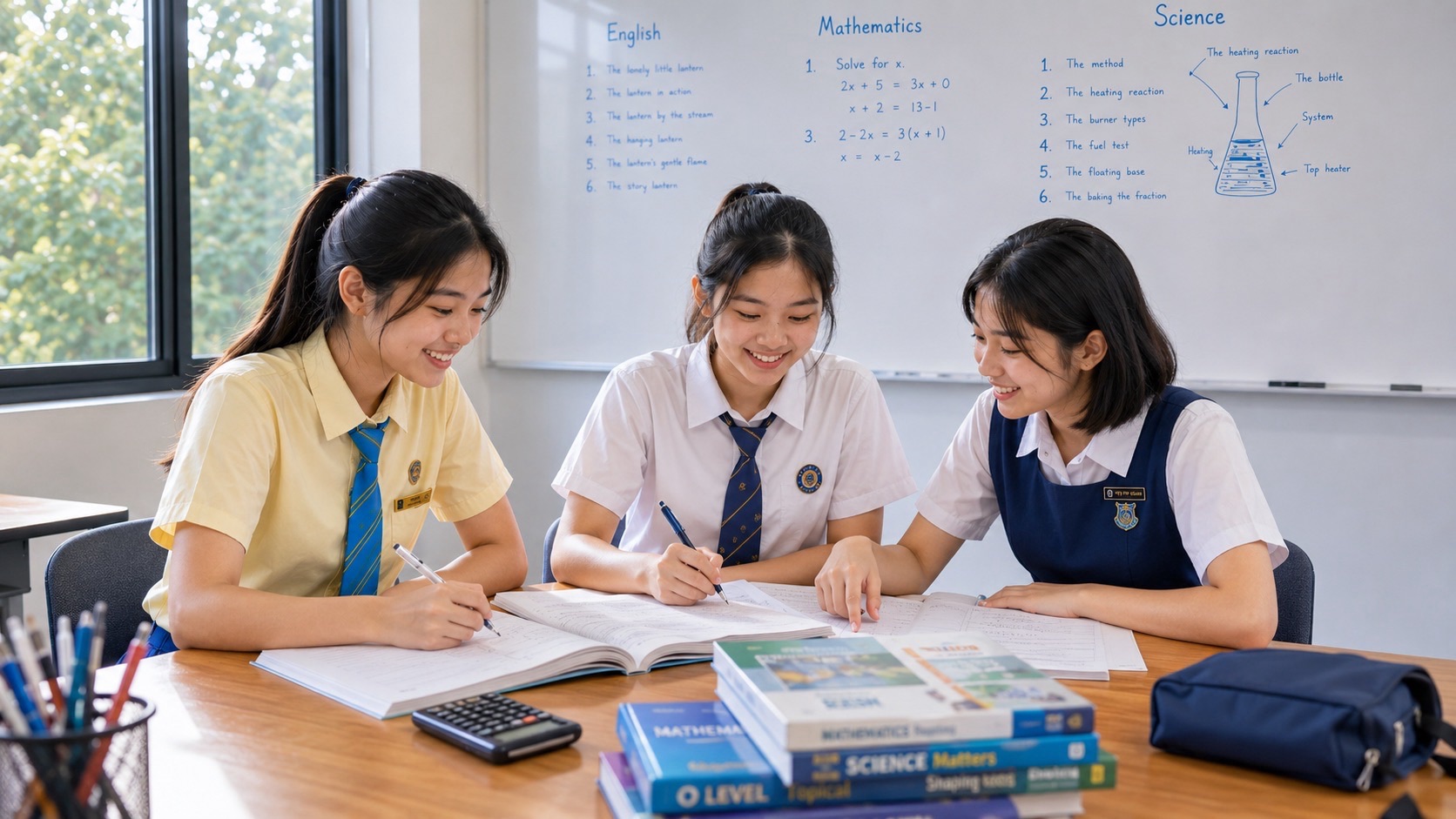
At eduKatePunggol, Secondary 4 Mathematics is taught in focused groups of up to three students in 1.5-hour lessons near Punggol MRT. This guide supports the wider Secondary 4 SEC Mathematics year plan. The examples below are original teaching examples.
Probability measures how likely an event is
For an event A, probability lies between 0 and 1 inclusive.
- 0 means impossible;
- 1 means certain;
- a value between them describes partial likelihood.
When outcomes are equally likely, a simple probability can often be written as:
number of favourable outcomes / total number of outcomes.
Worked example 1: a simple event and its complement
A fair six-sided die is rolled. Find the probability of rolling a number greater than 4.
The favourable outcomes are 5 and 6, so:
P(number > 4) = 2/6 = 1/3.
The complement is “not greater than 4”, so:
P(not greater than 4) = 1 − 1/3 = 2/3.
The complement rule is useful because an event and its complement together cover all possibilities.
Venn diagrams: place the overlap first
Suppose 40 students are surveyed. 22 study Art, 18 study Music and 8 study both.
Start with the overlap: 8 belongs in A ∩ M.
Art only = 22 − 8 = 14.
Music only = 18 − 8 = 10.
Total in at least one set = 14 + 8 + 10 = 32, so neither = 40 − 32 = 8.
If a student writes 22 in the Art-only region and 18 in the Music-only region, the overlap gets counted twice. Filling the intersection first prevents that error.
Worked example 2: probability from a Venn diagram
Using the same survey, choose one student at random. Find the probability that the student studies exactly one of Art or Music.
Exactly one means Art only or Music only:
P(exactly one) = (14 + 10)/40 = 24/40 = 3/5.
The word “exactly” matters. The 8 students in both sets are not included.
Tree diagrams organise sequential events
A tree diagram shows stages. Probabilities on branches from the same point should add to 1.
To find the probability of one complete path, multiply along the path. To combine different mutually exclusive complete paths that all satisfy the requested event, add their path probabilities.
Worked example 3: two independent selections with replacement
A bag contains 3 red counters and 2 blue counters. One counter is selected, replaced, and then a second counter is selected.
Because the first counter is replaced, each draw has P(R) = 3/5 and P(B) = 2/5.
Find the probability of two red counters:
P(RR) = (3/5)(3/5) = 9/25.
Find the probability of one red and one blue in any order:
P(RB or BR) = (3/5)(2/5) + (2/5)(3/5) = 12/25.
The two orders are different paths and both satisfy the event, so their probabilities are added.
Without replacement, the second probabilities change
Use the same bag, but do not replace the first counter.
If the first counter is red, 2 red and 2 blue remain out of 4. If the first is blue, 3 red and 1 blue remain.
Therefore:
P(RR) = (3/5)(2/4) = 3/10.
The second-stage branches depend on the first outcome. Copying 3/5 and 2/5 onto every second branch would incorrectly treat the draws as if replacement had occurred.
Worked example 4: probability of at least one success
A fair coin is tossed twice. Find the probability of at least one head.
We could add HH, HT and TH. A shorter route is to use the complement:
P(at least one H) = 1 − P(no heads)
= 1 − P(TT)
= 1 − 1/4
= 3/4.
The complement method is especially useful when the unwanted event has fewer cases than the wanted one.
Check whether the complete outcomes add to 1
For a complete tree, the probabilities of all final outcomes should add to 1.
This is a powerful error check. If the total is 0.87 or 1.16, a branch probability, multiplication or omitted path may be wrong.
Do not wait until the final paper to use this check. Build it into practice until it becomes automatic.
How we diagnose probability mistakes
Event-reading error: “at least”, “exactly”, “neither” or “both” is misread.
Representation error: the Venn overlap or tree branches are filled incorrectly.
Operation error: path probabilities are added instead of multiplied, or alternative paths are multiplied instead of added.
Dependence error: second-stage probabilities are not updated after an outcome without replacement.
Checking error: impossible totals above 1 or incomplete totals below 1 are accepted without review.
Why the three-student format helps
In a group of up to three students, the tutor can ask one learner to state the event in words, another to build the representation and another to explain why probabilities are multiplied or added.
This keeps the topic connected to meaning. A correct fraction reached through an incorrect tree should not be treated as secure understanding.
What a 90-minute lesson could look like
An illustrative lesson could begin with ten minutes of event language and complements, twenty minutes on Venn diagrams, twenty minutes on tree diagrams, twenty minutes of independent mixed probability questions and twenty minutes for error review, total-probability checks and continuation work.
Repair, stabilisation and extension
Repair: use small sample spaces, simple complements and two-set Venn diagrams with whole-number counts.
Stabilisation: mix Venn and tree questions, replacement and non-replacement, and require students to name the event before calculating.
Extension: use multi-stage events, compare complement and direct methods, and ask students to justify whether branch probabilities should change.
Try a short independent set
- A fair die is rolled. Find P(not rolling a 6).
- A fair coin is tossed twice. Find P(exactly one head).
- A bag has 4 green and 1 yellow counter. One is drawn and replaced, then another is drawn. Find P(two yellow).
Answers: 5/6; 1/2; and 1/25.
For the coin question, HT and TH are two separate paths. For the bag question, replacement keeps P(Y) = 1/5 on both draws.
What progress should look like
- event language is translated correctly before calculation;
- Venn overlaps are filled before exclusive regions;
- tree branches from the same node total 1;
- probabilities are multiplied along a path and added across relevant paths;
- without-replacement probabilities update correctly;
- complete outcome totals are used as an error check.
Punggol class details and consultation inputs
eduKatePunggol Secondary Mathematics tutorials run for 1.5 hours in groups of up to three students near Punggol MRT. Confirm current availability, fees and meeting arrangements directly.
Bring the student’s subject level, examination year and recent probability questions with the original Venn or tree diagrams intact. A wrong branch label can reveal more than the final fraction alone.
Frequently asked questions
When do I multiply probabilities?
Multiply probabilities along one complete sequence or path, using the probabilities appropriate at each stage.
When do I add probabilities?
Add the probabilities of different mutually exclusive outcomes or complete paths that all satisfy the event being asked for.
Why does replacement matter?
Replacement restores the original composition before the next draw. Without replacement, the remaining counts and therefore the probabilities can change.
Name the event before calculating it
Return to the Secondary 4 Mathematics year plan for the wider SEC runway. For data interpretation alongside probability, use the Secondary 4 statistics guide.
Describe the event, build the representation, then calculate and check the total. Families can WhatsApp eduKatePunggol with recent work to discuss a suitable next step.


