
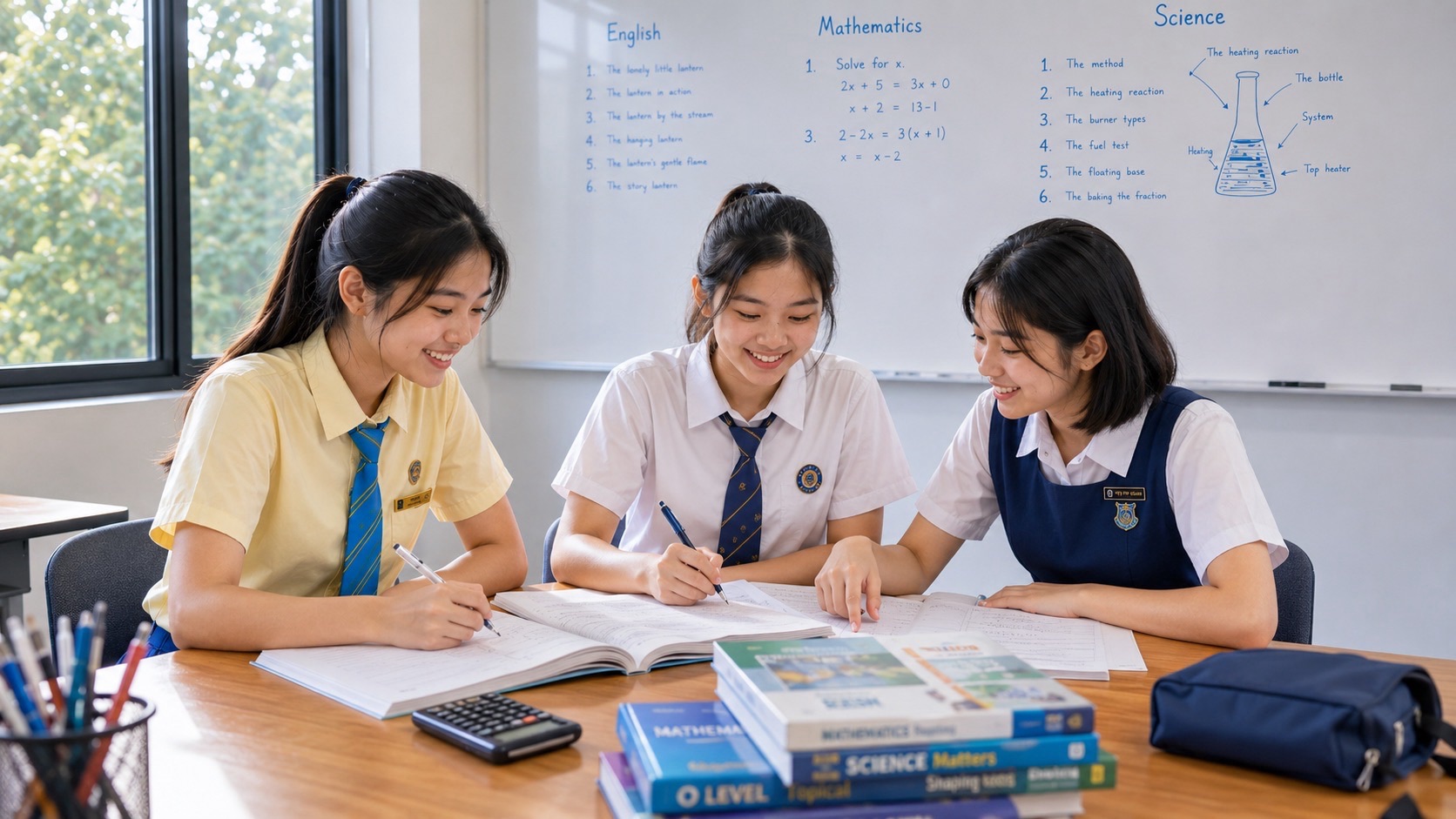
Secondary 4 unit conversion becomes easier when students treat units as part of the mathematics, not decoration added at the end. This Mathematics tuition guide for Punggol families explains length, area, volume, time, speed and rate conversion through original worked examples.
A student may know the correct formula but still lose the answer because centimetres were mixed with metres, minutes with hours, or square units were converted as if they were ordinary lengths.
At eduKatePunggol, Secondary 4 Mathematics is taught in focused groups of up to three students in 1.5-hour lessons near Punggol MRT. This guide supports the wider Secondary 4 Mathematics year plan.
Convert before combining unlike units
If one length is 2.4 m and another is 75 cm, do not add 2.4 + 75 directly.
Convert one quantity first:
2.4 m = 240 cm.
Then:
240 cm + 75 cm = 315 cm.
Alternatively, 75 cm = 0.75 m, giving 3.15 m.
Area conversion squares the length conversion
Since 1 m = 100 cm:
1 m² = 100² cm² = 10,000 cm².
A common error is to multiply by 100 only once.
Worked example 1: convert area
Convert 2.5 m² to cm².
2.5 × 10,000 = 25,000 cm².
The exponent on the unit tells you the conversion factor must also be raised to that power.
Volume conversion cubes the length conversion
Since 1 m = 100 cm:
1 m³ = 100³ cm³ = 1,000,000 cm³.
Worked example 2: convert volume
Convert 0.003 m³ to cm³.
0.003 × 1,000,000 = 3000 cm³.
This links directly to the surface-area and volume guide.
Time conversion is not decimal-place shifting
1 hour = 60 minutes.
So 1.5 hours = 1 hour + 0.5 hour = 1 hour 30 minutes.
It is not 1 hour 50 minutes.
Worked example 3: minutes to hours
Convert 45 minutes to hours.
45/60 = 0.75 hour.
This matters whenever speed is in km/h and time is given in minutes.
Worked example 4: km/h to m/s
Convert 72 km/h to m/s.
72 km = 72,000 m and 1 hour = 3600 s.
72,000/3600 = 20 m/s.
The conversion can be remembered as dividing km/h by 3.6, but understanding where 3.6 comes from makes the method easier to recover.
Rates need numerator and denominator units tracked separately
A rate such as $6/kg or 15 L/min contains two units.
If 15 L/min runs for 8 minutes, volume = 15 × 8 = 120 L.
If the time were given in seconds, convert it to minutes first or convert the rate to litres per second.
Worked example 5: rate conversion
A pump transfers 24 litres per minute. How much does it transfer in 2.5 minutes?
24 × 2.5 = 60 L.
The minutes cancel conceptually, leaving litres.
Use units as an error detector
If a question asks for area and the final unit is cm, something is wrong. If a speed answer ends in km²/h, something is wrong.
Units help verify that the structure of the calculation matches the quantity being asked for.
How we diagnose unit mistakes
Compatibility error: unlike units are combined directly.
Dimension error: a length conversion factor is used unchanged for area or volume.
Time-base error: minutes are treated as hundredths of an hour.
Rate error: numerator and denominator units are not tracked separately.
Answer-unit error: the calculation is numerically correct but reports the wrong unit.
Why the three-student format helps
In a group of up to three students, one learner can perform the conversion, another can explain the dimensional power and another can check whether the final unit matches the requested quantity. The tutor can catch the unit error before it contaminates several later steps.
What a 90-minute lesson could look like
An illustrative lesson could use ten minutes for common conversion retrieval, twenty minutes on length and time, twenty minutes on area and volume, twenty minutes on speed and rates, and twenty minutes for independent mixed applications, checking and error review.
Repair, stabilisation and extension
Repair: use one conversion at a time and write the unit on every line.
Stabilisation: mix length, time, area, volume and speed conversions.
Extension: embed conversions inside multi-step geometry, rate, scale-drawing and modelling problems.
Try a short independent set
- Convert 3.2 m to cm.
- Convert 0.4 m² to cm².
- Convert 90 km/h to m/s.
Answers: 320 cm; 4000 cm²; 25 m/s.
What progress should look like
- unlike units are converted before combination;
- area and volume conversions use squared and cubed factors;
- decimal hours are interpreted correctly;
- speed conversions preserve both distance and time units;
- final units match the quantity requested;
- units are used as a check, not added as an afterthought.
Punggol class details and consultation inputs
eduKatePunggol Secondary Mathematics tutorials run for 1.5 hours in groups of up to three students near Punggol MRT. Confirm current availability, fees and meeting arrangements directly.
Bring the student’s subject level, examination year and recent questions where the method was correct but units or conversions caused the error.
Frequently asked questions
Why is 1 m² not 100 cm²?
Because both length dimensions scale by 100, so the area scales by 100 × 100 = 10,000.
Why is 1.5 hours 90 minutes?
0.5 hour is half of 60 minutes, which is 30 minutes.
Make the units do part of the checking
Return to the Secondary 4 Mathematics year plan. For speed and journey applications, use the speed and rates guide.
Convert first, calculate second, and keep the units visible enough to expose impossible answers. Families can WhatsApp eduKatePunggol with recent work to discuss a suitable next step.


