
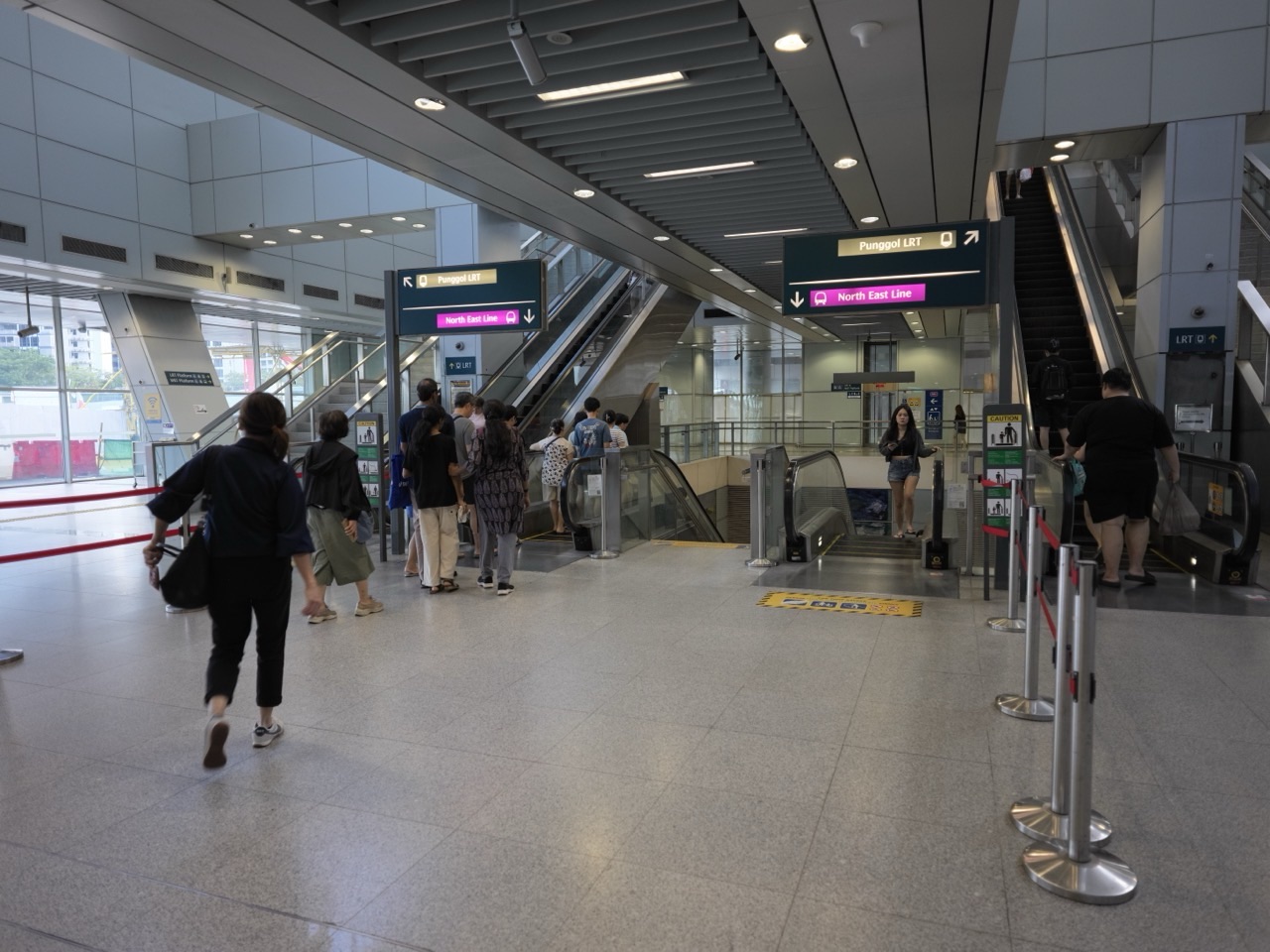
Living near Punggol MRT can make a household’s week simpler when its most frequent journeys begin at that station. The advantage is specific: a workable walk to rail, useful errands along the return journey, and access to the places the family actually uses. It is not a guarantee that every nearby home is quiet, affordable, accessible or suitable for the same school.
The Town Centre is best read as several destinations rather than one large building. Punggol MRT and the LRT connection, Waterway Point, One Punggol, the library and individual residential entrances each have their own approach. Before deciding that everything is “downstairs”, walk the routes that matter from the actual home.
This guide is for residents, buyers and tenants assessing that daily arrangement. It separates established transport from future rail plans, location from access, and personal preference from claims that would need measurements. There is no universal “best block” or guaranteed number of minutes saved.
Transport facts reviewed on 30 September 2026: Punggol Coast is already the northern terminus of the North East Line. The planned Cross Island Line connection at Punggol is different: LTA lists the Punggol Extension for 2032. A future interchange should not appear in a present-day commute as though it were operating.
Start by naming the place you will actually use
A listing saying “near Punggol MRT” gives a useful clue, not a complete route. Ask where the residential entrance is, which station entrance you would use and what lies between them. A straight-line map distance cannot account for the available crossings, the building’s permitted exits or a route chosen to avoid stairs.
Use a precise destination when speaking to a family member. “Meet at Waterway Point”, “meet at One Punggol” and “meet at the station” are not interchangeable instructions. Identify an entrance or another suitable landmark before people separate. This matters especially when a parent is collecting a child or someone is unfamiliar with the area.
For a viewing, begin at the lift lobby rather than at the development’s most attractive entrance. Walk to the destination you expect to use most. Then return with a realistic idea of bags, pace and weather. You are testing a daily connection, not deciding whether the place looks close on a promotional map.
A quick guide to the main questions
| What you need to decide | What to inspect or confirm |
|---|---|
| Is the MRT genuinely convenient? | The complete route from the home entrance to the station entrance you will use. |
| Can errands fit the commute? | The particular shop or service, its current terms, and the detour needed. |
| Does the library fit family life? | Borrowing, study and programme requirements separately, plus the walk home. |
| Will the home be comfortable? | The actual rooms, orientation and conditions at relevant times. |
| Can the school day work? | The gate, reporting and collection arrangements—not the station name. |
| What changes later? | Planned CRL infrastructure recorded separately from today’s route. |
| Is the price acceptable? | Current property-specific evidence and the household’s budget, not an assumed station premium. |
The answer can differ between two homes marketed under the same neighbourhood label. Treat the table as a set of checks, not a rating system.
Punggol MRT and Punggol Coast MRT are different stations
Punggol Coast opened on 10 December 2024, extending the North East Line beyond Punggol. LTA’s opening factsheet records the new station as the northern terminus. Older descriptions that still call Punggol the end of the line are therefore outdated.
For a Town Centre household, the important distinction is the destination. A journey towards Punggol Digital District is not the same as a trip to Waterway Point or the library at One Punggol. JTC’s directions to Punggol Digital District identify Punggol Coast MRT and Teck Lee LRT as district access points.
This prevents a common planning shortcut. Do not choose a home merely because it is “near Punggol” when the daily destination is specifically at Punggol Coast. Compare the actual onward journey. Conversely, a household that uses the original Town Centre frequently should not assume the newer northern hub replaces those trips. Both locations can be useful for different reasons.
The future interchange is not today’s transport service
LTA separates Cross Island Line Phase 1, expected by 2030, from Phase 2 and the Punggol Extension, expected in 2032. The extension is the relevant future rail project for Punggol. See LTA’s current CRL programme rather than treating every CRL reference as one opening date.
A planned interchange can be part of a long-term discussion, but it cannot reduce a 2026 journey. Write two versions of any route affected: the one the household can use now and the potential future arrangement. Avoid turning an expected opening date into a guarantee or a property-return forecast.
Also distinguish a project-wide fact from conditions at a particular home. The existence of rail construction does not establish how much sound, dust or access disruption one unit experiences. Inspect the actual location and consult relevant current notices. Neither enthusiasm about the future connection nor concern about works should replace property-specific evidence.
What a walk to the MRT can—and cannot—remove
For someone currently using a feeder bus or the LRT before the main rail journey, a practical walk to Punggol MRT may remove that first connection. That is a real possibility to test. It does not automatically remove all waiting, all rain exposure or a fixed number of minutes from every trip.
The home still has a first mile. It includes leaving the flat, using the lift, reaching the street and entering the station. At the other end, the workplace or appointment may involve another connection. A home marketed as station-adjacent should be assessed through the full journey, not the phrase alone.
Use a trial at the relevant time. If the family is deciding between two properties, begin from equivalent points at both. Record the result as an observation rather than a promise. A shorter feeder section can improve a routine, but the useful measure is how it changes that household’s actual day.
A time-saving example, clearly labelled
Suppose, purely as an illustration, that a tested route from Home A takes five minutes less than the route from Home B on each of ten weekly journeys. The arithmetic is 50 minutes a week, not a measured saving for every Town Centre resident. The example shows why repeated small differences can matter without claiming a universal commute advantage.
Now add another household member. If Home A creates a ten-minute detour on four school-collection journeys, the combined time difference changes. If one collection would become impossible before a fixed deadline, a simple total no longer describes the whole problem. The household needs to solve the deadline, not merely celebrate the adult’s faster commute.
Keep the calculation transparent. State the journeys counted, the person travelling and the assumptions used. Do not multiply a station-to-station illustration as though it were a door-to-door guarantee. The value of the exercise is understanding the trade-off, not producing an impressive annual number.
Rail, LRT and buses need not compete for every trip
Living near the Town Centre does not mean the MRT should begin every journey. A local destination may be reached more directly on foot, by bus or through the LRT. LTA describes the Punggol LRT as a two-loop connection between residential areas, Punggol MRT and the bus interchange. Its Sengkang–Punggol LRT page provides the system reference.
Choose according to the actual destination and current service. A trip to a school or a neighbourhood centre is a different question from travelling towards central Singapore. The direction display and current operator information matter more than the order of station names remembered from an old article.
A useful household plan may contain one normal route and one alternative. There is little value in maintaining a complicated list of every possible journey. Know enough to make the frequent trips reliably, then use current information when an unfamiliar destination or service change requires a different choice.
Waterway Point is a commercial destination, not the whole neighbourhood
Waterway Point’s own directory is the appropriate place to verify a shop before building an errand around it. For example, its FairPrice Finest listing confirms that grocery option. It does not establish that a particular product, promotion or service is available on the day you visit.
For residents, the practical question is how a shopping trip connects with the journey home. A modest detour after work may be useful. Walking through a busy commercial space with several bags and a tired child may be less appealing. Neither observation means the mall is good or bad; it means the task and traveller differ.
Keep commercial access separate from residential access. A retail entrance, a station route and a development’s private entrance may have different conditions. Ask which route you are allowed to use rather than assuming that a visually connected complex creates an unrestricted shortcut for every nearby household.
One Punggol serves different purposes from a shopping mall
The People’s Association lists One Punggol’s community facilities, ServiceSG Centre, library and hawker centre on its hub-information page. These are distinct services within a shared development. Their co-location can be useful, but it does not mean every service has identical hours, eligibility or booking arrangements.
Choose the particular purpose of a visit. Returning a book, attending a programme, making a service enquiry and meeting for a meal are different tasks. The organisation responsible for each task should provide its current requirements. Avoid assuming that entering the building guarantees access to a court, room or programme.
For a household considering the area, ask how often those services would actually be used. A weekly library visit may justify considerable weight in the comparison. An activity the family only imagines taking up should receive less weight until it becomes a real intention. A useful home supports ordinary life, not an unlimited list of possible future hobbies.
Read the library as several services, not just a quiet building
NLB lists Punggol Library at 1 Punggol Drive, One Punggol, and identifies Punggol MRT and Sam Kee LRT as relevant access points. Use its current library page for visitor and service information. The word “nearby” should not substitute for walking the route from your own home.
Decide whether the family needs borrowing, children’s reading time, independent study or a registered programme. A general visit does not guarantee a particular seat or access to an activity. Where a booking or other condition applies, verify it for the actual use rather than assuming all library services operate as walk-in space.
For children, a manageable borrowing routine can be enough. The family does not need to turn every visit into a formal lesson. For a teenager, the return trip after study may matter more than the outward journey. Match the facility to a real reading or study habit instead of describing proximity as an automatic academic advantage.
Food convenience should be measured against dinner
An area can offer several food choices without solving the household’s dinner problem. Begin with the evening sequence: who returns first, who collects the child, who cooks or buys food, and when everyone needs to eat. The useful option is the one that fits that sequence.
Check opening hours and any dietary requirement directly with the provider. Do not infer halal certification, allergy suitability or ingredient choices from the cuisine or a general mall description. A food outlet’s presence in a directory is not a guarantee about every menu item or period of operation.
It is reasonable to keep more than one dinner arrangement. A planned home meal, a simple takeaway and an occasional meal out can serve different evenings. Avoid using the number of restaurants as a proxy for household convenience. A reliable option on the way home may matter more than many interesting choices that require another trip.
Groceries: distinguish the daily top-up from the weekly load
A household may use a nearby store for a small basket and a different arrangement for heavier shopping. Decide which task you are evaluating when judging the home. A route comfortable with bread and fruit may be difficult with bulky household supplies.
On a viewing, test the return from the shop to the residential entrance. Include the crossing, lift and final corridor rather than stopping the evaluation at the development boundary. Think about the caregiver or family member who will regularly carry the load, not only the adult conducting the viewing.
Delivery can be an option, but check the address, charges and receiving arrangement. It is not helpful if a delivery window repeatedly conflicts with the only caregiver’s school collection. The best routine may combine local shopping and delivery in a modest, practical way. It does not need a claim that Town Centre residents have the “strongest grocery setup” in Punggol.
Living near a service does not guarantee access to it
This distinction applies beyond shops. A childcare centre may be nearby without a suitable vacancy. A class may operate in the area but not at the required level or time. A public service may require an appointment or documents. Verify the particular arrangement before treating it as a solved part of the move.
When making enquiries, give the information that changes the answer: the child’s age, required days, collection time, access need or service requested. A broad question such as “Do you have classes?” may return a positive answer that is not useful to the household.
Keep written terms or current official information for decisions involving payment, enrolment or a fixed deadline. Distinguish a general marketing description from a confirmed arrangement. The proximity of a building is a location fact; whether the family can use what it offers is a separate access question.
School planning begins with the child, not the MRT
A home near Punggol MRT may simplify an adult commute while leaving the child’s school journey unchanged or more difficult. Write both routes before deciding that the location solves the family’s transport needs. The school gate, reporting time, care arrangement and person accompanying the child all matter.
For Primary 1 registration, use MOE SchoolFinder and the current registration guidance. Do not assume that a home described as “near the MRT” falls within a particular distance from a school or creates admission priority. The official process is address-specific and must be checked directly.
For an already-enrolled child, changing home need not automatically mean changing school. Consider the current learning and care arrangements as well as the journey. A shorter adult commute can be valuable, but it should not conceal the educational or practical cost of a separate transition for the child.
The after-school chain needs its own map
Draw the route from school to the next destination and then home. A child may go to student care, CCA, a grandparent’s home, tuition or an activity. Each transfer needs a responsible person or an agreed age-appropriate independent arrangement. Proximity to a transport hub does not supply supervision.
Confirm what the care provider actually does. Does it collect from the school, require the family to arrange transport, or operate another defined handover? Obtain the current answer rather than relying on the fact that several centres appear nearby on a map.
For two children, put their schedules together. A sequence that works for each child considered separately may fail when one adult must handle both. The practical benefit of the Town Centre is greatest when its routes connect the family’s real destinations, not when the family spends the afternoon moving between unrelated commitments that happen to sound local.
Waiting time is part of the price of an activity
A parent waiting during a class is spending time even when the child is productively occupied. Before assuming a nearby programme is convenient, calculate the whole block: leaving home, arrival margin, the class, collection and return. Include any sibling who must wait too.
A nearby library, food option or errand may make the gap useful, but it should not be assumed. Check whether the waiting person can actually access the place at that time and whether the gap is long enough to use it comfortably. A short interval can be consumed almost entirely by walking and checking the clock.
Sometimes the simplest arrangement is to stay nearby with a modest task. Sometimes a different class time removes the waiting problem. The home location is only one part of the decision. A facility-rich area should not encourage the family to fill every available gap until the entire evening becomes tightly scheduled.
A worked example: what the Town Centre changes for one household
Consider an illustrative family choosing between a home with a tested walk to Punggol MRT and another requiring a feeder journey. One adult works at a destination served conveniently by the NEL. Their child attends a school elsewhere in Punggol, and a grandparent handles two afternoon collections. These are invented circumstances, not a report about particular residents.
The adult may gain a simpler commute from the Town Centre home. The child may gain little if the school route still requires a separate connection. The grandparent may prefer the other home because it lies along a familiar return route. Record all three effects before assigning a general convenience score.
Now ask about fixed constraints. If the grandparent’s collection remains workable, the adult’s daily improvement may justify the choice. If the collection fails, the family needs another arrangement before counting the home as more convenient. A transport hub can simplify some journeys without automatically simplifying the whole household.
Noise is a room-level question
A neighbourhood description cannot determine how a particular bedroom sounds. The relevant conditions include the room’s orientation, distance from activity, window position and the times when the household needs quiet. Do not accept “quiet estate” or “busy town centre” as a complete acoustic assessment.
Where viewing access permits, listen from the actual room at relevant times. A person working nights has different needs from someone usually out during the day. A child studying after school may be affected by a different pattern from an adult returning late. Note what you observe without inventing measurements or claiming the same condition always occurs.
Ask follow-up questions when a material issue remains unclear. A short viewing may miss periodic activity or works. Equally, one unusual sound should not be turned into a permanent verdict about the home. The aim is to understand the risk and decide whether it fits the household’s needs, not to label the whole centre noisy.
Construction needs current evidence, not confident predictions
When works are relevant to a home, identify the project and obtain current information from the responsible party. A broad announcement can establish that a project exists, but it may not answer a question about the temporary pedestrian route beside one block. Keep those different levels of information separate.
Inspect the actual approach to the building. Has the pedestrian route changed? Is a preferred entrance available? What can be observed from the rooms? Record dates because construction conditions can change. Avoid treating a single visit as proof of the experience for the entire remaining programme.
There is no need to choose between celebrating future infrastructure and acknowledging present inconvenience. Both can be true. The family should decide whether the known interim arrangement is acceptable without assuming a guaranteed future price benefit or a fixed level of disruption that has not been established.
Crowds and convenience can occur in the same place
A concentration of destinations can make errands easier while creating busier moments around entrances, shops or transport. Whether that matters depends on when and how the household uses the area. A person who shops at a flexible time may have a different experience from a family moving through the same space during a fixed collection window.
Test the route at the times that matter. Do not compare a quiet weekday viewing with another neighbourhood visited at its busiest period and call the result a town-wide ranking. Keep the observation specific: the place, time and task being attempted.
Also ask whether the busiest space is essential to the journey. A resident may have an alternative entrance or route, but that must be confirmed rather than assumed. The question is not whether crowds exist anywhere nearby. It is whether the route the household will use repeatedly remains comfortable and practical.
Inspect the home as carefully as its surroundings
Convenient transport cannot correct a layout that does not suit the household. Decide how the rooms would be used: sleep, study, work, care, storage and ordinary family time. A home may be attractive during a short viewing yet require compromises that become difficult every day.
Stand where the desk would go, consider privacy and access, and think about the people using each space. Ask the appropriate professional about material condition or technical issues beyond a normal viewing. Do not infer that newer means defect-free or that an older unit necessarily needs extensive work.
Keep the building entrance and shared areas in the assessment. The route from a bedroom to the station begins inside the home. A lift arrangement, entrance restriction or long internal walk can change the practical meaning of an otherwise convenient address. Evaluate the complete living arrangement, not only the transport icon on a listing.
Comparing HDB and private homes without a category shortcut
HDB and private developments can involve different arrangements, but the category alone does not tell you which home fits. Compare the actual layout, condition, entrance route, recurring charges and facilities that the household intends to use. Do not count every amenity as valuable simply because it exists.
Lease and tenure questions require property-specific verification. Avoid presenting all private housing as though it removes the need to consider lease length. Likewise, do not assume one type automatically has lower total upkeep without assessing the actual charges and condition.
Use current official and professional information for legal, financing or eligibility questions. This guide is not a valuation or investment recommendation. Its purpose is to help the household recognise which practical features matter before a decision becomes dominated by a broad label such as “condo near MRT” or “HDB in the centre”.
A tenant’s convenience calculation
For a tenant, begin with the full current terms of the particular property. The asking rent is only part of the arrangement. Clarify the usable space, utilities, furnishings, responsibilities and any access conditions that affect daily life. Obtain appropriate advice for contractual questions rather than relying on a neighbourhood article.
Then compare the practical benefit of the location. Does it remove a feeder trip you actually make? Does it bring the child closer to an agreed care arrangement? Does it allow a useful errand on the route home? A higher rent should not be justified by imagined savings that have not been tested.
Include the possibility of change. A workplace, school or family circumstance may move. The household does not need to predict every future event, but it should understand the commitment being made. A convenient current location can be a reasonable choice without requiring a claim that it will always be the best base.
Price claims need comparable evidence
This article does not estimate an MRT premium or claim that a particular Town Centre property will increase in value. Such claims would need current, comparable evidence and assumptions that are not supplied by a general location guide. A nearby rail project is not a substitute for that work.
When comparing prices, label the figure. Is it an asking price, an agreed rental, a completed transaction or an estimate? Note the date and relevant property characteristics. A larger unit in different condition or with different lease terms should not be compared as though the only difference were distance from the station.
For the household, affordability comes first. Use a consistent budget and appropriate advice. Then decide whether the practical benefits justify the current cost for your own circumstances. There is no need to predict future buyers’ behaviour in order to recognise that a particular journey or layout matters to you now.
Older residents and caregivers need a complete access check
A short map distance may still include a difficult crossing, an inconvenient lift or a long stretch without a comfortable pause. Walk the route with the person who will use it where practical. The able-bodied adult conducting the property search should not become the default measure of everybody’s comfort.
For mobility equipment, verify the home entrance, station access and destination entrance as one connected journey. A lift shown on a map does not establish its current operating condition or eliminate every other barrier. Ask the relevant operator or building about material access questions and keep an appropriate alternative for essential trips.
A home near several services may be valuable, but only if the resident can reach and use them. A caregiver may also need to accompany the person, carry items or coordinate appointments. Include that work in the comparison. Convenience should be judged from the person receiving the care as well as the adult organising it.
Healthcare is not all concentrated at the MRT
Do not assume that a Town Centre address places every public healthcare service downstairs. SingHealth lists Punggol Polyclinic at 681 Punggol Drive, Oasis Terraces, #02-01. Its official location page provides the relevant service reference. The household should plan the journey to the actual provider handling the appointment.
A nearby private clinic is a different option with its own services, hours and terms. Confirm what is needed rather than inferring suitability from proximity or opening hours. Retail operating hours should not be used as a substitute for clinical registration or appointment information.
For a medical emergency, follow SCDF’s emergency medical guidance and call 995 as appropriate. Choosing where to live and planning routine appointments are not the same as choosing emergency care. A neighbourhood guide should never turn “nearby” into a clinical recommendation.
Make the home-to-waterway connection real
A waterfront nearby can support an ordinary walk, run or family outing, but it should be evaluated through the entrance and route you would use. Do not assume every Town Centre home has the same direct connection or view. The destination may be near while the practical path still requires a detour.
Try the outing at the time it would happen. An adult considering a morning run, a family wanting a short after-dinner walk and an older resident seeking a gentle outing need different lengths and exit options. Current park access and weather should shape the plan.
Give the outing a modest purpose. A short repeatable walk can be more useful than an ambitious route the family rarely completes. The housing decision does not need to promise a transformed lifestyle. It needs to show whether an activity the household genuinely values can become easier to do.
Town Centre, Cove and Oasis are not the same choice
Cove is an East Loop station rather than a North East Line station. Oasis is associated with a different neighbourhood destination, including Oasis Terraces. Those distinctions help orient a comparison, but they do not establish the best route from every home. Walking, bus and LRT alternatives must be assessed for the actual address.
Do not write “LRT transfer required” as though it applies to every household outside the centre. A resident may prefer a bus, a direct walk or another arrangement. Equally, do not describe every Town Centre home as having immediate rail access. The home entrance and final destination remain part of the trip.
Compare two realistic addresses and two realistic routines. One home may reduce the work commute while another simplifies a child’s school and care arrangement. The correct choice is not necessarily the one that wins the transport category in isolation. It is the one whose combined compromises the household understands and can operate.
Punggol Coast may matter more for a different workplace
For a person working or studying in Punggol Digital District, the northern part of the town may deserve its own comparison. JTC’s directions establish the district’s access points, but they do not prove that every nearby home is within an easy walk of every campus or office entrance.
Begin with the actual building and reporting time. Then compare the route from a Town Centre home with the route from another realistic location. A trip that appears short between stations may still have a substantial final walk. The same care is needed in reverse when a northern home relies on regular journeys to the original Town Centre.
Do not present the two hubs as competitors that cannot both be useful. A family may use one for work and the other for errands or community activities. The task is to understand the resulting travel pattern, not to choose the newer name because it sounds like the future of the whole town.
Three viewing visits with different purposes
Use the first visit to understand the home and its immediate approach. Locate the permitted entrance, inspect the rooms and walk to the most important destination. Keep questions you cannot answer on a separate list rather than converting uncertainty into a positive or negative assumption.
Use a second visit, where practical, to observe a relevant time period. That may be the morning commute, an after-school window or an evening when the household needs quiet. Make the visit serve a question. Repeating the same comfortable viewing at the same quiet hour adds less information than checking an unresolved concern.
The third stage is not necessarily another physical visit. It may be a provider enquiry, a current document check or a route trial. Close the important gaps before spending time comparing minor finishes or optional amenities. This sequence helps the family move from an attractive impression to a decision grounded in the parts of life the home must support.
Keep observation and inference in separate sentences
A good note might say: “We walked from the lift lobby to the station entrance in dry weather, carrying one bag.” It should not silently become “The route is easy for everyone in all weather.” The observation is useful precisely because its limits are visible.
The same applies inside the home. A room that was quiet during the viewing may still need another check at a different time. A shop seen open on one evening may have a different holiday schedule. A lift used successfully once does not establish its reliability over a year. These are not reasons to distrust everything; they are reasons to describe the evidence accurately.
Use the notes to decide what needs checking next. If another observation would not change the family’s decision, further research may add little. If a missing fact could make the school handover impossible or a bedroom unsuitable, it deserves priority over a long list of optional features.
A household with two children needs one combined timetable
Imagine two children finishing activities at different times. A central home may reduce one journey, but the collecting adult still cannot be in two places simultaneously. Confirm supervision and collection arrangements before treating the location as a complete solution.
Draw the sequence for the same weekday. Include the adult’s starting point, the first collection, any waiting arrangement, the second collection and the trip home. If a gap appears, decide whether another adult, a different activity time or a changed care arrangement can solve it. Do not rely on children to negotiate conflicting instructions between adults.
Once the timetable works, simplify it. A small agreed plan is easier to maintain than continuous messages about minor changes. The home should reduce the household’s burden where possible, but no location can compensate indefinitely for a schedule built from overlapping commitments that were never considered together.
Leave room for an ordinary evening
A concentration of shops and activities can make it tempting to add one more errand or lesson. Before doing so, look at the time remaining for dinner, schoolwork, rest and being at home. Convenience can be spent on recovery rather than immediately converted into another commitment.
A shorter commute may have value even when it produces no visible achievement. A parent arriving with more time to listen, a child not eating in a rush, or a less hurried preparation for the next day can be worthwhile outcomes. They need not be turned into exaggerated claims about educational performance.
The important question is what the family wants the saved time to do. If every improvement is absorbed by another appointment, the routine may remain as pressured as before. A useful home is not simply a base for completing more tasks. It is also a place where the household can stop travelling and live comfortably.
Decide whether the benefits survive a difficult day
After the ordinary route is understood, consider one realistic disruption: heavy rain, a delayed connection, a caregiver unavailable or a child finishing late. Identify the essential journey and the simplest acceptable alternative. Optional errands may move; care responsibilities still need a clear handover.
Do not maintain an elaborate contingency manual for every imaginable event. The family needs to know who can act, which information is current and when to change the plan. A backup that is too complicated to explain may not help at the moment it is needed.
If the same problem appears repeatedly, stop treating it as an exception. A weekly conflict deserves a different schedule or arrangement. If it occurs rarely and the fallback works comfortably, the family can accept that imperfection without rejecting the home. Reliability means handling ordinary variation, not expecting every day to be identical.
A clear decision is better than a perfect score
At the end of the assessment, write a short explanation of why the home fits or does not fit. Include the main benefit, the main compromise and any unresolved condition. The explanation should be specific to the household rather than a claim that Town Centre living is best for everyone.
For example, a family might accept a smaller layout because the tested school and work routes combine well. Another might reject a nearby home because the bedroom conditions do not suit a night-shift worker. A third might prefer a different precinct because grandparents provide daily care there. These are illustrative decisions, not market recommendations.
Stop searching for a universal verdict once the important requirements are met. Reopen the comparison when a real circumstance changes, such as a school, workplace or care need. A home decision can be sound for the present without pretending to solve every possible future version of the family.
Frequently asked questions
Is living near Punggol MRT always the best car-free option?
No. It can be useful when the main journeys start from that station, but the school, care network and workplace may point elsewhere. Compare the whole routine from the actual home. A bus or a different local centre may solve an important trip more directly than the Town Centre.
Is Punggol MRT still the North East Line terminus?
No. Punggol Coast opened on 10 December 2024 and became the northern terminus. Use the correct station name when giving directions, planning a visit or evaluating a workplace journey. Punggol and Punggol Coast should not be treated as interchangeable meeting points.
Can I use the future CRL connection in today’s commute estimate?
No. Keep the currently operating journey separate from the planned extension. LTA’s Punggol Extension programme is for 2032. That is relevant context for a longer-term decision, not a train service available for a 2026 trip or a guaranteed personal time saving.
Does “near MRT” establish Primary 1 registration distance?
No. A station label cannot determine the official home–school distance or admission outcome. Use the exact address and current MOE guidance. Practical walking convenience and the registration process are related concerns but are not the same measurement or decision.
Are One Punggol and Waterway Point the same destination?
No. They serve different purposes and have distinct entrances and services. Specify which place you mean and where to meet. A library programme, a government-service enquiry and a shopping errand should each be checked with the organisation responsible for that particular activity.
Will I save five to fifteen minutes every trip?
There is no defensible universal saving. Test the route from the particular home and compare equivalent journeys. Any illustrative calculation should be labelled as such. The actual effect depends on the first mile, destination, waiting, transfers and the times at which the household travels.
How should I compare a Town Centre home with Cove?
Use the actual addresses. Compare the walk or feeder journey to the NEL, the school route, errands, home condition and the person performing each trip. Cove’s station relationship is useful orientation, not proof that every home marketed near it has the same travel time.
Can a future interchange justify paying more?
That is a property-specific financial decision requiring current evidence and appropriate advice. This guide does not estimate a premium or forecast returns. Separate the value of a route to your household from assumptions about what another buyer might pay years later.
The useful meaning of “near the centre”
The Town Centre can be a convenient base when its connections fit the life already happening around them. The most convincing evidence is ordinary: a workable walk to the station, a school handover that does not collide with work, an errand completed on the return home and rooms that suit the people living there.
Keep the distinctions clear. Planned rail is not operating rail. A nearby building is not a guaranteed service. A viewing is not a year of experience. A preference for activity or quiet is not a ranking of neighbourhoods.
For the next level of detail, compare Living in Punggol Without a Car, the Cove LRT neighbourhood guide, or the Punggol, Pasir Ris and Tampines comparison. The Complete Punggol Guide provides wider orientation. Use the linked official providers for current access and services, then let the household’s real week decide whether this particular home belongs on the shortlist.


