
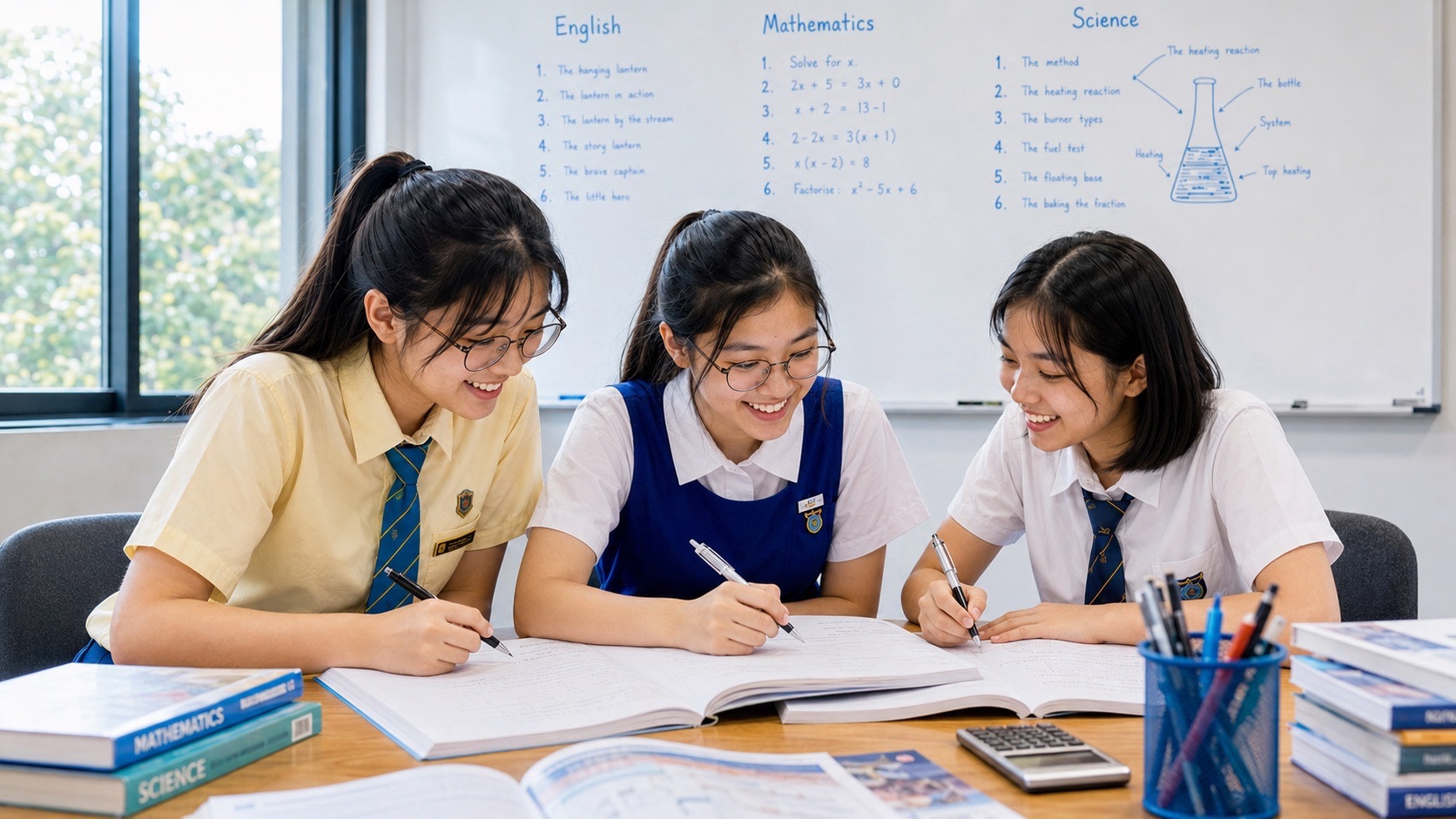

Secondary 2 Science practical skills tuition in Punggol is where experimental work should begin moving from simple fair-test language to deeper reasoning about design quality. A strong Secondary 2 Science tutor in Punggol helps students plan investigations, choose measurements, interpret graphs, judge reliability and explain whether a conclusion is justified by the evidence.
Parents comparing Secondary Science tuition Singapore, lower secondary Science tuition, experimental skills tuition, data interpretation, small-group Science tuition and upper-secondary Science readiness are often looking for the same transition: from knowing the words “independent variable” and “fair test” to actually using them to make scientific decisions.
At eduKate Punggol, our 3-pax Secondary 2 practical-skills tutorials build that transition before students enter upper-secondary Pure or Combined Science pathways. Students learn to design cleaner comparisons, record data more intelligently, separate observation from inference and evaluate methods with specific reasoning rather than memorised phrases.
From Fair Test to Experimental Design
“Keep everything else the same” is only the beginning. Students need to know which conditions matter, why they matter and whether perfect control is even possible. We teach experimental design as a relationship between the question, the variables and the evidence required.
Choosing What to Measure
A dependent variable must be measurable in a way that answers the question. Students learn to distinguish direct measurement from proxy measurement and to ask whether the chosen method is sensitive enough to reveal the expected change.
Range, Resolution and Repeated Readings
By Secondary 2, students should begin thinking about measurement quality. An instrument may be suitable in principle but poorly matched to the range or resolution needed. Repeated readings can reveal random variation, but they cannot rescue a systematically biased method.
Tables and Graphs as Analytical Tools
Results should be organised so patterns become visible. Students practise table headings, units, consistent precision, graph scales and plotting. They also learn that a graph is not merely a required picture; it is a way to test the relationship between variables.
- Choose axes from the variables.
- Use a scale that makes good use of the graph area.
- Plot carefully.
- Identify trends and anomalies.
- Interpret only after reading the evidence.
Reliability, Accuracy and Validity
Students often use these words loosely. We teach them through practical examples. Reliability concerns consistency. Accuracy concerns closeness to an accepted or true value where such a reference exists. Validity concerns whether the investigation actually tests the intended question.
These distinctions matter because different weaknesses require different improvements.
Evaluation: Link the Weakness to the Fix
A useful evaluation names the problem, explains its effect and proposes a repair. Students learn to avoid empty improvements such as “be more careful”.
- Problem: identify the specific limitation.
- Effect: explain how it could distort the results.
- Repair: propose a method change that targets that distortion.
Preparing for Upper Secondary
Upper-secondary Science places greater demands on practical reasoning. Students encounter more formal apparatus, more complex variables, calculations and structured evaluation. Secondary 2 is therefore a good year to stabilise the evidence habits before the content load increases.
Why 3-Pax Tuition Helps
- Students explain their design choices aloud.
- Graphs and tables can be checked closely.
- Misconceptions about variables can be corrected immediately.
- Evaluation answers can be challenged for specificity.
- Practice can be adjusted for the student’s current school programme and readiness.
Class Details
- Format: 3-pax small-group tutorial
- Level: Secondary 2 Science practical and experimental skills
- Duration: 1.5 hours weekly
- Focus: experimental design, measurement, variables, tables, graphs, reliability, validity, conclusion and evaluation
- Method: experiment-planning tasks, data interpretation, guided critique, error analysis and fresh retesting
Practical Reasoning Is Upper-Secondary Preparation
A student who can explain why an investigation works enters Secondary 3 with an advantage. The content may become more specialised, but the evidence logic remains: define the question, create the comparison, measure carefully, interpret cautiously and evaluate honestly.


