
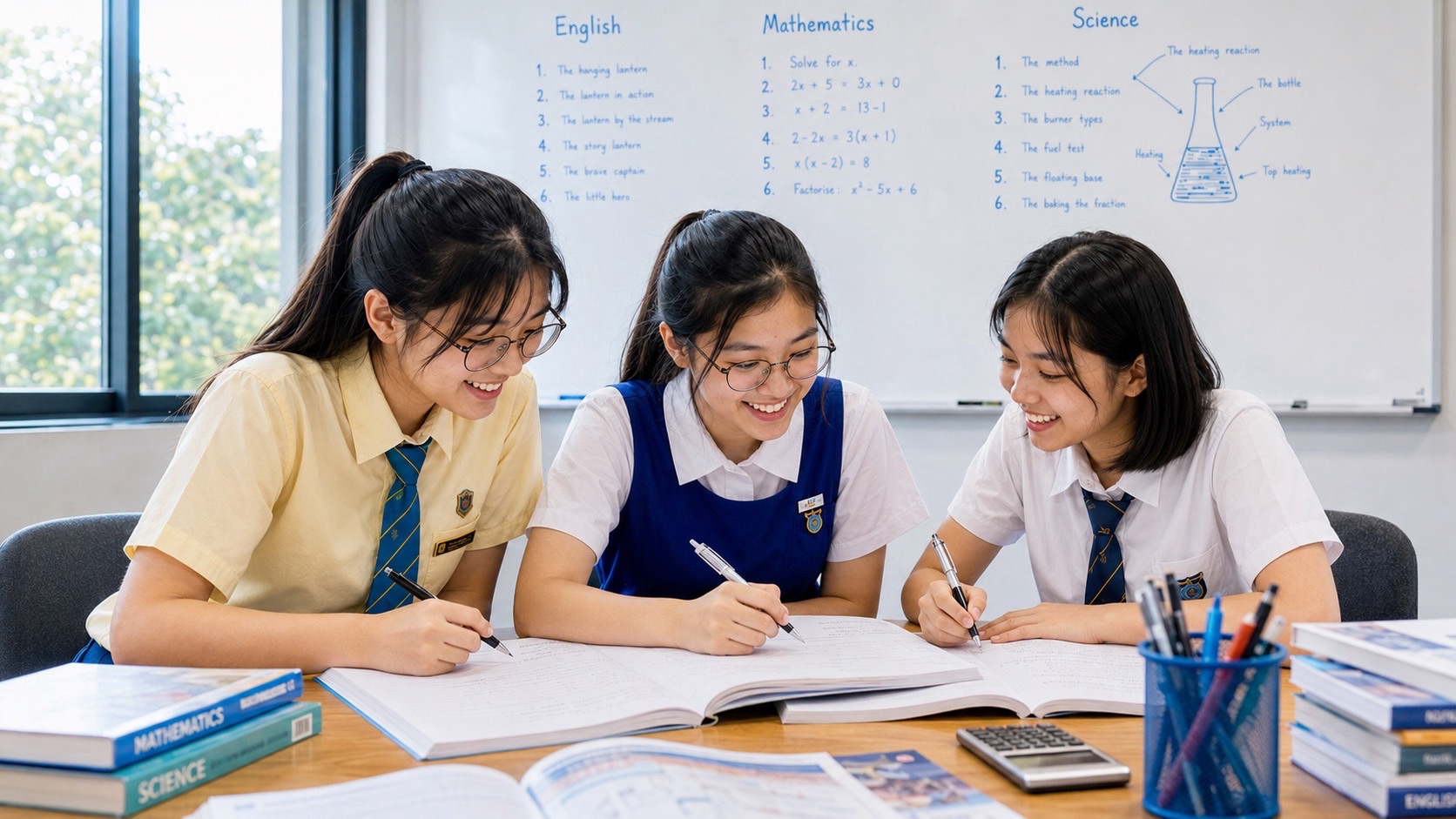

Service boundary: This page is a Secondary 2 Science study guide. It does not claim that eduKatePunggol currently offers Secondary 2 Science tuition. For current eduKatePunggol subjects, class availability and consultation, use Tuition at eduKatePunggol.
Secondary 2 Science tuition in Punggol sits at an important point in the secondary-school journey. Students are no longer complete beginners, yet the year still belongs to lower-secondary Science. A good Secondary 2 Science tutor in Punggol therefore has two jobs: strengthen the connected Biology, Chemistry and Physics foundation already being built, and prepare the student for the sharper demands of upper-secondary Science.
Families comparing Secondary Science tuition Singapore, G2 or G3 Science tuition, small-group Science classes and MOE Secondary 2 Science syllabus support will see the same themes repeatedly: concept mastery, exam techniques, data-based questions, open-ended explanations, critical thinking and confidence. Those terms matter, but only when they are joined into a working learning system.
Use a close-feedback study loop: identify the recurring concept or evidence problem, repair it, mix topics, and retest on unfamiliar school-style questions.
Secondary 2 Is the Year Connections Start to Matter More Than Chapters
In Secondary 1, many students can survive by treating each chapter as a separate package. In Secondary 2, that strategy becomes less reliable. Matter links to chemical changes. Cells link to transport and body systems. Forces link to energy transfers. Electrical systems require students to combine models, quantities and cause-and-effect relationships.
The student who remembers each topic in isolation may perform well on familiar exercises but struggle when an assessment combines ideas. This is often the first sign that the problem is not memory capacity. The problem is knowledge organisation.
Our job is to help students build a network rather than a stack of notes.
From Remembering to Selecting the Right Science
One of the hardest Secondary 2 skills is deciding which scientific idea belongs in the answer. Students often know several facts about a topic, then write all of them. The result is long but poorly targeted.
We train a different routine:
- Identify what the question asks to explain, compare, predict or evaluate.
- Locate the evidence given in the diagram, graph, table or scenario.
- Select the scientific model that connects the evidence to the requested outcome.
- Write only the causal chain needed.
- Check whether every sentence earns its place.
This is a small change with a large effect. Science answers become shorter, more precise and easier to verify.
Why 3-Pax Science Tuition Works Differently
A three-student class gives the tutor enough variety for discussion without losing sight of individual thinking. One student may confuse a variable. Another may understand the method but use weak vocabulary. A third may finish quickly yet make unsupported assumptions. These are different learning problems even when the final mark is similar.
- The tutor can inspect each student’s written reasoning.
- Questions can be redirected immediately when a misconception appears.
- Students explain ideas aloud rather than remaining passive.
- Peers provide alternative reasoning routes without turning the class into a lecture hall.
- Practice can be adjusted for repair, stabilisation or extension.
- Assessment preparation can remain close to each student’s school sequence.
The purpose of the small group is not luxury for its own sake. It is visibility.
The Secondary 2 Diagnostic: Where Is the Bottleneck?
Before adding more work, we ask where performance is being lost. Common bottlenecks include:
- Concept gap: the underlying model is incomplete.
- Retrieval gap: the student understood before but cannot access the idea now.
- Representation gap: the student understands prose but not graphs, diagrams or tables.
- Language gap: the student knows the idea but cannot express it precisely.
- Transfer gap: the student succeeds on familiar examples but fails when context changes.
- Method gap: the student does not know how to approach experiments, comparisons or evaluation questions.
- Assessment gap: time pressure or poor checking causes avoidable losses.
Once the bottleneck is named, practice becomes more efficient.
Data Interpretation: Read Before You Explain
Secondary 2 students increasingly need to work from evidence. We teach a disciplined sequence: read the axes and units, identify variables, describe the visible trend, locate unusual points, compare the correct conditions and only then explain the pattern using scientific knowledge.
This prevents a common mistake: seeing a familiar topic and writing a memorised explanation before checking whether the data actually supports it.
Experiments: From “Fair Test” to Evidence Quality
By Secondary 2, “keep everything else the same” is not enough. Students should understand why variables are controlled, what repeated measurements do, how measurement choices affect reliability, and whether a conclusion is stronger than the method allows.
- What is deliberately changed?
- What outcome is measured?
- Which conditions could create an alternative explanation?
- How should the outcome be measured?
- Would more repeats improve confidence?
- Does the evidence support a causal claim or only a relationship?
- What improvement directly addresses the identified weakness?
These questions prepare students not only for school assessments but for the more formal practical and experimental reasoning they meet later.
Scientific Explanations: Cause → Mechanism → Effect
Weak answers often jump from the starting condition straight to the final outcome. Strong answers show the mechanism in between. We train students to ask what changes first, what process carries that change forward and what observable effect follows.
This cause–mechanism–effect structure is useful across Chemistry, Physics and Biology. It gives students a portable way to organise explanations even when the topic changes.
Preparing for the Secondary 2 to Secondary 3 Transition
Secondary 2 is also a preparation year. Schools and students begin thinking about upper-secondary subject combinations and the level of Science the student will take next. The best preparation is not premature cramming of upper-secondary chapters. It is a secure lower-secondary base.
We therefore pay attention to:
- accuracy with scientific vocabulary;
- ability to connect concepts across chapters;
- confidence with equations, quantities and units where relevant;
- reading of graphs, tables and diagrams;
- quality of experimental reasoning;
- ability to explain mechanisms clearly;
- retrieval of older material without complete re-teaching; and
- independence when facing unfamiliar questions.
These are better indicators of readiness than whether a student has already seen next year’s notes.
When Secondary 2 Science Tuition May Be Useful
- Marks are falling even though the student studies more.
- The student can recite notes but cannot apply them.
- Graph and table questions cause disproportionate losses.
- Open-ended answers are scientifically plausible but not precise enough.
- Older topics fade quickly.
- Practical and experiment questions feel unpredictable.
- The student is uncertain about readiness for upper-secondary Science.
- The student performs well and needs deeper reasoning rather than more routine repetition.
What a Useful Parent–Tutor Discussion Looks Like
Bring evidence. Recent school papers, marked worksheets, practical work, teacher comments and the current school topic sequence are more useful than a general statement that Science is “weak”. We look at how marks are lost and whether the same error appears in different forms.
The objective is to determine whether the student needs repair, consolidation, assessment control or extension. A good plan should be specific enough that progress can later be checked.
How to Use This Study Guide
- Level: Secondary 2 Science.
- Focus: integrated concepts, data, experiments, scientific explanation and readiness for upper-secondary Science.
- Method: diagnose → repair → connect topics → vary → retest.
- Use with: current school evidence and the student’s actual subject pathway.
The Real Goal: A Student Who Can Reconstruct the Science
Memorisation has a place in Science. Students need vocabulary, definitions, relationships and factual knowledge. But durable performance appears when those pieces can be reconstructed into a model and used in a new situation.
That is the standard we work toward at eduKate Punggol. By the end of Secondary 2, the student should not merely possess more notes. The student should be better at deciding what matters, using evidence and explaining why an answer is justified.
Continue Reading
- How Science Knowledge Networks Work
- How Science Data Interpretation Works
- How Science Experiment Design Works
- How Science Transfer Works
For current eduKatePunggol subjects, class availability and consultation, use Tuition at eduKatePunggol.


