
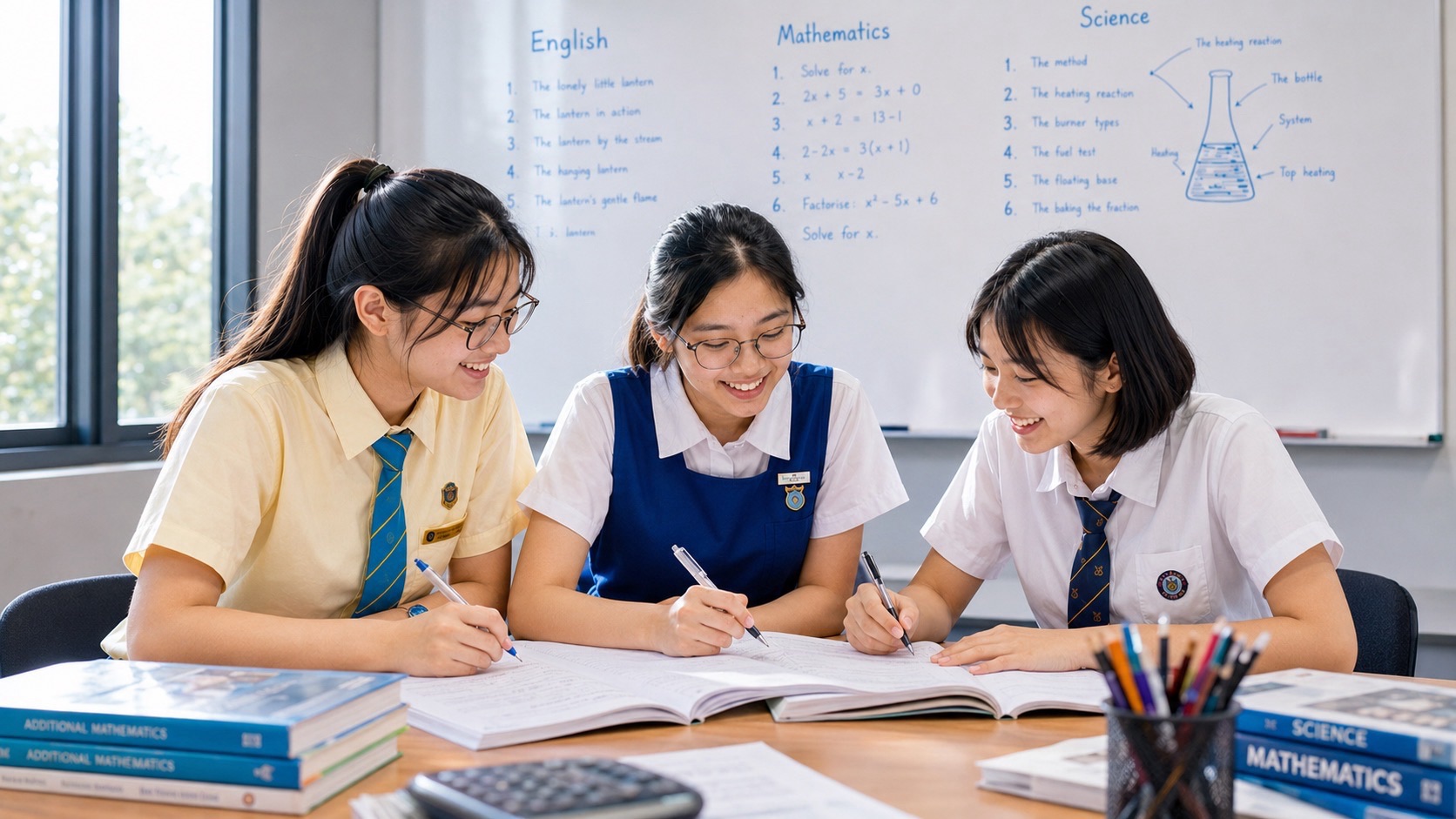

Secondary 1 Science practical skills tuition in Punggol should teach a student how scientific evidence is made. A strong Secondary 1 Science tutor in Punggol helps students understand variables, observation, measurement, fair comparisons, tables, graphs and experimental conclusions instead of treating practical work as a list of laboratory steps to memorise.
Parents comparing Secondary Science tuition Singapore, lower secondary Science tuition, small-group Science tuition, experimental skills, data interpretation and MOE Science syllabus support are often looking for the same thing: a child who can read an unfamiliar investigation and work out what was changed, what was measured, what the evidence shows and what the evidence cannot prove.
At eduKate Punggol, our 3-pax Secondary 1 Science practical-skills tutorials build that reasoning early. Students learn to move from question to variable to method to evidence to conclusion. The aim is not premature examination drilling. It is to make experimental thinking part of how the student understands Science from the start of secondary school.
Practical Science Starts With a Question
A practical task becomes manageable when the student first asks what relationship is being tested. Without that, apparatus becomes a collection of objects and measurements become numbers without purpose.
- What is deliberately changed?
- What outcome is measured or observed?
- Which conditions should stay sufficiently constant?
- What evidence would answer the question?
Variables Are Jobs, Not Vocabulary
Students often memorise “independent, dependent and control variable” but still cannot design a fair comparison. We teach each variable by its job. The independent variable creates the comparison. The dependent variable records the response. Control variables prevent other factors from becoming alternative explanations.
This makes the language useful. When the student understands why a variable matters, unfamiliar experiments become easier to decode.
Observation Before Explanation
Secondary students need to separate what they see from what they think it means. A colour change, temperature reading, movement, precipitate or measured value is evidence. The scientific explanation comes afterwards.
That separation is one of the foundations of scientific reasoning. It also improves written answers because students stop blending observation and inference into one vague sentence.
Measurement: Match the Tool to the Quantity
We teach students to ask what is being measured, which instrument is suitable, what unit belongs to the measurement and whether the scale can provide useful precision. A ruler, thermometer, balance, stopwatch or measuring cylinder is not simply an item to name; it is part of the evidence system.
Tables: Organise the Evidence
A clear table helps the student see the comparison. Headings should identify the quantity, units should be shown appropriately, and repeated readings should be organised consistently.
- Give each column a meaningful heading.
- Use units clearly.
- Keep observations and calculated values distinct.
- Use sensible and consistent precision.
- Record results immediately instead of relying on memory.
Graphs: Read the Relationship, Not the Shape
Students learn that a graph is a relationship between variables. They identify axes and units before interpreting the line. This prevents common errors in which students tell a story from the visual shape without checking what the graph actually represents.
Conclusion: Stay Inside the Evidence
A conclusion should answer the experimental question and remain proportional to the evidence. We teach students not to claim a universal rule from a tiny dataset or invent a mechanism the experiment did not test.
Evaluation: Improvement Needs a Reason
“Repeat the experiment” and “use better apparatus” are not automatically strong answers. Students identify the weakness first, explain how it could affect the result, then propose an improvement that addresses that exact problem.
- Weakness: what is uncertain or uncontrolled?
- Effect: how could it change the evidence?
- Improvement: what practical change reduces that problem?
Why 3-Pax Practical Skills Tuition Helps
- Each student must explain why a method works.
- Experimental diagrams can be corrected immediately.
- Tables and graphs can be inspected closely.
- Generic evaluation statements can be challenged.
- Students compare valid methods and learn that Science can have more than one workable design.
Class Details
- Format: 3-pax small-group tutorial
- Level: Secondary 1 Science practical and experimental skills
- Duration: 1.5 hours weekly
- Focus: variables, observation, measurement, tables, graphs, fair comparisons, conclusions and evaluation
- Method: explanation, guided practice, experiment-planning tasks, data questions, error analysis and retesting
Build the Evidence Habit Early
The best time to learn practical reasoning is before it becomes a final-year problem. A Secondary 1 student who learns to respect variables, measurements and evidence develops a foundation that supports every later Science subject.


