
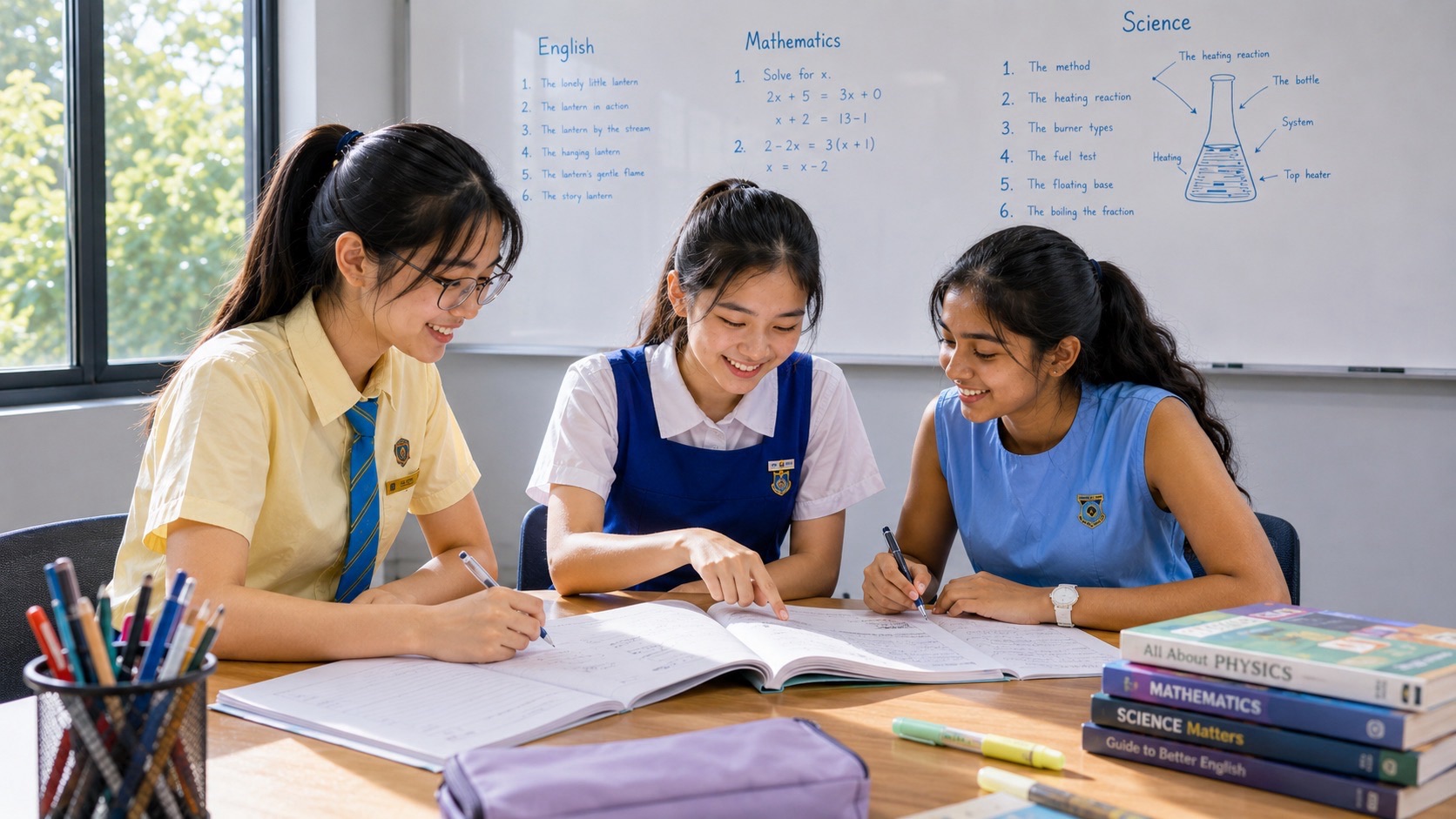

Secondary 2 Science exam preparation in Punggol should do two jobs at once: improve current school assessment performance and prepare the student for the greater independence of upper-secondary Science. A strong Secondary 2 Science tutor in Punggol helps students retrieve older concepts, interpret data, evaluate experiments, write precise explanations and identify the exact reason marks are being lost.
Parents comparing Secondary Science tuition Singapore, Sec 2 Science tuition, small-group Science tuition, Science exam techniques, data-based questions, experimental skills and upper-secondary readiness are often looking for a more reliable student rather than a larger stack of worksheets.
At eduKate Punggol, our 3-pax Secondary 2 assessment programme treats each paper as evidence. We diagnose whether the loss came from knowledge, retrieval, representation, data reading, scientific language, practical reasoning or execution. That diagnosis then determines the next lesson.
Secondary 2 Assessments Test Connections
By Secondary 2, students cannot rely as heavily on treating each chapter as an isolated unit. Questions increasingly require ideas to be selected from a growing knowledge network. The student has to decide which scientific model is relevant before writing.
Retrieval: Can the Student Reconstruct Without Notes?
Rereading creates familiarity, but school assessments require retrieval. We use short closed-book prompts, mixed-topic questions and diagram reconstruction so students discover which concepts are genuinely available.
Interleaving: Remove the Chapter Label
Topic worksheets tell the student which knowledge to use. Mixed practice does not. That makes interleaving harder, but also more realistic. The student must identify whether the question is about particles, forces, cells, energy, chemical change or another model before applying it.
Data Questions: Evidence Before Explanation
- Read axes, headings, units and conditions.
- Identify the variables.
- Describe the trend accurately.
- Use numerical evidence where required.
- Identify anomalies or limits.
- Then apply the scientific model.
Experimental Questions: Method Has a Reason
Students should be able to explain why variables are controlled, why repeated readings may be useful, why a particular apparatus is appropriate and whether a proposed improvement actually addresses the identified weakness.
Open-Ended Answers: Cause → Mechanism → Effect
Secondary 2 is a good year to make explanation structure explicit. Students learn to identify the starting condition, show the scientific process in between and state the resulting effect. This reduces vague answers and creates a reasoning habit that transfers into upper-secondary Science.
Multiple Choice: Fast Does Not Mean Careless
We teach students to eliminate distractors for a scientific reason, notice negative wording, estimate where useful and flag uncertain items for deliberate review. The aim is controlled speed rather than rushing.
Error Analysis: Turn Marks Into Training Decisions
- Knowledge error: the content was unavailable.
- Concept error: the model was wrong.
- Selection error: the student knew several ideas but chose the wrong one.
- Data error: the representation was misread.
- Language error: the answer was scientifically vague.
- Execution error: time, attention or checking failed.
Each error category creates a repair. We then use a fresh question to test whether the repair transfers.
Upper-Secondary Readiness Is More Than a Mark
A student is becoming ready for upper secondary when older knowledge remains accessible, graphs and experiments are manageable, explanations are precise and unfamiliar questions no longer cause complete shutdown. These are useful leading indicators before subject combinations become more specialised.
Why 3-Pax Assessment Preparation Helps
- Each student’s error pattern stays visible.
- Data and practical questions can be discussed deeply.
- Written answers can be checked sentence by sentence.
- Practice can shift between repair, stabilisation and extension.
- Students can compare reasoning routes without disappearing in a large class.
Class Details
- Format: 3-pax small-group tutorial
- Level: Secondary 2 Science assessment preparation
- Duration: 1.5 hours weekly
- Focus: cumulative retrieval, mixed topics, data interpretation, experiment questions, open-ended answers and error analysis
- Progression: build dependable assessment habits before upper-secondary Science
The Goal Is a Student Who Can Diagnose the Paper
Secondary 2 exam preparation becomes useful when the student can recognise what the question is doing, retrieve the appropriate Science, use the evidence and check whether the answer is complete. That capability is the real bridge into Secondary 3.


