
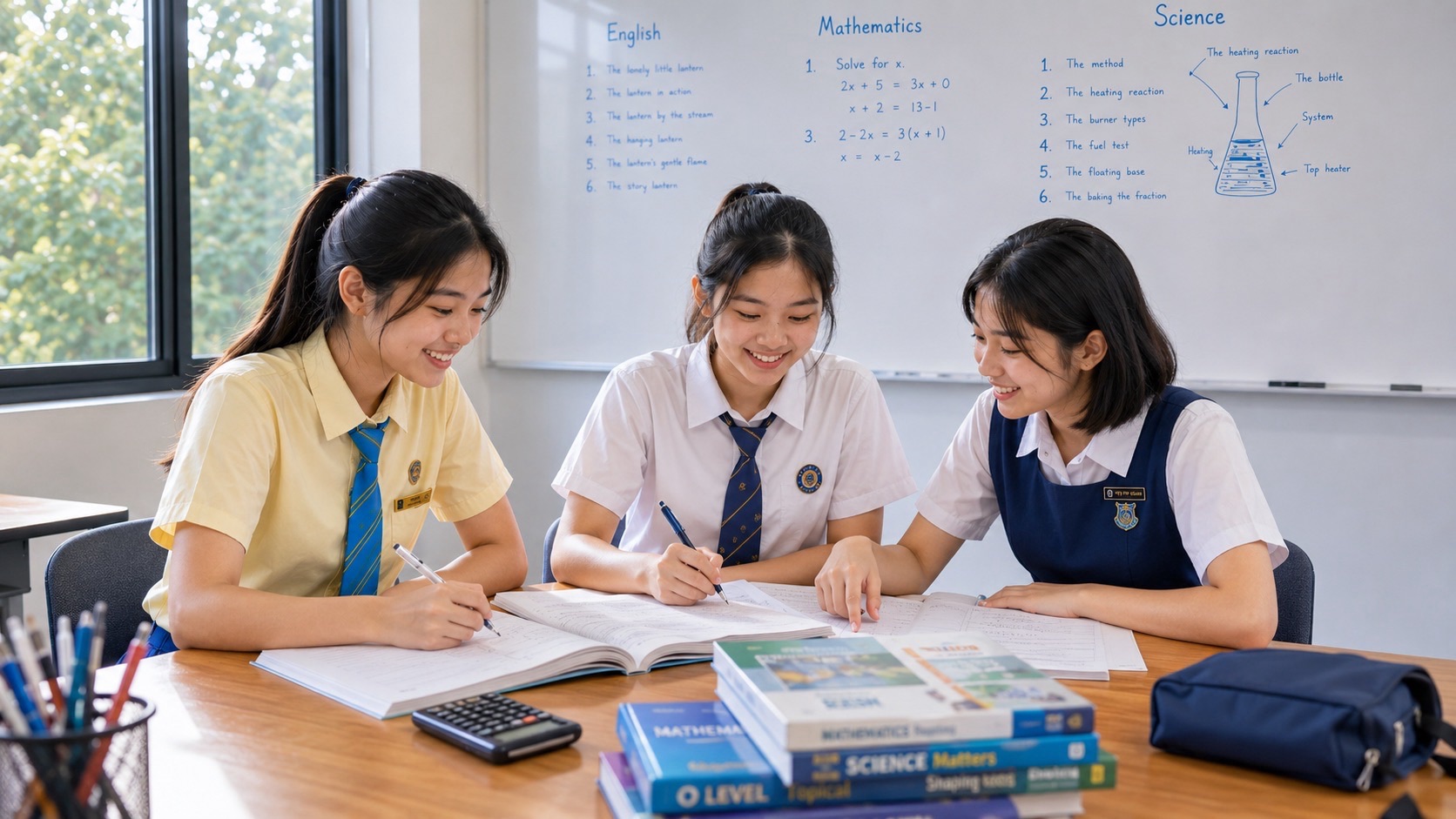

Lower Secondary Science tuition in Punggol should build the scientific operating system students need before upper-secondary subject combinations become more specialised. For Secondary 1 and Secondary 2 students learning at different subject levels under Full Subject-Based Banding, a strong Science tutor in Punggol adapts the depth and pace while preserving the same core habits: understand the model, read evidence, reason experimentally and explain precisely.
Parents comparing Secondary Science tuition Singapore, Secondary 1 Science tuition, Secondary 2 Science tuition, G2 Science tuition, G3 Science tuition, small-group Science tuition and upper-secondary Science preparation are often trying to solve several problems at once: concept gaps, weak scientific vocabulary, difficulty with graphs, uncertain practical skills and inconsistent school assessment performance.
At eduKate Punggol, our 3-pax lower-secondary Science tutorials treat Secondary 1 and Secondary 2 as a connected runway. We strengthen the ideas, evidence habits and assessment skills that students will later need in Chemistry, Physics, Biology and Combined Science. The exact subject level and school sequence may differ, but the core scientific reasoning remains transferable.
What Changes After Primary Science?
Lower-secondary Science increases abstraction. Students work with models they cannot directly see, move between diagrams and text, compare multiple variables and explain mechanisms with more specialised language. The transition can feel difficult even for students who performed well in PSLE Science.
The answer is not simply more worksheets. Students need a better knowledge structure.
Secondary 1: Build the Scientific Language
Secondary 1 is the foundation year. Students learn to separate observation from inference, read graphs carefully, identify variables, use scientific terms precisely and connect cause to effect in written explanations.
Secondary 2: Build the Knowledge Network
Secondary 2 adds a second challenge: older topics must remain available while new ideas arrive. Students need retrieval, interleaving and stronger transfer so they can apply a concept when the context changes.
G2 and G3 Support: Adjust Depth Without Losing the Core
Students may learn subjects at different subject levels according to their school programme. We adjust the complexity, vocabulary load, question depth and pace to the learner while preserving the same core scientific habits: evidence, models, variables, data, explanation and checking.
The label should guide the level of demand; it should not become a fixed judgment about the student. Progress is built from current evidence.
Concept Mastery: Build Models, Not Lists
Facts become more durable when attached to models. Matter, forces, energy, cells, systems and chemical changes all become easier when students understand what exists, what changes, what causes the change and what evidence would reveal it.
Scientific Vocabulary: Precision Is Functional
Terms such as increase, decrease, transfer, absorb, dissolve, react, diffuse, variable and control have specific jobs. We teach students to use scientific words because they improve meaning, not because they make an answer sound sophisticated.
Data Interpretation: Read Before Explaining
- Identify variables and units.
- Describe the pattern directly.
- Use numerical evidence where relevant.
- Notice anomalies or limits.
- Then explain with the scientific model.
Experimental Reasoning: Method Has a Purpose
Students learn what variables do, how measurement affects evidence, why repeats may help and how to evaluate a method. Practical reasoning is taught as evidence design rather than a collection of laboratory phrases.
Assessment Skills: Convert Understanding Into Marks
School assessments require students to identify command words, select relevant knowledge, use the evidence supplied and write complete mechanisms. We use error analysis to distinguish content gaps from reading, data, language and execution errors.
Why 3-Pax Lower Secondary Science Tuition Helps
- Each student’s misconceptions remain visible.
- Questions can be adjusted to the student’s subject level and current topic.
- Graphs, diagrams and written explanations can be checked closely.
- Students can discuss alternative reasoning without becoming passive.
- Practice can move between repair, stabilisation and extension.
Three Learning Pathways
Repair
Foundational concepts or language are unstable. We rebuild the earliest dependency before increasing difficulty.
Stabilisation
The student understands in class but performs inconsistently. We strengthen retrieval, precision, data skills and assessment control.
Extension
The student is secure with routine work and needs unfamiliar applications, deeper data, stronger experimental evaluation and cross-topic transfer.
Class Details
- Format: 3-pax small-group tutorial
- Levels: Secondary 1 and Secondary 2 Science
- Subject level: support according to the student’s G2/G3 school programme where applicable
- Duration: 1.5 hours weekly
- Focus: concept mastery, scientific language, data interpretation, practical reasoning, retrieval and school assessment skills
- Progression: build the foundation for upper-secondary Science pathways and the SEC era
Lower Secondary Is the Scientific Runway
Secondary 1 and 2 should not be treated as waiting years before “real” Chemistry, Physics or Biology begins. They are where students learn the habits that make those subjects possible: modelling, measuring, comparing, explaining and revising claims from evidence.
At eduKate Punggol, the aim is to make those habits reliable before the upper-secondary content load arrives.


