
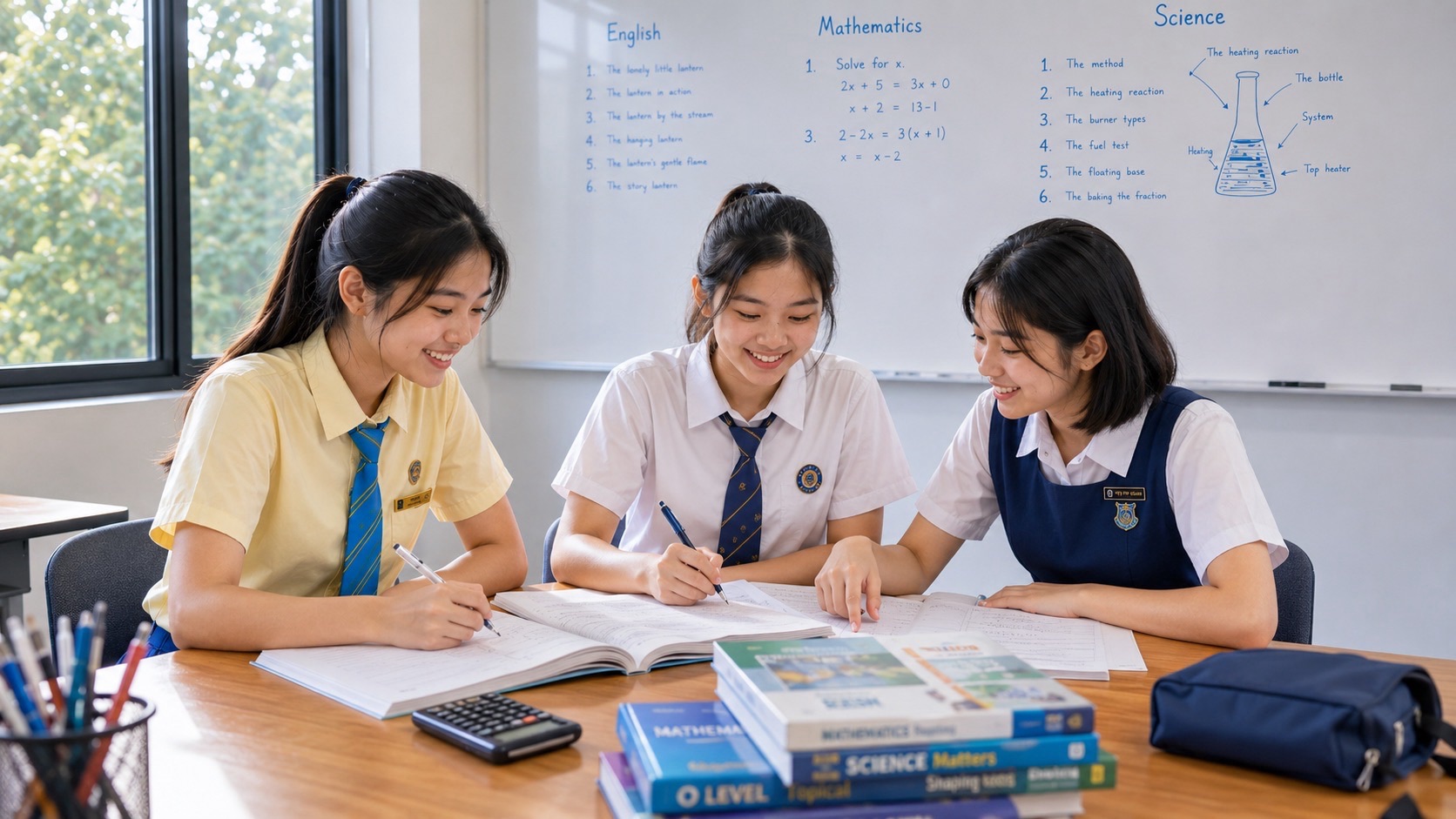
Exam-system check · 27 September 2026: students graduating in 2026 remain on the existing GCE examination routes. From 2027, the Singapore-Cambridge SEC uses subject-level Science syllabuses at G1, G2 and G3. Always match revision to the student’s exact Science route and current official SEAB syllabus.

Secondary Science exam preparation in Punggol should train more than memory. Students need practical reasoning, data interpretation, scientific vocabulary, calculation control, answering techniques, retrieval and the ability to decide what a question is really testing. Those skills support students across lower-secondary Science, Pure Science, Combined Science and final-year examination preparation.
Parents searching for Secondary Science tuition Singapore, Science exam preparation, O-Level Science tuition, Combined Science tuition, Pure Science tuition, practical Science skills or data-based question techniques often find programmes organised by chapter. Chapters matter, but examination performance depends on skills that cut across chapters.
Service boundary: this page is a Secondary Science exam-preparation guide; it does not claim that eduKatePunggol currently offers Secondary Science tuition. For current subjects, class availability and consultation, use Tuition at eduKatePunggol. The cross-topic methods below can be used with school lessons, independent revision or another tutor.
Why Exam Preparation Cannot Be Only Content Revision
A student can know every definition in a chapter and still lose marks. The paper may present the idea through a graph, an experimental setup, an unfamiliar context, a calculation or a comparison. The knowledge is present, but the student fails to recognise how it should be used.
This is the difference between content possession and performance control.
Good exam preparation therefore has two tracks running together:
- What do I know? Concepts, definitions, relationships, equations and models.
- What can I do with it? Interpret, compare, predict, calculate, explain, evaluate and verify.
Skill 1: Read the Question Before Retrieving the Answer
Students often recognise a topic and start writing before reading the full task. That is dangerous because the same topic can support very different questions. “Describe”, “explain”, “compare”, “predict” and “evaluate” are different jobs.
We teach students to identify:
- the command word;
- the object or variable being discussed;
- the evidence supplied;
- the number of parts that must be answered;
- the scientific model likely to be relevant; and
- the level of detail the mark allocation appears to require.
The first few seconds should reduce ambiguity, not increase speed.
Skill 2: Data Interpretation — Separate What You See From Why It Happens
Graphs and tables reward disciplined reading. A student should first describe the evidence, then explain it. Mixing the two too early causes assumptions to replace observations.
- Read the axis labels, units, table headings and conditions.
- Identify the independent and dependent variables where appropriate.
- Describe the trend using the actual variables.
- Use numerical values when a comparison needs evidence.
- Notice plateaus, turning points, anomalies or overlapping values.
- Only then apply the relevant scientific explanation.
This routine works across topics because the job is not topic-specific. It is evidence reading.
Skill 3: Practical Reasoning — Every Method Choice Has a Job
Practical questions become manageable when students understand why each part of a method exists. The independent variable creates the comparison. The dependent variable records the outcome. Control conditions protect the comparison. Repeats improve confidence in the pattern. Suitable apparatus makes measurement possible at the required resolution.
When students suggest an improvement, we ask them to complete the sentence: “This improves the investigation because…” If they cannot state the reason, the suggestion may be generic rather than relevant.
Skill 4: Scientific Explanation — Make the Mechanism Visible
Weak explanations often name the starting condition and final result but omit the mechanism. A useful structure is:
- Condition: what changed or what is different?
- Mechanism: what scientific process connects the condition to the outcome?
- Effect: what happens as a result?
This is not a sentence template to memorise. It is a way to check whether the causal chain is complete.
Skill 5: Comparison — Compare the Same Thing on Both Sides
Comparison questions are easy to under-answer. Students write that A is “higher” without saying higher in what. Or they describe A and B separately without making the relationship explicit.
We train students to name the variable, direction and conditions clearly. A comparison should make it impossible for the reader to wonder what was being compared.
Skill 6: Calculation Control — Formula Is Only One Step
Science calculations require more than recalling an equation. Students need to identify the requested quantity, select the relationship, convert units where necessary, substitute values correctly and judge whether the answer is plausible.
- Write or identify the relevant relationship.
- Check that the quantities match the symbols.
- Convert units before substitution when needed.
- Show enough working to diagnose an error.
- Attach the correct unit.
- Estimate whether the magnitude is sensible.
Visible working is not merely presentation. It is a debugging tool.
Skill 7: Retrieval — Can the Student Reconstruct Without Notes?
Rereading creates familiarity. Examinations require retrieval. We therefore use short closed-book prompts, mixed questions, diagram reconstruction and explanation-from-memory tasks so students discover what they can actually access.
Retrieval also identifies what should be revised next. If a student cannot retrieve a concept at all, more exam technique will not solve the problem. The knowledge needs reactivation or re-teaching.
Skill 8: Interleaving — Choose the Method Instead of Being Told the Chapter
Topic worksheets remove one important decision: the student already knows which chapter to use. Mixed practice restores that decision. The question might require heat transfer, particles, forces, cells or a combination. The student must identify the model from the evidence.
This makes practice feel harder, but it is closer to the examination task.
Skill 9: Timed-Paper Control
Time pressure changes decision-making. Students may rush familiar questions, become trapped on one difficult item, or leave too little time for structured responses. Timed practice should therefore be reviewed not only for correctness but for pacing.
- Where did time accumulate?
- Which question should have been left temporarily?
- Which answers were rushed despite being easy?
- How much checking time remained?
- Did the student change correct answers without evidence?
The paper becomes a record of decisions, not merely a score.
Skill 10: Error Analysis — Turn Every Wrong Answer Into a Repair Job
Corrections are useful only when they change future behaviour. We classify errors into knowledge, concept, selection, language, calculation, representation, practical, evidence and time-management categories.
Then we retest with a fresh question. Copying the model answer proves very little. Solving a new problem after the repair shows whether learning has changed.
Why 3-Pax Exam Preparation Helps
Exam preparation needs close observation. In a three-student class, the tutor can see not only whether an answer is wrong but how the student arrived there. Students also benefit from hearing another learner explain the same problem differently.
- Frequent individual questioning
- Immediate correction of reasoning errors
- Close checking of calculations and units
- Targeted practical and data questions
- Mixed-topic practice matched to current weaknesses
- Timed-paper work when the foundations are ready
- Fresh retesting after correction
A Simple Examination Preparation Cycle
We use a repeating cycle:
- Diagnose: identify the current loss pattern.
- Repair: teach or reactivate the missing concept or skill.
- Practise: use focused questions until the method becomes stable.
- Mix: combine topics so the student must select the correct approach.
- Time: add examination pressure when appropriate.
- Review: classify errors rather than simply marking wrong answers.
- Retest: use a fresh question to verify the repair.
This keeps revision from becoming a pile of completed papers with the same mistakes recurring.
What Parents Can Use to Judge Progress
Marks matter, but they are not the only early signal. Useful leading indicators include:
- fewer repeated error types;
- faster retrieval of older topics;
- more precise scientific vocabulary;
- better completion of multi-part questions;
- more reliable units and calculations;
- clearer practical explanations;
- less tutor prompting; and
- greater stability across unfamiliar questions.
These improvements usually appear before a large examination result changes.
How to Use This Exam-Preparation Guide
- Match the student’s programme: lower-secondary, Pure Science or Combined Science.
- Skills: practical reasoning, data interpretation, scientific explanations, calculations, retrieval, mixed practice and timed-paper control.
- Materials: current school work, official syllabus requirements, mixed revision, micro-tests and correction–retest sets.
- Method: identify the repeated loss → repair the mechanism → test it on a fresh question → add time pressure only after control improves.
Exam Preparation Should Make the Student More Independent
The strongest examination preparation does not create a student who needs more prompts. It creates a student who can diagnose the question, select a method, check the evidence and recover when the first idea does not work.
Practical skills, data interpretation and answering techniques should be trained as connected parts of scientific thinking. That is what allows performance to transfer from revision to school assessment and from practice to the examination paper.
Continue Reading
- How Science Experiment Design Works
- How Science Data Interpretation Works
- How Science Explanation Works
- How Science Assessment Works
For current eduKatePunggol subjects, class availability and consultation, use Tuition at eduKatePunggol.


