

Service boundary: This page is a Secondary 1 Science study guide. It does not claim that eduKatePunggol currently offers Secondary 1 Science tuition. For current eduKatePunggol subjects, class availability and consultation, use Tuition at eduKatePunggol.
Secondary 1 Science tuition in Punggol should do more than give a student extra worksheets. A good Secondary 1 Science tutor in Punggol helps a new secondary-school student understand how Biology, Chemistry and Physics ideas connect, how the MOE Secondary Science syllabus expects evidence to be used, and how to answer data-based and open-ended questions with precise scientific language.
Parents searching for Secondary Science tuition Singapore, small-group Science tuition, G2 or G3 Science tuition, or an exam-focused Science tutor are often trying to solve the same underlying problem: the child knows facts but does not yet control the reasoning that links a question, a model, an observation and a justified answer. This study guide is designed around that transition.
This guide treats Secondary 1 Science as a foundation year for the whole secondary journey. It emphasises concept mastery, scientific vocabulary, graph and table interpretation, experimental reasoning, explanation writing, retrieval practice and school-assessment readiness. The aim is not simply to memorise more content. It is to help the student learn how secondary Science works.
Secondary 1 Science Is a Change of Language
Primary Science gives students an important base: observation, classification, cycles, systems, interactions and the use of evidence. Secondary 1 keeps those habits but increases the abstraction. Students are asked to work with models they cannot directly see, connect multiple variables, distinguish observation from inference and communicate in a more disciplined scientific register.
A student may therefore enter Secondary 1 with a respectable PSLE Science result and still feel unsettled. That does not automatically mean the child has become weak in Science. It may mean the child is meeting a new level of representation. Particle models, cells, forces, energy transfers, light rays, chemical changes and systems require a student to move between words, diagrams, symbols, tables and causal explanations.
This is why early tutoring should not begin with panic. It should begin with diagnosis.
What We Diagnose Before Teaching More
The visible mark is only one signal. Two students who both score 58% may need very different help. One may misunderstand the underlying concept. Another may understand the Science but misread command words, ignore data, write vague explanations or lose marks through incomplete comparison statements.
- Can the student separate observation from explanation?
- Can the student identify what a graph actually shows before interpreting it?
- Can the student explain a relationship using the correct variable names?
- Can the student distinguish a model from the real object or process?
- Can the student use scientific terms precisely rather than approximately?
- Can the student state a claim and support it with evidence from the question?
- Can the student recognise when an experiment is unfair?
- Can the student retrieve an older concept when the surface features of the question change?
These questions tell us far more than “needs more practice”. They tell us what kind of practice is required.
Why Three Students Changes the Lesson
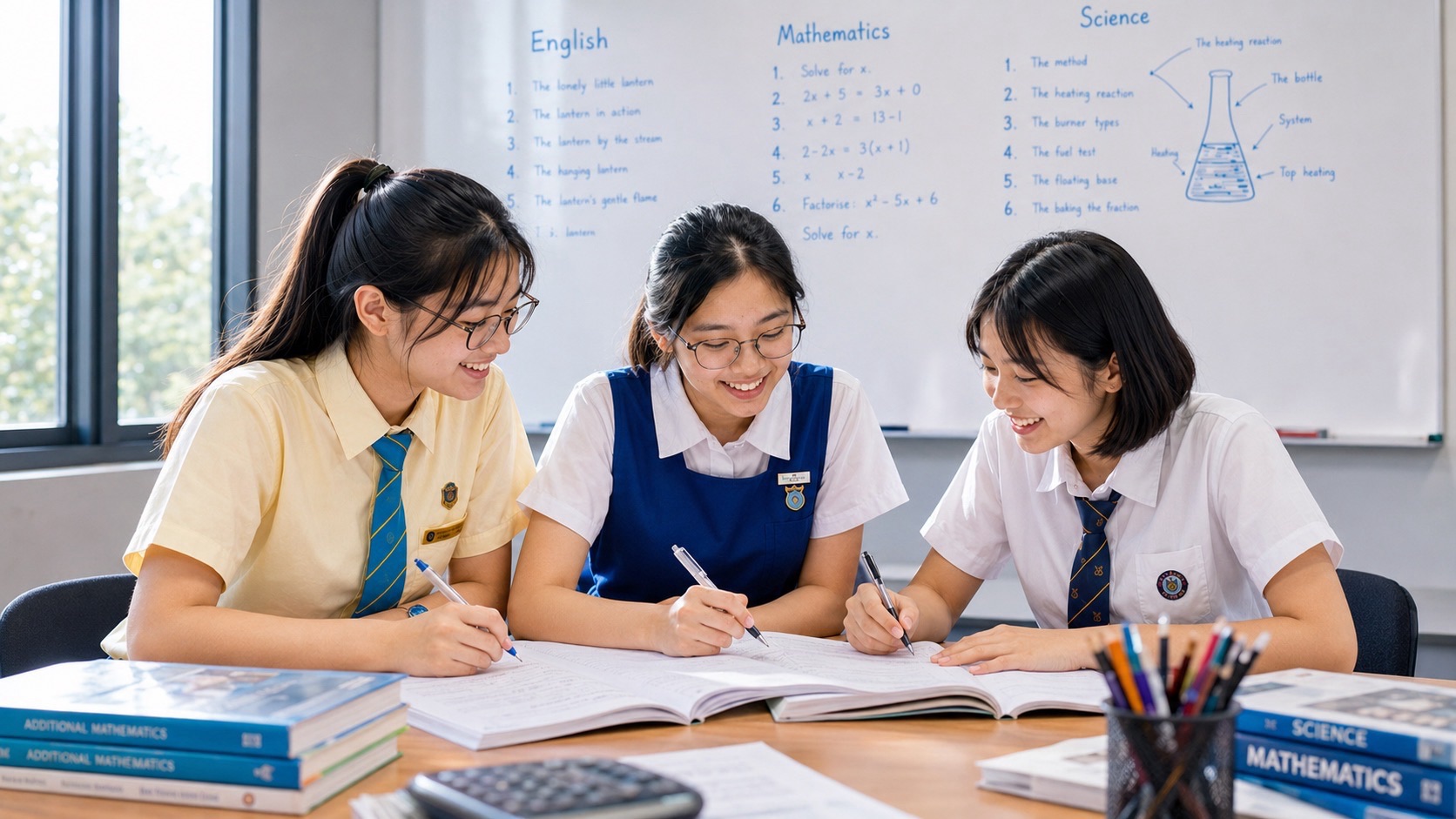
A 3-pax class is deliberately small. Science learning benefits from discussion, but discussion is only useful when every student can be seen. In a group of three, the tutor can ask one student to predict, another to challenge the prediction and a third to explain what evidence would settle the disagreement. That makes thinking visible.
The tutor can also inspect written work closely. A wrong Science answer is often produced several steps before the final sentence. The student may have selected the wrong evidence, assumed a cause that was not tested, confused correlation with mechanism, or used an everyday word where the question requires a precise scientific term.
- Each student answers frequently.
- Misconceptions are harder to hide.
- Working and diagrams can be checked in real time.
- The tutor can vary the question without changing the concept.
- Students can compare explanations and learn why one is stronger.
- Feedback can be immediate and specific.
- School-assessment preparation can be adjusted to the student’s current gaps.
The Four Learning Jobs in a Secondary 1 Science Lesson
1. Build the model
Students first need a coherent mental model. Facts are attached to a structure: what exists, what changes, what causes the change and what evidence would reveal it.
2. Represent the model
The same idea may appear as prose, a labelled diagram, a graph, a table, a ray diagram or a sequence of experimental observations. We train students to recognise the underlying Science when the representation changes.
3. Use the model
Students then apply the concept to unfamiliar situations. The question is no longer “Do you remember this note?” but “Can you use the model when the context changes?”
4. Explain the model
Finally, students must express the reasoning. A strong explanation names the relevant scientific idea, connects cause to effect and uses the evidence provided rather than writing a memorised paragraph that only sounds scientific.
Scientific Vocabulary: Precision Before Decoration
Secondary Science vocabulary is functional. Words such as increase, decrease, transfer, absorb, reflect, dissolve, react, diffuse, variable, control, system and evidence are not impressive terms to sprinkle into an answer. They do specific jobs.
We teach students to ask: What does this word commit me to? If I write “causes”, do I really have evidence for causation? If I write “more”, more of what? If I write “faster”, which rate am I comparing? Precision is one of the fastest ways to improve both understanding and written performance.
Graphs, Tables and Data-Based Questions
Data questions often expose whether a student is reading or guessing. We use a simple routine: identify the variables, read the scale, describe the pattern, locate exceptions, then interpret only what the evidence supports.
- Read: What is measured?
- Compare: Which values or conditions must be compared?
- Describe: What pattern is directly visible?
- Explain: Which scientific model accounts for that pattern?
- Limit: What can the data not prove?
This habit becomes increasingly valuable in Secondary 2, upper-secondary Pure Science and Combined Science because students are expected to interpret evidence rather than repeat notes.
Experiment Questions: Fair Test Is Only the Beginning
Students often learn to say “keep variables constant”, yet cannot explain why. We teach experiment design as a chain of reasoning: the question determines the independent variable, the outcome determines the dependent variable, and the control conditions protect the comparison from alternative explanations.
Students also learn to distinguish repeat measurements from repeated trials, identify sources of uncertainty, decide whether a proposed conclusion is supported, and suggest improvements that actually address the weakness in the method.
When Secondary 1 Science Tuition May Help
- The student memorises notes but cannot answer unfamiliar questions.
- Open-ended answers are vague or too short.
- The student loses marks on graphs and experimental questions.
- Scientific terms are used inaccurately.
- The student understands during lesson but forgets before assessment.
- Homework takes a long time because the student does not know how to start.
- Errors repeat even after correction.
- The student is anxious about the move from Primary Science to Secondary Science.
- The student is doing well and needs deeper transfer rather than more routine work.
What Parents Can Bring to the First Discussion
A recent test paper is useful, but so are marked worksheets, practical notes, school topic schedules and examples of questions the student could not begin. We look for repeated patterns rather than one dramatic mistake.
A student who loses ten marks from imprecise wording needs a different intervention from a student who cannot explain the particle model. One needs communication repair. The other needs model repair. Good tuition should know the difference.
How to Use This Study Guide
- Level: Secondary 1 Science.
- Focus: concepts, evidence, experiments, data interpretation, scientific vocabulary and increasingly independent explanation.
- Method: diagnose → explain → practise → vary → retest.
- Use with: current school work and the student’s school Science programme.
A Strong Secondary 1 Science Foundation Is Built, Not Assumed
Secondary 1 is the year students discover whether Science is going to remain a collection of facts or become a connected way of thinking. The difference matters. Students who learn to model, compare, test, explain and revise their ideas are better prepared for Secondary 2 and for the subject choices that come later.
At eduKate Punggol, the goal of a Secondary 1 Science tutorial is simple: make the student more capable when the tutor is not beside them. We rebuild weak foundations where necessary, stabilise students who are coping, and extend students who are ready for more demanding reasoning.
Continue Reading
- How Science Explanation Works
- How Science Data Interpretation Works
- How Science Experiment Design Works
- How to Choose a Tutor in Punggol
For current eduKatePunggol subjects, class availability and consultation, use Tuition at eduKatePunggol.


