
How to Improve Sec 4 G3 Additional Mathematics in Punggol | 2026 O-Level & 2027 SEC Guide
Secondary 4 G3 Additional Mathematics is an exam-year conversion problem. The student may already know a large part of the syllabus. The difficult question is whether that knowledge can be selected, executed, communicated and checked accurately enough under national-examination conditions.
This flagship guide is for Punggol students and parents navigating the final A-Math year. It also clarifies the 2026 → 2027 transition: the current 2026 graduating cohort remains under the existing O-Level framework, while from 2027 the Singapore-Cambridge Secondary Education Certificate begins and G3 Additional Mathematics is listed by SEAB as K341, with 4049 retained as the reference code for 2026 and earlier.
The teaching job is therefore twofold: use the correct examination framework for the student’s cohort, and build a reliable A-Math system across algebra, functions, trigonometry, coordinate geometry, calculus, mixed-problem routing, timing and examination execution.

First: know which national examination you are sitting
Students graduating in 2026 remain under the existing national examination arrangements. From 2027, the Singapore-Cambridge Secondary Education Certificate replaces the separate N- and O-Level certificates. For the first SEC cohort, SEAB lists G3 Additional Mathematics as K341, with 4049 shown as the reference code for 2026 and earlier.
That distinction matters because old tuition pages often mix the two cohorts. A 2026 Sec 4 student should prepare against the 2026 examination syllabus and paper structure. A 2027 Sec 4 student should use K341 and the SEC materials for that cohort.
| Cohort | Examination framework | Useful preparation rule |
|---|---|---|
| Sec 4 in 2026 | Existing O-Level framework, Additional Mathematics reference code 4049 | Use the 2026 syllabus, school prelims and current paper structure. |
| Sec 4 in 2027 | Singapore-Cambridge SEC, G3 Additional Mathematics K341 | Use the official K341 syllabus and SEC materials. |
| Later cohorts | SEC | Always check SEAB for the actual examination year. |
The mathematics itself remains continuous. The exam label changes; the dependency structure does not.
What G3 Additional Mathematics is actually building
The current K341 syllabus is organised into three broad content strands: Algebra, Geometry and Trigonometry, and Calculus. It also emphasises reasoning, communication, application and mathematical problem solving. Knowledge of G3 Mathematics is assumed.
That last sentence is important. A student can appear weak in A-Math while the real problem sits underneath the A-Math chapter. Weak symbolic control, graph interpretation, coordinate reasoning or ordinary Mathematics algebra can increase the difficulty of everything that follows.
| System | What the student needs | Common failure signal |
|---|---|---|
| Algebra | Accurate transformation, equations, inequalities, surds, polynomials and other syllabus algebra. | The idea is correct but symbolic work breaks. |
| Functions & graphs | Move between rule, graph and behaviour. | The student manipulates but cannot predict or interpret the graph. |
| Trigonometry | Use identities, equations and geometric relationships deliberately. | Random identity hunting. |
| Coordinate geometry | Translate geometric conditions into algebra and back. | Formulas are known but the relationship is not represented. |
| Calculus | Differentiate and integrate accurately and interpret the mathematics. | Rules are memorised but applications feel completely new. |
| Problem routing | Select and combine methods in mixed questions. | Needs the chapter name before beginning. |
| Exam execution | Sequence, communicate, check and manage time. | Knowledge exists but the paper is unfinished or unstable. |
The Sec 4 shift: from chapter mastery to paper control
Earlier in A-Math, the dominant question is often whether the student understands a topic. In Sec 4, the question becomes broader: can the learner coordinate the whole subject under realistic examination conditions?
- Can you recognise the mathematical family without a chapter heading?
- Can you choose a method quickly enough?
- Can you preserve algebraic accuracy through a long route?
- Can you show enough working to make the method visible?
- Can you recover when the first route fails?
- Can you leave a time-consuming question and return later?
- Can you maintain accuracy near the end of the paper?
- Can you retrieve Sec 3 content without relearning it from zero?
That is the difference between knowing A-Math and controlling an A-Math paper.
1. Repair algebra before trying to become faster
Algebra is the load-bearing wall of A-Math. If a student loses signs, mishandles fractions, substitutes inaccurately or changes an expression into a non-equivalent form, correct high-level reasoning will still lose marks.
An exam-ready algebra system should be:
- readable — the learner can see the structure before manipulating;
- equivalent — transformations preserve the relationship;
- purposeful — the chosen form helps the next step;
- auditable — enough working remains visible to find an error;
- compressible — once safe, unnecessary steps can be shortened.
Students often do the reverse: compress first, then hope accuracy follows. In the final year, a temporary return to slower, cleaner algebra can be one of the highest-return interventions.
2. Connect functions, equations and graphs
Functions are not an isolated chapter. They organise much of the subject. Equations describe relationships; graphs show behaviour; calculus later describes change in those relationships.
For every important function family, train several views:
- the symbolic rule,
- the graph shape,
- important intercepts and turning behaviour,
- parameter effects,
- domain or other relevant conditions,
- and contextual meaning when the function models a situation.
Use the graph as a checking representation. If the algebraic answer contradicts the expected graph behaviour, investigate before moving on.
3. Make trigonometric work deliberate
Trigonometric identities and equations often become a time sink because students know many relationships but do not know which transformation to begin with.
Use a route-selection sequence:
- Identify the target form or required result.
- Identify which side is structurally more complicated.
- Look for a common representation.
- Choose an identity that creates progress toward the target.
- Track intervals, signs and other conditions carefully.
- Check whether the final answer is consistent with the original equation.
This replaces identity roulette with controlled transformation.
4. Treat coordinate geometry as translation
Coordinate geometry joins geometric meaning and symbolic form. Lines, gradients, perpendicularity, circles and other relationships can be represented visually and algebraically.
When stuck, sketch the geometry before calculating. Then ask:
- Which geometric condition is given?
- How is that condition represented algebraically?
- What equation or relationship does the target require?
- Can the result be checked against the diagram?
Bidirectional translation is a stronger skill than memorising coordinate formulas one by one.
5. Make calculus meaningful and exam-ready
The current K341 syllabus includes differentiation and integration and applications within the stated syllabus scope. By Sec 4, the student should have moved beyond simply remembering the derivative rules.
Differentiation
Connect derivative to gradient and rate of change. When calculating, know what the derivative says about the original function.
Stationary points and optimisation
Do not stop at setting a derivative equal to zero. Interpret what the condition means, determine the required nature of the point and connect it back to the problem context.
Integration
Connect integration to reverse differentiation and accumulation. When using definite integration for area, connect the symbolic result to the geometric region and its sign.
Exam readiness requires both meaning and fluency. The sequence is meaning → method → retrieval → variation → application → timing.
6. Build an A-Math error architecture
“Careless” is too vague for a final-year correction plan. Classify the mark loss.
| Error class | What it looks like | Next action |
|---|---|---|
| Knowledge | A rule, definition or method is missing. | Targeted relearning and spaced retrieval. |
| Recognition | The method is known but not recognised. | Mixed-question classification. |
| Representation | The problem is not converted into useful mathematical form. | Switch among equations, graphs and diagrams. |
| Selection | Several methods are known but the wrong route is chosen. | Compare alternative routes and justify the choice. |
| Algebra | Correct route, damaged by symbolic execution. | Slow the transformations and build checkpoints. |
| Communication | Essential mathematical working is invisible. | Practise concise, markable solutions. |
| Time | Paper is unfinished. | Find where the minutes are lost before prescribing more speed. |
| Pressure state | Strong practice performance collapses in tests. | Use progressive realistic examination exposure. |
The correction should change the next practice. If the error label does not produce a different intervention, it is not precise enough.
7. Use prelims as diagnostic evidence
Prelims are valuable because they show what happened under a full school assessment. Treat the mark as one measurement and the script as a map.
| Prelim pattern | Likely issue | Priority |
|---|---|---|
| Many blank questions | Recognition, confidence or time allocation | Classify the blanks and train sectional timing. |
| Correct first steps, repeated later algebra errors | Execution reliability | Build symbolic checkpoints. |
| Routine questions strong, applications weak | Transfer and method selection | Use mixed unfamiliar contexts. |
| Strong first half, weak final section | Stamina or paper sequencing | Full-paper conditioning and pacing review. |
| Strong practice, weak prelim | Pressure-state or realism gap | Increase realistic timed exposure gradually. |
A prelim does not determine the final result. It tells you where the current system lost control.
8. Train timing in layers
Full papers matter in Sec 4, but timing still needs a progression.
- Correct untimed work. Establish a safe route.
- Short timed clusters. Test accuracy under mild pressure.
- Mixed timed sections. Add recognition and method selection.
- Longer sections. Train sequencing and recovery.
- Full papers. Train stamina, global time allocation and checking.
- Post-paper analysis. Let the result change the next revision block.
The clock is evidence. It does not tell you the cause by itself. A student may be slow because recognition is weak, because algebra is inefficient or because they overcheck every line. Those need different repairs.
9. Build a paper strategy before the national examination
You should already know how you respond when a question does not yield immediately.
- What tells you to leave and return?
- How do you mark a question for later?
- Which topics personally consume too much time?
- How much time do you reserve for checking?
- What is your checking order: signs, substitutions, conditions, graph behaviour, reasonableness?
- How do you recover if one difficult question disrupts confidence?
Paper strategy is not a motivational slogan. It is a rehearsed decision system.
10. Protect method marks with visible mathematical logic
Do not confuse concise working with invisible working. The examiner can only assess what is present on the script.
Your working should show the important transformations and mathematical relationships while avoiding unnecessary repetition. It should also allow you to debug the solution during checking.
Strong working is clear, economical and auditable.
How eduKate Punggol uses a three-student exam-year class
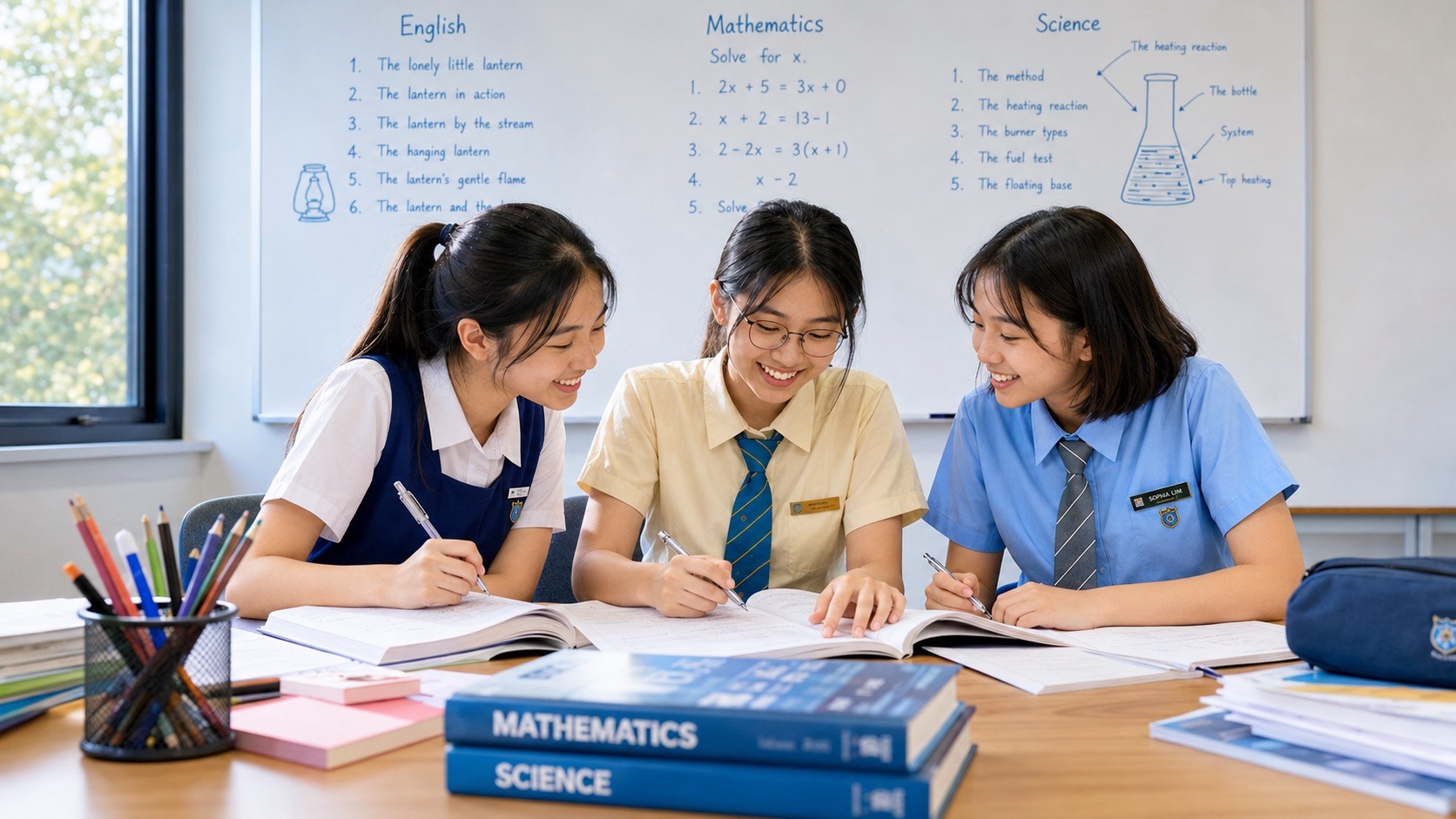
The current eduKate Punggol model is three students for 1.5 hours. In Sec 4, the small group allows the tutor to calibrate different final-year needs inside one A-Math corridor.
One student may need a rapid calculus repair. Another may understand the content but need timing and full-paper strategy. A third may already be strong and need harder mixed questions, alternate-route comparison and tighter checking.
Three students also creates useful peer contrast. Two correct routes can be compared for length, risk and checkability. A student can be asked to identify the first invalid step in another solution. That is exam-relevant reasoning.
The tutor should increasingly behave like a calibrator rather than a permanent solver. On examination day, the student must run the system alone.
Anatomy of a 90-minute Sec 4 A-Math lesson
| Phase | Exam-year function | Evidence |
|---|---|---|
| 0–10 min | Retrieve a known weak dependency. | Did the previous repair survive? |
| 10–20 min | Review school, prelim or timed-paper return. | Which error class is active? |
| 20–40 min | Repair the highest-value gap. | Can the student now reconstruct the method? |
| 40–65 min | Mixed A-Math application. | Can the learner recognise and select? |
| 65–82 min | Timed section or examination micro-simulation. | Does accuracy survive pressure? |
| 82–90 min | Error update and independent handoff. | What must the student now do without the tutor? |
The proportions change with the examination calendar. Near the final paper, realistic timing may occupy more space. Targeted repair remains available whenever one high-value weakness continues to leak marks.
Three hypothetical Sec 4 students, three different revision plans
These are hypothetical examples, not testimonials.
Student A — 58%, content broadly known, algebra unstable
The student should not relearn the whole syllabus. The priority is symbolic control, then mixed questions to see whether the repaired algebra survives different chapters.
Student B — 72%, strong chapters, weak unfamiliar questions
The priority is method selection, interleaving and representation. More blocked chapter drills would probably preserve the same plateau.
Student C — 84%, distinction-level knowledge, unstable paper control
The priority is high-quality full-paper conditioning, route comparison, checking discipline and recovery after unfamiliar questions. Routine worksheets may be too easy to expose the remaining risk.
The score tells us where the learner landed. The script tells us what to train.
A weekly Sec 4 A-Math revision system
| Task | Purpose | Question to ask |
|---|---|---|
| Repair two important errors | Stop repetition | Can I solve them now without the correction? |
| Retrieve an older Sec 3 topic | Keep the syllabus active | What survived after spacing? |
| Mixed A-Math set | Train routing | Did I select the correct method family? |
| One graph/representation task | Connect forms | Can I check the algebra another way? |
| Timed section | Condition execution | Where did time disappear? |
| Full paper when appropriate | Train stamina and global control | What happened after the paper became difficult? |
| Error review | Design next week | Which error category is still costing marks? |
The exact distribution changes with the learner and examination calendar. Revision should be evidence-driven, not ritual-driven.
The final-weeks rule: narrow the work, do not panic-expand it
In the final weeks, students often respond to anxiety by increasing everything at once: more papers, more notes, more late nights and more difficult questions. That can reduce the quality of retrieval and checking.
A stronger final-weeks sequence is:
- Map the remaining high-frequency errors.
- Repair the most expensive ones.
- Keep older topics alive through retrieval.
- Use timed mixed work to protect route selection.
- Use full papers to test the whole system.
- Review every paper by error class.
- Protect sleep and a familiar examination routine.
The goal is not maximum revision volume. It is maximum reliable control at the examination.
What parents can monitor without becoming the A-Math tutor
- Does the student know the main error categories from the latest paper?
- Are the same symbolic mistakes becoming less frequent?
- Can older topics still be retrieved?
- Are full papers being reviewed, not merely completed?
- Can the learner finish timed sections more reliably?
- Is the student maintaining enough sleep and recovery?
- Is tuition creating more independent control?
Parents do not need to reteach calculus. They can protect the conditions that allow the student to execute what has been learned.
What not to do in Sec 4 A-Math
- Do not tell a 2026 student they are already sitting the 2027 SEC.
- Do not do full papers without analysing them.
- Do not call every mark loss “careless”.
- Do not rush algebra that is still unstable.
- Do not memorise trigonometric identities without route understanding.
- Do not learn calculus as disconnected derivative rules.
- Do not spend equal revision time on every chapter regardless of evidence.
- Do not sacrifice sleep for low-quality late-night repetition.
- Do not expect a guaranteed A1 because tuition exists.
Frequently asked questions
Is the 2026 Sec 4 A-Math cohort sitting SEC?
No. SEC begins from 2027. The 2026 graduating cohort remains under the existing national examination framework.
What is G3 Additional Mathematics called from 2027?
SEAB lists G3 Additional Mathematics as K341 for the 2027 SEC, with 4049 shown as the reference code for 2026 and earlier.
Does K341 include calculus?
Yes. The current syllabus includes differentiation and integration and their applications within the stated syllabus scope.
How many full papers should I do?
There is no universal number. Use enough full papers to train mixed recognition, timing, stamina and checking, but review them carefully. A targeted repair set can be more useful than another full paper when one high-value weakness is obvious.
Can I still improve after prelims?
Yes. Use the prelim script to prioritise the most recoverable and highest-value weaknesses. No particular grade improvement can responsibly be guaranteed.
What is the current eduKate Punggol class format?
The current small-group model is three students for 1.5 hours. Current schedule and availability should be confirmed directly.
Can tuition guarantee A1?
No. Tuition can build stronger mathematical capability and examination execution, but the final result depends on the learner and the actual assessment.
Related eduKate Punggol A-Math routes
- Sec 3 G3 Additional Mathematics — First-Year A-Math Guide
- Punggol G3 Additional Mathematics Tuition — Build the A-Math System
- Punggol SEC Additional Mathematics Parent Guide
- How Mathematics Works — eduKateSG
The Sec 4 A-Math end condition
The exam-ready A-Math student does not need every question to look familiar. They can recognise structure, choose a defensible route, preserve algebraic accuracy, move between representations, use calculus meaningfully, show essential working, manage time, recover from a difficult question and check the result before the paper ends.
That is what the final year should build.





