
Punggol SEC Additional Mathematics Tuition | G2 & G3 A-Math Parent Guide
Additional Mathematics becomes manageable when the learner stops seeing it as a collection of disconnected formulas and starts seeing the structure that connects algebra, functions, trigonometry, coordinate geometry and calculus. For parents in Punggol, the most useful question is not simply whether a child should “do more A-Math”. The useful question is: what mathematical capability is currently missing, and what should tuition build next so that the student can work independently?
This guide is written for families navigating Singapore’s Full Subject-Based Banding environment and the transition into the Singapore-Cambridge Secondary Education Certificate (SEC). It explains the current G2 and G3 Additional Mathematics framework, how the subject differs across levels, why students struggle, what strong tuition should diagnose, how a three-student class is used, what a 90-minute lesson should accomplish, how progress should be measured, and how parents can decide whether tuition is actually useful.
It is deliberately long because A-Math is not a one-line problem. A student can score the same mark as another student for completely different reasons. One may have weak algebra, another may have poor recognition of question structure, another may know the method but lose marks under time pressure. The intervention has to match the real failure state.

Quick answer for parents
Full Subject-Based Banding has been fully implemented in Singapore since 2024. Students can offer subjects at G1, G2 or G3 according to their learning needs and school arrangements. From 2027, the Singapore-Cambridge Secondary Education Certificate replaces the separate N- and O-Level certificates. For the first SEC cohort, SEAB lists G2 Additional Mathematics as K232, with 4051 shown as the reference code for 2026 and earlier, and G3 Additional Mathematics as K341, with 4049 shown as the reference code for 2026 and earlier.
That administrative change matters for accuracy, but it does not change the central learning problem. Students still need to build mathematical structure: symbolic control, functions, trigonometry, representation, calculus, reasoning, transfer and examination execution. A change in examination label is easier than a change in cognition.
| Parent question | Useful answer |
|---|---|
| Is G2 A-Math simply an easier G3 A-Math? | No. They are separate subject-level syllabuses with different demand and scope. Use the student’s actual school syllabus and examination year. |
| Does taking A-Math guarantee a STEM pathway? | No. A-Math can support mathematics-heavy study, but admissions and prerequisites depend on the institution and programme. |
| Should tuition begin with past papers? | Only if the foundation is stable enough. If algebra or method selection is weak, targeted repair usually gives a higher return. |
| Should tuition promise A1? | No. Tuition can build distinction-level capability, but grades depend on the learner, school demands, practice, attendance and performance on the actual assessment. |
| What should progress look like? | Fewer repeated errors, cleaner algebra, better question recognition, stronger transfer, clearer working, better time control and increasing independence. |
The 2026 → 2027 transition: what changes and what does not
Students graduating in 2026 remain under the existing national examination arrangements. From 2027, graduating students sit SEC subjects at their respective subject levels. MOE has stated that the new SEC replaces the separate N- and O-Level certificates, while subjects continue to be examined at G1, G2 or G3.
Parents should be careful with online articles written before this transition. A page may still contain useful mathematics while carrying stale examination labels, old subject codes or old assumptions about streams. The correct approach is to use the most recent official SEAB syllabus for the student’s actual examination year.
For younger students, the 2027 codes are useful because they show the current SEC architecture, but they are not a promise that every later cohort will use exactly the same code or assessment detail. A Secondary 1 student in 2026 will sit a later SEC cohort, so families should check again when that examination year approaches.
What does not change is more important: mathematical dependencies remain. Algebra still supports functions. Functions still support graphs and later calculus. Trigonometry still requires symbolic and representational control. Examination performance still depends on retrieval, recognition, method selection, communication and time management.
What Full Subject-Based Banding changes for A-Math
Full Subject-Based Banding is useful because it reduces the temptation to describe an entire student by one stream label. A learner may be stronger in Mathematics than in English, or stronger in Science than in Humanities. Subject levels allow the school programme to reflect that uneven profile more accurately.
For tuition, that means we should treat G2 or G3 as a routing condition, not an identity. We do not teach a “G2 child” or a “G3 child”. We teach a learner who currently offers a subject at a particular level and has a particular set of strengths, gaps, habits and goals.
This also means that tuition should not use G3 as a prestige label or G2 as a ceiling. The teaching job is to maximise the learner’s present mathematical capability, then allow the school and family to make future subject-level decisions with better evidence.
G2 and G3 Additional Mathematics: what parents should compare
The two subject levels should be compared through learning demand rather than status.
| Dimension | G2 Additional Mathematics | G3 Additional Mathematics |
|---|---|---|
| Purpose | Extends Mathematics beyond the G2 core for students offering Additional Mathematics at G2. | Develops higher-demand algebraic, trigonometric, geometric and calculus capability built on G3 Mathematics. |
| Foundation | Requires reliable G2 Mathematics knowledge, particularly algebra, graphs, equations and number relationships. | The current K341 syllabus explicitly assumes knowledge of G3 Mathematics, even though that underlying knowledge is not tested directly as separate content. |
| Typical difficulty | Students may know procedures but struggle when wording or representation changes. | Students may imitate familiar examples but struggle to select, combine and justify methods in unfamiliar multi-step questions. |
| High-return tuition work | Reduce cognitive load, stabilise algebra, connect representations, then widen variation. | Build a connected A-Math system, train method selection and transfer, then condition for examination performance. |
| What not to do | Do not assume the learner simply needs “easier G3 worksheets”. | Do not race through difficult chapters while algebra and representation remain unstable. |
Parents should always confirm which subject level the school is actually offering. The most efficient tuition begins from the correct syllabus and the correct student state.
Why A-Math feels harder than ordinary Mathematics
A-Math increases symbolic density. There are more transformations, more dependencies between chapters and more situations where a student must recognise structure before a method becomes obvious. A learner can therefore understand the teacher’s explanation yet still fail the test because recognition and transfer were never trained.
There are several simultaneous changes:
- Algebra becomes infrastructure. It is no longer one chapter among many; it carries almost every major topic.
- Functions become a language of relationships. Students must connect equations, graphs and behaviour.
- Trigonometry becomes structural. Identities and equations require controlled transformation rather than isolated formula recall.
- Coordinate geometry becomes more algebraic. Geometry and symbolic reasoning have to operate together.
- Calculus introduces local change and accumulation. Rules must be connected to the behaviour of functions.
- Question cues become weaker. Students increasingly need to decide which method family applies.
- Errors become expensive. A small algebra slip can destroy a correct high-level idea several lines later.
This is why adding more questions does not automatically fix A-Math. Practice strengthens the process the student is already using. If that process is structurally weak, repetition can make the wrong route faster.
The A-Math dependency chain
We think of Additional Mathematics as a dependency network. Some skills sit underneath many others, so repairing them produces disproportionate benefits.
- Arithmetic and number control. Fractions, indices, signs and numerical structure still matter inside advanced algebra.
- Algebraic control. Expanding, factorising, rearranging, solving, substituting and simplifying must become reliable.
- Functions and graphs. Students need to interpret relationships and move between symbolic and graphical forms.
- Trigonometric structure. The learner must see identities, equations and functions as relationships, not a bag of isolated moves.
- Coordinate geometry and geometric reasoning. Algebra must represent spatial relationships accurately.
- Calculus meaning. Differentiation and integration should connect to change, gradient, accumulation and function behaviour.
- Method selection. The student must identify which mathematical family a new question belongs to.
- Execution and communication. Working must be sufficiently complete, logically ordered and easy to audit.
- Transfer. The final test is whether the student can use the structure when the surface form changes.
The earlier the broken dependency, the more later chapters it can damage. That is why a student who says “I am bad at calculus” may actually need an algebra repair first.
Algebra: the load-bearing wall
A-Math students often experience algebra as invisible. They focus on the new chapter—trigonometry, coordinate geometry or calculus—while the old algebra underneath consumes time and creates errors. We deliberately make algebra visible again.
A strong algebra repair is not simply “do more factorisation”. It asks:
- Can the student read the expression and identify its structure?
- Do they understand what remains invariant when the form changes?
- Can they choose between expansion, factorisation, substitution or rearrangement for a reason?
- Can they keep signs and brackets under control without skipping too many lines?
- Can they detect when a transformed expression is no longer equivalent?
- Can the same algebra survive when embedded inside a graph, trigonometry or calculus question?
The target is low-friction correctness. Speed is useful, but only after the learner can preserve mathematical equivalence reliably.
Functions: the chapter that is actually a language
A function describes a relationship between quantities. Students who treat functions as a collection of notation rules miss their role as the organising language for later graphs, trigonometric models and calculus.
A strong learner should be able to move among several representations:
- Symbolic: an equation or function rule.
- Graphical: shape, intercepts, turning behaviour and other relevant features.
- Numerical: values or a table.
- Verbal: a sentence describing how one variable changes with another.
- Contextual: what the relationship means in an application.
In tuition, we often change representations on purpose. If the concept survives the change, the learner has a more portable model.
Trigonometry: from formula hunting to controlled transformation
Trigonometric work becomes fragile when students memorise identities without understanding what can be transformed and what the target expression suggests. A better habit is to pause before moving symbols.
We ask the student to identify the target, the available relationships, which side is structurally more complicated, whether a common representation can be created, and what conditions apply to the solution. This turns trigonometry into a problem of controlled transformation rather than trial-and-error manipulation.
For G3 Additional Mathematics, the current K341 syllabus includes trigonometric functions, identities and equations as part of the subject content. The official syllabus remains the boundary; tuition should not invent extra “advanced” content and mistake quantity for quality.
Calculus: meaning before compression
Calculus is often taught procedurally because rules are efficient. But efficient rules without meaning are brittle. A student may differentiate correctly and still fail an application question because they do not know what the derivative represents.
Our sequence is to connect the mathematics first: gradient as a local description of change, derivative as a rate or slope function, stationary behaviour as information about the shape of a function, and integration as accumulation and the reverse relationship to differentiation within the syllabus context. Only then do we compress those ideas into fluent rules.
A useful teaching test is simple: after calculating, can the student explain what the answer means? If not, the symbolic procedure is not yet fully connected.
What a useful diagnostic looks like
A diagnostic should not merely produce a percentage. It should identify where performance broke. Two students with 55% can need completely different lessons.
| Observed error | Possible underlying issue | Repair direction |
|---|---|---|
| Correct formula, wrong substitution | Notation or variable-control weakness | Slow representation and substitution; make variable meaning explicit. |
| Repeated sign errors | Weak symbolic tracking or rushed working | Rebuild transformations with visible steps and checkpoints. |
| Can do textbook examples but fails mixed questions | Recognition and transfer problem | Interleave methods and require route justification before calculating. |
| Stops halfway through long questions | Working-memory overload or weak planning | Chunk the task, identify intermediate targets and practise representation first. |
| Finishes practice but collapses in tests | Retrieval, time or pressure-state problem | Introduce timed sections progressively after accuracy stabilises. |
| Correct answer with unclear working | Communication weakness | Train essential working and explanation so the route can earn marks and be checked. |
At eduKate Punggol, a recent marked paper is especially useful because it captures the student’s world return: what happened under real school conditions, not only inside a supported tuition exercise.
Why three students?
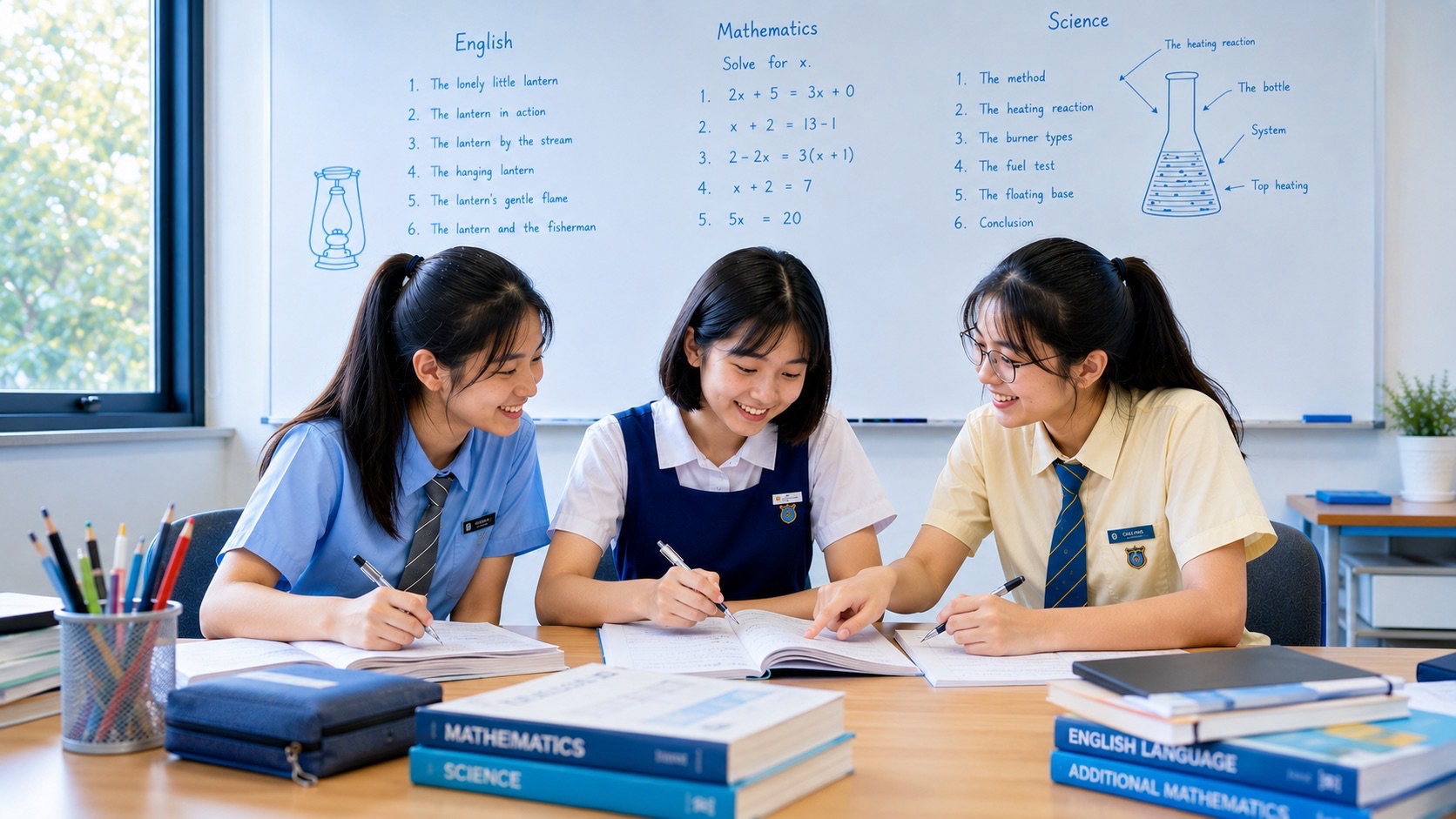
eduKate Punggol keeps the working group at three students. The point is not exclusivity. The point is observational bandwidth.
In a large class, a tutor can see whether the final answer is right. In a three-student class, the tutor has more opportunity to see how the answer was produced: which representation the student chose, which step caused hesitation, whether a rule was understood, and whether the learner can explain the route.
Three students also preserve peer contrast. One learner can explain a method while another compares it with their own route. A student may discover that a classmate reached the same answer by a cleaner transformation. The tutor can ask which route is safer under examination conditions and why.
The class therefore combines three useful properties:
- enough attention for individual diagnosis,
- enough social learning for comparison and explanation,
- enough continuity for the tutor to observe how the student’s state changes over time.
What should happen in a 90-minute A-Math lesson?
A 1.5-hour lesson should not be 90 minutes of worksheet completion. The internal structure depends on the student, but a useful lesson often contains several functions.
| Lesson phase | Typical purpose | What the tutor watches |
|---|---|---|
| Opening retrieval | Bring back an older dependency without notes. | What survives after spacing? |
| Diagnostic check | Review school work, recent errors or a marked assessment. | Has the failure pattern changed? |
| Concept or repair block | Teach the new idea or rebuild the weak dependency. | Which representation can the learner decode? |
| Guided practice | Stabilise the route with feedback. | Where does the student still need prompting? |
| Variation | Change the surface while preserving the structure. | Does the concept transfer? |
| Mixed application | Require method selection among several possibilities. | Can the student classify before calculating? |
| Reflection and handoff | Name the key error, next target and home retrieval task. | Can the student describe what changed today? |
Not every lesson needs every phase in equal proportion. Near an examination, timed mixed work may take more space. During a deep repair, representation and guided practice may dominate. The important thing is that the lesson has a learning job.
The eduKate A-Math learning cycle
- Observe. Use actual work, not assumptions.
- Narrow. Find the earliest weak link that explains several later errors.
- Represent. Teach the idea in a form the learner can decode.
- Retrieve. Remove the example and ask the student to reconstruct the process.
- Vary. Change coefficients, wording, diagrams and question form.
- Interleave. Mix methods so the question stops announcing its chapter.
- Time. Add realistic constraints after the route is stable.
- Fade. Reduce tutor support as independence grows.
- Check world return. Look for the improvement in new school work and assessments.
The cycle repeats because the student changes. Once one bottleneck is repaired, a different one becomes visible.
Four common student states
State 1: “I understand when someone explains it.”
This student may have a retrieval problem. The explanation feels clear, but the method is not reconstructed later. We reduce passive review and increase spaced retrieval, explanation and practice without notes.
State 2: “I can do chapter exercises but not school papers.”
This student often has a recognition and selection problem. Blocked practice has trained execution, but the paper requires the learner to identify which method applies. We use mixed sets and ask for route justification before calculation.
State 3: “I know the method but I keep losing marks.”
This may be an execution problem: signs, substitutions, units, skipped working or time pressure. We classify the error and build explicit checkpoints instead of calling everything careless.
State 4: “I am already strong and want more challenge.”
This student does not need more routine volume. They need controlled novelty: harder variation, alternate representations, mixed-method problems, explanation, proof-style reasoning where appropriate and more responsibility for evaluating their own solution.
A hypothetical diagnosis: same mark, different repair
Consider three hypothetical students who each score 58% on an A-Math paper. These are not testimonials or claims about actual students; they illustrate why diagnosis matters.
| Student | Observed pattern | Priority |
|---|---|---|
| A | Good conceptual choices, frequent algebra slips. | Symbolic control, visible working and checking. |
| B | Routine questions correct, mixed questions weak. | Recognition, interleaving and method selection. |
| C | Strong untimed work, paper unfinished. | Identify time loss, then train sectional timing and sequencing. |
Giving all three the same “more practice” worksheet would be inefficient. The mark is a measurement; the error architecture tells us what to teach.
From topic mastery to paper performance
Stage 1 — Clean single-method work
The student learns the method with enough clarity to produce correct working without excessive cueing.
Stage 2 — Controlled variation
Numbers, form and wording change. The learner must recognise the invariant structure.
Stage 3 — Mixed-method sets
Different chapters are placed together. The student must classify before calculating.
Stage 4 — Partial timing
Short timed blocks expose whether accuracy survives mild pressure.
Stage 5 — Full-paper execution
Stamina, question sequencing, checking and time allocation become part of the task.
Stage 6 — Post-paper error architecture
Errors are grouped by cause: knowledge, recognition, representation, algebra, execution, communication or time. The next revision cycle is then built from evidence rather than anxiety.
What a strong home routine looks like
The most effective home practice is not always the largest volume. A compact routine can include several learning functions across the week.
- Repair: redo one or two previously incorrect questions without looking at the solution.
- Retrieve: revisit an older topic after spacing.
- Current work: complete a short set on the present school topic with full working.
- Mix: combine several topics without headings.
- Explain: teach one solution aloud or write why the method applies.
- Time: use a short timed set only when the underlying method is sufficiently stable.
- Stop: end before fatigue turns reasoning into mechanical guessing.
The learner should bring unresolved questions to tuition with the attempted working intact. Erasing every failed route destroys useful diagnostic evidence.
What parents can monitor without becoming the tutor
Parents do not need to reteach calculus at the dining table. They can monitor the learning system.
- Is the child’s error log becoming more specific?
- Are the same mistakes repeating less often?
- Can the student explain why a method works?
- Does older material remain usable after several weeks?
- Can the learner begin unfamiliar questions without immediately asking for the chapter name?
- Is working becoming clearer and easier to check?
- Does accuracy survive moderate time pressure?
- Is the student becoming less dependent on hints?
These are often better leading indicators than asking whether every worksheet score increased.
When A-Math tuition is worth considering
Tuition is useful when there is a clear learning job it can perform. Consider additional support when:
- several topics are being damaged by the same algebra weakness,
- the student repeatedly cannot identify why marks are being lost,
- school pace is outrunning the time available for repair,
- the learner understands explanations but cannot retrieve methods later,
- mixed papers are much weaker than chapter practice,
- performance changes sharply under time pressure,
- or the student needs a smaller environment to ask questions and expose working.
Tuition is less useful when it simply duplicates school notes, adds worksheets without diagnosis or makes the learner dependent on the tutor to start every question.
What to bring to the first conversation
- A recent marked Mathematics or Additional Mathematics paper.
- Normal school homework showing the student’s own working.
- The current topic sequence or scheme of work, if available.
- Examples of questions the student found unusually difficult.
- Upcoming assessment dates that affect pacing.
- The student’s own description of where they get stuck.
The student’s description matters. A parent may see “low marks”, while the learner may identify a narrower problem such as “I never know which trigonometric identity to start with.” Narrow problems are more actionable than global labels.
What progress should look like
| Earlier state | Improving state | Longer-term direction |
|---|---|---|
| Needs the tutor to name the topic. | Can classify the question family. | Recognises structure in unfamiliar mixed questions. |
| Can follow a worked example. | Can reproduce the method from memory. | Can adapt the method when the surface changes. |
| Frequent algebra slips. | Working becomes slower but cleaner during repair. | Accuracy remains stable as speed increases. |
| Checks only the final answer. | Checks signs, equivalence and assumptions during work. | Detects implausible routes before spending too much time. |
| Finishes familiar worksheets. | Handles mixed sets. | Produces stable full-paper performance with increasing independence. |
| Needs frequent hints. | Can continue after a smaller prompt. | Recovers from a failed route independently. |
Marks may move with these signals, but the signals are more diagnostic because they reveal whether the mathematical system is becoming more reliable.
What strong tuition should never claim
Parents should be cautious about tuition pages that promise universal grade jumps, invent precise success percentages without verifiable data, publish anonymous testimonials as if they prove causation, or suggest that one teaching trick guarantees distinction.
A-Math results depend on the student’s starting point, school context, practice, attendance, prior foundation, health, motivation and performance on the assessment itself. A tutor can influence some of those variables, not all of them.
The defensible commitment is narrower and stronger: diagnose carefully, teach clearly, choose practice for a reason, measure what changes, and keep returning responsibility to the learner.
Frequently asked questions
Is G2 Additional Mathematics a stepping stone to G3 Additional Mathematics?
It can be part of a learner’s progression, but subject-level movement is not automatic. Schools consider readiness, subject combinations and their own processes. Tuition can build capability; it should not promise the school’s decision.
Should my child memorise every formula first?
Memorisation has a role, but recall without conditions and meaning is fragile. We want recall plus recognition plus correct application.
How soon should results improve?
There is no universal timeline. A narrow procedural gap may improve quickly; a long-standing algebra or reasoning weakness can require sustained rebuilding. We monitor error patterns, transfer and independence rather than promise a fixed grade by a fixed date.
Should a strong student be pushed far ahead?
Only when the present foundation remains secure. Being ahead in chapter number is not useful if understanding is thin. We prefer deeper transfer and better reasoning to superficial acceleration.
Is one-to-one always better than three students?
No. One-to-one can be useful for very specific needs, but a well-run three-student group can combine individual feedback with peer explanation, comparison and academic rhythm. The quality of diagnosis and teaching matters more than a simplistic format ranking.
How long is each eduKate Punggol class?
The current small-group model is 1.5 hours with three students. Current schedule and availability should be confirmed directly because classes change through the year.
Does eduKate guarantee a distinction?
No. We teach toward distinction-level capability—reasoning, method selection, accurate execution, transfer and stable exam performance—but we do not guarantee the final grade.
Should tuition replace school homework?
No. Tuition should connect to the learner’s school reality. School work provides evidence, pacing and assessment context. Additional practice should target a learning need, not compete blindly with the school workload.
Related eduKate Punggol Mathematics guides
- Punggol G3 Additional Mathematics Tuition — Build the A-Math System
- Secondary Additional Mathematics Tuition in Punggol — The A-Math System
- Secondary G3 Mathematics Tuition Center | SEC G3 Math Tutor
- Secondary Mathematics Tuition | Punggol
- How Mathematics Works — eduKateSG
The eduKate view
Additional Mathematics is valuable because it forces the learner to coordinate representations, rules, relationships and reasoning. The subject becomes manageable when those pieces stop behaving like separate tricks and begin to operate as one connected system.
For a Punggol family, the advantage of a local three-student class is practical: less travel friction, close observation, fast feedback and enough continuity for the tutor to see how the learner’s mathematical state changes over time.
The final goal is not dependence on tuition. It is a student who can read the problem, choose a representation, identify the relevant structure, execute cleanly, check the result, recover from an error and explain the mathematics.





