
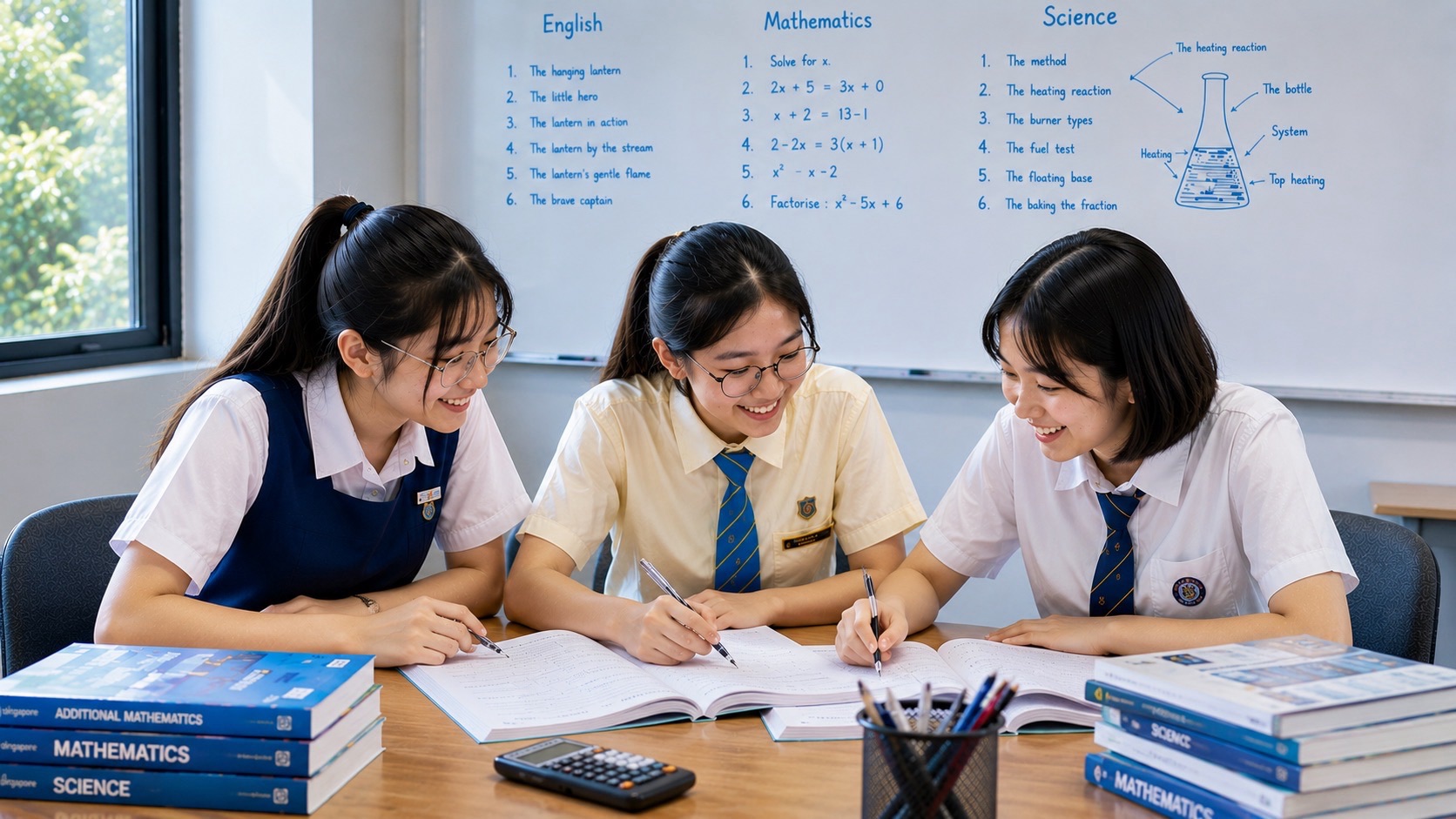
How to Improve Sec 3 G3 Additional Mathematics in Punggol | First-Year A-Math Guide
Secondary 3 G3 Additional Mathematics is often the first time a mathematically capable student feels that ordinary study habits are no longer enough. The subject increases symbolic density, connects chapters more tightly and introduces new ways of representing functions, trigonometric relationships and change.
For students in Secondary 3 in 2026, there is another important current detail: this cohort moves into the first Singapore-Cambridge Secondary Education Certificate year in 2027. SEAB lists G3 Additional Mathematics as K341 for the 2027 SEC, with 4049 shown as the reference code for 2026 and earlier.
This flagship guide is about the first-year A-Math transition. It explains what changes when A-Math begins, why algebra becomes the load-bearing wall, how functions and graphs should be connected, how trigonometry should be learned as controlled transformation, how calculus should be built from meaning into fluency, how to use a three-student 90-minute class, how to practise between lessons, how to diagnose mistakes and how to enter Sec 4 with a connected system rather than a pile of half-remembered chapters.

The current route: Sec 3 in 2026 → SEC G3 Additional Mathematics in 2027
MOE has confirmed that from 2027, the Singapore-Cambridge Secondary Education Certificate replaces the separate N- and O-Level certificates. Students will sit SEC subjects at their respective subject levels.
For the first SEC cohort, SEAB lists Additional Mathematics at G3 as K341, with 4049 shown as the reference code for 2026 and earlier. The K341 syllabus assumes knowledge of G3 Mathematics. That underlying Mathematics knowledge is not tested as a separate A-Math section, but it is needed to solve A-Math problems.
This is important for a Sec 3 learner because a difficulty that appears inside A-Math may actually come from earlier Mathematics. Weak algebra, graph reading, coordinate reasoning or number control can create friction across several A-Math chapters.
The correct question is therefore not, “Which A-Math chapter am I weak at?” It is often, “Which mathematical dependency is making several A-Math chapters expensive?”
Why the first year of A-Math feels different
A-Math is not simply G3 Mathematics with harder numbers. Several structural changes happen at once.
| Change | What the student experiences | What can go wrong |
|---|---|---|
| More symbolic density | Longer expressions and more transformations. | Small algebra errors destroy correct reasoning. |
| Stronger dependencies | Later chapters assume earlier algebra and function knowledge. | One weak foundation creates difficulty everywhere. |
| More representation switching | Equations, graphs and geometric meaning interact. | The student understands only one form of the idea. |
| More method selection | Several routes may be possible. | The learner hunts for a memorised trick. |
| Calculus introduces a new model of change | Rules have to connect to gradients, rates and accumulation. | The student memorises derivatives without understanding applications. |
| Higher exam compression | More mathematics has to be executed reliably in limited time. | Knowledge exists but paper performance is unstable. |
This is why strong Sec 2 students can feel unexpectedly uncomfortable in Sec 3 A-Math. They are not necessarily “bad at Math”. The operating system has become denser.
1. Make algebra the first priority
Almost every major A-Math topic depends on algebra. If algebra is slow, the student spends attention on manipulation that should be available for the new concept. If algebra is inaccurate, a good idea becomes a wrong answer several lines later.
Strong A-Math algebra means more than daily drills. The learner should be able to:
- read the structure of an expression,
- control indices, surds and logarithmic relationships where required by the syllabus,
- factorise and expand accurately,
- solve equations and inequalities while respecting conditions,
- choose a useful form for the next step,
- and detect when a transformed expression is no longer equivalent.
The first target is low-friction correctness. Speed comes later.
If you keep making sign or substitution errors, do not hide them by writing fewer lines. Make the working visible enough to diagnose. Compression should be earned.
2. Learn functions as the organising language of A-Math
Functions connect a large part of A-Math. They describe how one quantity depends on another, and they create the bridge between symbolic rules and graphs.
For every important function family, ask:
- What is the symbolic rule?
- What does the graph look like?
- What are the important intercepts or turning behaviours?
- How do parameters change the graph?
- What domain or conditions matter?
- What does the function represent in an applied problem?
If you can manipulate the formula but cannot predict the graph, your representation is incomplete. If you can sketch the graph but cannot connect it to the equation, the same is true in the other direction.
Strong A-Math students move between representations.
3. Treat trigonometry as controlled transformation
Trigonometric identities are not a bag of magic moves. The challenge is deciding how to transform an expression toward a target.
Before you move symbols, ask:
- What is the target form?
- Which side is more complicated?
- Can I create a common representation?
- Which identity is useful for that transformation?
- What interval or condition constrains the final solution?
This is slower than random identity hunting at first. Later it becomes faster because you stop exploring routes that never matched the target.
The current K341 syllabus includes trigonometric functions, identities and equations. Use the official syllabus boundary rather than adding arbitrary “advanced trig” simply to make tuition feel difficult.
4. Use graphs to connect algebra and intuition
Graph sketching is valuable because it gives you a second representation of a symbolic relationship.
Do not draw graphs only for presentation. Use them to predict and check:
- sign and shape,
- intercepts,
- turning behaviour,
- asymptotic behaviour where relevant,
- and whether an algebraic solution makes visual sense.
When algebra and graph disagree, investigate. The disagreement often exposes an error that one representation alone would hide.
5. Build calculus from meaning into fluency
Calculus is often the chapter that makes Sec 3 A-Math feel truly different. The current K341 syllabus includes differentiation and integration, derivatives of functions including products, quotients and composite forms, applications to gradients, rates and maxima/minima, and integration as reverse differentiation and area under a curve within the syllabus scope.
Do not begin by treating every derivative rule as an isolated formula. Build the idea first.
Differentiation
Understand derivative as local gradient and rate of change. Then learn the rules. When you differentiate, ask what the derivative tells you about the original function.
Stationary points and optimisation
Do not merely solve for a derivative equal to zero. Understand why that condition matters and what additional reasoning is needed to interpret the point.
Integration
Connect integration to reverse differentiation and accumulation. When the syllabus uses definite integrals for area, connect the symbolic operation to the geometric region.
The teaching sequence should be meaning → method → retrieval → variation → application → timing.
6. Learn coordinate geometry as a translation system
Coordinate geometry connects spatial relationships with algebra. A line, circle, gradient or perpendicular relationship can be described geometrically and symbolically.
Strong students can move in both directions:
- geometry → equation,
- equation → graph,
- graph → geometric meaning.
When a coordinate-geometry problem feels difficult, sketch it. A good sketch can reveal the relationship before the algebra begins.
7. Build an A-Math error taxonomy
“Careless” is too vague for A-Math. The subject is dense enough that different errors need different repairs.
| Error class | What it looks like | What to change |
|---|---|---|
| Knowledge | A rule, identity or method is missing. | Relearn and retrieve after spacing. |
| Recognition | The method is known but not recognised. | Use mixed questions and classification. |
| Representation | The problem is not converted into useful mathematical form. | Switch among equations, graphs and diagrams. |
| Selection | Several methods are known but the wrong route is chosen. | Compare routes and justify the choice before calculating. |
| Algebra | Correct high-level route, broken symbolic execution. | Slow transformations and use explicit checkpoints. |
| Communication | Essential working is missing or unclear. | Practise concise, markable solutions. |
| Time | The student cannot complete enough of the assessment. | Find where time is lost before prescribing more speed. |
| Pressure state | Strong untimed performance collapses in tests. | Condition progressively after methods are stable. |
Your correction notebook should increasingly tell you what kind of learner error is shrinking, not only how many questions were wrong.
8. Retrieve old A-Math before the next chapter buries it
A-Math chapters accumulate quickly. If you only revise the current chapter, earlier methods fade.
Use a retrieval ladder:
- Learn the method with explanation.
- Reconstruct it later without notes.
- Retrieve it several days later.
- Mix it with another A-Math topic.
- Use it in a changed representation.
- Check whether it survives in a school assessment.
This prevents Sec 4 from becoming a complete relearning of Sec 3.
9. Move from blocked practice to mixed A-Math
Blocked practice helps when a method is new. Once stable, you need mixed sets that force you to decide what the question is.
Before calculating, state:
- what is known,
- what is unknown,
- what relationship is present,
- which method families are plausible,
- and what evidence would tell you the chosen route is failing.
This trains the hidden examination skill: routing.
10. Add timing progressively, not immediately
Sec 3 is the right year to begin examination conditioning, but do not turn every exercise into a race.
- Correct untimed method work.
- Controlled variation.
- Mixed untimed questions.
- Short timed clusters.
- Timed mixed sections.
- Full-paper conditions when enough content is covered.
If accuracy collapses under timing, diagnose the cause. Slow recognition, slow algebra and pressure-state disruption require different interventions.
11. Use tuition to build independence
eduKate Punggol’s current small-group format is three students for 1.5 hours. The class size allows the tutor to see the mathematical process, not just the answer.
One student may use a long but valid trigonometric route. Another may have a shorter route. A third may make one invalid transformation that happens to lead to a plausible answer. Comparing these solutions is valuable because it teaches route quality, not merely final correctness.
The tutor can also fade support. Early in a chapter, you may receive a full explanation. Later, a single question should be enough. Eventually you should be able to choose the representation and route yourself.
A-Math tuition should reduce your dependence on tuition before the national examination year.
Anatomy of a 90-minute Sec 3 A-Math lesson
| Phase | Learning function | What we inspect |
|---|---|---|
| 0–10 min | Retrieve an older A-Math method. | Did previous learning survive? |
| 10–20 min | Review a school return or error. | Which failure state is active? |
| 20–45 min | Build or repair the main concept. | Which representation makes it clearest? |
| 45–65 min | Guided practice with reduced cueing. | Where does the learner still need help? |
| 65–80 min | Variation or mixed A-Math questions. | Can the learner transfer and select? |
| 80–90 min | Review, timed micro-check or handoff. | What must the student now do alone? |
The exact balance depends on the school topic sequence. We do not force every student through an invented fixed 12-week order if their school is teaching a different sequence.
Three hypothetical Sec 3 A-Math students
These examples are hypothetical, not testimonials.
| Student | Pattern | Priority |
|---|---|---|
| A | Understands calculus but loses marks through algebra. | Symbolic control and execution. |
| B | Strong chapter exercises, weak mixed questions. | Recognition, selection and interleaving. |
| C | Strong untimed work, test performance collapses. | Timing diagnosis and progressive conditioning. |
The same percentage can hide different problems. Diagnose the process before prescribing the practice.
Your weekly Sec 3 A-Math system
| Task | Purpose | Question to ask |
|---|---|---|
| Redo two old A-Math errors | Repair | Can I solve them now without the correction? |
| Retrieve an older chapter | Retention | What survived after spacing? |
| Current-topic set | Build method | Which step is unstable? |
| Mixed A-Math set | Selection | Did I choose the right route? |
| Explain one solution | Reasoning | Where did my explanation become vague? |
| Graph / representation check | Connection | Can I express the same idea another way? |
| Short timed section | Conditioning | Where did time disappear? |
You do not need all tasks every day. Spread them across the week so A-Math remains active without becoming constant cramming.
What progress should look like before Sec 4
- Algebraic errors repeat less often.
- Functions are connected to graphs.
- Trigonometric transformations become more deliberate.
- Calculus rules are connected to meaning.
- Old chapters remain retrievable.
- Mixed questions cause less hesitation.
- Working becomes easier to audit.
- Timed sections become more stable.
- The learner can identify their own error category.
- Fewer tutor prompts are needed.
These are signs that the A-Math system is becoming connected. Grades are important evidence, but these mechanisms explain whether the improvement is likely to survive.
What not to do in first-year A-Math
- Do not rush through chapters simply to be ahead of school.
- Do not treat algebra errors as minor if they appear across many topics.
- Do not memorise trigonometric identities without knowing the transformation they enable.
- Do not learn calculus rules without connecting them to gradients, rates and accumulation.
- Do not practise only blocked chapter worksheets.
- Do not time everything before the route is stable.
- Do not erase failed attempts before analysing them.
- Do not expect a guaranteed A1 because tuition exists.
What parents should monitor
- Is the student’s algebra becoming cleaner?
- Are old A-Math chapters still usable?
- Can the learner explain why a method works?
- Does the student know which error category is most active?
- Are mixed questions becoming less frightening?
- Can the student recover after a failed route?
- Is tuition creating more independence?
Parents do not need to reteach calculus. They can monitor whether the learning system is becoming more stable.
Frequently asked questions
Will Sec 3 students in 2026 sit O-Level A-Math in 2027?
No. From 2027, the national examination framework is SEC. G3 Additional Mathematics is listed as K341 for the 2027 cohort.
Is calculus part of G3 Additional Mathematics?
Yes. The current K341 syllabus includes differentiation and integration and their applications within the specified syllabus scope.
Should I learn product, quotient and chain rules?
They are included in the current K341 differentiation content. Follow your school sequence and the official syllabus for your examination year.
Should I start full A-Math papers in Sec 3?
Use full papers when enough content is covered. Earlier in the year, targeted repair and mixed sections can produce more learning per hour.
How quickly should marks improve?
There is no universal timeline. A narrow algebra error can change quickly; a broad transfer or retrieval problem can require sustained work.
What is the current eduKate Punggol class format?
The current small-group model is three students for 1.5 hours. Current schedules and available places should be confirmed directly.
Can tuition guarantee A1?
No. Tuition can build high-performance A-Math capability, but the final result depends on the learner, school work, practice and actual examination performance.
Related routes
- Punggol G3 Additional Mathematics Tuition — Build the A-Math System
- G2 & G3 Additional Mathematics Parent Guide
- Sec 4 G3 Additional Mathematics Guide
- Sec 3 G3 Mathematics — SEC 2027 Readiness
The Sec 3 A-Math end condition
By the end of the first A-Math year, the student should have more than chapter exposure. Algebra should be increasingly reliable, functions should connect to graphs, trigonometric transformations should be deliberate, calculus should carry meaning, old topics should remain retrievable and mixed questions should create less hesitation.
That is the runway into Sec 4 and the 2027 SEC K341 examination.





