
Secondary Mathematics Tuition | Punggol
Secondary Mathematics becomes difficult when new abstraction arrives faster than older foundations are being secured. Fractions turn into algebraic expressions. Arithmetic relationships become equations. Geometry becomes more formal. Graphs, functions and trigonometry require students to move between representations rather than repeat one familiar procedure.
Direct answer: Good Secondary Mathematics tuition in Punggol should identify the earliest weak link in a student’s mathematical chain, repair it, build dependable methods, mix topics so the student learns to choose the right method, and finally train accurate performance under examination conditions.
For the wider Primary-to-Secondary pathway, see Mathematics Tuition Punggol. This page owns the more specific Secondary 1–4 Mathematics route.
Choose the Secondary Mathematics level
- Secondary 1 Mathematics Tuition
- Secondary 2 Mathematics Tuition
- Secondary 3 Mathematics Tuition
- Secondary 4 Mathematics Tuition
- Secondary 4 Additional Mathematics Tutor
The transition from Primary to Secondary Mathematics
Primary Mathematics already demands reasoning, but Secondary Mathematics increases symbolic load. A student can no longer depend mainly on recognising a familiar word-problem pattern. Algebra becomes a working language. Students must manipulate symbols accurately, understand relationships and decide which mathematical representation makes a problem easier to solve.
This is why some students who were comfortable in Primary 6 suddenly appear weaker in Secondary 1. The underlying arithmetic may still be adequate, but the student has not yet learned to operate confidently with abstraction.
Five different causes of weak Secondary Mathematics
1. Foundation weakness
Fractions, ratio, percentage, negative numbers or basic algebra are not stable enough. Later topics therefore consume too much attention because the student is still struggling with prerequisite operations.
2. Concept weakness
The student remembers a formula or procedure but does not understand the relationship it represents. A small change in the question makes the method feel unfamiliar.
3. Representation weakness
The student cannot convert between words, equations, graphs, tables and diagrams. This is a major constraint because Secondary Mathematics often tests the same idea through several representations.
4. Method-selection weakness
The student can solve chapter exercises when the method is obvious but becomes uncertain in a mixed paper. The knowledge exists, but the student cannot yet select the correct tool without a chapter heading or tutor prompt.
5. Examination-execution weakness
The student performs reasonably well with unlimited time but loses marks through pacing, rushed algebra, incomplete working, poor checking or difficulty recovering after a hard question.
These problems look similar on a report card but require different interventions.
How Secondary Mathematics tuition should work
- Observe: inspect marked school papers and actual working.
- Diagnose: distinguish concept, foundation, representation, selection and execution errors.
- Repair: return to the earliest weak skill that is constraining later work.
- Model: demonstrate a clear method and explain why each step is valid.
- Guide: let the student attempt similar problems with decreasing support.
- Release: require independent work without step-by-step prompting.
- Correct: classify why mistakes happened and reattempt.
- Retrieve: bring older topics back after a delay.
- Mix: remove chapter labels so the student must choose the method.
- Condition: add timed sections and full papers when the mathematics is stable enough.
The purpose is to make the student’s mathematics progressively less dependent on the tutor.
Secondary 1 and 2: build the operating foundation
Lower Secondary is the best time to make algebra, equations, graphs, geometry and numerical reasoning stable. Students should learn to show clear working, recognise equivalent forms and explain mathematical choices rather than simply imitate examples.
When a Secondary 1 or 2 student is already struggling, repair should be selective. It is rarely efficient to restart the entire curriculum. The tutor should identify the few weak dependencies that are causing the largest number of later errors.
Secondary 3 and 4: connect understanding to examination performance
Upper Secondary students need increasingly reliable transfer. Topic practice remains useful, but the student must also recognise methods in mixed conditions, preserve accuracy across longer solutions and manage time across a complete paper.
For the 2026 graduating cohort, O-Level syllabuses remain in use. From 2027, graduating students sit the Singapore-Cambridge Secondary Education Certificate, with subjects examined at G1, G2 or G3 according to the student’s subject level. Teaching should therefore follow the learner’s actual current syllabus and examination pathway rather than relying on outdated stream labels.
E-Math and A-Math should not be treated as the same diagnostic problem
Elementary Mathematics develops broad mathematical competence across numbers, algebra, geometry, statistics and problem solving. Additional Mathematics places heavier demands on symbolic manipulation, functions, trigonometry and calculus. A student may therefore be secure in E-Math while becoming unstable in A-Math because the algebraic load is much higher.
Students needing the A-Math pathway can continue to our Punggol Secondary 4 Additional Mathematics Tutor guide.
Why a 3-student Secondary Math class can work
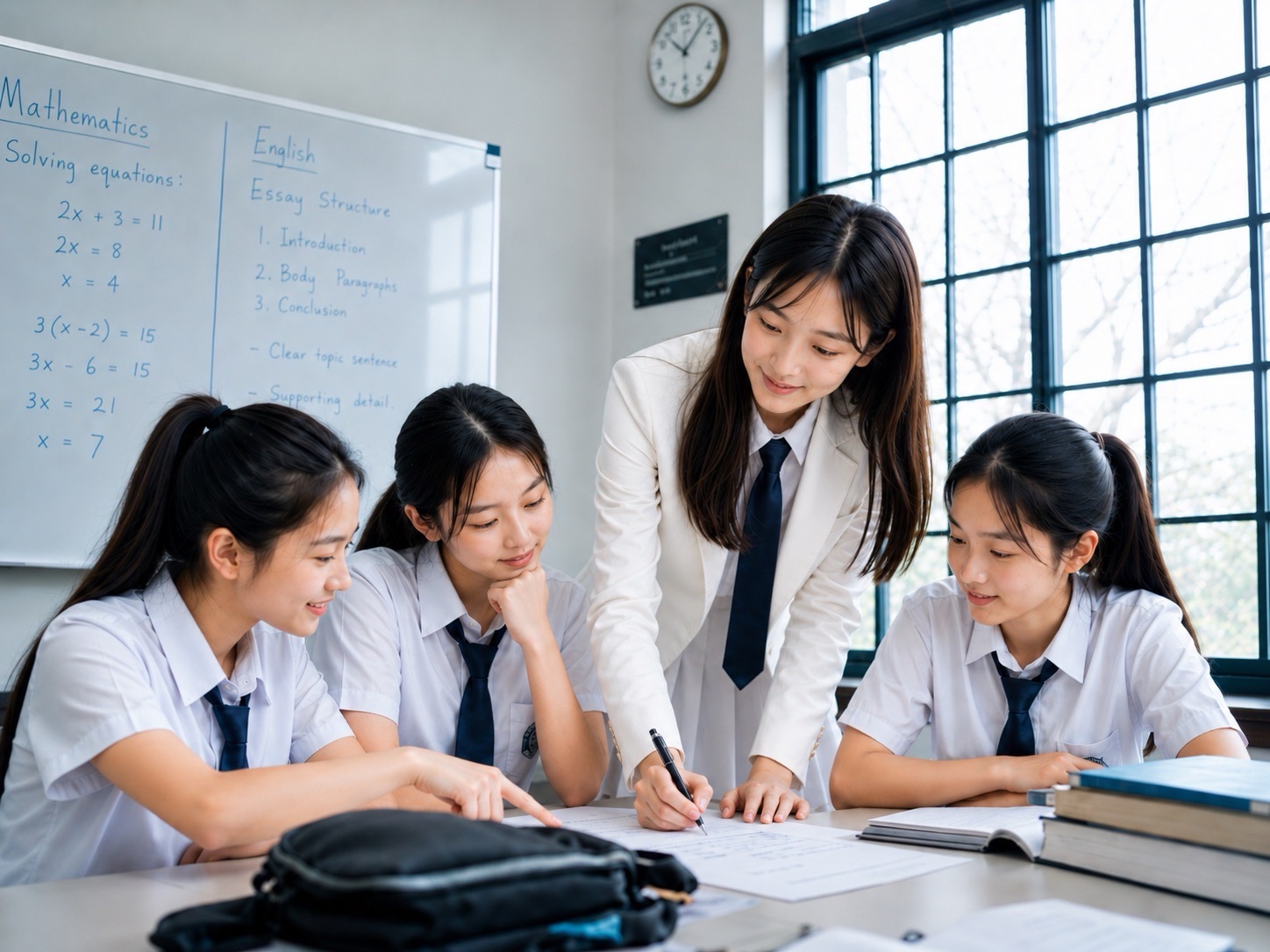
eduKatePunggol uses very small groups. In Mathematics, that allows the tutor to inspect the reasoning between the question and the answer.
- Working can be checked line by line rather than only at the final answer.
- The tutor can distinguish a misconception from a one-off arithmetic slip.
- Students can explain different methods and compare efficiency.
- Difficulty can be adjusted for each learner while retaining a shared lesson.
- Recurring errors become visible early.
- Support can be deliberately reduced as the student becomes more independent.
The advantage is greater observation, not simply a smaller room.
How parents can tell whether Secondary Math tuition is working
- The student begins unfamiliar questions with less hesitation.
- The same algebra or sign errors occur less often.
- Working becomes clearer and easier to audit.
- The student can explain why a method applies.
- Older topics remain available when mixed with newer ones.
- The student recovers more effectively after getting stuck.
- Timed performance becomes closer to normal lesson performance.
- The tutor needs to provide fewer prompts over time.
One test score can be noisy. A pattern of more reliable mathematical behaviour is stronger evidence of progress.
Questions parents should ask a Secondary Mathematics tutor
- How do you identify the earliest weak skill behind a wrong answer?
- How do you distinguish a careless mistake from a conceptual one?
- When do you go backwards to repair Primary or lower-Secondary foundations?
- How do you move students from guided examples to independent problem solving?
- How do you revisit old topics?
- When do you start mixed and timed practice?
- How do you stretch a strong student without simply adding more worksheets?
- How do you prevent a weak student from becoming dependent on worked solutions?
- How do you use marked school papers to decide the next teaching priority?
- What evidence tells you a skill has transferred to an unfamiliar question?
Frequently asked questions
Should a weak student do more Mathematics papers?
Papers are useful diagnostics, but they are inefficient as the only repair tool. If the same weakness repeatedly causes failure, repair that skill first and then use another mixed or timed paper to test whether the improvement transfers.
Can tuition guarantee A1?
No responsible tutor can guarantee a national-examination grade. Tuition can improve diagnosis, conceptual understanding, method quality, feedback, practice and examination preparation. The final result still depends on the learner’s starting point, consistency and performance on the day.
What should a student bring for the first diagnosis?
Recent marked school tests and examination papers with visible working are particularly useful. The working often shows more than the final mark because it reveals how the student is thinking.
Is Secondary 4 too late to repair Mathematics?
Not necessarily. The important question is the shape of the gap. A small number of high-impact weaknesses can sometimes be repaired efficiently. Broad foundation problems require stricter prioritisation because there is less time for low-value repetition.
Continue through the Mathematics pathway
- Mathematics Tuition Punggol — Primary, PSLE and Secondary
- Punggol Secondary 4 Additional Mathematics Tutor
- Punggol Tuition Center
- Tuition at eduKatePunggol
The goal of Secondary Mathematics tuition is not simply to finish more questions. It is to build a student who can recognise mathematical structure, choose a method, execute it accurately, check it, and recover independently when the first attempt does not work.
Secondary Mathematics Learning Routes
The local tuition page stays focused on diagnosis and learning in Punggol. For the complete four-year learning graph, continue through the capability ledger; when a chapter-level repair is needed, move into the audited textbook classrooms at eduKateSengkang.
- Secondary Mathematics Punggol — Four-Year Capability Ledger
- Secondary 1 textbook classroom route
- Secondary 2 synthesis and Secondary 3 handover
- Secondary 3 synthesis and examination transfer
- Secondary 4 SEC G3 K310 classroom route
Hidden/deep route: if a marked paper shows one recurring failure, do not restart the whole year. Enter the four-year ledger, identify the first weak dependency, use the smallest classroom that owns it, then return to mixed school or SEC work to verify transfer.





