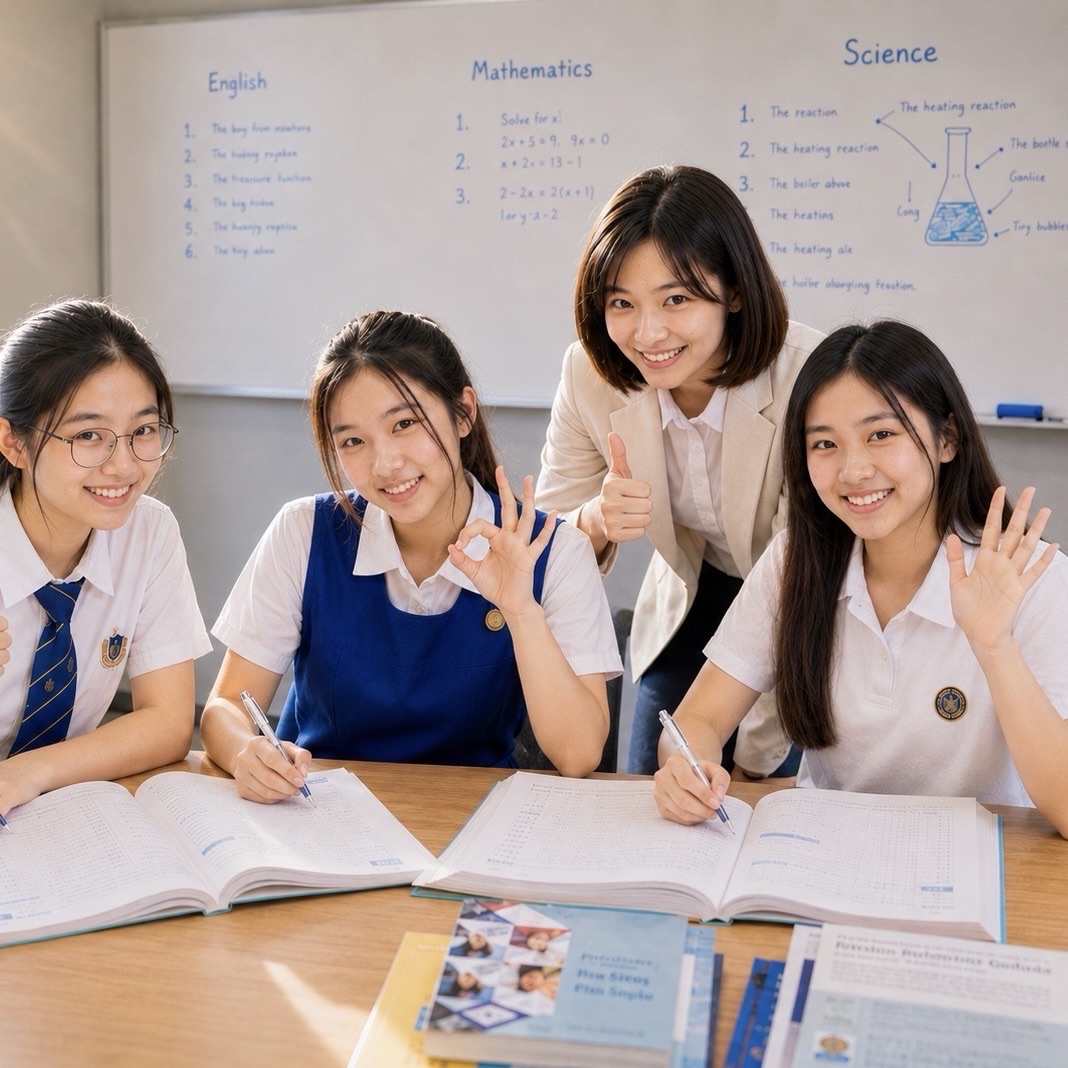
Current Punggol tuition service owner: this older page is retained for archive/reference only. For current Primary and Secondary English, Mathematics, Science and A-Math tuition, class information and consultation, use Tuition at eduKatePunggol. For deciding whether tuition is useful in the first place, use Choosing Tuition in Punggol.
Punggol Tuition Center | Primary and Secondary Tuition in Punggol
Parents usually start looking for tuition after noticing a symptom: marks fall, homework becomes slow, confidence changes, a teacher raises a concern, or an examination exposes a gap that ordinary revision did not repair.
The next step should not be to add tuition automatically. It should be to ask a better question: What function does this student need tuition to perform?
Direct answer: eduKatePunggol is a Punggol tuition center for Primary and Secondary students in English, Mathematics, Science and Additional Mathematics. We use very small 3-student classes so the tutor can observe the learner closely, identify the earliest weak link, repair it, practise it and check whether the student can use the learning independently.
Start with the subject
- English Tutor Punggol — reading, writing, comprehension, vocabulary, grammar, listening and oral communication.
- Mathematics Tuition Punggol — foundations, problem solving, mathematical representation, error correction and examination execution.
- Punggol Science Tuition — concepts, evidence, scientific reasoning, representations and answering technique.
- Secondary 4 Additional Mathematics Tutor — algebraic control, method selection, calculus, mixed practice and exam preparation.
For the wider route through the site, see Tuition at eduKatePunggol.
The student comes before the label
“Primary 5,” “Secondary 2,” “PSLE,” “G3” and “A-Math” tell us which curriculum or level a student is working in. They do not tell us what the student currently understands.
Two students in the same class can therefore need very different interventions. One may have a missing foundation. One may understand the topic but work too slowly. One may be technically strong but unable to transfer knowledge to unfamiliar questions. One may be doing well academically and need no additional tuition at all.
A useful tuition system has to recognise that difference before prescribing work.
The eduKatePunggol learning loop
- Recognise: understand the learner’s current level, school context, goal and concern.
- Observe: inspect actual work rather than relying only on a general description.
- Diagnose: locate the earliest weak link causing the visible problem.
- Teach: rebuild the missing knowledge, method or representation clearly.
- Practise: move from guided work to independent work.
- Correct: identify why an error happened and repair the cause.
- Retrieve: bring older learning back so it remains available.
- Transfer: test the skill in a different-looking problem or task.
- Condition: introduce realistic time and examination pressure when appropriate.
- Review: decide whether the student is becoming more stable and independent.
This is a more useful definition of tuition than “cover more worksheets.”
What a 3-student tuition class changes
eduKatePunggol classes are deliberately very small. A 3-student class is useful only if the tutor uses that small size to increase teaching resolution.
- The tutor can inspect each student’s actual working and not only the final answer.
- Students can be questioned often enough that misconceptions and weak reasoning become visible.
- Writing, oral responses and mathematical methods can receive individual feedback.
- Difficulty can be adjusted without losing the shared momentum of a class.
- Students can compare approaches and learn through explanation.
- The tutor can notice when a student is beginning to depend too heavily on prompts and deliberately release support.
Small-group tuition sits between two extremes: the anonymity of a large class and the isolation of one-to-one tuition. It keeps peer interaction while allowing close observation.
Primary tuition in Punggol
Primary school is where many later learning problems can still be prevented. English needs a growing language base; Mathematics needs stable number relationships and problem representation; Science needs conceptual understanding and evidence-based explanation.
As PSLE approaches, students also need to convert those foundations into reliable performance under assessment conditions. The correct order matters: understand first, practise deliberately, then condition for the examination.
Secondary tuition in Punggol
Secondary school increases abstraction, content load and independence. The same weakness can now appear across several subjects: weak reading affects Humanities and Science; weak algebra affects Mathematics and Additional Mathematics; weak organisation affects English writing and revision itself.
Full Subject-Based Banding is now fully implemented. Students may take subjects at G1, G2 or G3 levels according to their pathways and school arrangements. From 2027, graduating students sit the Singapore-Cambridge Secondary Education Certificate (SEC) rather than the old N- and O-Level certificates. Tuition should therefore use the student’s actual current syllabus and subject level, not outdated stream assumptions.
When tuition is likely to be useful
- The same weakness remains despite normal school practice.
- The student needs more feedback than the current learning environment can provide.
- New school content is arriving faster than an older gap is being repaired.
- The student understands lessons but cannot perform independently later.
- Timed assessments are much weaker than ordinary homework.
- Confidence has dropped because repeated failure is becoming a habit.
- A strong student needs more precise feedback, more challenging transfer work or better examination conditioning.
When tuition may not be the right answer
A student may not need tuition if school support is working, independent study is effective and progress is stable. Sometimes the real issue is sleep, over-scheduling, incomplete homework routines, missing materials or lack of time to consolidate what has already been taught.
The tuition center should be able to state what additional function it is serving. If that function cannot be named, adding another weekly lesson may create activity without solving the problem.
How parents can judge whether tuition is working
- The child needs fewer prompts to begin.
- Repeated errors become less frequent.
- The child can explain what was previously confusing.
- School feedback becomes easier to act on.
- Older topics remain available when mixed with new work.
- The student becomes more willing to attempt unfamiliar questions.
- Timed work becomes more stable.
- The tutor can explain the next learning priority clearly.
- The student becomes increasingly independent of the tutor.
Marks matter, but they should be interpreted with the student’s actual work. One result is a signal; a pattern of better learning behaviour is stronger evidence.
Questions to ask before choosing a Punggol tuition center
- How do you diagnose what my child actually needs?
- How large is the class and what does that size allow the tutor to do?
- How do you use school papers and teacher feedback?
- How do you correct recurring mistakes?
- How do you decide when to go backwards and repair a foundation?
- How do you revisit old learning after a chapter ends?
- How do you move from guided practice to independence?
- How do you prepare students for timed examinations without turning every lesson into paper drilling?
- How do you support a strong student differently from a weak student?
- How will you know whether tuition is no longer adding enough value?
Frequently asked questions
What subjects does eduKatePunggol teach?
The main tuition pathways on this site cover English, Mathematics, Science and Additional Mathematics across relevant Primary and Secondary levels.
Why use 3 students per class?
The small class gives the tutor more opportunity to inspect each learner’s actual work, ask discriminating questions and adjust support while preserving useful peer interaction.
Does tuition guarantee AL1 or A1?
No responsible tuition center can guarantee a national-examination grade. Tuition can improve diagnosis, teaching, practice quality, feedback and preparation. Results still depend on the learner’s starting point, consistency, school context and examination performance.
What should we bring for a first discussion?
A recent marked school paper is often the most useful starting point. It gives the tutor evidence of the student’s current methods, mistakes and level rather than forcing the first conversation to rely on general impressions.
Start here
- Tuition at eduKatePunggol
- English Tutor Punggol
- Mathematics Tuition Punggol
- Punggol Science Tuition
- Secondary 4 Additional Mathematics Tutor
The purpose of the tuition center is not to keep the child in tuition forever. The purpose is to make learning clearer, repair what is missing, strengthen what is fragile and return more of the work to the student.