Current Secondary 4 A-Math tuition owner: this page owns the tutor-selection and diagnosis question. For the complete live Secondary 4 Additional Mathematics tuition programme, use Secondary 4 Additional Mathematics Tuition at eduKatePunggol. For the wider Punggol A-Math route, use Additional Mathematics Tuition in Punggol.
Punggol Secondary 4 Additional Mathematics Tutor
Secondary 4 Additional Mathematics is not usually difficult because of one impossible chapter. It becomes difficult when several small weaknesses begin interacting at once: algebra that is not fully secure, methods that are remembered but not understood, recurring sign errors, slow question recognition, weak checking habits, and exam pressure.
For a student in Punggol, the useful question is therefore not simply, “Should I get an A-Math tutor?” The better question is: “What is preventing this student from turning what they know into reliable marks, and can tuition repair that specific problem?”
Quick answer: Good Secondary 4 Additional Mathematics tuition should diagnose the student before adding workload. It should repair weak foundations, improve mathematical method, reduce repeated errors, train mixed-topic decisions and condition the student to perform accurately under time pressure.
The 2026 examination context
For students sitting the Singapore-Cambridge GCE O-Level in 2026, Additional Mathematics remains an O-Level subject. The 2026 school-candidate syllabus lists Additional Mathematics as subject code 4049. From 2027, Singapore moves to the new Singapore-Cambridge Secondary Education Certificate (SEC) framework for graduating students, with subjects examined at their respective G1, G2 or G3 levels.
That transition makes accurate language important. A Secondary 4 student preparing in 2026 should be taught for the examination they are actually sitting, while younger cohorts need teaching that also understands the incoming SEC structure. The mathematics itself still rewards the same deeper abilities: conceptual control, precise algebra, method selection, clear working and stable performance.
Who this page is for
This guide is for parents and students looking for Secondary 4 Additional Mathematics support in Punggol, especially when one or more of the following is happening:
- marks are inconsistent even though the student studies;
- the student understands examples but cannot start unfamiliar questions;
- older algebra weaknesses keep appearing inside newer topics;
- careless errors are repeated across tests;
- timed papers are much weaker than untimed practice;
- the student avoids difficult A-Math questions because confidence has fallen;
- prelim or national-examination preparation has exposed gaps that normal homework did not reveal;
- the student is already strong but wants more stable high-level execution rather than simply more worksheets.
Not every student needs tuition. The job of tuition is not to make a busy student busier. It is to create a useful intervention where school, self-study and ordinary practice are not yet producing a stable result.
Why Secondary 4 Additional Mathematics becomes unstable
Additional Mathematics is cumulative. A question may look like calculus, trigonometry or coordinate geometry on the surface, but the student can still lose the question because of algebra underneath it. This is why simply revising the chapter named on the test paper can miss the real weakness.
A useful tutor separates the problem into layers.
1. Concept weakness
The student does not yet understand what the method means, when it applies or why one step follows another. Repeating the same model answer may create familiarity without genuine control.
2. Algebra weakness
The student understands the higher-level idea but loses marks while expanding, factorising, rearranging, substituting, simplifying or handling signs. Because algebra travels through the whole subject, one weakness can contaminate many chapters.
3. Recognition weakness
The student knows several methods but cannot tell quickly which one the question requires. This becomes more visible in mixed papers, where the chapter heading is no longer present to tell the student what to do.
4. Execution weakness
The student can explain the idea verbally but produces incomplete or unstable working. Marks disappear through omitted steps, poor notation, premature rounding, sign errors or weak checking.
5. Exam-state weakness
The student performs well in a comfortable lesson but deteriorates under a full paper, a clock and the emotional pressure of an examination. This is not solved by explanation alone. It requires deliberate conditioning.
These five problems need different repairs. That is why diagnosis matters more than volume.
What a good Secondary 4 A-Math tutor should actually do
A tutor should not become a second worksheet distributor. The tutor should make the student’s mathematical state more visible, then change it deliberately.
Diagnose before prescribing
A marked school paper, recent test, homework set or short diagnostic task is often more useful than asking, “Which chapter are you weak in?” Students do not always know the source of their own errors. The tutor should look for repeated patterns across several questions.
Repair the earliest weak link
If differentiation keeps breaking because algebra is weak, the efficient intervention is not fifty more differentiation questions. Repair the algebra that the differentiation depends on, then return to the calculus and test whether the improvement transfers.
Teach method, not imitation
A student should gradually be able to explain why a method was chosen, what each line of working is doing and what could invalidate the answer. This turns a procedure from something copied into something usable.
Make correction part of learning
The first attempt tells us what the student can currently do. Correction tells us what needs to change. A strong correction loop asks the student to identify the error, name the cause, repair the method and reattempt a related question later without the original solution in front of them.
Return to old topics
A chapter that was correct last month is not automatically available during an examination. Retrieval needs to be maintained. Mixed-topic practice forces the student to recognise the method without being told which chapter is being tested.
Train under realistic load
Near examinations, students need experience deciding what to attempt first, when to move on, how to protect method marks, how much checking time to reserve and how to recover after a difficult question. A student who only practises isolated exercises may never train these decisions.
How a 3-student class can be used well
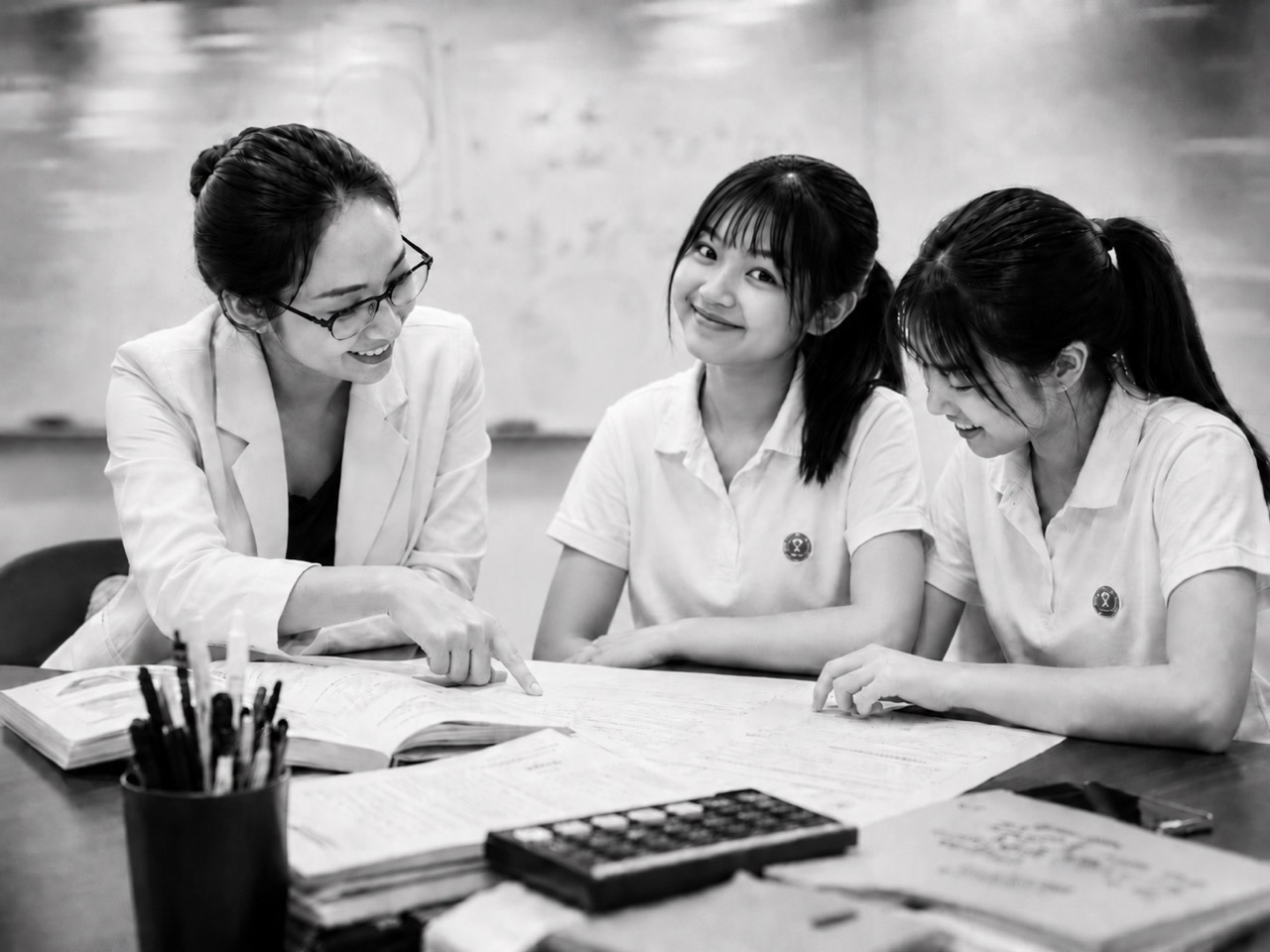
eduKatePunggol uses very small groups. A 3-student class is valuable only if the small size changes what the tutor can actually observe and do.
- Each student’s working can be inspected rather than only the final answer.
- The tutor can ask one student to explain a method while checking whether the others can follow and challenge it.
- Different students can work at different points of difficulty without disappearing inside a large class.
- Repeated errors can be noticed quickly.
- The tutor can move between explanation, guided practice and independent work without turning the lesson into a lecture.
- Students still receive some peer comparison and classroom energy while retaining close tutor access.
The class size is therefore not the teaching method by itself. It is an operating condition that allows more precise teaching.
What the 2026 A-Math syllabus demands
The 2026 O-Level Additional Mathematics syllabus assumes knowledge of O-Level Mathematics and extends students into a connected body of algebra, functions, geometry and trigonometry, and calculus. The important teaching implication is that the student cannot treat each topic as a sealed box.
- Algebra: quadratic functions, equations and inequalities, surds, polynomials and partial fractions, binomial expansions, exponential and logarithmic functions and related manipulation.
- Functions and graphs: students need to move between symbolic and graphical representations and understand how features of a function affect its behaviour.
- Geometry and trigonometry: coordinate geometry, trigonometric functions, identities and equations require both conceptual interpretation and controlled algebra.
- Calculus: differentiation and integration become useful only when the student can also manipulate expressions accurately and recognise the structure of a problem.
A tutor should therefore keep asking a transfer question: Can the student use the idea when it appears in a different-looking problem?
From unstable performance to A1-level performance
An A1 is never guaranteed by tuition, and a responsible tutor should not sell it as a certainty. What can be built is the set of behaviours that make high performance more plausible and more repeatable.
Stage 1: Stop the collapse
Identify the chapters and underlying skills that are causing repeated losses. Reduce confusion. Re-establish clean working on essential methods. The first goal is stability, not speed.
Stage 2: Build dependable topic control
The student should be able to solve standard questions independently, explain why the method works and correct common variations without immediate prompting.
Stage 3: Mix the topics
Now the student must recognise which tools belong to which problem. This is where memorised chapter routines are tested against real examination decision-making.
Stage 4: Reduce preventable mark loss
Track recurring error families: sign errors, algebra slips, missing conditions, incomplete working, poor graph reading, wrong method choice and avoidable time loss. The aim is not perfection; it is to stop paying for the same mistake repeatedly.
Stage 5: Condition the examination state
Timed sections and full papers are used to test whether learning survives pressure. The student learns pacing, question triage, recovery, checking and the discipline to continue thinking when the paper becomes uncomfortable.
The final goal is simple to state but difficult to build: the student should be able to reproduce good mathematics when the tutor is not beside them.
When Secondary 4 A-Math tuition is worth considering
- There is a persistent gap between effort and results. The student is working, but the same weaknesses remain.
- The student cannot diagnose their own mistakes. Corrections are copied rather than understood.
- School pace is moving faster than repair pace. New topics continue arriving while old gaps remain open.
- Exam conditions expose a different student. Untimed work is acceptable, but timed papers collapse.
- The student needs more individual observation than a large classroom can provide.
- The student is strong and needs higher-resolution feedback. The issue is no longer basic understanding but precision, selection, speed and consistency.
When tuition may not be necessary
A student who is learning well in school, correcting errors independently, maintaining steady performance and managing workload may not need another weekly commitment. Some students need better study routines, sleep, school consultation or more disciplined use of existing materials before they need a tutor.
This is an important test of tuition quality: the tutor should be able to explain what additional function tuition is serving. If the only answer is “more practice,” the intervention may be poorly specified.
What parents should ask before choosing an A-Math tutor
- How do you identify the difference between a concept error and an algebra error?
- What do you do when a student keeps repeating the same mistake?
- How do you revisit older topics once a chapter is finished?
- When do you move from topic practice to mixed and timed practice?
- How do you know whether the student is becoming more independent rather than more dependent on tuition?
- How is a strong student stretched without simply being given more work?
- How is a weak student repaired without lowering the final standard?
- How do you use marked school papers and prelim papers to decide what to teach next?
- What does progress look like besides a single test score?
- How does the class structure allow the tutor to see each student’s actual working?
These questions reveal much more than a list of worksheets or a promise of grades.
Why local Punggol tuition can matter
Secondary 4 students already carry school, homework, CCA, revision and examination pressure. A tuition arrangement that looks good academically but is difficult to sustain can still fail in practice. Travel time, lesson rhythm and weekly fatigue affect whether the student can remain consistent.
For Punggol families, local tuition can reduce some of that friction. The benefit is not “Punggol” as a magic academic ingredient. The benefit is that a workable local routine can protect regular attendance, energy and continuity during an important year.
A useful weekly learning loop
- Observe: inspect current work, errors and confidence.
- Diagnose: identify the earliest weak link causing the visible problem.
- Teach: explain the concept or method at the level the student can use.
- Guide: solve selected questions with support.
- Release: require independent attempts without step-by-step prompting.
- Correct: identify why errors happened and reattempt.
- Retrieve: bring an older topic back into the lesson.
- Transfer: use a different-looking or mixed question to test whether the learning travels.
- Condition: add timed work when the underlying knowledge is ready for pressure.
That loop is more useful than measuring tuition by the number of pages completed.
Frequently asked questions
Is Secondary 4 too late to start A-Math tuition?
Not necessarily. The important factor is the size and type of the gap, not the calendar alone. A student with a few identifiable weaknesses may improve quickly once they are repaired. A student with broad foundation problems needs a more selective plan because there is less time to waste.
Should a weak student do more papers?
Only when papers are testing something the student has actually learned. Full papers can diagnose weakness, but repeatedly sitting papers without repairing the causes of failure can simply rehearse failure. Repair first, then use papers to test transfer and endurance.
What should a student bring to the first lesson?
Recent marked school tests, examination papers, worksheets that show recurring mistakes and the student’s current notes are highly useful. They provide evidence of what the student can and cannot yet do.
Can tuition guarantee an A1?
No responsible tutor can guarantee a national-examination grade. Tuition can improve the quality of preparation, identify weaknesses earlier, build stronger methods and reduce preventable errors. The final result still depends on the student’s starting point, effort, attendance, school context, examination performance and many other factors.
What is the difference between understanding and exam readiness?
Understanding means the student can follow and use the idea. Exam readiness adds recognition, speed, accuracy, endurance, method presentation, checking and decision-making under pressure. Both are necessary.
Can strong students benefit from tuition?
Yes, when tuition adds something specific: harder transfer questions, deeper error analysis, more efficient solution choices, better paper strategy or tighter feedback. Strong students do not need unnecessary repetition.
How quickly should progress appear?
Different changes appear on different timescales. A student may understand a repaired idea within one lesson, but stable retrieval and exam performance require repeated successful use. Look for structural progress: fewer repeated errors, cleaner working, better question starts, stronger explanations and more stable timed performance.
What should parents monitor?
Monitor whether the child is becoming more independent, whether the same mistakes are decreasing, whether schoolwork is easier to start, whether corrections are understood and whether marks are becoming more stable. One unusually good or bad score should not be the only signal.
Continue from here
- Punggol Mathematics Tuition — Learning Pathway and Student Support
- How Additional Mathematics Tuition Works in Punggol
- What Is G3 Secondary 4 Additional Mathematics Tuition?
- Tuition at eduKatePunggol
For the 2026 O-Level syllabus, parents and students should also refer directly to the Singapore Examinations and Assessment Board for the current official Additional Mathematics syllabus and examination information.
The standard to aim for
The purpose of Secondary 4 Additional Mathematics tuition is not to make a student dependent on a tutor. It is to make the student’s mathematics increasingly independent of the tutor.
A useful tutor helps the student move from confusion to diagnosis, diagnosis to repair, repair to controlled practice, controlled practice to mixed application, and mixed application to stable examination performance.
That is the standard parents should look for when choosing a Secondary 4 Additional Mathematics tutor in Punggol: not more noise, not more promises, but a clearer learning system and a student who can increasingly do the mathematics alone.