
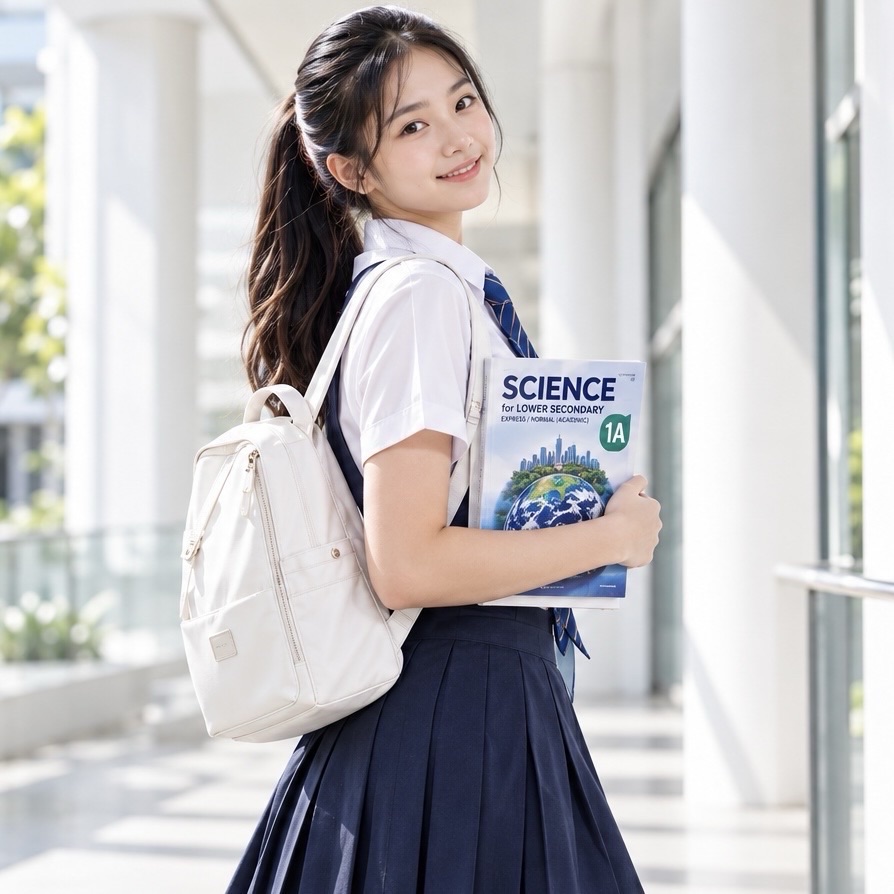
Secondary 2 G2 Science (Physics, Biology) tuition preparation for Punggol students should strengthen integrated lower-secondary Science now, particularly measurement, forces, light, heat, electricity, cells, living systems, transport and ecosystems, while preparing for possible upper-secondary subject choices. SEAB’s published 2027 SEC Science (Physics, Biology) syllabus is K224. It is an upper-secondary combination, not a national examination or separate subject combination that every Secondary 2 student already takes. At eduKatePunggol, the published Secondary 2 Science programme emphasises focused small-group learning, careful explanation and independent application. Confirm the current class arrangement and the child’s school assessment scope before enrolling.
A confident Secondary 2 Science journey begins by finding the point where a student’s understanding stops becoming a reliable answer. We call this niche syllabus engineering: identify the exact curriculum demand, repair the missing connection and verify whether the learner can use it in an unfamiliar task. A child may be interested in following how a ball moves, noticing how living things respond to their surroundings, or asking how a body transports materials; these are starting resources that can develop into scientific capability. The purpose is not to accelerate blindly into K224 or give more worksheets. It is to help the child understand models, make accurate decisions, communicate evidence and preserve suitable Secondary 3 options.
- Secondary 2 G2 Science is an integrated lower-secondary programme; the school’s current taught scope determines the immediate assessment demands.
- K224 is the 2027 SEC reference for Physics and Biology; a Sec 2 learner in 2026 would ordinarily reach Sec 4 in 2028. Verify that future examination year’s requirements.
- In the published 2027 structure, Papers 1, 2, 5, 6 are taken; each discipline contributes half of the combined result (20% multiple choice and 30% structured questions).
- Scientific reasoning, investigation and data interpretation matter; there is no separate practical examination paper in this published G2 scheme, but experimental skills are assessed within theory.
- Develop vocabulary, models, units, graph reading and evidence-based explanations before adding speed or unfamiliar upper-secondary material.
- Use the four-week plan, original diagnostic workshop and school discussion to decide whether the Physics–Biology combination is suitable if offered.
- High-frequency questions in this guide are common learning and parent concerns, not statistics or predictions of future examinations.
Choose your reading route
Use questions 1–6 to understand G2 and the future K224 route. Questions 7–20 address topic-level concepts and transferable skills; select only school-taught material for current revision. Questions 21–26 help families plan assessment preparation and Secondary 3 choices. The original workshop is designed for a short independent follow-up, not an official examination paper.
Syllabus, assessment and readiness
- 1. What is my Secondary 2 child actually learning before K224?
- 2. How do G2, Posting Group 2 and SEC differ?
- 3. How does the 2027 K224 reference assessment work?
- 4. Why can Science convert latent energy into usable capability?
- 5. How does niche syllabus engineering find the missing connection?
- 6. How do I decide whether Physics and Biology might suit my child?
Physics and Biology: foundations
- 7. Why does a student need to measure before explaining movement?
- 8. How can force and energy be understood without confusing them?
- 9. How does heat transfer connect to living systems?
- 10. Why is the ray model of light important to later Science?
- 11. How can simple circuits become understandable systems?
- 12. What should my child understand about cell structure?
- 13. How do structures become explanations of functions?
Models, evidence and applications
- 14. How do digestion and absorption differ?
- 15. Why do living things need transport systems?
- 16. How can diffusion support later biological and physical reasoning?
- 17. How should ecosystem relationships be read?
- 18. How can human reproduction be taught with scientific precision?
- 19. How do diagrams become useful instead of memorised pictures?
- 20. What is the difference between biological observations and causal explanations?
Mixed practice, decisions and support
- 21. Why does my child understand chapter examples but struggle with mixed questions?
- 22. What should a focused small-group Science tutorial look like?
- 23. What if my child is failing, passing inconsistently or already strong?
- 24. What is a manageable four-week Secondary 2 Science plan?
- 25. What decisions about Secondary 3 and later pathways should parents discuss?
- 26. How should a Punggol family decide whether Science tuition is appropriate?
1. What is my Secondary 2 child actually learning before K224?
MOE’s lower-secondary G2 Science curriculum builds interconnected ideas across Physics, Chemistry and Biology. Its framework includes scientific inquiry, the diversity of materials, models of matter and cells, interactions such as forces and chemical change, and living and electrical systems. The school determines the particular sequence over Secondary 1 and 2. Some relevant ideas may have been covered earlier, while others are still to come. The combination in this article is a possible upper-secondary destination, not a replacement for integrated Science in Secondary 2.
For Physics and Biology, the most useful preparation is to consolidate relevant existing foundations without neglecting the third science discipline. Ask the school for the current term topic list, practical activities, assessment format and end-of-Secondary-2 information. If a learner has missed an earlier concept, repairing that prerequisite may improve their current work more than pre-teaching an advanced chapter. The topic clinics below are examples of learning connections and should be selected according to the actual school scope.
2. How do G2, Posting Group 2 and SEC differ?
Full Subject-Based Banding allows students to take subjects at levels appropriate to their learning needs and readiness. G2 is the level of an individual subject; Posting Group 2 refers to admission and initial subject arrangements. A student might take G2 Science and another subject at G3. Do not use the former stream labels to infer every present or future subject combination.
SEAB’s national SEC begins in 2027. The K224 reference supersedes the previous subject-code reference 5106. A Secondary 2 student in 2026 would generally reach Secondary 4 in 2028, and the applicable 2028 documents must be checked when published. The immediate task is school-level learning. A future national paper can guide long-term skill development, but should not be used to judge the child on topics the school has not taught. Ask the school which subject level and future options actually apply to your child.
Previous question · Contents · Next question
3. How does the 2027 K224 reference assessment work?
The 2027 specification assigns Papers 1 and 2 to Physics, and Papers 5 and 6 to Biology. Each pair is completed in one 75-minute session. The multiple-choice paper has 20 compulsory items for 20 marks and 20% of the combined result; the structured paper has 30 marks and 30%. The structured paper has a compulsory 22-mark Section A and an eight-mark Section B in which one of two questions is selected. Across both disciplines the total is 100 raw marks. There is no separate practical examination paper in this published scheme.
The published assessment objectives broadly divide marks between understanding scientific knowledge and applying it to information or problems (about 45% each), with investigation-related skills about 10% in the theory papers. This is why lessons should develop evidence, models, numerical reasoning and experimental understanding rather than only recall. It does not mean a Secondary 2 school test must reproduce those percentages or session lengths. The school may use different written, practical or formative assessments. Check the actual examination year before relying on the national structure.
Previous question · Contents · Next question
4. Why can Science convert latent energy into usable capability?
Latent energy is an educational metaphor for existing knowledge, observations, curiosity, effort and reasoning that have not yet become an independently usable skill. It is not a measurable physical store of energy or a claim about intelligence. In Science, everyday observations can provide a starting point for a formal model. A student can discuss how a cyclist moves and how a body needs food, yet cannot distinguish the physical description of the motion from the biological explanation of how cells obtain useful energy from nutrients. The tutor turns everyday understanding into two complementary models. Neither a force diagram nor a digestive diagram can substitute for the other.
In the movement and living-systems case, the student should first describe what they observed, then choose the relevant model, identify supporting evidence and produce a precise explanation. The teacher changes the situation later: a new graph, unfamiliar organism, or altered physical arrangement. If the learner applies the same reasoning independently, there is evidence of growing capability. If they can only repeat the original example, more transfer work is needed. School Science should strengthen the ability to explain the world, not simply accumulate isolated definitions.
Previous question · Contents · Next question
5. How does niche syllabus engineering find the missing connection?
A wrong answer is the visible end of a reasoning sequence. The cause could be unfamiliar vocabulary, a weak prerequisite, an incorrect model, a misread graph, an arithmetic slip, a missing unit or an incomplete explanation. For this pairing, an illustrative learner might show graph interpretation and a missing structure-to-function link in a Biology response. These difficulties call for different interventions. Repeating an entire practice paper will not necessarily reveal which one matters most.
An effective lesson uses a small diagnostic task, identifies the first incorrect operation, models that operation, rehearses it and asks for a fresh independent attempt. If a calculation uses the wrong denominator, teach the relationship between the quantities rather than just the answer. If a written explanation names a structure without linking it to a function, teach the causal connection. Keep a record of the degree of assistance. This is an eduKate teaching design, not an official SEAB algorithm or a guaranteed score-improvement technique.
Previous question · Contents · Next question
6. How do I decide whether Physics and Biology might suit my child?
The possible pairing may suit students with interest in physical quantities and systems as well as cells, organisms and environmental interactions, but interests and current marks are only part of the decision. All G2 Science combinations require the ability to apply scientific ideas, understand data and communicate evidence. No combination is inherently the easy choice for every student. The school may not offer all three combinations, and placement can depend on its criteria, timetable, staffing, resources and the learner’s overall subject profile.
The 2027 K224 reference later develops measurement, mechanics, thermal physics, waves, electricity and radioactivity, together with cellular processes, human and plant systems, and relationships between organisms and environments. At Secondary 2, use these broad directions as a conversation starter rather than an instruction to complete all those topics now. Ask the student which questions they enjoy solving, which models make sense, and which skills still need support. Ask the Science teacher about school-specific options and what evidence of readiness matters. The aim is to find a sustainable path while keeping the current integrated Science foundation strong.
Previous question · Contents · Next question
7. Why does a student need to measure before explaining movement?
The description ‘it went faster’ is less informative than distance and time data. A moving object’s average speed equals total distance travelled divided by total time taken. At lower secondary, students can use familiar journeys to learn how to choose relevant quantities and units. Distinguish a directly measured time or distance from a calculated speed. When speeds or accelerations appear in upper-secondary Physics, this foundation becomes essential.
Original exercise: a runner covers 120 m in 30 s. Average speed is 4 m/s. Another runner covers 150 m in 50 s, averaging 3 m/s. The second travelled farther but had the lower average speed. Ask the child to explain why distance alone does not establish speed. A fresh problem might provide a distance-time graph and require interpretation of a flat section. Label the advanced graph work as a bridge to the later syllabus if the school has not taught it yet.
Previous question · Contents · Next question
8. How can force and energy be understood without confusing them?
Force is an interaction; energy describes a system’s capacity for change and its transfers. A ball can experience several forces at once, and its change of motion depends on the resultant force. A child who says ‘the ball has force’ may be confusing momentum, motion and the forces acting on it. Use a sketch to show which object exerts each force, rather than drawing every arrow in the direction of movement.
Consider a ball rolling along a rough floor and slowing down. Friction acts against motion, and energy is transferred from the ball to the surroundings, including thermal energy. It is not necessary to say that the ball’s force has been used up. Now ask how a person walking differs from the ball: muscular activity and interaction with the ground are involved. Distinguish the physical and biological explanations. Where the school has not yet taught quantitative dynamics, keep the exercise qualitative and focus on identifying interactions.
Previous question · Contents · Next question
9. How does heat transfer connect to living systems?
Thermal energy transfers because of temperature differences. A surface that loses heat more rapidly may cool more quickly, under comparable conditions. Many organisms are affected by environmental temperature, although different organisms regulate or respond to temperature in different ways. Avoid vague claims that a substance or organism ‘absorbs cold’. Teach direction and mechanism before asking a student to explain an adaptation.
Use fictional temperature data for two containers initially at the same temperature. A covered container cools less than an uncovered one over the same interval. Ask what the data supports and what factors should be controlled. Then discuss a thick layer of insulating material in a different context, such as animal fur reducing heat transfer. The analogy illustrates a physical mechanism but does not prove that every animal or insulating structure works identically. Ask the student to explain the relevant feature and effect, using the specific evidence.
Previous question · Contents · Next question
10. Why is the ray model of light important to later Science?
Light travels in straight lines in a uniform medium, and rays represent its direction. The angle of reflection at a plane mirror equals the angle of incidence, measured from the normal. A learner who draws the reflected ray on the wrong side of the normal or measures an angle from the surface needs model and diagram practice before more questions. Ray diagrams help students explain what can be seen and where light travels.
In a fictional model, a beam hits a mirror at 25° to the normal. It reflects at 25° to the normal. If the incident beam were 25° to the surface, the angle to the normal would be 65°. Ask the student to explain the difference. In another exercise, compare an opaque object blocking light with a transparent material transmitting much of it. This connects physical behaviour with everyday observations. When using light in school practical work, follow safe supervision; do not shine lasers towards eyes.
Previous question · Contents · Next question
11. How can simple circuits become understandable systems?
A circuit represents connections and paths rather than a collection of components with isolated meanings. A switch changes whether a path is complete; a lamp transfers electrical energy to light and heat. In a simple series circuit, current is not gradually consumed by each lamp. In a parallel arrangement, branches offer different paths. The student’s first task is tracing the connections before calculating or predicting.
Draw two fictional circuit diagrams on paper. One contains two lamps in a single loop; the other has one lamp in each of two parallel branches. If one lamp is removed, ask which remaining path is still complete. The learner should show the route rather than guess from where the symbols appear on the page. This is useful later in Physics. It also develops systems thinking that is relevant when reading diagrams of living systems, though biological transport is not literally an electric circuit. Home practice should be paper-based or use approved low-voltage equipment; never mains wiring.
Previous question · Contents · Next question
12. What should my child understand about cell structure?
Cells are basic units of life. A typical animal cell has a cell membrane, cytoplasm and nucleus, among other structures; a typical plant cell additionally has a cell wall and may contain a large vacuole and chloroplasts depending on the cell type. Not every plant cell has chloroplasts, and diagrams are simplified models rather than identical portraits of all cells. The learner should connect structures with roles.
Ask the child to compare a typical leaf cell with a typical animal cell and explain why chloroplasts are associated with photosynthesis in appropriate plant cells. If the answer only lists organelle names, ask what each selected structure does. Then show a root cell diagram or describe another specialised cell. The absence of chloroplasts in many root cells is not necessarily a mistake. The student must use context rather than apply a generic plant-cell picture to every cell.
Previous question · Contents · Next question
13. How do structures become explanations of functions?
A common Biology difficulty is knowing a feature but not explaining how it supports a function. A root hair cell has an extension that increases surface area, which helps with absorption. An answer saying only ‘it has a long hair’ names a feature but does not establish how that feature helps. The key chain is structure, relevant property, process and benefit.
Give the child a fictional diagram comparing a smooth root cell surface with one having an extension. Ask which has a larger surface exposed to the surroundings and why that matters. Later, use a different example involving a thin exchange surface, when appropriate for the school scope. The student should not copy the root-hair answer indiscriminately; they must identify the actual mechanism. This approach links Biology explanations with physical reasoning about area, distance and movement of substances.
Previous question · Contents · Next question
14. How do digestion and absorption differ?
Digestion breaks large food molecules into smaller substances that can be absorbed; absorption is the movement of the products into internal transport pathways, principally through the small intestine. Digestion does not mean food simply disappears. A learner who recites organ names may still confuse where food is broken down, where useful substances are absorbed and how they are transported afterwards.
Ask the student to trace a simplified path from food entering the mouth to substances being absorbed and carried to cells. Label the processes at suitable locations rather than treating every arrow as digestion. Then ask a transfer question: if a person can break food down but absorption is impaired, why might less nutrient reach body cells? The explanation should link the different processes. Avoid giving personal dietary or medical advice; this is a conceptual Science task and any health concerns belong with appropriate professionals.
Previous question · Contents · Next question
15. Why do living things need transport systems?
Living cells need materials and may produce waste products. In humans, the circulatory system transports substances such as oxygen and nutrients and carries waste products to appropriate organs for removal. In plants, xylem carries water and mineral salts, while phloem transports sugars and other organic substances from sources to sinks. These systems support organisms whose cells cannot all exchange materials directly with the environment.
Ask the learner to distinguish a transport route from a substance being transported. A blood vessel is a route; oxygen is a transported substance. A plant’s xylem is a tissue; water and dissolved mineral ions are among the materials carried. Use a new diagram with arrows and ask the student to identify what moves, from where and to where. Later ask how a change in one part of a system might affect another. That explanation is more valuable than listing disconnected organ names.
Previous question · Contents · Next question
16. How can diffusion support later biological and physical reasoning?
Diffusion describes the net movement of particles from a region of higher concentration to one of lower concentration as a result of their random movement. It is not a conscious decision by particles. This model links the particulate nature of matter to exchange in living systems. Where the school has taught diffusion, ask the student to describe the direction and explain why net movement occurs.
Original task: in a simplified diagram, there are more dissolved particles on the left than the right, and a boundary permits those particles to cross. The net movement is initially from left to right. Once concentrations are equal, individual particles still move, but there is no net change caused by a concentration difference. The learner should distinguish equal distribution from stopped motion. Then apply the idea to an appropriate biological exchange example after its relevant details have been taught. Avoid treating every form of transport in organisms as diffusion; other processes and conditions can be involved.
Previous question · Contents · Next question
17. How should ecosystem relationships be read?
An ecosystem involves interactions among organisms and their physical environment. A food chain represents feeding relationships and the transfer of energy through them. Arrows conventionally point from the organism being eaten to the consumer. Students sometimes draw the arrow from predator to prey because they read it as ‘eats’, losing the intended direction of transfer.
Use an original simplified food chain: grass → grasshopper → frog. Ask which organism is the producer and which receives energy by feeding on grass. If grasshopper numbers decrease, frogs may have less of this food source, assuming other factors remain unchanged. Do not assert a guaranteed population outcome without considering alternatives and the broader food web. Then give another ecosystem with two prey species and ask the child to explain how the effect could differ. A reasoned conditional prediction is stronger than a memorised one-line rule.
Previous question · Contents · Next question
18. How can human reproduction be taught with scientific precision?
The lower-secondary curriculum includes the human reproductive system. A suitable lesson explains structures and processes using accurate, age-appropriate scientific terminology, guided by the school syllabus and respectful classroom practice. Fertilisation involves the union of sperm and egg cells. The student should distinguish the cells involved, the structures where relevant events occur and the sequence of processes. This is not a topic for shame, jokes or unsupported health advice.
Ask a student to read a labelled school diagram, identify a structure and explain its function as taught. Check whether the learner can trace a sequence without confusing a cell, organ and process. Use the school’s materials for specific reproductive-health content and encourage respectful questions. If a learner asks about a personal health issue, consult a qualified healthcare professional or trusted school resource. The objective of tuition is accurate biological understanding and clear scientific language.
Previous question · Contents · Next question
19. How do diagrams become useful instead of memorised pictures?
Physics diagrams often represent directions, connections or interactions, while Biology diagrams represent structures, pathways and relationships. In both subjects, the child must interpret what a label or arrow means. The fact that two arrows look similar does not make their meanings interchangeable. In a circuit the path may indicate an electrical connection; in a biological diagram it may show the direction of transport.
Use two unfamiliar paper diagrams. First ask the learner to identify a normal and trace a reflected light ray. Second, show a simplified plant transport diagram and ask what moves along one labelled tissue. The learner should explain which model applies before answering. If they can label pictures only when the layout matches the textbook, vary the orientation or remove the labels. A reliable student can reconstruct the meaning from the represented relationships, not simply remember where a word appears.
Previous question · Contents · Next question
20. What is the difference between biological observations and causal explanations?
A graph showing that plant growth differs between two groups establishes a measured difference under the conditions of that experiment. It does not automatically identify the cause unless relevant variables have been controlled and the design supports the conclusion. Biology and Physics both require care with evidence, even when the situation looks familiar. A learner should distinguish a measured value, an observed pattern and a proposed explanation.
Consider fictional plants measured after seven days: group A averages 6 cm of growth, group B averages 3 cm. The groups received different light conditions but also different amounts of water. The data show different growth, but the comparison cannot isolate light as the cause. Ask the student to redesign the comparison by holding water and other relevant conditions consistent. A similar problem in Physics might compare cooling rates from different initial temperatures. This shared reasoning skill transfers across both halves of K224.
Previous question · Contents · Next question
21. Why does my child understand chapter examples but struggle with mixed questions?
A textbook chapter tells the learner which model to use. A mixed task removes that clue, so the learner must choose the idea before carrying out the operation. Use a short set consisting of a light-ray diagram, a cell comparison and a data question about a change in a living system. Ask the student what each question is really asking before providing any formula or definition. This exposes whether the difficulty is model selection or execution.
Record method selection, calculation or explanation, and independence as separate observations. A student may choose the correct model but forget a unit, or retrieve an accurate fact that does not answer the question. Fix the relevant operation. Later give a similar mix containing a new graph, unfamiliar organism, or altered physical arrangement. Gradually add time pressure only when the underlying model and communication are stable. This supports both school assessments and the later multi-component examination without pretending to predict national questions.
Previous question · Contents · Next question
22. What should a focused small-group Science tutorial look like?
The published Punggol Secondary 2 Science programme describes small-group tutorials with a weekly 90-minute rhythm; confirm the actual current group size, fees and schedule. A possible lesson uses a short retrieval check, a model or diagram, a carefully selected practice task, an independent mixed example and feedback. The tutor should inspect the learner’s reasoning rather than wait until the final answers are marked.
For Physics and Biology preparation, a child may need different amounts of time on different concepts. A small group can provide peer discussion and exposure to another explanation while still requiring each student to complete independent work. Ask whether the tutor distinguishes an observed improvement from a coached answer. A class that provides constant hints may produce complete worksheets without building independence. Keep actual practical science activities within suitable supervised settings; tuition should not promise facilities or laboratory arrangements that have not been confirmed.
Previous question · Contents · Next question
23. What if my child is failing, passing inconsistently or already strong?
A student with repeated failures should begin with a short unassisted sample of taught topics. Determine whether the main difficulty is reading, scientific terminology, prerequisite Mathematics, selecting a model or producing a justified response. If the problem is graph interpretation and a missing structure-to-function link in a Biology response, repair those before demanding a longer paper. A student who passes inconsistently may need retrieval across older and newer topics, plus mixed problem selection. A strong learner can benefit from unfamiliar evidence, more complex explanations and careful extension within appropriate scope.
Use actual work instead of comparing the child with classmates. If the learner struggles to read questions, the English guide may help develop question focus and causal comprehension; if units or proportional reasoning are unstable, the Mathematics guide provides relevant foundations. Persistent learning difficulties may call for school support or a suitable specialist assessment. Tuition is not a substitute for qualified professional support. A student making sound progress with the school may not require additional lessons.
Previous question · Contents · Next question
24. What is a manageable four-week Secondary 2 Science plan?
Week 1 — collect one marked assessment and short independent tasks across current integrated Science. Identify two recurring bottlenecks. Week 2 — repair those operations through small, explicitly modelled examples. For this pairing, illustrative priorities could be graph interpretation and a missing structure-to-function link in a Biology response. Week 3 — transfer the repaired skills to a new diagram, dataset or context, and include older material. Week 4 — complete a school-scope mixed set independently, compare the error record with Week 1 and choose the next priorities.
Use brief practices that fit school homework, CCA, rest and family commitments. A record may include date, skill, first wrong step, correction, assistance given and next independent task. If the child still needs hints in Week 4, repeat a smaller repair cycle. The timetable is a planning aid, not a promise of improvement by a fixed date. The child should understand why the next lesson has been selected and gradually take responsibility for checking the accuracy of their own work.
Previous question · Contents · Next question
25. What decisions about Secondary 3 and later pathways should parents discuss?
At the end of Secondary 2, schools provide information about upper-secondary subject options and eligibility. Confirm whether the school offers Physics and Biology as a G2 combination, or whether other Science combinations or subject levels are available. Ask about the prerequisites, selection timetable, workload and any bridging support. A move to a more demanding subject level should follow evidence of readiness, not pressure to choose the highest possible label.
MOE has announced post-secondary admissions changes for the 2028 intake, but a student currently in Secondary 2 may apply later. Check the actual requirements for the intended intake, course and institution with the school’s Education and Career Guidance team. Neither K224 nor any one Science grade guarantees admission. The entire subject combination, results and applicable course prerequisites matter. A strong sustainable G2 profile can be a useful route. Preserve flexibility by building independent scientific reasoning now rather than trying to determine a career from a single lower-secondary mark.
Previous question · Contents · Next question
26. How should a Punggol family decide whether Science tuition is appropriate?
Begin by bringing the school assessment scope, a marked paper and an unassisted response to a consultation. Ask what the tutor thinks the earliest bottleneck is, how the next lesson will address it, and how success will be checked on a fresh task. The centre’s published contact location is 83 Punggol Central, Singapore 828761, by appointment. Confirm current availability, group size, subject-level fit and fees directly; do not assume a particular schedule from a guide.
Tuition is most useful where a specific unresolved skill gap is limiting progress or a learner needs purposeful extension that existing support does not provide. No responsible tutor can guarantee a national examination grade, subject placement or exact examination topics. If ordinary school feedback and home practice already work well, more tuition may not be needed. The objective is increasingly independent scientific literacy and informed educational choice, not unnecessary additional workload.
2027 SEC reference and the Secondary 2 bridge
| 2027 K224 paper | Raw marks / weighting | Current learning priority |
|---|---|---|
| 1 — Physics multiple choice | 20 / 20% | Recognise relevant model and discriminate alternatives |
| 2 — Physics structured | 30 / 30% | Apply ideas; use working and evidence |
| 5 — Biology multiple choice | 20 / 20% | Vocabulary, understanding and application |
| 6 — Biology structured | 30 / 30% | Communicate reasoning, interpret data and investigations |
Original parent–student diagnostic workshop
These fictional exercises illustrate scientific operations and are not official questions or marking schemes. Choose the items that match the school’s taught curriculum. Use written data, diagrams and safe discussion at home; any laboratory or apparatus work requires appropriate supervision.
Movement and graphical reasoning clinic
Two fictional students travel along a straight path. Student A covers 200 m in 50 s, averaging 4 m/s; Student B covers 180 m in 30 s, averaging 6 m/s. The second covers less total distance but has the greater average speed. Ask the child to calculate both speeds, state the units and explain why total distance alone cannot decide who was faster on average. If the school has taught distance-time graphs, ask what a steeper straight section means when scales match.
Next use a fictional dataset where a student covers 50 m in the first 10 s and then remains at the same position for 10 s. The average speed over 20 s is 2.5 m/s. The flat part of a distance-time graph would represent no additional distance over that interval. A learner who averages the moving speed over only the first part has changed the denominator. Ask the child to state the question’s time interval explicitly. This builds careful reading and physical reasoning rather than formula substitution alone.
From cell structure to system function
Use an original conceptual comparison: a typical leaf cell contains chloroplasts, while a typical human cheek cell does not. Ask which structure is associated with photosynthesis, and why a generic animal cell diagram is inappropriate for describing a leaf cell. Then discuss a root hair cell’s extended surface and ask how it supports absorption. Require a relationship, not merely an organelle name.
For the next exercise, ask how water absorbed by roots can reach leaves through plant transport tissue. The answer should distinguish absorption at the root from movement through xylem and use of water elsewhere. If the student describes roots as ‘taking food from the soil’, repair the distinction between water and minerals absorbed by roots and sugars formed through photosynthesis. Use taught school content and suitable diagrams. A learner who can explain the sequence in new words has gained more than a memorised list.
An ecosystem and evidence clinic
A fictional school garden contains flowering plants, insects and birds. Students count insects on equal-sized plots. One plot has more flowers and a greater number of insects; another has fewer flowers and fewer insects. The pattern is consistent with flowers providing resources for some insects, but the observation alone does not isolate the cause. Other factors such as shade, temperature or plant species may differ. Ask what additional information would improve the conclusion.
Then consider a simple food web with one insect-eating bird feeding on two insect species. If one species declines, the bird may be affected differently than if it had only one food source. Ask the learner to use the food web arrows and state assumptions. This tests conditional reasoning rather than memorising the phrase ‘population decreases’. Use observation from a safe public garden or paper datasets without disturbing wildlife or collecting animals. Environmental responsibility is part of scientific literacy.
A two-discipline revision clinic
Give the student four independent tasks: interpret a circuit diagram, explain a cell structure, read a distance-time graph if taught, and justify a claim about an ecosystem from supplied evidence. Before answering, ask the learner to identify which model and which representation are relevant. Mark selection, execution and communication separately. If the student can select Biology concepts but struggles with numeric relationships, use the Mathematics guide for prerequisite repair.
Repeat a similar mix several days later with changed examples. Compare the proportion of tasks attempted independently and the types of error, rather than focusing only on the total score. If a child needs more scaffolding for Biology explanations, ask for a short feature-to-function sentence before returning to full structured answers. If the problem lies in Physics units, repair units before adding complex calculations. Balanced learning protects both disciplines and supports a more informed Secondary 3 choice.
Keep an independent learning record
A short record turns the diagnosis into a plan. In the first column, name the actual topic and task rather than just K224. In the second, record the first point where the answer became unreliable. In the third, note whether the tutor modelled, hinted, or did not assist. In the fourth, record the result of a fresh task on a later day. Compare like-for-like practice conditions. The record is particularly useful when the child has several teachers, because everyone can see which connections are already secure and which are still being repaired.
An illustrative record may show that a learner chose the right model independently but omitted a unit, or that they correctly described the observation while still needing a hint to explain it. Those results are neither all-or-nothing success nor failure. They reveal a precise next teaching target. Keep feedback constructive: ask what operation to improve, rather than telling the child they are not a Science person. A family can bring this record to a teacher discussion without having to attempt to grade every question itself.
Official syllabus and Punggol learning resources
- MOE lower-secondary G2/G3 Science curriculum (updated April 2024)
- SEAB 2027 K224 Science syllabus and assessment scheme
- SEAB 2027 G2 school-candidate subject directory
- Detailed Punggol K224 examination reference guide
- New SEC G2 Science (Physics, Biology) parent examination guide
- Secondary 2 Science tuition in Punggol — integration and readiness
- The core aim of Punggol Secondary 2 Science tuition
- Secondary 2 G2 Mathematics companion guide — numbers, graphs and units
- Secondary 2 G2 English companion guide — comprehension and precise explanations
- eduKate small-group teaching reference
- Punggol centre contact and programmes
Compare the other two possible G2 Science combinations: Science (Physics, Chemistry) · Science (Chemistry, Biology). The school’s actual subject offerings and eligibility criteria govern the choice.


