
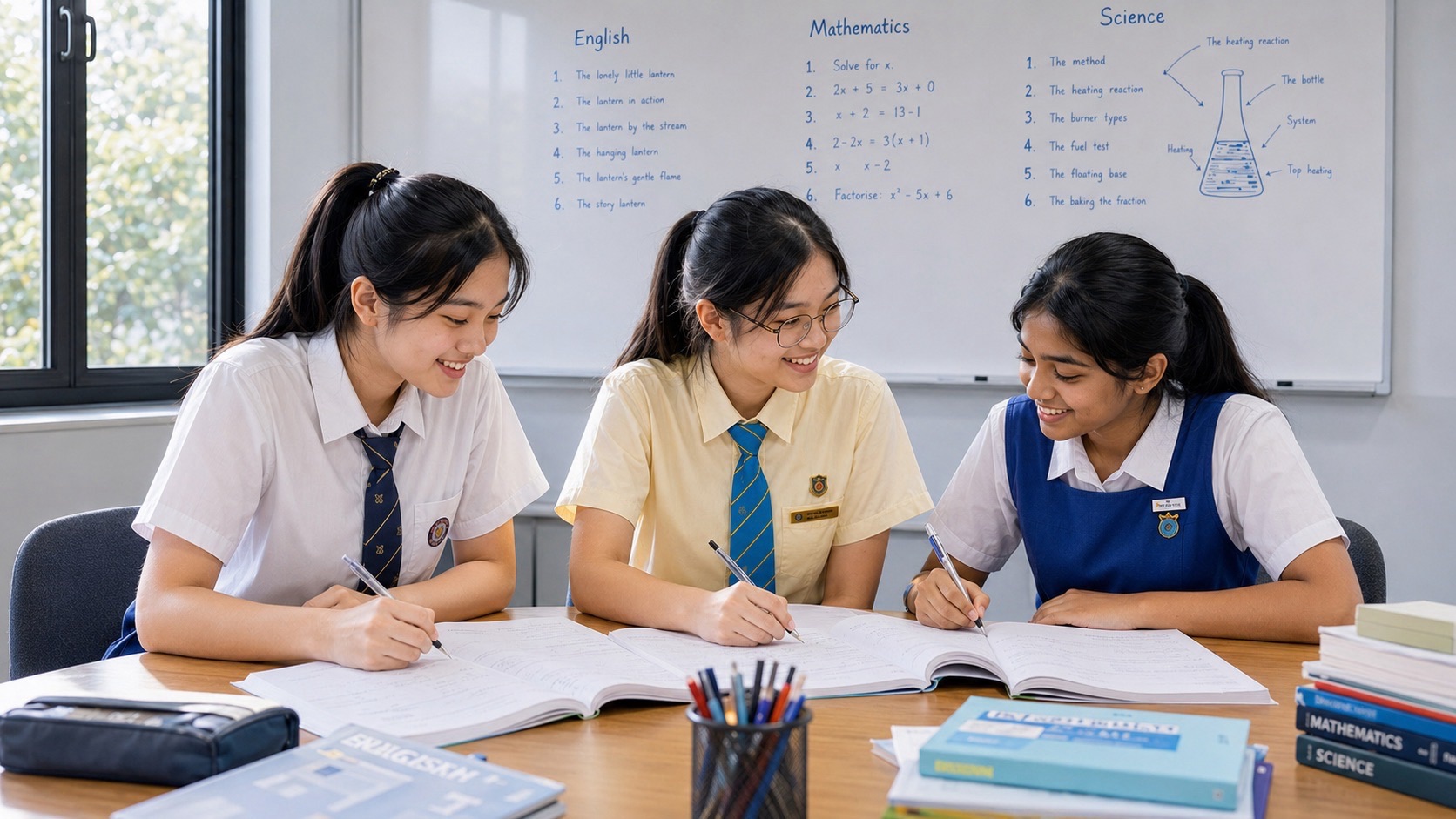
Punggol Science Tuition in Secondary 2 should help students do more than keep up with a busier syllabus. Families searching for Secondary 2 Science Tuition are often reaching the year when earlier lower-secondary foundations must become stable enough to support upper-secondary subject choices, deeper practical work and a more demanding mix of Biology, Chemistry and Physics ideas.
The core aim of Secondary 2 Science tuition in Punggol is to consolidate the scientific operating system built in Secondary 1 and make it more independent. Students should retrieve older concepts without being told the topic, interpret graphs and tables more confidently, handle calculations and units with less friction, plan and evaluate investigations, write clearer explanations and begin seeing how lower-secondary Science opens into the separate disciplines that follow.
Explore related Science guides and choose your next reading step.
Secondary 2 Is the Consolidation Year
Secondary 1 introduces the new language of lower-secondary Science. Secondary 2 should make that language usable.
By now, students have encountered enough models and representations that gaps can no longer hide easily. Weak graph reading appears across topics. Poor retrieval begins to affect cumulative tests. Vague explanation becomes costly as questions demand more mechanism.
Tuition should therefore move from introduction toward integration.
The Core Aim: Connect, Retrieve and Transfer
A Secondary 2 student should increasingly be able to answer three questions independently: What concept is this really about? Which representation or evidence matters? How does the model explain the result?
The learner should not need every worksheet to carry a chapter label. Mixed questions are increasingly important because they prepare students to identify the correct model themselves.
Audit the Secondary 1 Foundations Early
Before rushing into new content, identify which earlier skills remain unstable.
- Graph and table interpretation.
- Units and basic calculations.
- Independent, dependent and controlled variables.
- Observation versus inference.
- Scientific vocabulary.
- Command words.
- Diagram reading.
- Cause-and-effect explanations.
- Retrieval after delay.
Repairing these early can prevent them from becoming upper-secondary problems.
Scientific Models Should Become More Flexible
Students should no longer use a model only in the context where it was first taught.
If a particle model explains one diffusion example, it should help with another. If an energy idea works in one system, the student should look for the same relationship in a changed setup.
Transfer is one of the most important Secondary 2 goals because upper-secondary Science becomes increasingly unfamiliar in surface form.
Graphs: Move From Reading to Interpretation
Secondary 2 students should go beyond identifying a trend. They should connect the trend to a scientific model and recognise anomalies, plateaus or turning points.
The reading sequence remains useful: axes, units, scale, pattern, then explanation. Strong students also ask what the graph cannot prove.
Tables: Evidence Needs Selective Comparison
Large tables can overwhelm students if they try to use every value.
Teach them to identify the exact comparison required by the question. Which values differ only in the relevant variable? Which evidence supports the claim?
Selective evidence is more persuasive than data dumping.
Calculations: Build Fluency Before Upper Secondary
Secondary 2 is a good year to strengthen scientific calculation habits before Physics and Chemistry become more quantitative.
Students should write the relationship, convert units, substitute clearly and check magnitude. If algebraic rearrangement is needed, it should feel like part of the method rather than a separate crisis.
Units: Make Them Automatic
Unit errors are highly preventable if habits become automatic now.
Students should carry units through working, convert deliberately and use them to check whether the final quantity makes sense.
Practical Reasoning: From Fair Test to Method Design
Secondary 2 practical work should become more than identifying variables.
Students should begin planning ranges, intervals, instruments and repeat measurements. They should justify why a method produces useful evidence.
This makes the later jump to more formal practical assessments much smaller.
Evaluation: Match the Improvement to the Problem
A generic improvement is rarely strong. Students should identify whether the problem is random variation, poor resolution, uncontrolled conditions, small sample size or another weakness.
Then propose the improvement that addresses that exact limitation.
Scientific Vocabulary Should Become a Network
By Secondary 2, there are enough terms that isolated memorisation becomes inefficient.
Build concept networks. Link related terms, contrasts, examples and representations. Ask students to move from definition to application and back.
Vocabulary is strongest when it helps the learner classify a new situation.
Command Words Should Be Automatic
Students should recognise the difference among describe, explain, compare, suggest, calculate and evaluate almost immediately.
This allows more working memory to be spent on the Science itself.
Explanation: Make the Mechanism Visible
Weak explanations often state the condition and result but skip the scientific mechanism.
Ask, “What happens in the middle?” That missing middle is frequently the mark-bearing idea.
A precise explanation should be long enough to show the relationship and short enough to stay focused.
Mixed Retrieval: The Hidden Upper-Secondary Preparation
Upper-secondary Science requires students to switch between conceptual families rapidly.
Secondary 2 tuition should begin mixed retrieval now. A short set might include particles, energy, cells, forces and data interpretation. The student identifies the relevant model before solving.
This trains classification, one of the most important but least visible exam skills.
Cumulative Review: Do Not Let Term 1 Vanish
Science knowledge decays when it is not retrieved.
Each week should contain a small amount of old material. Five minutes can be enough: one definition, one graph, one diagram, one practical question.
The goal is not to keep every detail constantly active. It is to keep the retrieval routes open.
The Secondary 2 Error Ledger
- Old topic forgotten.
- Graph pattern misread.
- Calculation setup weak.
- Unit conversion missed.
- Experimental variable confused.
- Practical improvement generic.
- Explanation missing mechanism.
- Scientific term used vaguely.
- Question type misread.
- Changed context mistaken for a new topic.
The ledger should point to action and include delayed retesting.
Preparing for Upper-Secondary Subject Choices
Secondary 2 can be the point when students and families begin thinking about Physics, Chemistry, Biology or Combined Science pathways depending on school offerings and eligibility.
Tuition can provide useful evidence about learning strengths. Does the student enjoy quantitative relationships? Are chemical models intuitive? Does the learner handle biological systems and vocabulary comfortably?
But subject choice should not become a prestige contest. Interest, readiness, school guidance, workload and future plans all matter.
Physics Readiness Signals
Students who enjoy relationships among quantities, diagrams, measurements and mathematical reasoning may feel drawn toward Physics.
But interest matters more than stereotypes. A student can become strong in Physics with practice even if calculations were not initially a favourite.
Chemistry Readiness Signals
Chemistry rewards students who can move among observations, particles and symbols while handling patterns and quantitative relationships.
A learner who enjoys reactions, materials and the logic of transformation may find the subject especially engaging.
Biology Readiness Signals
Biology suits students who enjoy systems, structures, processes and data about living organisms.
Strong vocabulary helps, but the deeper skill is tracing causal chains and interactions.
Do Not Over-Specialise Too Early
Secondary 2 is still a foundation year. Students should not decide that they are “a Physics person” and stop caring about Biology, or vice versa.
Lower-secondary breadth helps later subject choices and keeps the learner scientifically flexible.
Secondary 2 Homework Should Build Independence
The tutor should gradually reduce scaffolding.
Homework can begin with a closed-book retrieval task, continue with mixed application and finish with one transfer question. Students should correct their own work before waiting for the next lesson.
The Cold Start Test
One useful measure of independence is whether the student can begin a fresh question without the tutor’s first clue.
Give an unfamiliar problem and wait. Does the learner identify the topic, draw a representation or list known quantities? Or does the student freeze until prompted?
The goal is not immediate perfection. It is productive initiation.
School Tests Should Become Diagnostic Tools
A Secondary 2 paper can show whether the student is ready for deeper work.
Look beyond the mark. Which errors cross topics? Which old concepts disappeared? Which questions were slow? Which correct answers were guesses?
Use the paper to plan the next month.
Science Notes Should Become More Compact
As understanding improves, students should be able to compress topics into smaller core maps.
A good map contains the model, key relationships, representations, vocabulary and known personal risks. It should trigger recall rather than replace it.
How to Use Assessment Books Well
Assessment books are useful when the student knows why a set is being attempted.
One set may target graphs. Another may target practical evaluation. Another may mix topics. Finishing a book from front to back is not automatically the best strategy.
Selection should follow evidence.
When Tuition Should Teach Ahead
Previewing can help if the student is secure and school pace is demanding.
But teaching ahead should not become a substitute for repairing older gaps. A student who cannot read graphs reliably gains little from seeing advanced chapters early.
When Tuition Should Slow Down
Sometimes the most productive lesson spends twenty minutes on one misconception.
Slowing down is appropriate when the error affects many future topics. Strong teaching optimises future performance, not pages completed today.
Strong Secondary 2 Students Need Transfer and Evaluation
Extension should make the problem less familiar, not simply longer.
Use imperfect data, changed conditions, experimental design, competing explanations and cross-topic connections. This builds readiness for upper-secondary depth.
A Weekly Secondary 2 Routine
- Mixed retrieval from older topics.
- Current concept or school alignment.
- One quantitative or graph task.
- One practical-design or evaluation task.
- Independent mixed questions.
- One unfamiliar transfer item.
- Correction and error-ledger update.
- Brief upper-secondary connection when useful.
A Year-End Secondary 2 Audit
Before Secondary 3, students should audit more than chapter coverage.
- Can I read graphs and tables independently?
- Can I handle units and basic calculations reliably?
- Can I identify variables and evaluate methods?
- Can I retrieve Term 1 topics now?
- Can I write precise explanations?
- Can I begin unfamiliar questions without waiting for a hint?
- Do I understand my likely upper-secondary Science route?
- Which one cross-topic weakness must be repaired before next year?
This audit makes the handoff to Secondary 3 intentional.
How Parents Can Help
Parents can ask process questions rather than becoming content tutors.
- Which old topic did you retrieve this week?
- What is your top recurring Science error now?
- Which upper-secondary Science sounds interesting, and why?
- What did the last school test reveal?
- What can you now begin without the tutor helping?
How the eduKate Ecosystem Connects
For the broad lower-secondary pathway, see Lower Secondary Science Tuition Punggol | Secondary 1–2 G2 & G3 Small Groups. The foundation article The Core Aim of Punggol Science Tuition | Secondary 1 Science Tuition covers the first-year transition.
For the next step, The Core Aim of Punggol Science Tuition | Pure Science Tuition and The Core Aim of Punggol Science Tuition | Combined Science Tuition show how the pathway can branch later.
Frequently Asked Questions
What is the main aim of Secondary 2 Science tuition?
To consolidate lower-secondary foundations, strengthen retrieval and transfer, and prepare the student for more specialised upper-secondary Science.
Why is Secondary 2 important for Science?
It is the year when earlier habits either become reliable or become hidden gaps that carry into Secondary 3.
Should Secondary 2 students start Pure Science topics early?
Only when foundations are secure and preview serves a clear purpose. Strong graph, practical and retrieval skills are often a better investment than rushing ahead.
How should Secondary 2 students revise?
Use mixed retrieval, compact core maps, targeted practice and delayed retesting rather than rereading each chapter in isolation.
How can tuition help with subject choices?
By providing evidence about the student’s strengths, interests and learning patterns across different kinds of scientific reasoning. Final decisions should also consider school guidance and workload.
How important are practical skills in Secondary 2?
Very important. Method design, variables, measurement and evaluation become increasingly useful in upper-secondary Science.
What should a year-end audit include?
Graphs, calculations, units, practical reasoning, explanation, retrieval of old topics, independence and readiness for the likely upper-secondary route.
How do we know the student is ready for Secondary 3?
The learner can retrieve older ideas, begin unfamiliar questions independently, handle common representations and explain recurring errors with a clear repair method.
The Core Aim, in One Sentence
The core aim of Punggol Science Tuition for Secondary 2 Science is to turn lower-secondary knowledge into a connected, retrievable and increasingly independent system—strong enough to support upper-secondary Physics, Chemistry, Biology or Combined Science without carrying hidden gaps forward.
When Secondary 2 is used well, the student reaches the end of lower secondary with more than completed chapters. The learner has a clearer map of Science, a stronger method for dealing with evidence and error, and a much better foundation for choosing and succeeding in the next stage.


