
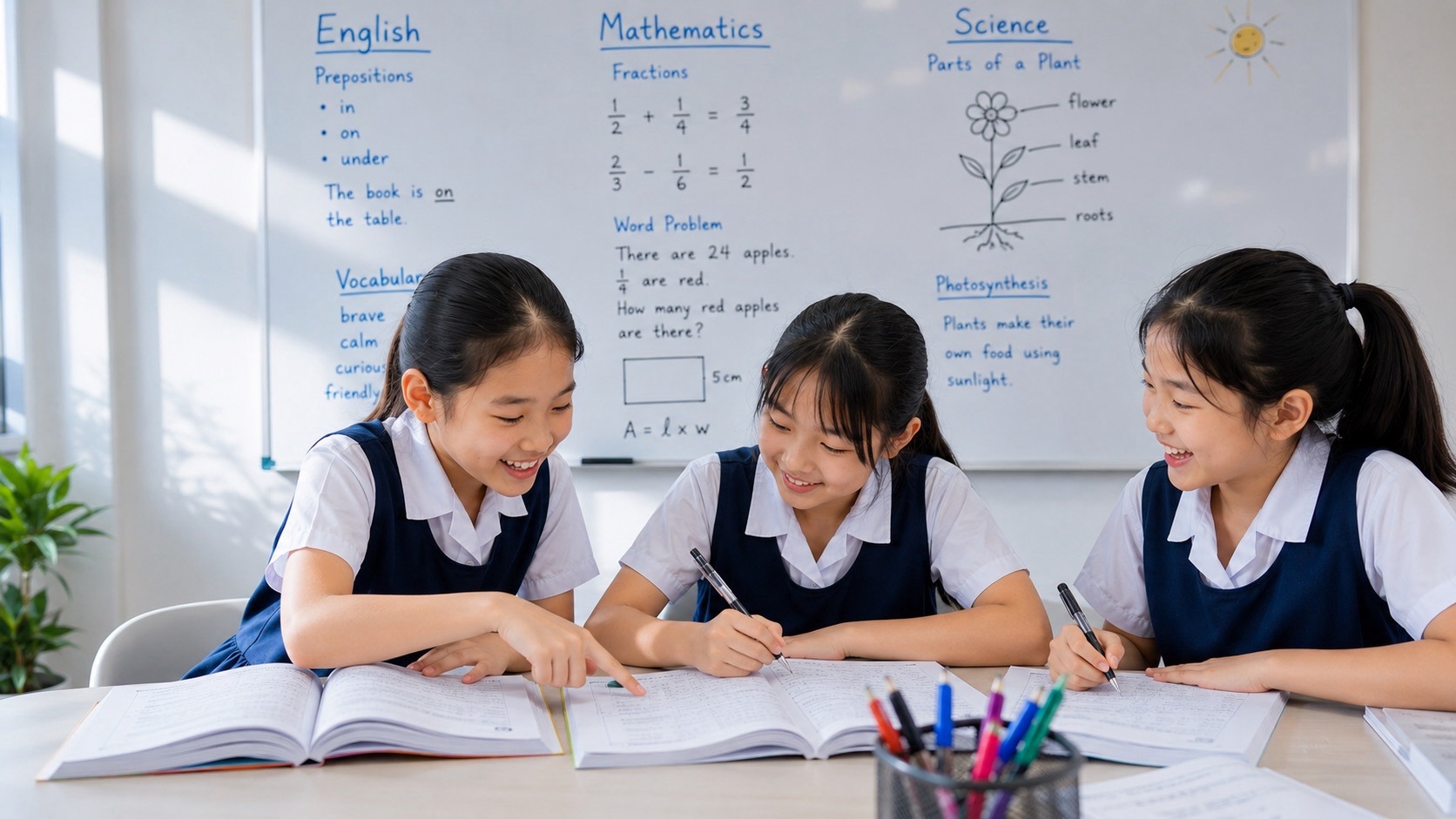
Primary 2 Programme for Active Learning (PAL) in Punggol helps children explore the arts, movement and outdoor experiences while developing confidence, curiosity, cooperation and social-emotional skills. Parents can start by asking what PAL module their child’s school is currently teaching, what activity the child tried and how they worked with classmates. A pupil who enjoys experimenting with materials but struggles to share them needs different guidance from one who is confident in games but hesitant about acting in a small group. The useful next step is usually school participation and a supportive home activity—not buying another tuition package.
PAL is an MOE school programme for Primary 1 and 2, not a separate SEAB examination subject or a standalone national P2 exam syllabus. It gives pupils experiential exposure to the four broad domains of Sports and Games, Outdoor Education, Visual Arts and Performing Arts; schools organise specific modules. Punggol Cove Primary School’s PAL information describes P2 modules in Visual Arts, Outdoor Education and Drama, following its P1 modules in Music, Dance and Sports and Games. That is a confirmed school example, not a universal timetable. eduKatePunggol’s advertised three-pupil tuition is for core academic subjects, so this article does not claim a dedicated PAL tuition class is available.
- Level: Primary 2, within MOE’s two-year Programme for Active Learning framework.
- Four broad domains: Sports and Games, Outdoor Education, Visual Arts and Performing Arts.
- Key aims: Confidence, curiosity, cooperation, responsible behaviour and social-emotional development through active experiences.
- Punggol Cove example: Its P2 PAL covers Visual Arts, Outdoor Education and Drama; another school may schedule different modules.
- Assessment reality: No SEAB P2 PAL paper, no weighted P2 examination, and no exam-style revision course required.
- Tutor decision: PAL is delivered through school; any additional arts, drama or movement enrichment is optional and must be verified as a real specialist service.
- Parent’s first move: Ask the child what they explored, what choice they made, how they worked with others and what they might try differently.
1. PAL is an experience, not another academic paper
Many families are familiar with English, Mathematics and Mother Tongue worksheets. PAL is different. It creates opportunities for children to learn by doing, moving, making, observing and interacting. Its success cannot be assessed simply by whether the pupil writes the correct definition of cooperation or colours a picture within the lines.
A Primary 2 child might design something with art materials, take part in a short drama activity or work with classmates to explore an outdoor problem. The adult’s role is to provide an appropriate challenge, guide reflection and protect children physically and emotionally.
Parents should not be worried if one child prefers drawing while another enjoys movement. PAL’s breadth is part of its purpose. Learning in varied settings can reveal interests and ways of engaging that may be less visible during desk-based academic work.
2. The national four-domain structure explained
PAL gives pupils exposure to Sports and Games, Outdoor Education, Visual Arts and Performing Arts over Primary 1 and 2. The domains are complementary. Movement offers opportunities to coordinate and cooperate. Outdoor experiences encourage curiosity about places and safe exploration. Art supports visual expression. Performing arts can help children communicate through sound, story and movement.
It would be inaccurate to say each P2 pupil completes all four domains in the same term. Schools organise modules to meet the programme’s objectives. Parents should read their child’s actual class or school information, including the current term’s activity and any safety or materials instructions.
PAL is not a replacement for the separately taught subjects Music, Art or Physical Education. Those have their own MOE syllabuses and learning outcomes. PAL adds experiential opportunities and social-emotional development alongside the regular curriculum.
3. Punggol Cove Primary: a local example parents can inspect
Punggol Cove Primary’s public PAL page describes a sequence across the two lower-primary years. Primary 1 modules include Music, Dance and Sports and Games; Primary 2 modules include Visual Arts, Outdoor Education and Drama. The school explains that teachers design and facilitate activities that welcome creativity, play, inquiry and teamwork.
This is useful evidence of how a real Punggol primary school organises PAL. It is not proof that Punggol Green, Edgefield, Greendale, Waterway, Oasis, Valour or another school uses exactly the same module pattern, materials or assessment arrangements. Check the child’s own school’s communication.
The school’s examples include collaborative art making and outdoor projects. Parents can ask whether their child enjoyed planning, sharing materials or testing an idea. A child who says ‘we built something’ may have learned as much about working with others as about the object itself.
4. What confidence means at Primary 2
Confidence is not always being the first pupil to speak or the most energetic participant. A child who usually hesitates may show confidence by volunteering one idea, trying a new material or asking a question in front of a small group. Adults should notice these small steps.
A suitable PAL activity makes participation possible without public humiliation. If the child is reluctant to perform, the teacher might offer a partner role, a short preparation period or a non-speaking contribution before inviting further participation. The pupil’s comfort and safety still matter.
Parents can ask, ‘Was there anything you tried that you had not tried before?’ A specific achievement gives the child something real to reflect on. Avoid saying that another classmate’s louder performance proves greater confidence.
5. Curiosity: asking questions before receiving answers
Curiosity appears when pupils wonder what will happen and seek to find out. An outdoor module might invite a child to predict which simple structure will remain stable, while a Visual Arts module might ask what happens when materials or shapes are combined differently.
Teachers can use questions such as ‘What do you notice?’, ‘What do you predict?’ and ‘How could we check safely?’ If the pupil guesses incorrectly, the next step is to observe what happened rather than be shamed. This is inquiry at an age-appropriate level.
Parents can extend the same habit at home: ask the child to inspect a safe everyday object, form a question and try a small permitted experiment. It should not become an elaborate assignment that the adult completes while the child watches.
6. Cooperation: share responsibility without erasing individual contribution
In a three-child group, one pupil may talk continuously, another may organise materials and the third may remain silent. A thoughtful adult makes room for everyone’s contribution. Ask each pupil to choose a role and rotate roles where appropriate.
A collaborative art or building project gives the group a shared purpose. But completing the object does not automatically mean cooperation occurred. Did everyone have a turn? Was a suggestion considered? What happened when two ideas conflicted? These are the learning questions.
Cooperation also includes knowing how to ask for help, negotiate politely and raise a safety concern. Children should not be taught to obey a peer’s demand simply to be seen as cooperative.
7. Visual Arts: learn to see and make choices
Visual Arts within PAL can allow pupils to experiment with shapes, colours, textures and collaborative construction. Imagine a group creating an imaginary underwater scene from clean, safe craft materials. The children decide what to include, share tools and explain what they made.
The most important moment may not be the final picture. It may be a pupil realising that two materials attach differently or that another child’s idea can improve the group’s design. Ask what they changed and why.
Parents can support this with inexpensive materials at home, but should not dictate a perfect model. A simple original collage or drawing is more aligned with creative exploration than an elaborate project designed and finished by the adult.
8. Outdoor Education: safety is part of the experience
A P2 outdoor activity can help pupils notice the environment, follow boundaries and work together. Children may examine a safe outdoor area, observe simple natural features or complete a teacher-designed group challenge. These are not excuses to approach water bodies, collect unsafe objects or enter restricted spaces.
At home in Punggol, adults can use an ordinary supervised walk to discuss shade, ground conditions, directions and safe use of shared pathways. A child might notice that a public path serves pedestrians, cyclists and people with mobility needs. Ask how the family can move respectfully.
The activity should change or stop when weather or safety conditions make it unsuitable. Heat, lightning, rain and haze matter. Never ask a young pupil to conduct a solo ‘outdoor investigation’ near a waterway merely to extend PAL learning.
9. Drama: express a situation without forcing a performance
Drama activities at Primary 2 can involve short role-play, storytelling, gestures and imaginative movement. The goal may be to communicate a character’s feeling or respond to another pupil’s idea. It need not require a stage, costume or memorised full-length script.
A simple scene could involve two characters who want to borrow the same book. The children explore what each person might say and a respectful way to resolve the situation. The adult can focus on clear communication and imaginative participation rather than choosing a single ‘best actor’.
Children who are uncomfortable speaking publicly may begin with a small supporting role, a puppet or a group movement. The educator should never use drama to pressure pupils into revealing private family circumstances or reenacting distressing personal events.
10. Sports and Games: build participation, not only winners
Although a particular school may schedule Sports and Games in P1, the domain belongs to PAL exposure across lower primary. It can help children experience varied movement challenges, cooperative play, turn-taking and fair rules.
A simple non-contact activity might require pupils to transport soft objects together, agree on a route and take turns leading. The educator can ask what improved when they listened to one another. The objective is cooperation and coordination, not a league ranking.
Sports activities must remain age-appropriate. Use safe equipment, adult supervision, sufficient space and suitable movement demands. Children should not be expected to complete advanced training simply because a parent hopes for future sporting distinction.
11. Performing Arts beyond the school musical
Performing Arts can include Music, Dance and Drama, depending on the school’s module choices. Some children respond to sound patterns, others to movement or acted stories. The experience broadens expression and gives pupils alternative ways to communicate.
A teacher may invite children to invent a short soundscape for a rainy day or create movements showing the growth of a plant. These are original creative prompts and do not require a polished public performance. Ask the children what the sounds or movements are meant to communicate.
The adult should respect cultural contexts and use appropriate source material. No one school module is a comprehensive representation of all musical or dramatic traditions in Singapore. Curiosity and respectful listening are more valuable than unsupported stereotypes.
12. Social-emotional learning is woven through PAL
PAL supports the broader development of social and emotional competencies. A child learns about themselves while working in a group, notices peers’ emotions and practises responding thoughtfully when plans change. This complements MOE CCE 2021, with its emphasis on values, Identity, Relationships and Choices.
A group activity can be frustrating when a shared design collapses or two ideas cannot be combined. The teacher can model a pause, invite each child to describe the problem and ask for a safe next step. Learning to recover from a small setback is worthwhile.
Adults should not claim PAL teaches children to suppress all frustration. A child can be disappointed and still learn to speak respectfully. If a child shows significant or recurring distress, family and school support should address the wellbeing concern directly.
13. A good PAL reflection is short, specific and sincere
At the end of an activity, invite the child to describe what they tried, something they noticed and how another person helped. A Primary 2 answer may be only two sentences. It does not have to sound like a formal academic essay to be meaningful.
For instance, after a collaborative construction challenge a child might say, ‘Our tower fell when we put the heavy part on top. We moved it lower and the next tower stood longer.’ That answer shows observation, adjustment and teamwork without any exam jargon.
Parents can ask a similar question at home: ‘What would you change next time?’ Resist immediately giving a model response. The child needs room to interpret their own experience.
14. Ten original PAL activities for Punggol families
Activity 1: build a tiny imaginary neighbourhood
Offer safe cardboard shapes, paper and tape. Ask the child or a small group to make an imaginary neighbourhood with places people may use. Let pupils divide responsibilities and explain their choices. The learning includes visual design, cooperation and community awareness, not a factual map of Punggol.
Activity 2: invent a soundscape
Create gentle original sounds for rain, footsteps and a quiet park using voices or safe percussion items. Ask pupils to arrange a beginning, middle and ending. A family member can listen and describe the imagined scene. Keep sound levels comfortable for children and neighbours.
Activity 3: a simple role-play about sharing
Use fictional characters who want the same craft tool. Invite two possible solutions and let children try a respectful phrase. Ask whether both pupils had a chance to contribute. Avoid using role-play to expose a specific child’s real conflict in front of peers.
Activity 4: notice three outdoor textures
During a supervised safe walk, ask the child to describe three visible surfaces without touching unsafe objects. They might compare smooth paving, a tree trunk and grass from a suitable distance. Make a sketch later and ask how the surfaces differ.
Activity 5: cooperate to move safe objects
Give two children a small set of soft items to move from one marked area to another using agreed turns. Ask which part required planning and which required listening. Ensure the play area is clear and avoid speed contests that could lead to collisions.
Activity 6: change a drawing deliberately
Ask the child to draw a familiar place and then deliberately change one feature to communicate a different mood. Perhaps darker clouds show a coming storm in an imaginary scene. Invite an explanation instead of deciding in advance which artistic choice is correct.
Activity 7: ask a better question
Show a safe everyday object or picture and invite the pupil to ask two questions. Choose one that could be explored through observation, such as ‘Which side feels smoother?’ with an appropriate harmless object. Keep the activity simple and supervised.
Activity 8: lead a short movement sequence
Invite the learner to create three safe steps or gestures and teach them to a willing family member. Then swap leader and follower roles. The child practises communication and listening while developing body awareness.
Activity 9: solve a small design problem
Use clean paper to create a simple bridge between two supports for a lightweight toy. Ask the child to predict what will happen, try it and revise one feature. Avoid sharp tools or unsafe loads. The value is inquiry and persistence, not engineering perfection.
Activity 10: reflect on shared work
After any activity, ask each participant to name one contribution by someone else and one thing they learned. This supports appreciation without turning the activity into a competition about who was most talented or helpful.
These are optional home or enrichment examples inspired by the PAL domains. They are not official MOE module lesson plans or a claim that every Punggol school assigns these activities.
15. PAL and the value of play
Play can involve real planning, observation and collaboration. A child arranging craft materials or inventing a game may be learning about problem-solving and relationships even without a worksheet. Adults should preserve enough freedom for the child to try, revise and enjoy.
Too much adult control can remove the very choices PAL is intended to encourage. If every child’s artwork must look identical or every group activity has only one permitted solution, curiosity may be reduced. A skilled teacher guides safety and learning goals while allowing reasonable creative variation.
Parents can make room for unstructured play at home. PAL is not a reason to create a compulsory seven-day enrichment schedule. Children also need rest, reading, movement and time with family and friends.
16. Is there a PAL tutor or a PAL exam?
PAL is an MOE programme delivered by schools, not a standalone national subject with an SEAB code and examination paper. A commercial claim that a child must take ‘P2 PAL tuition to score AL1’ is misleading. There is no such P2 national PAL grade.
A private arts, music, drama or sports workshop may be beneficial enrichment for a child with a particular interest, but it is not automatically PAL tuition. Parents should distinguish the school’s learning aims from the provider’s curriculum and ask which specific skills will be taught.
eduKatePunggol’s public teaching routes describe small academic groups mainly in English, Mathematics and Science. This guide does not confirm a dedicated PAL group or timetable. Families should verify any enrichment provider, instructor credentials, cost, location and current availability directly.
17. What an effective small group might look like
Three learners could work together on a construction or storytelling challenge. The educator can protect individual contributions and monitor whether each pupil notices, tries and explains. The group should be small enough for careful feedback but not so tightly controlled that the tutor completes the task on the children’s behalf.
For a child who is hesitant to share ideas, offer a small role with a clear purpose and invite a contribution at an appropriate moment. For a child who dominates, teach how to ask a peer for an opinion and accept a different suggestion. This is differentiated social learning.
A small group may not fit every child’s needs. Some benefit from the familiar school environment; some need specialist support or accommodations. Parents should not assume that any educational difficulty can be repaired by purchasing a three-pupil lesson.
18. Illustrative 60-minute PAL-style enrichment workshop
- 0–10 minutes: Welcome, safety rules, group agreement and a short curiosity prompt.
- 10–20 minutes: Explore materials, sounds, movement or a suitable outdoor observation.
- 20–35 minutes: Plan an original task with the child’s own choices and a shared purpose.
- 35–48 minutes: Try the task, notice what happened and make one intentional revision.
- 48–55 minutes: Share or demonstrate the outcome, giving everyone a respectful speaking turn.
- 55–60 minutes: Reflect on one discovery and one way the group cooperated.
This workshop is an original example, not an announced eduKatePunggol PAL class or MOE lesson. Actual school modules may run differently. Appropriate supervision, safe equipment, breaks and children’s needs should shape any real programme.
19. The repair, stabilisation and extension approach to PAL
A child who struggles to participate may benefit from a low-pressure role and one predictable task, with encouragement that does not demand immediate public performance. The aim is a safe first success, not to declare the pupil uncooperative. Discuss sustained difficulties with the teacher rather than relying on online labels.
A child who participates but relies on the adult for every decision may benefit from structured choices. Ask them to choose between two safe materials, predict an outcome and explain a decision. Gradually offer more independence when readiness improves.
A child who is already confident may benefit from richer inquiry, more thoughtful group roles and a longer project. Extension should deepen observation, creativity and social awareness, not impose premature academic examinations on a programme designed around active learning.
20. Six-week family exploration plan
Week 1: listen to the child’s PAL story
Ask which module their school has been teaching, what they enjoyed and what surprised them. Speak with the teacher if you need clarification. Record one small learning goal such as contributing an idea or managing shared materials respectfully.
Week 2: explore one creative idea
Choose a brief safe art, music or drama activity based on the child’s interest. Allow them to decide at least one important feature. Ask why they made the choice, then let the work remain their own.
Week 3: practise cooperation
Complete a simple shared task with another willing person. Agree on roles, rotate turns and notice how listening changes the outcome. Avoid comparing the child negatively with siblings or classmates.
Week 4: observe the local environment safely
During a supervised walk, ask the child to notice a pattern, material or safe public-space feature. Invite a drawing or description at home. Outdoor observation should stop when conditions become unsuitable.
Week 5: revise an idea after feedback
Return to a simple design, story or movement pattern. Ask what could change and let the pupil attempt one modification. Focus on the learning process rather than perfection or speed.
Week 6: reflect and decide if extra support is needed
Compare the child’s participation, curiosity and cooperation with the start. Ask the school teacher what progress they have observed. If PAL is being enjoyed and development is steady, there is little reason to purchase additional ‘PAL tuition’.
21. Why parents should not turn PAL into a race
Some Primary 2 families worry about later PSLE results, secondary-school posting and future CCAs. Those will require appropriate decisions in later years, but PAL is intended to broaden early experiences. It should not be sold as a shortcut to school admissions or a guaranteed leadership award.
A child who finds joy in dance at eight may later discover an interest in coding, design or football. Another may find that outdoor activities build social confidence even if they never join a sports team. The educational value is the experience and growing capacity to learn.
An overcrowded schedule can diminish curiosity. Parents should consider the child’s sleep, school activities, travel and preferences before adding enrichment. Sometimes the best support is leaving an afternoon free.
22. Punggol resources that connect with PAL
The eduKatePunggol PAL and FTGP guide explains the relationship between lower-primary active learning and the wider education system. The Punggol primary schools CCAs and programmes guide helps families compare school experiences while reminding them that programmes vary.
For subject-specific experiences, the Primary 2 Art parent guide discusses visual expression; the Primary 2 Music guide covers listening and creation; and the Primary 2 PE guide covers movement and safety. These are related curricula, not replacements for the school PAL programme.
The Primary 2 CCE guide explains the values and social skills that PAL can help pupils practise through active experiences. Parents can also read Punggol Cove Primary’s PAL programme for a concrete local example.
23. When parents should speak with the school
Contact the form teacher when the child repeatedly feels excluded, cannot participate because of barriers that could be accommodated or reports unsafe behaviour during activities. A short conversation about the actual school module and the child’s needs is more useful than guessing from a social-media clip.
If a child has a disability, sensory need or medical concern, ask about suitable participation and support arrangements. The aim should be inclusion and safety, not using PAL activities to force the pupil into a uniform performance standard.
Where wellbeing or safeguarding issues arise, use the school’s appropriate channels and qualified support rather than a private enrichment workshop. PAL’s emphasis on supportive experience should make it easier to ask for help, not harder.
Frequently asked questions
Is PAL a standalone MOE syllabus subject with a SEAB exam?
No. It is the Programme for Active Learning for P1 and P2. There is no separate national P2 PAL examination paper or P2 weighted school exam.
What are PAL’s four broad domains?
Sports and Games, Outdoor Education, Visual Arts and Performing Arts. A school plans specific modules across the two lower-primary years.
What does Punggol Cove Primary do for P2 PAL?
Its public programme page identifies Visual Arts, Outdoor Education and Drama for Primary 2. That is the school’s own sequence and may differ from another Punggol primary school.
Must my child join extra classes to succeed in PAL?
No. PAL is delivered at school. Family play and ordinary conversation can reinforce the experience. Private enrichment is optional and should meet a genuine interest or need.
What does cooperation look like at Primary 2?
Taking turns, sharing materials fairly, listening to peers, helping appropriately and explaining a shared decision. It is more than finishing an attractive group project.
My child is shy during drama. Is that failure?
Not necessarily. A supportive role, small group or gradual participation may be appropriate. Discuss persistent concerns with the class teacher and avoid humiliating public-performance demands.
Can PAL improve school examination scores?
PAL helps build broader dispositions and experiences. It should not be marketed as a guaranteed route to particular English, Maths or future PSLE marks.
Is PAL the same as PE or Art?
No. PE and Art have their own formal national syllabuses. PAL gives additional active experiences across several domains and reinforces social-emotional learning.
Does eduKatePunggol run dedicated PAL tuition?
This guide does not claim that it does. Its publicly advertised tuition primarily covers English, Mathematics and Science. Confirm any enrichment offering with the actual provider.
What is the most useful question to ask my child?
‘What did you try, and what did you learn from it?’ Follow with ‘How did you work with the others?’ These questions invite reflection rather than competition.
Sources and next steps
- Punggol Cove Primary — Programme for Active Learning.
- Punggol Cove Primary — PAL facilities and learning environment.
- MOE Primary Art Teaching and Learning Syllabus 2024.
- MOE 2023 Music Syllabus.
- MOE 2024 Physical Education Syllabus.
- MOE CCE 2021 Primary syllabus.
- eduKatePunggol PAL and FTGP parent guide.
- eduKatePunggol school programmes and CCA guide.
The best PAL outcome is a young learner who tries something unfamiliar, discovers a new interest, works more thoughtfully with others and feels safe to learn again. Parents should protect that purpose rather than invent another Primary 2 examination or sell compulsory tuition for it.


