
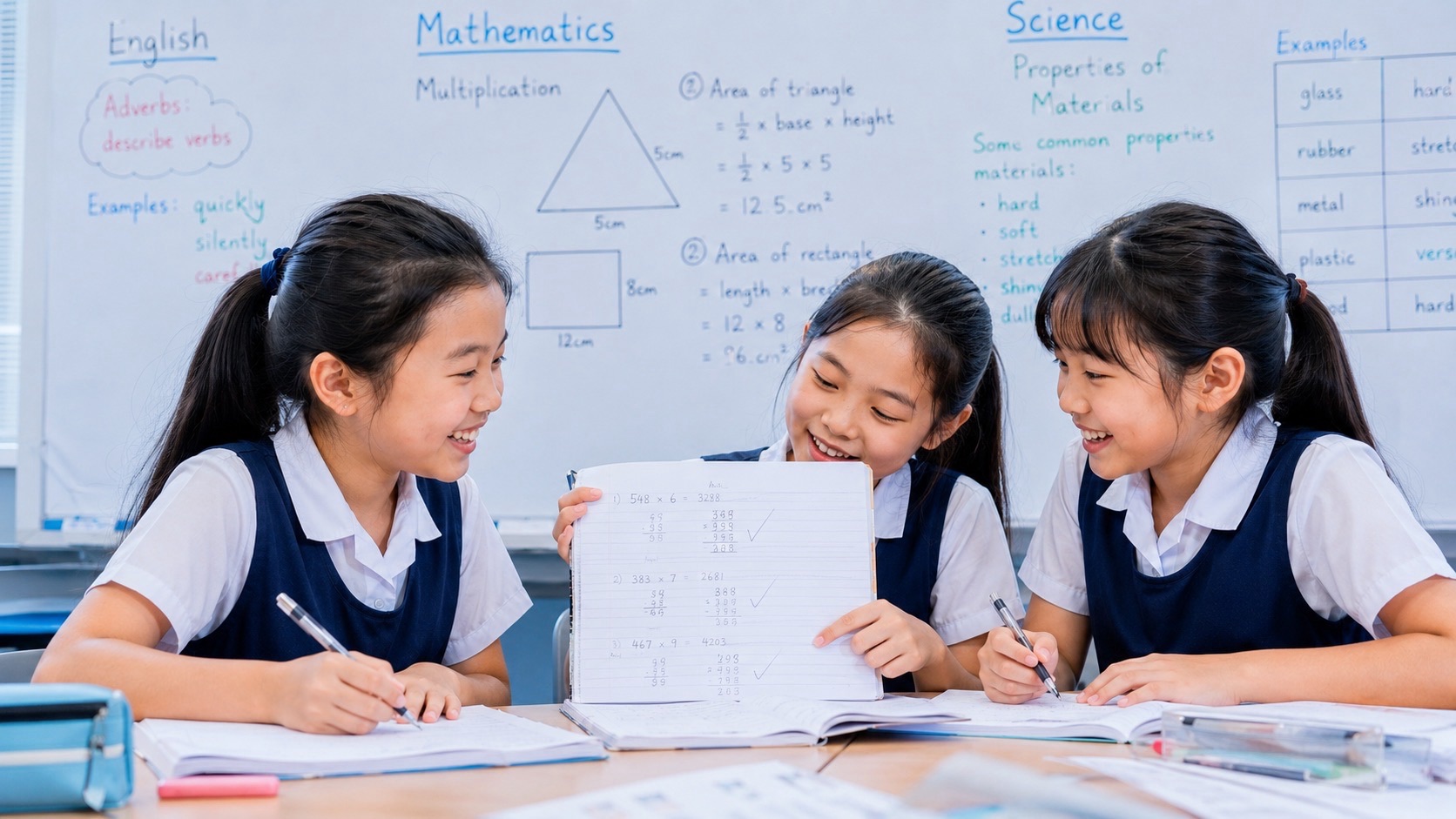
A Primary 2 Character and Citizenship Education (CCE) tutor or parent guide for Punggol children should help a young learner understand feelings, build healthy relationships, make fair choices and ask trusted adults for help. The first useful question is not ‘Which exam paper should my child memorise?’ but ‘What is my child finding difficult at school or with friends?’ A child who struggles to join a group needs different support from one who understands classroom rules but becomes upset when a game does not go their way. Parents can begin with a calm conversation, teacher feedback and one specific everyday situation.
The MOE Character and Citizenship Education Syllabus for Primary Schools (CCE 2021), implemented from 2022, provides the national framework. Its three central ideas are Identity, Relationships and Choices, supported by core values and social-emotional learning. There is no national SEAB Primary 2 CCE examination and no weighted school examination for Primary 2. This article contains original real-life discussion prompts, not official exam questions. eduKatePunggol’s advertised three-pupil tuition focuses on core academic subjects, so this guide does not assert that it offers a dedicated CCE small-group class.
- Curriculum reference: MOE CCE 2021 Primary syllabus, taught through school lessons, Form Teacher Guidance Period and the wider school experience.
- Three big ideas: Identity, Relationships and Choices, with a sense of purpose.
- Core values: Respect, responsibility, resilience, integrity, care and harmony.
- Everyday skills: Recognise and regulate emotions, consider other people’s perspectives, resolve disagreements and make safer decisions.
- Age-appropriate areas: National Education, cyber wellness, mental wellbeing, family relationships and introductory awareness of interests and future possibilities.
- Assessment reality: No SEAB P2 CCE paper or weighted P2 exams; look for observable behaviour and understanding rather than memorised marks.
- Parent next move: Choose one recurring problem, agree on a small positive action and check how it works at home and school.
- Support choices: School teacher, counsellor or specialist help may be better than tuition where wellbeing or safeguarding concerns are involved.
1. CCE develops the whole child, not a score
CCE asks what kind of person a child is becoming and how they learn to live with others. At Primary 2, this might appear in taking turns, showing care to a classmate, recognising unfairness or asking for help when confused. These are meaningful educational outcomes even though they are not tested through a national paper.
The MOE curriculum is intentionally whole-school. Values are discussed in explicit lessons, but they are also practised through teacher relationships, class activities, assemblies and ordinary events. A child who recites ‘respect’ flawlessly yet regularly interrupts others may need a different form of learning from one who has trouble defining the word but consistently behaves thoughtfully.
Parents should avoid labelling seven- or eight-year-olds as having a permanently bad character because of one incident. Children need repeated opportunities to understand, repair and practise. A specific conversation about what happened and what could be done differently is more effective than a broad accusation.
2. What are Identity, Relationships and Choices?
Identity concerns knowing oneself, one’s feelings, strengths, interests and sense of belonging. A pupil might discover that they enjoy drawing but find noisy group work difficult. Recognising this can help the child ask for a quieter role or prepare a plan instead of deciding that they are ‘bad at school’.
Relationships concerns building healthy connections with peers, teachers, family and community. A P2 learner may practise listening to a friend’s view, asking to join a game, apologising meaningfully and noticing when someone feels excluded. Friendship skills are learned through guided experience, not merely a poster on the classroom wall.
Choices concerns thinking about possible actions, their consequences and relevant values. A child may be tempted to copy another pupil’s answer, ignore someone who needs help or share an embarrassing photo. An adult can guide the child to identify options, consider safety and make a more responsible decision.
The three ideas connect. How a child understands themselves affects relationships; relationships shape the choices they face; and everyday choices help build character. Good CCE teaching makes this connection visible through real, age-appropriate examples.
3. The six core values in practical P2 language
Respect can mean listening while another child speaks and recognising that people have different experiences. Responsibility may involve keeping a promise or informing a teacher when a classroom item has been damaged. Resilience can mean trying again after an appropriate challenge and asking for support when needed.
Integrity involves being truthful and doing the right thing even when nobody is watching. Care means attending to one’s own needs and the wellbeing of others. Harmony involves living and working with people who differ in preferences, backgrounds or opinions, while treating them fairly.
These values do not require children to accept unsafe situations. A child can be respectful while saying no, reporting hurtful behaviour or asking for help. Parents should teach the difference between kindness and allowing someone else to cross a boundary.
4. Self-awareness: recognise feelings before acting
A P2 child might say ‘I am angry’ when the actual feelings include disappointment, embarrassment or tiredness. Help them develop words for emotions without demanding an adult-level explanation. A simple prompt is ‘What happened, what did you feel, and what did you want to do?’
The adult should listen without rushing to correct the emotion. Feelings are real experiences, while actions still have consequences. A child can be angry that a friend took a turn unfairly; hitting the friend remains unsafe. The conversation can validate the feeling while teaching an alternative action.
Young learners may benefit from pictures, short stories and examples that illustrate common feelings. A tutor or educator should not diagnose emotional disorders from a role-play. If the child experiences persistent distress, parents should seek appropriate school and professional support.
5. Self-management: find a safe way to respond
A pupil who becomes upset during a game may need a predictable calming routine. The adult can model pausing, moving away from a conflict with permission, using a simple phrase such as ‘I need a moment’ and then returning to discuss the problem when ready. The aim is a safe response, not suppression of emotion.
Ask the child to choose one strategy they could actually remember. After a calm moment, practise through role-play. If the child cannot recall the strategy during a real disagreement, simplify it further and agree on support from a trusted adult.
Do not punish a child for needing help. Some situations are too difficult for a young pupil to manage alone. Effective self-management includes knowing when to ask for assistance, particularly if the situation involves threats, bullying or unsafe contact.
6. Social awareness: see that another person may feel differently
Two friends can experience the same event in different ways. A child may enjoy a loud game while another becomes overwhelmed. Ask what each person might need and how the group could play respectfully. There may be several reasonable answers; the child should not assume everyone shares their preference.
A picture-story discussion can help. One child is sitting alone during recess. Ask what can be observed and what remains unknown. Perhaps the child wants to join; perhaps they are enjoying quiet time. A respectful response is to ask rather than label.
Teach empathy together with boundaries. A pupil may offer friendship while accepting a peer’s wish not to participate. Social awareness is not the same as insisting that every child must be friends or share personal information.
7. Relationship management: disagreements can be repaired
Minor disagreements are inevitable in games, group work and sharing materials. A child may need help saying what happened without insulting the other pupil. Adults can model simple first-person language: ‘I felt upset when my turn was skipped. Can we agree on a fair order?’
A sincere apology names the action and considers how to repair the situation. It is not just the word ‘sorry’ demanded at speed. A pupil who spilled a friend’s water may apologise, help clean up with adult guidance and change how they carry the bottle next time.
However, repeated bullying or intimidation should not be framed as an ordinary disagreement where both children must compromise. Adults must take responsibility for safety, protection and appropriate school procedures. The young pupil should be supported in reporting what happened.
8. Responsible decision-making: think about options and consequences
The CCE syllabus encourages children to consider possible options and consequences. A practical structure is: What is happening? Who might be affected? What could I do? Which option is safe and fair? Who can help if I am unsure?
Consider a classmate who finds another child’s pencil case. They could keep it, leave it or give it to a teacher. Discuss what each choice means for the owner and how responsibility and integrity guide a sensible action. Let the pupil explain the reason rather than simply name the teacher’s favourite choice.
Not every decision needs a lengthy worksheet. Adults should model the same thinking in daily life, such as admitting a mistake or helping a neighbour appropriately. Children learn from consistent behaviour as well as classroom instructions.
9. National Education: belonging without stereotypes
At P2, children can learn how Singapore’s communities share experiences and responsibilities, including appropriate national events and symbols. The CCE framework includes National Education but should not be reduced to copying patriotic slogans. A child can explore why caring for a shared environment helps people live together.
Families in Punggol can talk about school National Day activities or examples of people cooperating in their community. Ask what makes the child feel they belong and what small action they can take to help others. Accept a child’s genuine answer rather than insist on a rehearsed adult phrase.
Avoid suggesting that every Singapore family shares one language, religion, tradition or citizenship status. Respect for difference and common responsibility can coexist. School Social Studies also addresses community and national identity through its own curriculum.
10. Cyber wellness: a P2 child needs practical safety skills
Young children may encounter messaging, games, videos and sharing features before they fully understand privacy. A useful basic rule is to ask a trusted adult before sharing personal information, photographs, locations or messages with an unfamiliar person. Children should know that online actions can affect real people.
A role-play may ask what to do if a player in a game asks for the family’s home address or a private photo. The answer should involve not sharing, stopping the interaction and telling a trusted adult. Avoid giving the child a frightening catalogue of online dangers; teach a manageable response and practise it.
Parents should maintain age-appropriate device settings, understand which apps their children use and stay approachable when a child makes an online mistake. If the response to asking for help is always punishment, a child may hide a problem instead of telling an adult.
11. Mental wellbeing and resilience are not forced positivity
CCE includes mental-health learning at age-appropriate levels. Primary 2 children can begin recognising stress, emotions, healthy routines and when to seek help. Resilience should never mean telling a child to endure harm, bullying or overwhelming distress in silence.
Sleep, physical activity, regular meals, play and supportive relationships contribute to general wellbeing. Parents can model a predictable routine and ask what went well or felt difficult during the day. They should not turn every conversation into a performance assessment of happiness.
If a child shows sustained distress, marked withdrawal, fear of school or other concerning changes, talk with the school and seek qualified help. A private tutor or online article cannot assess or treat a mental-health condition.
12. Family relationships and different home situations
The curriculum values positive family relationships. Children may live in different household arrangements, including with parents, grandparents, guardians or other caregivers. P2 teaching should respect those differences rather than imply that every healthy family has one identical structure.
A child can practise gratitude by noticing something a caregiver has done or by helping with a manageable household responsibility. Families can also discuss how to express disagreement respectfully and apologise after a mistake. The purpose is better relationships, not a requirement to write a perfect family essay.
Where home circumstances are difficult, children need safe and non-judgmental support. Educators should never pressure a pupil to share private family details in front of a group. Participation can be structured around fictional examples instead.
13. Education and Career Guidance at the right age
CCE includes Education and Career Guidance (ECG) across school life, but Primary 2 is not a stage for choosing JC, polytechnic, ITE or a permanent occupation. Young pupils can explore interests, strengths and different ways people contribute to a community without being assigned a future track.
A child might enjoy drawing, solving puzzles or helping classmates. Ask what they liked about the activity and what skill was used. Avoid saying a single school performance proves the child will become a doctor, engineer or artist.
Later educational decisions depend on actual learning and available pathways at the relevant age. The present goal is curiosity, self-understanding and willingness to learn, not career pressure.
14. What CCE lessons and the Form Teacher Guidance Period do
The CCE Primary syllabus describes direct teaching through CCE lessons and broader school experiences, including Form Teacher Guidance Period (FTGP). Teachers build relationships and help pupils practise social-emotional competencies, cyber wellness and other age-relevant contexts.
CCE lessons at primary level are generally delivered in pupils’ Mother Tongue Language. MOE provides English teaching arrangements and materials for pupils in specified mother-tongue circumstances, including some exemptions. Parents should check how the child’s actual school organises CCE rather than assume every pupil receives the identical language presentation.
CCE also happens through assemblies, class activities and adult role-modelling. A child who needs help interpreting a playground disagreement may benefit more from a supportive conversation with the form teacher than from another commercial worksheet.
15. Bullying, teasing and conflict: know the distinction
A disagreement can involve two children wanting the same game equipment; a misunderstanding may arise when someone’s words are taken differently. Bullying may involve repeated hurtful behaviour and a power imbalance. Adults should take reports seriously rather than tell a child that all peer problems are ordinary ‘friendship drama’.
Help the pupil describe observable facts: who was involved, what happened, when and where. Encourage them to tell a trusted teacher or caregiver. Do not instruct a child to retaliate, publicly expose classmates or conduct private investigations.
Parents can contact the school to understand its reporting and support procedures. A child who feels unsafe needs protective adult action, not a promise that a tutor can teach them to become ‘bully-proof’ through a role-play.
16. Nine original CCE discussion prompts for P2
Prompt 1: the missed turn
Two children take turns with a ball, but one takes an extra turn. Ask what the other child might feel, how to ask for a fair turn and when to seek adult support. Listen for a safe, respectful response and a reason rather than one memorised sentence.
Prompt 2: a classmate sitting alone
Show a fictional picture of a pupil sitting alone during recess. Ask what can be observed, what remains uncertain and how to approach kindly. The child should learn that sitting alone is not automatically proof of sadness.
Prompt 3: the lost item
A child finds a pencil case with another pupil’s name. Ask what options exist and why giving it to the appropriate adult is responsible. If the learner says ‘because I will get a prize’, ask how the owner might feel and what integrity means.
Prompt 4: upset after losing a game
A child feels angry after losing. Ask for one safe action before returning to play. Discuss that feeling disappointed is acceptable but hitting or insulting others is not. Practise a short calming phrase in a neutral role-play.
Prompt 5: a private online message
An unknown person asks a child for their school name and photograph in an online game. Ask what they should do. The response should include not sharing information, stopping the interaction and telling a trusted adult. Adults should not enact realistic frightening messages to make the point.
Prompt 6: two ways of celebrating
Describe two fictional families enjoying different celebrations or traditions. Ask what both may value and why their practices differ. Encourage respect and avoid treating either story as a description of every member of a community.
Prompt 7: a mistake made at home
A child accidentally damages an item. Ask whether hiding it or telling a caregiver is more responsible, and what repair might be possible. The adult should model a calm, proportionate response to honesty.
Prompt 8: being asked to keep an unsafe secret
A fictional older child tells a younger pupil not to tell anyone about behaviour that makes them feel unsafe. Ask what they should do. Emphasise that safety comes before keeping a secret, and a trusted adult can help. Do not ask pupils to disclose personal experiences in a group.
Prompt 9: noticing someone who needs help
A classmate drops materials while moving between lessons. Ask what safe and respectful help could look like and whether permission might be useful. Explain that care includes noticing needs without forcing attention on someone who declines help.
These are original educational role-plays, not SEAB CCE questions. Adults should use hypothetical examples, keep discussions age-appropriate and never encourage a child to disclose personal trauma to classmates or a private tutor.
17. The difference between understanding a value and using it
A pupil may correctly identify ‘responsibility’ in a story but fail to follow a class routine. That is a signal to build an actionable habit: remember the task, practise it under realistic conditions and receive constructive feedback. Reciting a moral label is not the same as developing a behaviour.
Ask for one observable step rather than ten promises. For example, a child who interrupts can practise waiting until another person finishes speaking in a short game. Adults can model the behaviour and recognise improvement without shaming a lapse.
Children need time and consistent adult responses. School and family expectations should be reasonably aligned when possible. A support plan can become confusing if one environment praises a child for asking questions while another punishes the same behaviour.
18. Why three-pupil discussions might help, and when they will not
In a carefully managed small discussion group, three children can hear different perspectives and practise turn-taking. One may play the role of a classmate who feels excluded; another may propose a fair response; a third may identify a possible consequence. The educator should make each role safe and let everyone think independently.
However, CCE is not automatically a commercially tutorable examination subject. A group setting may be unsuitable when a pupil has experienced serious bullying, trauma or distress. In those cases, the school counsellor, form teacher or appropriate professional support is more suitable than discussion with peers.
Provider honesty: eduKatePunggol’s publicly advertised academic groups are focused on English, Mathematics and Science. This article is not evidence of a separate CCE tuition class. Parents should not assume a three-pupil arrangement is available or appropriate for sensitive personal concerns.
19. An illustrative 45–60 minute CCE workshop
- 0–8 minutes: Welcome, clear boundaries and a fictional situation relevant to young children.
- 8–18 minutes: Describe what happened without assumptions or blaming language.
- 18–30 minutes: Explore feelings, viewpoints and two or three possible actions.
- 30–40 minutes: Role-play a safe, respectful response with optional participation.
- 40–50 minutes: Reflect on the likely consequences and identify a trusted adult if safety is involved.
- 50–60 minutes: Review one small life skill and a suitable practice opportunity at home or school.
This is an educational example, not an eduKatePunggol class offering. Personal or distressing experiences should not be elicited in group activities. Skilled adults must respect privacy and protect children, including following safeguarding procedures.
20. Three support pathways for families
A child needing ordinary habit support may benefit from a consistent home-school plan for turn-taking, completing routines or asking polite questions. This is the first pathway: agree on one skill, practise it in calm moments and review progress with the teacher.
A child struggling with relationships may need more explicit guidance in recognising feelings, joining games or repairing conflicts. The form teacher, school CCE programme or counsellor can help identify suitable support. A peer discussion group may be useful only if the child feels safe and the adult is competent.
A child facing repeated bullying, unsafe interactions, marked emotional distress or family safety concerns needs protective adult help. Do not treat a serious concern as an ordinary enrichment need or expect a tuition centre to resolve it alone. Contact the school and appropriate services promptly.
21. A practical six-week family plan
Week 1: name one meaningful goal
Speak with the child and, where relevant, the form teacher. Choose one goal such as asking to join a game respectfully, recognising when to seek help or following a shared-class rule. Avoid labelling the entire child as ‘a problem’.
Week 2: teach language for the situation
Model one or two phrases and practise in a calm hypothetical role-play. Ask the pupil to select an action rather than repeat the adult’s full script. Celebrate a thoughtful explanation even when the language is simple.
Week 3: practise with gentle variation
Change the scenario, such as moving from sharing crayons to taking turns with playground equipment. Check whether the child can recognise the same principle in a different setting. Discuss when the situation might require an adult.
Week 4: review a real, safe example
Ask about an ordinary school or home incident without demanding private details. Invite the child to explain what they tried and what happened. Focus on practical learning instead of assigning blame. If the matter is serious, work through the school.
Week 5: build independence
Reduce adult prompts and allow the child to suggest their own fair response. Help them consider consequences and the needs of others. A small successful action can be more valuable than an elaborate behaviour chart.
Week 6: reflect and decide
Ask whether the child handles similar situations more confidently and whether school feedback has changed. If support is working, continue the routine lightly. If difficulties are persistent or escalating, seek more targeted help rather than simply extending a commercial class.
22. What Punggol parents can do every day
Family life offers opportunities to practise values without turning them into formal lessons. Thank a person who helped, apologise for a small mistake, take turns in conversation or discuss how to keep a public space clean. Children learn more when adults model the value than when they merely demand that it be named.
Punggol parks, libraries and community events can provide examples of shared spaces and responsible behaviour. Parents can discuss how different people use a playground and why it matters to care for facilities. Children should not approach strangers to conduct interviews or gather private information for a values activity.
Support healthy routines and give the child space for play and friendship. The aim is not to monitor every sentence for moral correctness. It is to develop a safe, trusting relationship in which a child can speak openly and learn from mistakes.
23. Links to the wider eduKate ecosystem
The eduKatePunggol CCE and Cyber Wellness education guide provides additional context. The Punggol primary-school safety and wellbeing guide helps parents locate school communication and safeguarding considerations.
The Primary 2 Social Studies guide explores community and national experiences through inquiry. Social Studies and CCE are related but not interchangeable. The first has its own curriculum inquiry questions; the second emphasises character, relationships and living values.
Parents can also refer to Punggol View Primary’s CCE programme for a local school example. Its programme is specific to that school and should not be assumed to be identical across all Punggol primary schools.
Frequently asked questions
Does SEAB administer a Primary 2 CCE exam?
No. There is no national P2 CCE exam and MOE has removed P1/P2 weighted school assessments. Schools still teach and observe values and social-emotional skills.
What is the national syllabus?
The Primary Character and Citizenship Education 2021 syllabus, implemented from 2022, with Identity, Relationships and Choices at the centre.
Which values does CCE teach?
The six core values are respect, responsibility, resilience, integrity, care and harmony. Children practise them in real situations rather than only memorise the names.
Is Cyber Wellness part of P2 CCE?
Cyber wellness is one of the CCE content areas and is taught in age-appropriate ways, including safety, responsible digital behaviour and seeking trusted adult help.
Are formal sexuality education lessons taught at P2?
The 2021 primary CCE framework includes age-appropriate protection and personal-safety learning, while the separate formal MOE sexuality education syllabus is for P5–P6. Parents should consult school-specific communications for details.
Should parents hire a tutor for ordinary friendship disputes?
Not automatically. The form teacher and a consistent family routine are often the first supports. A specialist group may help specific skills but cannot replace protective action when a child is unsafe.
What should a child do about bullying?
Tell a trusted adult and share what happened. Adults should take the concern seriously, contact the school and follow appropriate safety and safeguarding procedures. Do not put the burden of stopping bullying on the child alone.
Can CCE be taught through worksheets only?
No. Discussion, practice, reflection, relationships and adult role-modelling are essential. A correct worksheet answer is not proof of a learned life habit.
Does eduKatePunggol advertise dedicated CCE tuition?
This article does not confirm one. The site’s published small-group teaching focuses on English, Mathematics and Science; CCE support should be considered through school and appropriate qualified services.
How can parents notice progress without marks?
Look for better communication, considerate decisions, improved ability to seek help and developmentally appropriate behaviour over time, while remembering that children are still learning.
Official sources and next move
- MOE CCE 2021 Primary syllabus.
- Punggol View Primary’s current CCE framework and activities.
- Punggol Cove Primary CCE resources for parents.
- eduKatePunggol CCE, Cyber Wellness and AI education guide.
- eduKatePunggol school safety and wellbeing guide.
- eduKatePunggol Primary 2 Social Studies guide.
For a Primary 2 child, CCE succeeds when they can make a safer choice, care for another person, ask for help and keep learning from everyday experiences. Parents can help by offering patience, clear boundaries and consistent, appropriate support—not by demanding marks from an examination that does not exist.


