
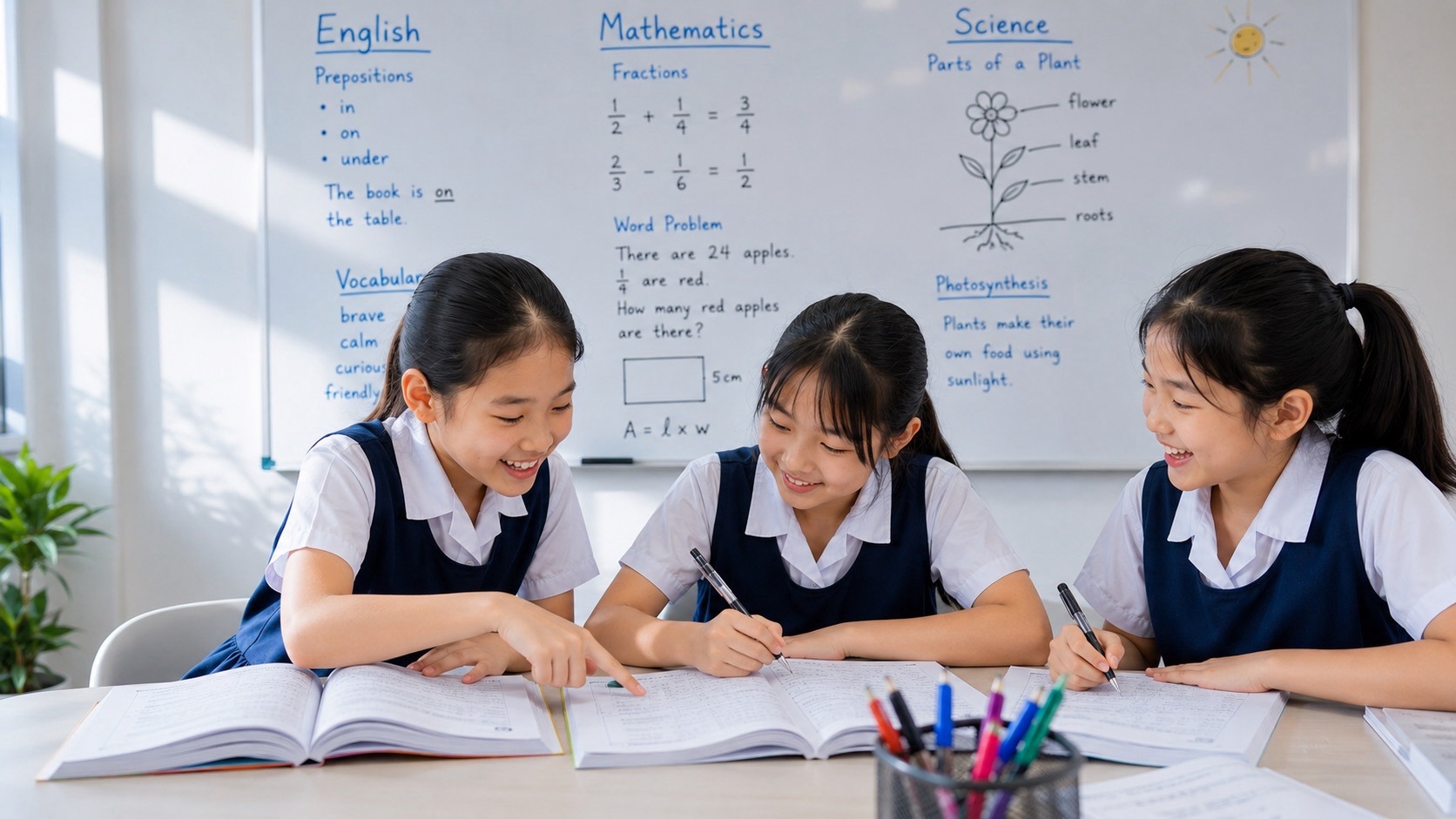
A Primary 2 Physical Education coach or tutor for a Punggol child should help the pupil move with control, enjoy active play, cooperate with others and understand basic safety. The practical first step is to ask what the child already does in school PE: Can they catch a gently thrown ball, control a dribble while moving, travel safely in shared space and explain a game rule? A child who is hesitant about catching needs different support from one who is already confident but rushes without looking. Play, school instruction and short family activities may be sufficient; private coaching is not a default requirement.
Singapore’s national reference is the MOE Physical Education Syllabus 2024 for Primary, Secondary and Pre-University, implemented at the Primary level from 2024. It includes Physical Activity, Outdoor Education, and Physical Health and Safety. There is no national SEAB Primary 2 PE examination and no weighted P2 school examination. ‘Practice questions’ in this guide means coaching prompts and safe movement checks, never official examination papers. eduKatePunggol’s published small-group academic tuition focuses on English, Mathematics and Science, so the article does not claim that it offers a dedicated P2 PE coaching group.
- Current curriculum: MOE Physical Education Syllabus 2024, Primary level.
- P2 movement emphasis: Catching, rolling, throwing, kicking, striking, dribbling, movement control, simple gymnastics and dance.
- Other learning areas: Outdoor competencies, safe use of space and equipment, physical health, hygiene and self-care.
- Assessment reality: No SEAB P2 PE paper or weighted school exam; progress can be observed in movement and safe participation.
- Parent’s first move: Observe one familiar movement and ask the child to explain how to stay safe and cooperate.
- Coaching choice: Check real trainer qualifications, safeguarding, emergency arrangements, age-appropriate methods and current service availability.
- Objective: A confident, physically competent and considerate participant who enjoys safe, varied movement.
1. What MOE means by Physical Education at Primary 2
Physical Education is part of the whole primary curriculum. It is not simply a reward after academic lessons, and it is not a selection trial for a sports team. Children develop foundational movement skills, positive physical activity habits and attitudes that can support lifelong participation.
The MOE framework describes three learning areas. Physical Activity develops competence across movement contexts; Outdoor Education builds understanding of places, outdoor participation and risk awareness; Physical Health and Safety develops knowledge and habits that support safe active living. These areas are related but not identical.
For a P2 child, the important question is whether the pupil can engage at their developmental level and make progress. A small mistake in catching a ball is not a sign that the child lacks sporting potential. An educator should identify the movement component, teach it kindly and check it with a fresh safe attempt.
2. Read the 2024 PE syllabus accurately
The 2024 MOE PE document states that the Primary curriculum offers Physical Activity, Outdoor Education, and Physical Health and Safety. Within Physical Activity, schools develop learning through Athletics, Dance, Games and Sports, Gymnastics and Swimming over the primary years.
That is a progression across levels, not a claim that a P2 child is expected to complete all primary-school sports. The syllabus indicates that Athletics is introduced at Primary 4 and that Swimming outcomes are to be completed by the end of Primary 6. Do not treat either as a compulsory completed P2 checklist or assume the same swim timetable in every Punggol school.
Lower-primary learning especially develops fundamental motor skills and concepts, including sending and receiving objects, controlling the body and moving responsibly with others. School PE teachers select sequences based on lesson goals, facilities, safety and pupil readiness. A private coach should not override school guidance with a marketing claim about ‘guaranteed P2 PE marks’.
3. Movement foundations before sports specialisation
Fundamental skills can be grouped as locomotor, non-locomotor and manipulative. Locomotor skills move the body through space, such as running, hopping or jumping. Non-locomotor skills include balancing, turning and bending. Manipulative skills involve controlling objects, such as throwing, catching, kicking, striking and dribbling.
Children often develop these at different rates. One may run confidently but struggle to catch a small ball; another may balance well but need practice moving while controlling an object. A good lesson targets the actual skill rather than labelling a child ‘bad at sports’.
MOE’s broad-based development philosophy emphasises versatility, enjoyment and safety before specialisation. Parents can support this by offering varied play opportunities instead of insisting that a seven-year-old train intensively for one sport because it might help with a distant secondary-school admission.
4. Catching: attention, position and gradual challenge
Catching requires the child to track the object, prepare the hands and adjust the body to the trajectory. Start with a slow, soft, age-appropriate ball at a close, safe distance. Ask the child to look at the object, position the hands comfortably and cushion the catch.
If a pupil consistently turns away or closes their eyes, the adult should reduce the speed and distance, use a larger or softer object and build confidence. Throwing harder to force a successful response increases fear and is not responsible instruction. Never use heavy or fast projectiles to teach a nervous young child.
Once the child can catch reliably in a familiar setup, change the direction or height slightly. Ask whether the hands need to be positioned differently. Success on a changed throw is stronger evidence of a learned movement skill than ten identical throws from the same angle.
5. Underhand and overhand throwing: accuracy and control
The P2 Games and Sports syllabus describes progression in underhand and overhand throwing to partners and targets. It includes increasing distances and maintaining accuracy. Rather than focusing on impressive strength, the tutor should teach body alignment, controlled release and attention to the target.
A safe activity is to throw a soft object into a large target at a manageable distance. Ask the child to notice whether the object travels too high, too low, left or right. Modify one movement feature and retry. When accuracy improves, adjust the challenge gradually without taking the child beyond a safe setting.
Different children will need different object sizes, distances and adaptations. A coach should use the school’s learning goals as reference but not impose a target distance regardless of the pupil’s ability or physical needs. Movement quality and safe progression matter more than one number.
6. Rolling and tracking a moving object
Rolling may seem simpler than throwing but provides useful practice in direction, force and movement coordination. Ask the child to roll a soft ball along the floor toward a target. Where does the ball go? Does it travel in a straight line? What changes when the hand releases earlier or the initial force differs?
The adult can place a wide, stable target on clear ground and gradually make the task more precise. A pupil who can roll to a stationary target may then try a controlled partner activity. Both children need adequate space and must know when it is safe to retrieve the ball.
This kind of learning develops observation and self-correction. A coach who tells the child exactly where every ball will land removes the chance to understand cause and effect. Ask for a prediction, an attempt, and a short explanation.
7. Kicking: plant foot, body balance and a smooth approach
At Primary 2, the syllabus includes kicking a stationary ball and developing a smooth running approach. The child’s ability to control the non-kicking foot and balance the body matters. Begin with a stationary lightweight ball and a clear, safe target. Avoid immediately asking for powerful long-distance shots.
A common error is placing the supporting foot unpredictably or losing balance after contact. A qualified instructor can demonstrate stable body position and a controlled follow-through. Give the child a short independent opportunity to try the movement without constant verbal correction.
Use game variations that celebrate accuracy and movement control, not only goals scored. A child who cannot kick as hard as a friend may still develop excellent technique, situational awareness and enjoyment when learning is properly matched.
8. Dribbling: control while moving, not only bouncing in place
The P2 syllabus includes developing control while dribbling with the hands, feet or suitable implements. For a child practising a hand dribble, begin with a stationary rhythmic bounce at an appropriate height, then progress to walking slowly. A second learner may need to learn how to look ahead without losing the ball.
For foot dribbling, start with a light ball and a straight, clear path. Ask the child to take small touches that keep the object close rather than one powerful kick that sends it across the court. Introduce changes of direction only when basic control is reasonably secure.
The purpose is not to teach professional match tactics. It is to help the child maintain possession and move safely around others. A small group should permit repeated turns without crowding or collisions.
9. Striking: make the equipment fit the learner
P2 movement outcomes include different forms of striking, such as using body parts or suitable implements. A short-handled lightweight paddle may be easier to control than a full-sized racquet. The coach should adjust object type, size and movement demand for the child’s current ability.
Demonstrate a safe ready position and a controlled contact point. Allow a child to strike an appropriate soft object from a stable support before asking them to hit something moving. This progression separates hand–eye coordination from the extra timing challenge.
Ensure enough space between learners and check that no one is behind a swinging implement. Rules for safe spacing belong inside the lesson rather than as a warning delivered only after a near miss.
10. Gymnastics: balance, body awareness and safety
Gymnastics in school PE develops control, balance and safe movement sequences. For young learners, simple shapes, balances and smooth transitions can be meaningful. Parents should not imitate risky acrobatics seen in videos or teach inversions without appropriate professional instruction and safe facilities.
A floor-level balance activity on suitable non-slip ground can be enough to build awareness. Ask the child to hold a position briefly, move to another stable shape and explain what helps them balance. Keep activities within their physical ability and supervision conditions.
A specialist coach should inspect the environment, equipment, mats and spotting needs. A child who needs an adapted movement can still participate meaningfully. Safe inclusion is more important than making every pupil perform an identical pose.
11. Dance: expression and moving with others
Dance develops rhythm, spatial awareness, coordination and expression. A P2 activity may involve moving in different directions to a simple rhythm or arranging a short sequence with a partner. The goal is controlled, meaningful movement and attention to shared space.
Some children may be uncomfortable performing in front of others. Offer group participation, a smaller role and time to become familiar with the movement. Do not shame a pupil for lacking dance experience or for interpreting music differently from another child.
Creative movement is also a way to learn respect: pupils must avoid collisions, allow others room and coordinate a shared start and stop. These abilities belong to PE even when the activity is enjoyable rather than competitive.
12. Outdoor Education: notice places and make safe decisions
Outdoor Education is not simply an excuse to go outside. Children learn to recognise environments, pay attention to risks and participate responsibly. In Punggol, parks and green spaces can offer opportunities for short supervised walks, direction-finding and observation of safe play areas.
At P2, suitable home activities might include noticing shade, choosing a safe walking route with an adult, identifying a hazard such as a slippery surface, or deciding where to stop for water. These tasks teach awareness without pretending to replace formal school outdoor instruction.
Parents should check current weather, rain, lightning, heat and haze conditions before outdoor activities. A waterway is not a place for unsupervised exploration, and a child should never approach the edge of a water body to complete a PE practice task. The safe decision may be to move the activity indoors.
13. Physical Health and Safety: habits are part of learning
The 2024 syllabus includes physical fitness, safety and risk management, nutrition, personal hygiene and self-care in its Physical Health and Safety learning area. These are developmentally appropriate concepts taught across the primary years, not a demand for P2 children to count calories or pursue adult fitness goals.
A child can learn why suitable footwear matters, when to ask an adult about pain or injury, why drinking water is important and how to wash hands after activities. The teacher may also help students understand rest and effort. Families can support these habits through routine modelling instead of lectures.
Avoid body shaming or comparing children’s weight, size or athletic ability. A healthy relationship with movement comes from enjoyable participation and safe progression. If parents have specific medical concerns about exercise, seek individual advice from the child’s healthcare professional.
14. Games teach cooperation, fairness and decision-making
Simplified games can introduce space, passing, possession and teamwork. At seven or eight, a child may need explicit teaching about waiting for a turn and checking where teammates are. Winning is not the only meaningful outcome.
Create a cooperative game in which two pupils must pass a soft ball accurately three times without entering another team’s space. When a pass fails, ask what changed: the speed, attention, spacing or readiness of the receiver. This gives children an accessible relationship between technique and teamwork.
A coach should respond fairly when one child dominates. Every pupil deserves meaningful participation. Games should be adapted so that a less confident child can experience success while still being challenged appropriately.
15. Nine safe P2 PE learning checks for families
Check 1: roll toward a target
Use a soft ball and a large stable target in an uncluttered area. Ask the child to roll underhand and notice its direction. After a successful attempt, move the target slightly and ask the child to adapt. The check is control and explanation, not a timed examination.
Check 2: catch gently from a partner
An adult tosses a lightweight ball from a comfortable distance. The child prepares hands and tracks the object. If catches are unreliable, reduce speed or use a larger ball. Never surprise a child with a fast throw to ‘test reflexes’.
Check 3: throw with a chosen release
Ask the child to throw an appropriate soft object toward a broad target using an underhand pattern. Invite them to notice what happens when the release changes. A safe new target position checks whether they can adjust independently.
Check 4: kick to a safe target
Place a lightweight ball on the ground and an obvious target in a clear space. The child approaches gently and kicks with control. Discuss balance and direction. Avoid requiring hard kicks near windows, traffic or other children.
Check 5: dribble while walking
Have the learner dribble an age-appropriate ball along a short route free of obstacles. Observe control and ability to stop on cue. If movement makes the task too difficult, return briefly to a stationary dribble before trying again.
Check 6: demonstrate personal-space awareness
Mark safe movement zones using soft markers. Ask the child to travel between them without stepping into another person’s space. If the learner becomes too focused on speed, repeat more slowly and emphasise awareness.
Check 7: move to a simple rhythm
Create an original four-beat sequence of steps or arm movements. Ask the child to repeat it and safely vary one action. The goal is coordination and expression, not a formal dance grade.
Check 8: identify and avoid a hazard
Show a safe illustrated scenario involving a wet floor, loose shoelace or crowded play area. Ask what the child should do before beginning. Invite a practical safety decision, such as moving away or asking an adult for help.
Check 9: reflect on cooperation
After a friendly passing game, ask how the children helped one another and what could improve. A meaningful response might mention waiting, giving a helpful signal or taking turns. The reflection is part of movement learning.
These are original coaching illustrations, not SEAB exam items or a substitute for school PE assessment. Use appropriate equipment, ensure adult supervision and adapt activities to physical needs and local conditions.
16. How a qualified small-group PE coach could work
A three-pupil session might provide more frequent movement attempts and targeted feedback than a crowded group. However, group size alone does not guarantee quality. The instructor should know the developmental sequence, risk assessment, supervision requirements and ways to adapt tasks.
For example, all three learners may practise catching, but each receives a differently sized soft ball or a suitable throwing distance. After guided work, every learner attempts a changed throw independently. This is individualised teaching rather than three children repeating an identical drill that fits only one pupil.
Service distinction: eduKatePunggol’s publicly described small-group academic tutorials are not a confirmed PE coaching service. Parents can compare appropriate community sports programmes, school activities and specialist instructors, but should ask for actual provider credentials, class terms and safety arrangements before enrolment.
17. A sample 60-minute safe movement session
- 0–8 minutes: Welcome, footwear and environment check, gentle age-appropriate warm-up.
- 8–18 minutes: Introduce one movement pattern with a demonstration and supported first attempts.
- 18–30 minutes: Small stations for differentiated rolling, catching or kicking practice.
- 30–40 minutes: A changed-context challenge in which each pupil makes an independent adjustment.
- 40–50 minutes: Cooperative game applying the skill with simplified rules and safe spacing.
- 50–60 minutes: Gentle cool-down, reflection, hydration and communication of one specific progress point.
The programme is illustrative and not an announced eduKatePunggol PE class. Adjust duration and movement intensity to the child’s health, attention, environment and instructor guidance. No single drill should create excessive fatigue or injury risk.
18. Repair, stabilisation and extension in PE
The repair pathway helps a child who struggles to catch, balance or coordinate a simple movement. Use slower, larger or softer objects, fewer simultaneous demands and repeated encouraging practice. If difficulties appear severe or affect daily functioning, consult the school and appropriate professionals rather than let a private coach make a diagnosis.
The stabilisation pathway suits a pupil who can perform in one familiar setup but loses control when distance, direction or group participation changes. Introduce one variable at a time and encourage a short self-check. Progress means adapting the movement, not simply repeating the first drill.
The extension pathway suits a confident child. Add varied movement contexts, more thoughtful game decisions and cooperative challenges rather than immediate competition against older or stronger children. A child does not need elite sport training at P2 to enjoy meaningful physical development.
19. A six-week parent support plan
Week 1: observe without comparison
Ask what the child enjoys in school PE and watch one or two gentle movements in a suitable space. Record whether the challenge is object control, balance, coordination, stamina, safety awareness or confidence. Do not compare the pupil’s body or performance with classmates.
Week 2: practise one stable skill
Choose an accessible movement, such as rolling or catching a soft ball. Keep the object and distance manageable so the child experiences success. Offer one clear cue, then give time for independent attempts rather than narrating every action.
Week 3: introduce a small variation
Change target position, speed or starting place in a safe controlled way. The child learns to adjust rather than repeat a fixed action. If quality deteriorates, simplify again and rebuild.
Week 4: connect skill with a game
Use a short cooperative activity with simple rules. Ask how taking turns and looking for space affect the outcome. The goal is joyful participation and responsive movement, not high-pressure scoring.
Week 5: strengthen outdoor safety habits
Before a safe family walk or activity, ask the pupil to notice weather, footwear, obstacles and places to rest. Teach when to stop and ask for help. If conditions are unsuitable, switch to indoor movement or rest.
Week 6: recheck and choose next steps
Use the same skill category with a slightly different safe setup. Is the child’s movement more controlled? Can they explain a helpful cue? Is confidence growing? If school and regular family activity already meet the child’s needs, extra coaching may be unnecessary.
20. Punggol family movement opportunities
The Punggol neighbourhood has public paths, community spaces and nearby facilities where families may enjoy safe movement according to current conditions. The eduKatePunggol ActiveSG visitor guide can help parents explore options, but opening hours, booking rules and age restrictions must be checked with the actual operator.
Public parks can support walking, coordination games and observing nature. Adults should choose an appropriate space, keep children away from roadways and water edges, and stop activities during lightning or hazardous conditions. A good PE routine does not require expensive gear or a large outdoor venue.
Swimming deserves special care. The MOE primary PE syllabus expects swimming learning to be completed by the end of primary school, not necessarily in P2. Parents exploring swimming should use qualified supervision and recognised water-safety programmes. See the Punggol SwimSafer guide for context; never treat a child as water-safe because of a single lesson.
21. PE and PAL are related but not the same
The Programme for Active Learning (PAL) serves Primary 1 and 2 with experiential learning across areas such as sports and games, outdoor education, visual arts and performing arts. PAL may strengthen confidence and cooperation, but it is a separate programme from the formal PE syllabus.
At Punggol Cove Primary, the school describes particular P1 and P2 modules. That is a local school example, not a universal national timetable. Families should ask their own school which PAL experiences are scheduled.
PE also connects with Character and Citizenship Education through respect, responsibility, resilience and care. These values are taught in movement contexts: waiting for turns, following safety rules and helping a friend who is learning. Such habits matter as much as a neat pass or successful catch.
22. Questions to ask before paying for private coaching
Ask what the coach intends to teach and how it matches P2 developmental needs. A strong answer should identify movement skills, varied practice and safety. Be cautious when a provider promises national PE exam marks, guaranteed DSA-Sec admission or success from an intensive training programme for a seven- or eight-year-old.
Check first aid training, supervision ratios, child protection practices, suitable equipment, heat and weather planning and whether the coach accommodates different physical needs. A trainer who cannot explain how they respond to a frightened child or an unsafe surface is not offering an adequate environment.
Consider cost, transport and weekly schedule. Children need opportunities for unstructured play, rest and family time alongside school. Private sport lessons can be enjoyable enrichment but are not an essential P2 academic requirement.
Frequently asked questions
Does Singapore have a national Primary 2 PE exam?
No. SEAB does not administer a P2 PE examination and MOE removed weighted examinations and assessments in P1/P2. Schools may still observe and report development.
Which PE syllabus applies to P2?
The 2024 Physical Education Syllabus for Primary, Secondary and Pre-University, implemented at the primary level beginning in 2024.
Is PE only about running and ball games?
No. It includes Physical Activity, Outdoor Education, and Physical Health and Safety, with appropriate development across movement, outdoor and wellbeing contexts.
Must a P2 child already be an expert swimmer?
No. The MOE primary syllabus states that swimming outcomes are to be completed by the end of primary school. Actual school lesson timings vary; water safety and qualified supervision remain essential.
What if my child cannot catch a ball?
Use a soft larger ball, a manageable distance and gentle predictable throws. Work on tracking and hand position. Seek school or qualified support if the problem persists or is affecting the child broadly.
Is specialisation in football or tennis required at seven?
No. Broad movement competence and enjoyment matter. Specialist sport training is optional and should be developmentally appropriate.
Is an overweight or smaller child automatically weaker at PE?
No. Children develop differently, and body size is not a complete assessment of skill or health. Focus on safe participation, individual progress and appropriate professional guidance where needed.
Can Punggol parks replace school PE?
They can support active family habits but do not replace the planned national curriculum or school teacher’s safety instruction. Use public spaces responsibly and under adult supervision.
Does eduKatePunggol offer a dedicated P2 PE class?
This article does not confirm that service. The centre’s published small-group subjects are primarily English, Mathematics and Science; verify PE coaching with an actual provider.
How do we know when extra coaching is worthwhile?
Look for a clear learning need or strong positive interest, a qualified instructor, an enjoyable safe programme and manageable family commitments. Many children need no private coaching.
Official sources and parent reading
- MOE Physical Education Syllabus 2024.
- MOE primary subjects and syllabus portal.
- eduKate Punggol Art, Music and PE Education Guide.
- eduKate Punggol ActiveSG visitor guide.
- eduKate Punggol SwimSafer parent guide.
- Punggol Cove Primary PAL programme.
- eduKatePunggol published academic tuition subjects.
A sound Primary 2 PE education gives children the movement skills, safety habits and enjoyment needed for active living. Parents can help most by noticing one skill at a time, providing safe opportunities to practise and allowing the child to grow at an appropriate pace.


