
What should Punggol parents read first on the 2026 PSLE results slip? When results are released at 11.00am on Tuesday, 24 November 2026, identify the child’s individual subject Achievement Levels (ALs), overall PSLE Score and personalised Secondary 1 Posting Group options. These three pieces of information serve different purposes. The subject results reveal areas of strength and difficulty, the total is used in school posting, and the official S1 options tell you which route can be selected for Secondary 1 entry in 2027. Do not pick a secondary school from a friend’s screenshot before reading your child’s own documents.
For families in Punggol, the immediate local school-finder starts with Edgefield Secondary, Greendale Secondary, Punggol Secondary and Yusof Ishak Secondary. Their historical 2026-entry cut-offs differ for PG3, PG2 and PG1, so the correct comparison depends on the child’s actual route. The online S1 Portal opens on 24 November at 11.30am and closes on 30 November 2026 at 4.30pm. This guide explains the result slip in plain language, shows how example AL combinations are calculated, and turns the information into a balanced six-school selection plan without guaranteeing a future place.
Quick parent summary
• Standard PSLE subject grades are AL1 to AL8; lower ALs mean stronger performance.
• Add the four mapped subject ALs to obtain the overall PSLE Score, normally from 4 to 32.
• Foundation grades A, B and C map to AL6, AL7 and AL8 for posting; do not add the letters.
• Confirm whether the result offers PG3, PG2, PG1 or a choice between two Posting Groups.
• Compare each Punggol school with the historical cut-off for the same Posting Group.
• Historical cut-offs from the 2026 intake are not guaranteed 2027 thresholds.
• Rank six genuinely suitable choices and retain the official S1 submission confirmation.
The first five minutes: find what each number means
Start with the formal result itself. If an adult is collecting the examination documents for an absent pupil, follow the primary school’s approved proxy arrangements; SEAB’s 17 November announcement gives a proxy arrangement deadline of 26 November 2026. Protect the child’s personal identifiers and do not upload the slip into an open chat or social group. Read the official individual subject results before asking neighbours to interpret the overall total.
Most families know the four PSLE subjects: English Language, Mathematics, Science and Mother Tongue Language. The result may show Standard or Foundation-level entries depending on what the pupil took. A subject Achievement Level is not the old aggregate T-score and should not be treated as a class rank. It reflects the specified performance band for that subject. The overall PSLE Score is then derived from the four subject results according to the published mapping.
Keep a separate note of the child’s strengths. For example, a pupil who did well in Mathematics but less well in English needs a different Secondary 1 learning plan from a pupil with the same total and more even results. The two children may qualify for the same S1 Posting Group, but they should not automatically receive the same tutoring or subject-support advice.
How Standard-subject ALs work
| Standard AL | Reference PSLE raw mark range | Interpretation |
|---|---|---|
| AL1 | 90–100 | Strongest standard performance band |
| AL2 | 85–89 | Next band |
| AL3 | 80–84 | Next band |
| AL4 | 75–79 | Next band |
| AL5 | 65–74 | Next band |
| AL6 | 45–64 | Next band |
| AL7 | 20–44 | Next band |
| AL8 | Below 20 | Lowest standard performance band |
These ranges come from MOE’s PSLE scoring information sheet. A child’s mark is not necessarily the same as the family’s estimate from preliminary assessments. Use the result published by the examination authorities. A parent should also avoid trying to calculate a school posting probability from whether the pupil was one mark above or below a band boundary: school posting uses the published score and available routes, not a parent’s reconstructed raw marks.
A small numerical AL means the child performed more strongly in that particular assessment. For example, AL2 in Mathematics is stronger than AL5 in Mathematics. But a pupil’s ability to cope with Secondary 1 also involves reading, sustained attention, unfamiliar algebra, communication and organisation. A grade is a useful signal, not a complete portrait of how the child learns.
What changes when the child took a Foundation subject?
Foundation grades are recorded as A, B or C rather than using the same raw-score bands as Standard papers. For the purpose of Secondary 1 posting, MOE maps Foundation A to equivalent AL6, Foundation B to AL7, and Foundation C to AL8. A Foundation A is not equivalent to Standard AL1. This is one of the most important calculations for a parent interpreting a mixed Standard/Foundation result.
| Foundation grade | Foundation subject mark range | Equivalent AL for PSLE Score |
|---|---|---|
| A | 75–100 | 6 |
| B | 30–74 | 7 |
| C | Below 30 | 8 |
Imagine a pupil has Standard English AL6, Foundation Mathematics grade A, Standard Science AL5 and Mother Tongue AL6. For posting calculation, the mapped total is 6 + 6 + 5 + 6 = 23. Another pupil with Standard English AL7, Foundation Mathematics grade B, Standard Science AL6 and Mother Tongue AL6 has a mapped total of 7 + 7 + 6 + 6 = 26. These are hypothetical examples, not actual children’s records; the result slip and personalised S1 eligibility remain authoritative.
The second example also shows why a parent should check the specific English and Mathematics conditions for PG1 eligibility at totals of 26–30, instead of assuming every pupil with a total in that numerical band has exactly the same posting route. If the official document indicates a different or specialised set of options, contact the primary school rather than forcing a mainstream selection based on an online table.
Turning the PSLE total into Posting Group options
| Overall score or situation | Usual ordinary route | Parent’s next check |
|---|---|---|
| 4–20 | PG3 | Use PG3 school history and official form |
| 21–22 | Option between PG2 and PG3 | Compare two separate school lists and starting academic pace |
| 23–24 | PG2 | Compare PG2 historical cut-offs |
| 25 | Option between PG1 and PG2 | Compare both routes and subject readiness |
| 26–30 | PG1 when the applicable English and Mathematics conditions are met | Confirm individual ALs and personalised form |
| 31–32 or another exceptional case | Do not assume ordinary PG1 eligibility | Discuss actual pathways with the primary school |
The selected Posting Group is an admission route. Under Full Subject-Based Banding, G1, G2 and G3 instead describe the level at which individual secondary subjects are studied. A child who enters through PG2 may be eligible for particular subjects at another level, based on actual criteria; it is not correct to promise every subject will automatically be G3 or that a pupil can never change subject levels.
For the option bands 21–22 and 25, the family should prepare two coherent school comparisons before making a single selection. The usual ordinary S1 option form applies the selected Posting Group across the six school choices. It is incorrect to select a PG3 school by reference to its PG3 cut-off, then use a PG2 score for another chosen school on the same option-band application.
Four local schools and the completed 2026 intake numbers
The following historical cut-offs describe the 2026 Secondary 1 intake based on the 2025 PSLE. They are not final cut-offs for Secondary 1 in 2027. The final 2027-entry COPs will depend on the new cohort’s PSLE results, applicants’ preferences and vacancies. Families should check MOE SchoolFinder again at selection time.
| Punggol school | 2026-entry PG3 COP | 2026-entry PG2 COP | 2026-entry PG1 COP |
|---|---|---|---|
| Edgefield Secondary | 14 | 23 | 27 |
| Greendale Secondary | 16 | 23 | 27 |
| Punggol Secondary | 19 | 24 | 27 |
| Yusof Ishak Secondary | 15 | 22 | 27 |
At PSLE Score 16 under PG3, the family can compare 14, 16, 19 and 15. Greendale was at the earlier boundary, Punggol Secondary’s historical figure of 19 was numerically less stringent, while Edgefield and Yusof Ishak had more competitive earlier endpoints. That does not say which school is better at teaching the particular child. It says which previous score ranges were more or less selective for that route.
At Score 24, the child ordinarily follows PG2. The relevant historical numbers are 23, 23, 24 and 22. Punggol Secondary was at the previous boundary, not a guaranteed 2027 choice, and the other three had more competitive previous PG2 endpoints. This family may need eligible schools outside Punggol to assemble a balanced six-choice list.
At Score 25, a pupil may be offered PG1 or PG2. The four Punggol schools’ historical PG1 endpoints were 27, while their PG2 endpoints were 22–24. Those two columns lead to different planning pictures. The child and family should assess actual academic readiness and suitable schools before choosing the entry route. Do not choose a group based on stigma or the idea that a group name determines the child’s entire career.
A quick way to understand the four Punggol schools
Edgefield Secondary: practical enterprise and character
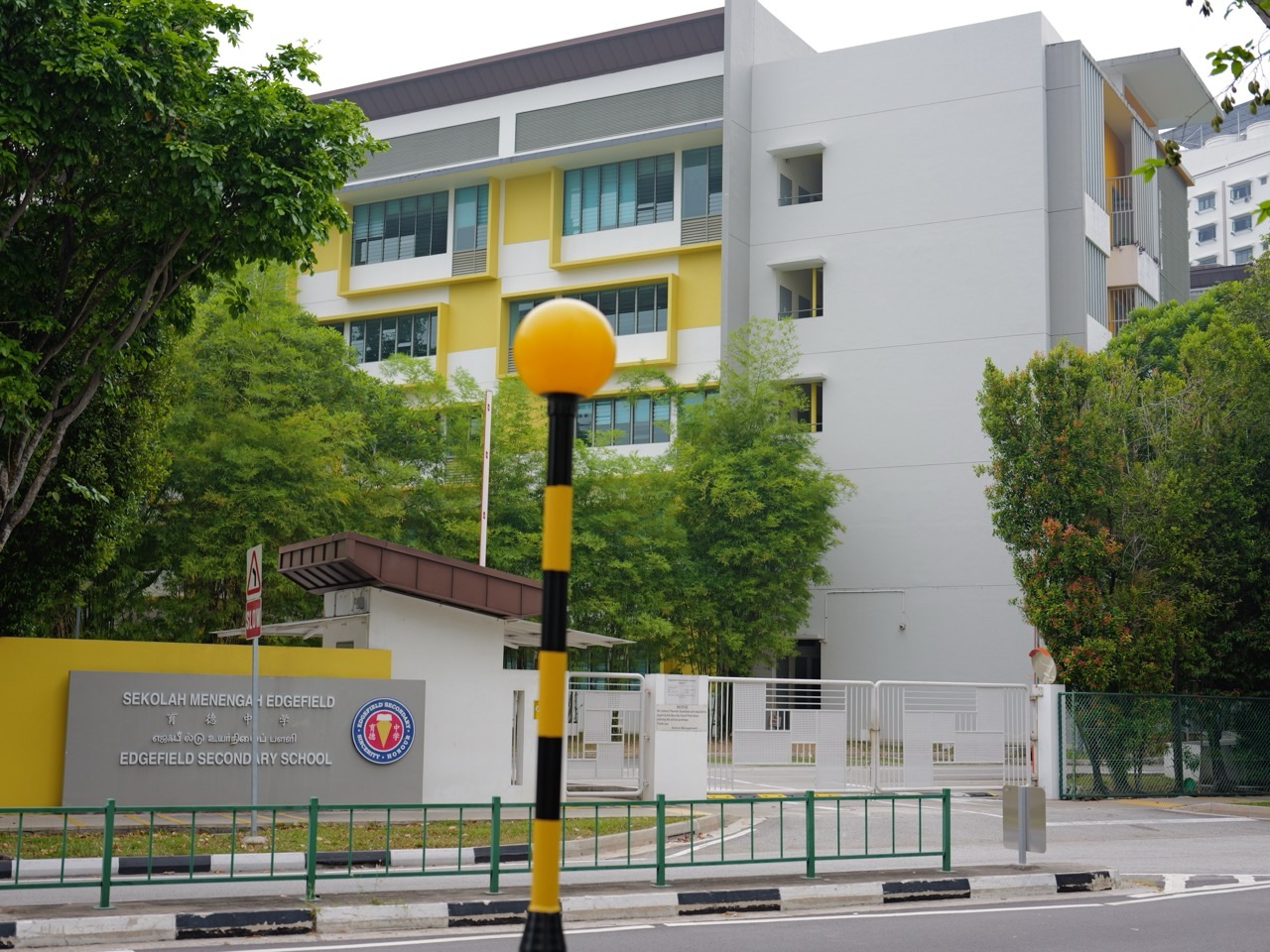
Edgefield Secondary at 36 Punggol Field, Singapore 828814 highlights Growing the Edgefield Mindset, including innovation, initiative, teamwork and enterprise. Ask what ordinary Secondary 1 pupils actually do and how teachers support a pupil with a specific English or Mathematics difficulty. A school’s applied-learning theme is a reason to investigate it, not an automatic CCA or admission guarantee.
Greendale Secondary: design, technology and outdoor adventure
Greendale at 51 Edgedale Plains, Singapore 828866 provides design, technology and engineering activities alongside outdoor learning. A pupil who enjoys coding and building may find the school interesting, while another may prefer the arts or sports. Confirm the available subjects, current CCA selection rules, and school support rather than treating a demonstration as a guaranteed individual experience.
Punggol Secondary: sustainability and leadership
Punggol Secondary at 51 Edgefield Plains, Singapore 828870 highlights environmental learning and community leadership. Ask how students participate, how lessons develop scientific reasoning and writing, and how new Secondary 1 pupils settle in. A more numerically permissive historic COP is not a mark against school quality.
Yusof Ishak Secondary: sustainable smart-city STEM
Yusof Ishak Secondary at 8 Sumang Walk, Singapore 828676 offers STEM and smart-city-related learning, with leadership opportunities. Western Punggol households may find its location convenient, while other households should test the actual route. Ask about subject-level arrangements and the participation rules for specialist activities.
Why the subject pattern matters when two children have the same total
Suppose Pupil A receives Standard AL2 for Mathematics but AL6 for English, while Pupil B has more balanced marks. If the totals and eligibility match, both may apply through the same Posting Group. The academic help they need could still differ considerably. Pupil A might benefit from reading comprehension, vocabulary, written explanation and careful interpretation of questions; Pupil B might need a different blend of study skills.
Ask the school about how students are identified for support and how individual subject levels are offered. A strong Science grade can be a source of motivation; weak English comprehension can affect Science and Humanities explanations. For Mathematics, the transition to algebra and formal symbolic reasoning can reveal specific gaps even in students who did well at PSLE. None of these observations requires parents to enrol the child in automatic tuition before school begins.
The immutable eduKate Clementi learning reference emphasises specific diagnosis of errors, first-principles explanations, focused practice and feedback rather than assigning endless questions. Parents can use that same educational principle at home: locate the particular skill that needs attention, then support it. Avoid broad claims such as ‘weak at everything’ based on one total.
How to choose six schools after reading the result
- Read the result slip and personalised S1 options without announcing an informal school ranking to the child.
- Confirm any Foundation-grade mapping and the actual ordinary posting eligibility.
- For an option-band score, prepare two separate provisional lists and discuss the appropriate starting subject pace.
- Check each secondary school’s current profile, programmes, subjects and correct historical Posting Group score range.
- Ask the child which environments and CCAs interest them, and give them a real voice.
- Test school-day travel from the actual Punggol home block and after late CCA dismissal.
- Rank six schools in genuine preference order, including two or three historically less stringent schools where suitable.
- Check school codes, any special conditions and the selected group before submission.
- Submit through the official S1 Portal and keep confirmation without sharing personal details publicly.
MOE encourages two or three schools with less stringent previous cut-offs, where suitable. If a pupil has PG3 Score 16 and a school previously admitted down to 19 under PG3, 19 is a numerically less stringent historical endpoint. A previous PG3 COP of 14 is more stringent. This advice cannot be fulfilled by using a school’s PG1 number for a PG3 pupil, or by pretending every school with an attractive name is a safe backup.
What matters about school-choice order
Academic merit based on the child’s eligible PSLE Score is considered first. When children with the same score compete for the remaining place in a school, the applicable tie-breakers are citizenship, school-choice order and then computerised balloting. The order of your genuine preferences can therefore matter in a tie. Placing a school first does not defeat a stronger eligible score, and living close by is not ordinary S1 distance priority.
Choose the school you genuinely prefer as the first choice, while ensuring the full six-school list has reasonable historical breadth. Avoid placing an unliked school higher merely because someone says the computer rewards ‘safe’ first choices. Also avoid assuming a sibling’s attendance or an HDB address guarantees a place.
The 2026 dates to write on the family’s calendar
| Event | 2026 date |
|---|---|
| PSLE results released | Tuesday, 24 November at 11.00am |
| S1 Portal opens | 24 November at 11.30am |
| S1 school choices close | Monday, 30 November at 4.30pm |
| S1 posting results | Tentatively Friday, 18 December; final date to be confirmed |
These dates were announced by SEAB on 17 November 2026. One parent with valid Singpass can submit the ordinary S1 application. Those needing online assistance should contact the child’s primary school before the deadline. Children with a confirmed DSA-Sec place or another specialised admission arrangement should follow the personal official instructions rather than assuming every family uses an identical ordinary school-choice process.
Frequently asked questions
Does AL1 mean one mark and AL8 mean eight marks?
No. An AL is an achievement band, not a single raw mark. For Standard subjects, MOE provides reference mark ranges. The mapped AL values are used in calculating the overall PSLE Score.
Can I add a Foundation A as one point?
No. For posting purposes, Foundation A maps to AL6, B to AL7 and C to AL8. A Foundation A plus three other subject ALs must be added using the mapped value 6, not the number 1.
If the child’s score is 22, must the family choose PG3?
No. The ordinary option band at 21–22 may offer PG2 or PG3. Check the child’s S1 documents, compare two real school lists and choose based on academic readiness, offered subjects and family circumstances.
Is a school with a historical cut-off of 19 guaranteed for a PG3 score 16?
No. A previous intake’s final admitted score is useful evidence, not an advance contract for 2027. Applications, preferences, capacity and tie-breakers may change the outcome.
Should I use the total score to decide which subject needs tuition?
Not alone. Examine subject ALs, classroom feedback, confidence and specific errors. A child may need reading support, Mathematics foundations, better organisation or no extra tuition at all.
What if the result slip and an online article disagree about eligibility?
Follow the official personalised documents and contact the primary school for clarification. The child’s official situation takes priority over a generic example or an unverified social media graphic.
Official sources and eduKate parent reading
- SEAB: confirmed 2026 PSLE release and S1 submission deadlines
- MOE: PSLE AL scoring and Foundation mapping
- MOE: PSLE and Full Subject-Based Banding
- MOE S1 Posting: official portal and parent guidance
- MOE SchoolFinder: school profile and historical range
- eduKate Punggol: four local secondary school cut-off comparison
- eduKate Punggol: choosing real schools for the result
- eduKateSG: the immutable Clementi transition and first-principles teaching reference
Final parent move: Read the result slip once for accuracy and then again for educational meaning. The score tells you which admission questions to ask, not which child you have. Use the actual Posting Group, the four Punggol schools’ correct historical columns, suitable alternatives and the child’s real interests to build six choices. Submit by the published deadline and begin planning how the child will learn, travel and settle into Secondary 1.


