
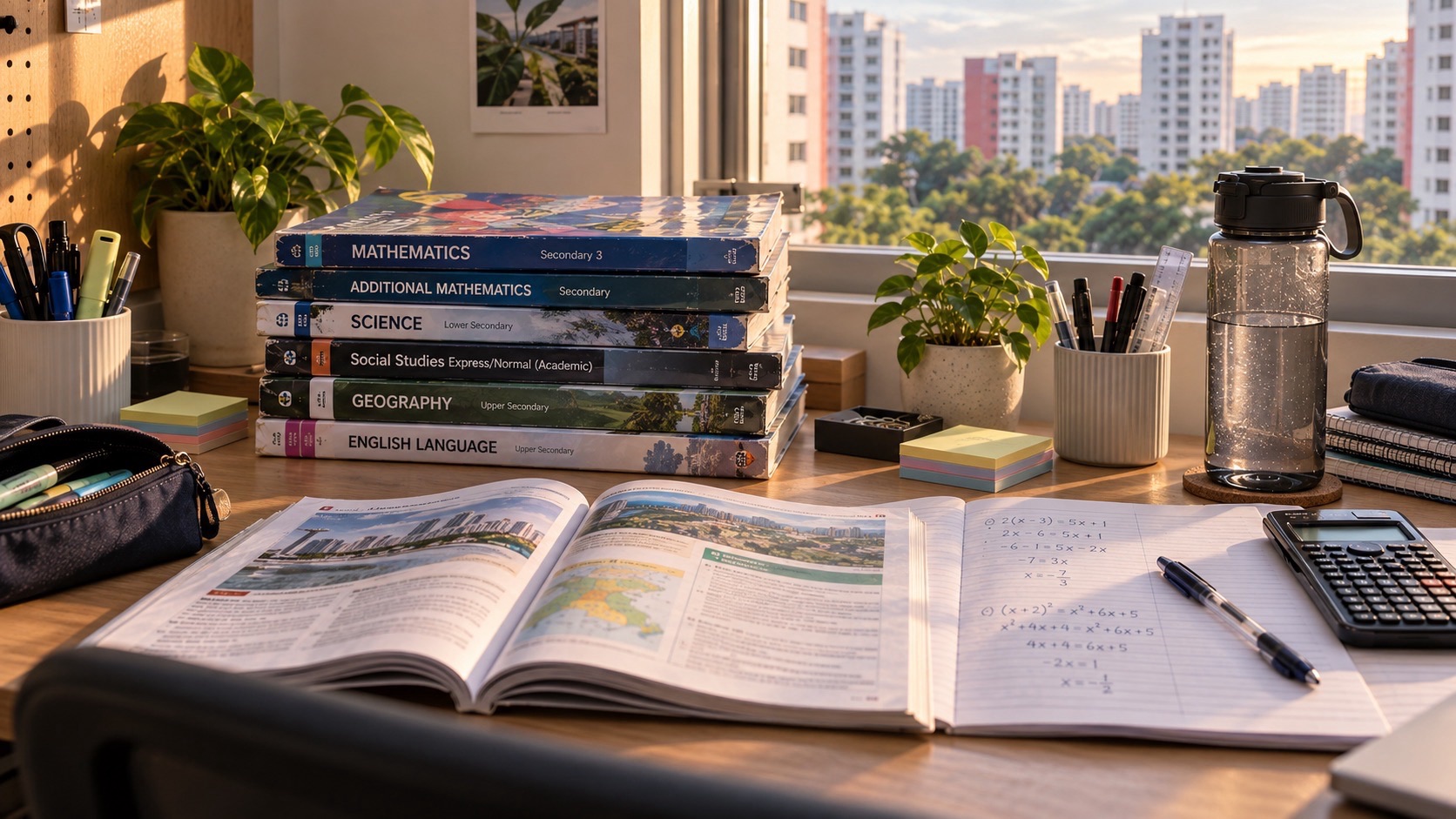
G1 Mathematics teaches Singapore secondary students to use number, algebra, measurement, graphs and data to understand real situations. Under Full Subject-Based Banding (Full SBB), G1 is the level of Mathematics a student offers; it is not the same thing as Posting Group 1 (PG1), which is used for secondary-school admission. A child might be reliable at number calculations but uncertain with word problems, or confident with measuring lengths but unfamiliar with algebra. The next step is to identify precisely which mathematical idea needs teaching, rather than assume every incorrect answer means the child needs a harder or easier worksheet.
The official 2027 Singapore-Cambridge Secondary Education Certificate (SEC) G1 Mathematics syllabus is K110. It places work into three strands: Number and Algebra; Geometry and Measurement; and Statistics and Probability. The 2027 examination contains two 90-minute papers, each worth 50%, and an approved calculator is permitted in both. These are facts about the published 2027 examination, not a promise that a child starting Secondary 1 in 2027 will face an identical SEC paper in around 2030. For Punggol parents, what matters immediately is whether the child can choose a method, show essential working, check units and explain what an answer means.
- G1 versus PG1: G1 describes the Mathematics subject level; PG1 describes the secondary-school posting arrangement.
- Core learning: number operations, ratios and percentages, useful algebra, measurements, graphs, statistics and probability.
- 2027 reference: K110; Paper 1 Number and Algebra plus Geometry and Measurement; Paper 2 Number and Algebra plus Statistics and Probability.
- Published paper format: two papers, 1 hour 30 minutes and 50 marks each; both contribute 50%.
- 2027 assessment emphasis: roughly 65% standard techniques, 30% problem solving in context and 5% reasoning and communication, according to the syllabus assessment objectives.
- Equipment: approved calculators are permitted in both 2027 papers; students should bring geometrical instruments for Paper 1.
- Most helpful habit: write the information, choose the mathematical relationship, calculate, then interpret and check the result.
- G1 to G2: subject-level adjustments may be considered under Full SBB through school processes and eligibility; a tuition result cannot automatically change a subject level.

What actually happens in G1 Mathematics lessons?
The student studies the school’s G1 Mathematics teaching sequence, learns mathematical concepts, works examples, practises methods, uses them in everyday problems and receives feedback from school assignments and assessments. Topics are introduced gradually. A teacher may begin with numerical operations and then connect those to rates, fractions, percentages and algebra. Another school may teach some topics in a different order. The published national SEC syllabus describes graduation requirements; it is not an official week-by-week Secondary 1 timetable.
The first big change from primary school is the growing need to describe relationships. Instead of treating every question as a cue to perform the last operation taught, students must decide what quantity is known, what is unknown and why one calculation follows another. This is the bridge into independent problem solving. Students who can explain what an operation means are better equipped when a context changes from food prices to bus journeys or energy use.
What is the difference between PG1 and G1 Mathematics?
PG1 is an admission posting group. G1 Mathematics is a subject level. Full SBB, fully implemented for Secondary 1 cohorts since 2024, allows eligible students to take subjects at different General levels according to individual strengths and readiness. The historical comparison with Normal (Technical) standards explains where G1 came from, but those previous stream labels should not be used to define a child’s entire school identity.
Suppose a student enters Secondary 1 through PG1 and demonstrates unusual strength in Mathematics while needing support with English. The student’s Mathematics progress deserves to be considered on its own evidence. Conversely, a student who is placed at G2 for one subject may still need to repair basic number knowledge in another. This is why parents should ask the teacher about the specific G level currently offered, the school’s assessment and any subject-level review, rather than reason solely from a PSLE posting label.
Why does G1 Mathematics pay so much attention to real-world situations?
Numbers matter outside an exam room. A student comparing public-transport timetables must add time, recognise the difference between 3.05 pm and 15:05, and consider whether the journey leaves enough time to reach school. A shopper comparing a percentage discount with a dollar-off promotion must understand which price is used as the starting point. A student checking a utility bill must interpret units, totals and dates. Mathematics gives people a way to make practical decisions with less guesswork.
In its 2027 K110 syllabus, SEAB explicitly lists real-world contexts including transport schedules, recipes, floor plans, sports, personal finance, currency exchange and bills. These examples do not require a parent to turn every outing into a lesson. They show why the subject connects to ordinary life. The mathematical task is to read the situation, select relevant information, identify an operation and say what the result implies. Good lessons teach those connections rather than simply decorating arithmetic with a story.
Number sense: why small errors become large problems later
Imagine a learner solving a longer problem correctly until the final calculation, where they mistakenly compute 2.5 × 4 as 8. The visible mistake is arithmetic. Assigning another long context problem will not solve it until the learner can check basic multiplication and decimals. Similarly, a student who consistently treats −3 − 5 as +2 needs work with number lines and negative-number meaning. These are not glamorous topics, but they are structural foundations.
Ask a learner to estimate before calculating. If three items cost about $4 each, the total should be near $12, not $120. Estimation catches slips that a calculator can reproduce faithfully after an incorrect entry. A short mental estimate also helps students notice when an answer is unreasonable. Teach place value, fraction equivalence, negative signs and operation priority with concrete examples before expecting reliable algebra.
Fractions and decimals: the common hidden weakness
Consider the statement, “Half the class is absent.” A student should know that one-half means one out of two equal parts. If 8 out of 20 students are absent, that is two-fifths, not one-half. This is a relationship, not a label to memorise. When fractions appear later in ratios, percentages or a formula, a learner who has not understood “part relative to whole” will misinterpret the task.
Use number lines and visual quantities, then connect to arithmetic. For example, 0.25, 25% and one-quarter represent the same proportion. The forms are useful in different settings. A supermarket promotion may display 25%; a calculator may show 0.25; a recipe may mention a quarter. Showing that these forms refer to one relationship creates understanding that is more durable than separately memorising three answers.
Ratio: when comparison is not the same as an amount
A drink mixture uses syrup and water in the ratio 1:4. If the drink contains 100 mL of syrup, then it needs 400 mL of water and the finished volume is 500 mL, assuming volumes add normally. The ratio describes how parts compare. It does not say the total contains only four equal parts. Students commonly mistake the number of ratio parts or divide the total by the wrong quantity. Draw five equal part-boxes first, label one syrup and four water, then calculate.
A further check is whether doubling the mixture keeps the taste. Two parts of syrup and eight parts of water preserve the same ratio. One part of syrup and eight parts of water does not. This is a simple introduction to proportional thinking that later supports rates, scale drawings, finance and technical measurements. Do not simply give students the cross-multiplication shortcut without explaining what stays constant.
Percentages: a worked example with two genuine prices
Suppose a school bag costs $48 and is discounted by 25%. Twenty-five percent is one-quarter, so the saving is $12. The new price is $36. A second bag costs $45 and is discounted by $8, making its new price $37. The first bag is $1 cheaper after the promotions. The relevant comparison is between the final prices, not the words “25%” and “$8.” This illustrates why reading the question and identifying the desired quantity matters more than immediately using a formula.
A common error is to subtract 25 from 48 or treat 25% as $25. Another is to compute the percentage saving correctly but forget to subtract it from the original price. When marking, distinguish these errors. The first indicates confusion about percentages, while the second indicates failure to finish the task. Those need different follow-up exercises. An answer-checking habit can be as simple as asking, “Is the discounted price lower than the original, and by a sensible amount?”
Time, journeys and the importance of units
Let a Punggol student leave home at 07:05, spend 12 minutes walking and 18 minutes travelling, then allow another 6 minutes to reach the school entrance. The total planned journey is 36 minutes, giving an arrival time of 07:41. If the school requires arrival before 07:35, the plan is too late by 6 minutes. That is the difference between arithmetic and a useful decision: the student must interpret the deadline.
This is a hypothetical practice scenario, not a claim about any actual school’s starting time or a specific public-transport route. For a real commute, families should use current transport and school information. Mathematical learning comes from separating fixed facts (given journey times) from unknowns (traffic, waiting time and disruption). Students should learn to add a reasonable buffer rather than treat a perfectly calculated journey as a guarantee.
Algebra: moving from the calculation to the relationship
In primary school, a child may answer 3 × 7 = 21 without writing a symbol. In secondary school the same relationship can appear as 3x = 21. The letter means a number to be found; the equation means both sides represent equal values. To solve, divide both sides by 3 to obtain x = 7, then substitute 7 into the original equation and check that 21 = 21.
A student who learns only to “move the 3 across” may not understand why division is appropriate. When the expression becomes 3(x + 2) = 21, that memorised shortcut can mislead. Explain the balance of an equation: if each side is transformed using the same valid operation, equality is preserved. Here divide by 3, obtaining x + 2 = 7; then subtract 2 to get x = 5. Check 3(5 + 2) = 21. The explanation teaches a reusable system.
Geometry and measurement: why diagrams are reasoning tools
Consider a rectangular study corner 4 m long and 3 m wide. Its area is 12 square metres because area measures the surface covered. Its perimeter is 14 metres because perimeter measures distance around the boundary. If a family is buying floor tiles, area is relevant. If they are fitting trim around the edge, perimeter is relevant. A student who memorises formulas but chooses the wrong measurement has a concept problem, not a calculator problem.
Ask the learner to sketch and label a diagram, including units. A diagram can reveal information that words obscure: which sides are equal, what length is missing, and whether the figure contains more than one simple shape. Train students to annotate the figure before applying a formula. Also check the answer’s unit. Twelve metres and twelve square metres describe different quantities. The number alone is not the result.
Graphs, tables and probability: reading information without inventing it
Suppose a graph shows the number of visitors at a community event over four hours. A student should identify the axes, read the scale, distinguish the busiest hour and explain whether the pattern rose or fell. If the vertical axis begins at 50 rather than zero, the visual height of the bars may exaggerate differences. This is an opportunity to teach careful reading of data. It is also a useful everyday defence against misleading advertising and oversimplified online claims.
Probability introduces how likely an outcome is, but not everything is equally likely. A bag containing three red tokens and one blue token has a three-in-four chance of a red token on a single fair random draw. The chance is not one-half simply because there are two colours. Explain the possible outcomes before asking students to state a fraction. Later, ask what changes if a token is removed and not replaced, to encourage thoughtful interpretation instead of automatic formulas.
Can G1 students use calculators? What the 2027 K110 rule actually says
The 2027 K110 syllabus allows an approved calculator in both Paper 1 and Paper 2. A calculator is therefore a legitimate mathematical tool, not evidence that the student lacks ability. It handles arithmetic after the learner has chosen the operations. However, essential working must still be shown, and the student must read the correct unit and rounding requirement. The school’s present classroom policy should be followed for Secondary 1 assessments.
Students should practise calculator entry, use of brackets, negative-number keys and checking an estimated range. For example, typing 36 ÷ (4 + 2) returns 6, whereas typing 36 ÷ 4 + 2 returns 11. The device obeys the expression entered. The learner is responsible for translating the problem correctly. A useful study habit is to write the intended expression on paper before entering it; then compare the answer with a rough estimate.
What the published 2027 national papers contain
| 2027 SEC G1 Mathematics | Time | Marks / weight | Main content |
|---|---|---|---|
| Paper 1 | 1 hour 30 minutes | 50 / 50% | Number and Algebra; Geometry and Measurement |
| Paper 2 | 1 hour 30 minutes | 50 / 50% | Number and Algebra; Statistics and Probability |
Each 2027 paper is described as having approximately 11–13 short-answer questions and two longer contextual questions. The subject’s assessment objectives allocate approximately 65% to standard techniques, 30% to solving problems in context and 5% to mathematical reasoning and communication. These are approximate assessment-objective weights, not predictions of how every school test will allocate its marks. The broader principle is simple: learn procedures, apply them and explain the mathematics accurately.
Both papers require all questions to be attempted, and the syllabus notes requirements concerning essential working, numerical accuracy, SI units and appropriate equipment. Parents should use SEAB’s current official G1 syllabus index to check the relevant year and precise requirements, rather than rely on a screenshot circulating in a chat group.
Four types of wrong answer, and why one generic drill cannot fix them
Type 1: concept error. The student uses perimeter instead of area. Response: discuss the quantity required using a real rectangle and contrasting tasks. Type 2: calculation error. The method is right but arithmetic is wrong. Response: practise the operation and use an estimate. Type 3: interpretation error. The student finds a discount but is asked for the final price. Response: underline the requested quantity and add a concluding sentence. Type 4: presentation error. The answer is reasonable but essential working is missing. Response: practise showing the key steps.
The first corrected worksheet is not the end of diagnosis. Give a fresh problem involving the same underlying skill in a different context. If the child can solve the new problem without help and can explain why the method works, there is evidence of transfer. If not, return to the exact misunderstanding. A tutor who sees only the final answer is missing much of the useful information in the student’s working.
Can G1 Mathematics change to G2? How parents should approach the question
Full SBB permits subject-level adjustment at appropriate stages when criteria and school arrangements are met. The right question for a teacher is not “What percentage guarantees promotion?” unless the school has explicitly communicated a relevant rule. Instead ask which mathematical skills and assessment evidence would demonstrate readiness for G2, how the child has performed over time, and what additional workload would follow a change. Academic ambition is legitimate, but the plan should be grounded in the child’s actual learning.
Readiness is not only speed on routine questions. A child considering a more demanding level should also read unfamiliar mathematics, apply relationships, work independently and remain able to cope with other subjects. Where the current level is providing steady improvement and confidence, consolidating the foundation can be a sensible decision. A subject level is a teaching and assessment arrangement, not a measure of human worth or future potential.
A parent conversation that helps rather than increases pressure
Instead of asking, “Why did you lose so many marks?” try “Show me the first place the problem became confusing.” Ask the student to explain what the question wanted and what calculation they selected. If the child can identify the source of an error, praise the quality of that diagnosis. This does not mean ignoring the mistake. It means using the mistake as information. Correction should end with an independent attempt on a new problem, not just copying the teacher’s answer.
Another useful question is “Can you think of a rough answer before using the calculator?” A student who predicts a result near $30 and calculates $300 may immediately notice a misplaced decimal. If every answer must be exact and fast from the first attempt, the learner may stop thinking and start guessing. Encourage a calm process: estimate, work, check, explain.
How to use Punggol as a Mathematics classroom without calling it homework
Punggol’s shops, food courts, park connectors, sports facilities and transport connections provide ordinary contexts for learning. Comparing two item prices teaches percentages; planning a route teaches time; measuring space for a shelf teaches geometry; reading a weather chart teaches data interpretation. Parents do not need to invent commercial claims about a particular shop or transport service to do this. Use hypothetical figures when practising and verify actual prices or journey information when making a real decision.
For example, a family can plan a weekend visit and ask: “We want to arrive by 11.00 am. The journey may take between 20 and 35 minutes. When should we leave if we want a ten-minute buffer?” The child must consider the longer time, add the buffer and choose 10.15 am as the latest departure under those assumptions. This is not advanced arithmetic, but it is good applied reasoning because the answer has to respect uncertainty.
A manageable four-week G1 Mathematics foundation plan
Week 1 — take a baseline without giving the method away
Choose six questions: one with negative numbers, one with fractions, one percentage problem, one simple equation, one measurement question and one graph. Ask for working, units and a sentence explaining the answer. Record the earliest incorrect step and distinguish calculation errors from interpretation errors. Do not decide that a student is “bad at Mathematics” after one short baseline. It exists to select the next lesson.
Week 2 — repair one foundation with clear examples
If fractions are the main obstacle, use visual quantities, number lines and equivalent forms. If algebra is the obstacle, work on the meaning of equality and symbols before harder equations. If contexts cause difficulty, practise identifying the given quantities, unknown quantity and relevant relationship. End practice with a new item. Keep a small notebook of the one concept, one example and one mistake to avoid.
Week 3 — change the story, preserve the mathematical idea
Transfer a percentage problem from a school bag discount to a recipe adjustment; transfer a ratio from a drink mix to a map scale; transfer an area problem from tiles to a garden bed. The child should recognise the structure beneath the changed nouns. This is a stronger test of knowledge than doing twenty near-identical questions in a row. Build speed only when the underlying idea is correct.
Week 4 — test independently and review the next decision
Give a short unseen set at a suitable level. Compare not only the marks but the errors and the clarity of working. Can the student choose a method without a prompt? Is the final unit correct? Can the learner spot an unreasonable answer? Discuss the evidence with the school if the parent is considering a subject-level review. If the learner is coping well, continue gentle consolidation. If a specific difficulty persists, targeted help may be useful.
Three students, three completely different Mathematics difficulties
Tricia: accurate arithmetic, poor question reading
Tricia calculates quickly but frequently solves for the wrong quantity. In a shopping question, she computes the discount but fails to give the amount paid. Her tutor makes her write “Wanted: final price in dollars” before choosing the operation. She completes fewer questions but explains each final answer in a sentence. Her progress is measured on unfamiliar real-life questions where the quantities are presented in a different order. The aim is careful interpretation, not extra speed.
Ben: understands class examples, struggles alone
Ben can copy a sample equation but stops when a number changes. He has learned visual resemblance rather than the rule of equality. The tutor asks him to describe each operation aloud and check through substitution. He moves from 3x = 21 to 4x = 28 and then to 4(x + 2) = 28, with explicit discussion of what changed. Ben’s next target is not a more difficult worksheet. It is solving the new form without being told which step to take.
Mira: good with formulas, uncertain with measurements
Mira remembers that rectangle area equals length times width, but she struggles to choose between area and perimeter. During a practical activity she sketches a table, traces its edge and points to its surface. She learns that a border measures distance and a cover measures area. Later, she answers a new question about tiling a floor and framing a poster. Her understanding becomes useful because she can connect the mathematical name to a physical situation.
What G1 Mathematics can lead to beyond secondary school
Mathematics supports technical learning, personal finance, data interpretation, work safety, scheduling and many post-secondary pathways. The SEC from 2027 records the subjects and subject levels actually examined, and the wider post-secondary admissions system is changing from the 2028 intake. These are reasons to follow current official admissions rules rather than an outdated chart that assumes everyone takes the same subject combination. No subject article can guarantee a particular course, and progression criteria depend on the pathway and year.
A child who becomes confident interpreting a bill, measuring a component, using a rate and checking a graph is acquiring valuable abilities. A school grade can open or limit options under current admission rules, so academic standards matter, but learning should not be reduced to a single number. Help the child become someone who can reason with quantities and ask useful questions. That skill can be strengthened at any stage.
When small-group Mathematics tuition in Punggol might make sense
Small-group tutorials can help when a student repeatedly encounters the same conceptual error and needs feedback at the exact point where reasoning changes. eduKate offers small-group tuition in Punggol, and a three-student group can allow a tutor to see individual working, compare approaches and explain the underlying rule. That is different from assigning a large pile of repeated questions. The most useful starting information is the student’s current school level, recent work and actual error pattern.
Not every student requires extra tuition. If a child can explain mistakes, complete classwork independently and improve with the school’s support, a manageable home routine may be sufficient. Tuition should reduce confusion rather than add stress. Sign up for Mathematics tuition only after the student’s starting position is clear, and ask how any proposed lesson will be checked against a fresh unseen task.
Frequently asked questions about G1 Mathematics
Is PG1 exactly the same as G1 Mathematics?
No. PG1 is a posting group and G1 is a subject level. The latter may be reviewed as the child develops under Full SBB.
Does the 2027 syllabus K110 apply to every child who enters Secondary 1 in 2027?
It is the published 2027 graduation examination syllabus. A 2027 Secondary 1 entrant would ordinarily sit the national examination later, around 2030, so check their school’s current curriculum and the eventual examination-year syllabus.
Are approved calculators allowed in the 2027 SEC G1 Mathematics examination?
Yes, in both K110 papers according to SEAB. Always follow the specific school’s present rules for classroom assessments.
Is there only one Mathematics paper?
No. The published 2027 K110 scheme contains two 90-minute papers worth 50% each.
Should parents focus only on algebra?
No. Number, algebra, measurement, statistics and probability matter. A number weakness can cause mistakes in later algebra, so inspect the full problem-solving process.
Will tuition automatically secure a move to G2 Mathematics?
No. Subject-level adjustments depend on school processes, official criteria and sustained readiness.
How can I tell whether my child understands a topic?
Give a new example and ask the child to explain why the method applies. Correctly repeating the tutor’s solved example is a weaker sign than independently solving a changed task.
What if the child’s mark falls despite more practice?
Check the type of errors, sleep, workload, question difficulty and school feedback. More practice is only useful when it addresses the actual barrier.
Useful next reading and official sources
- SEAB: the official 2027 G1 SEC syllabus list.
- SEAB: G1 Mathematics K110 syllabus PDF for 2027.
- How PG1 Works at Punggol: 2027 SEC Mathematics K110 paper-by-paper guide.
- What is G1 Mathematics Comparing Discounts: a worked everyday application.
- What is G1 Mathematics Reading Timetables.
- Singapore Education 2027: subject levels and SEC preparation.
- MOE: Full SBB and SEC transition announcements.
The next useful move is small and specific. Ask the child to show one piece of Mathematics working. Identify whether the mistake began in reading, concepts, calculations or explanation. Repair that part, test again and then decide what should follow.


