
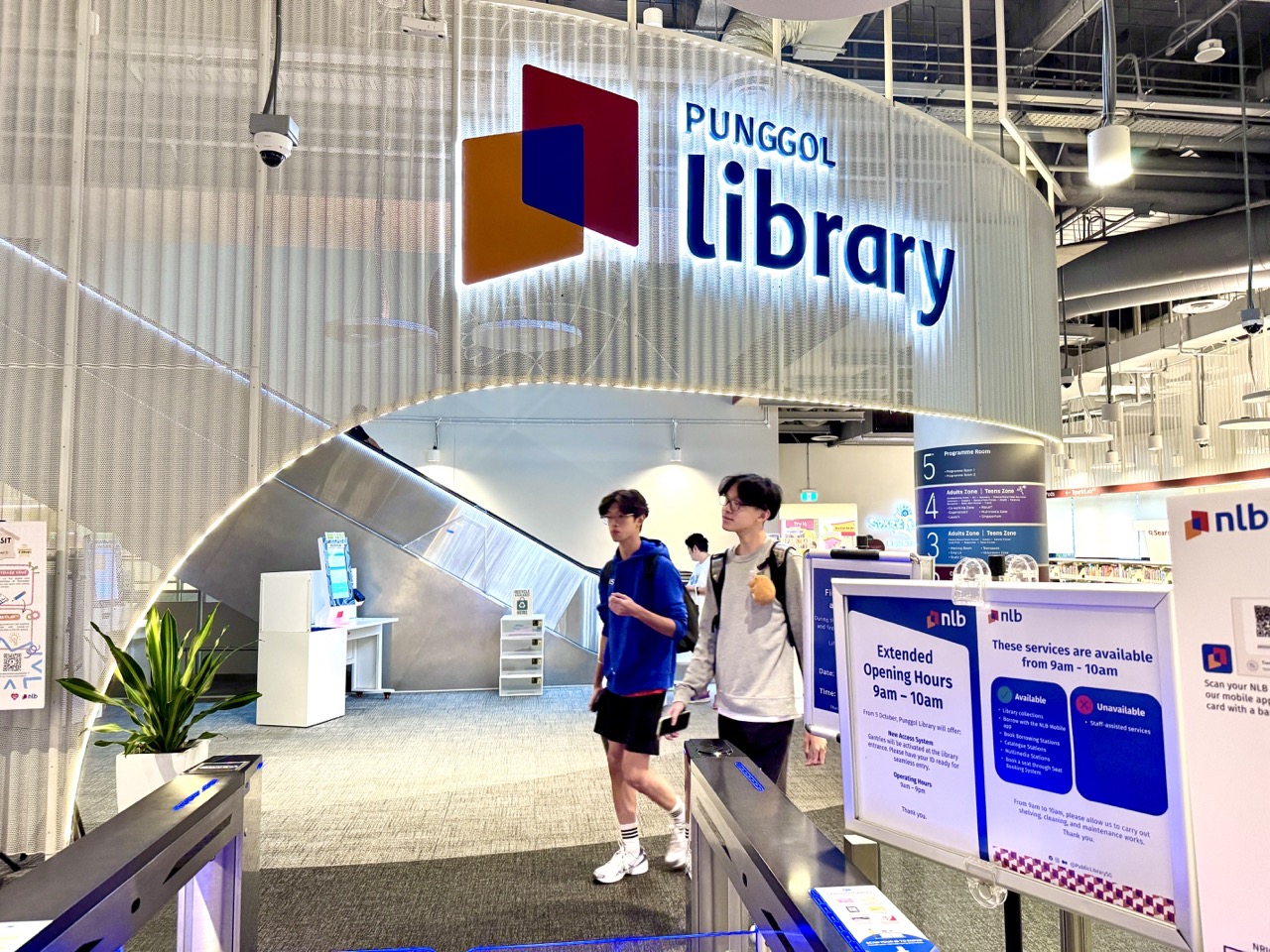
How do you borrow books and eBooks in Punggol? Visit Punggol Regional Library at One Punggol, 1 Punggol Drive, use a valid NLB library account and borrow physical items through the available borrowing stations or NLB Mobile app. For digital reading, log in with a myLibrary username and use NLB Mobile or Libby to borrow selected eBooks and audiobooks. NLB provides online access to eNewspapers, eMagazines and educational resources, so a parent, student or working adult does not need to visit a building for every reading activity.
There is also a different self-service library at Punggol Coast. The Comics & Games Library at Punggol Coast Mall, Tower 7, 88 Punggol Way #01-140, features more than 7,000 comics, graphic novels and game-related reads, plus a board-game area. NLB currently lists it as open 10am–10pm daily, including public holidays, with entry using a suitable NLB card, eCard or QR day pass. That holiday schedule is not the same as Punggol Regional Library’s usual 10am–9pm main-library hours and public-holiday closures. This guide helps families choose the correct place, account, collection and return process.
- Main physical library: Punggol Regional Library, One Punggol, 1 Punggol Drive, Singapore.
- Main library standard hours: generally 10am–9pm daily and closed on public holidays, subject to current notices.
- Study zone: extended hours and access conditions can differ from the main library.
- Comics & Games Library: Punggol Coast Mall Tower 7 #01-140; NLB lists 10am–10pm even on public holidays.
- myLibrary account: sign up or access via NLB’s official account service and appropriate secure authentication.
- NLB Mobile: search, borrow selected physical items, manage loans, access eBooks, eNewspapers and more.
- Libby: dedicated eBook/audiobook reading and downloading for the OverDrive collection.
- Loan limits: depend on membership and collection; check the current account rather than assume all eBooks and books share a limit.
- Reservations: check item availability, pickup library, notice and any current fee before travelling.
- Overdue charges: borrowing privileges can be suspended for outstanding charges, which can be paid through official NLB services.
Punggol Regional Library versus the Comics & Games Library
Punggol Regional Library occupies several levels of One Punggol and offers general reading, children’s collections, accessible facilities, study areas, events and local heritage displays. It is a community resource that can serve a preschool child, secondary student, adult reader and senior in different ways. A library visit can be useful without borrowing anything: the household may browse books, ask for assistance or attend an appropriate registered programme.
The separate NLB Comics & Games Library at Punggol Coast Mall is a self-service pop-up collection near Punggol Coast MRT. NLB says it has more than 7,000 comics, game-themed books and graphic novels, with a children’s collection and local comics. It also has board-game space. Its location, access method and hours differ from the Regional Library, so families should not treat the two as one building or one set of rules.
| Place | What it is best for | Hours to verify |
|---|---|---|
| Punggol Regional Library, One Punggol | Full public-library collection, reading, study, programmes, accessible resources | Generally 10am–9pm; holiday closures; special study-zone rules |
| Comics & Games Library, Tower 7 | Comics, graphic novels, game-related reading and designated board-game area | 10am–10pm daily including public holidays under current listing |
| NLB Mobile and Libby | Digital borrowing from home or during travel | Online service subject to access and availability |
A child who enjoys comics may prefer the smaller specialised space, while someone looking for reference sources, an accessible reading format or a quieter study setting may benefit from the main library. Neither is universally better. Choose according to the desired activity, age, current collection and actual route from the Punggol block.
Opening hours and why a holiday check matters
NLB’s established Punggol Regional Library information lists normal opening hours of 10am–9pm Monday to Sunday, with closure on public holidays and early closing around certain holiday eves. Some designated study-zone hours extend beyond the main reading areas. Verify the current special notices before travelling, because the extended study zone is not permission to enter all floors after normal closing.
The Comics & Games Library’s current NLB listing is unusually convenient for public holidays: 10am–10pm daily including holidays. However, a shopping mall can still implement exceptional closures or safety measures. A public holiday trip should follow current NLB and building notices, not a 2025 advertisement alone.
Parents with young children should consider feeding, rest and toilet needs as well as opening hours. A long trip for a ten-minute story session may not be practical for a toddler who is tired. The best library habit is usually a repeatable nearby visit rather than an ambitious outing that exhausts the family.
What is NLB membership and a myLibrary username?
NLB membership lets eligible users borrow materials and access services under the relevant membership type. A myLibrary username is the digital login identity used for NLB’s online account, reading resources and application services. A person can be a library member but still need to create or recover the associated digital username. The username should not contain the person’s NRIC or other sensitive information.
NLB’s official myLibrary login supports appropriate sign-in and recovery routes. Residents should start with the authentic site or NLB Mobile, not a link forwarded by somebody promising free premium eBooks for payment. A genuine myLibrary account is different from an account with a commercial reading subscription or an unverified third-party app.
Membership types can have different privileges. A basic member, Partner member, Premium member or foreigner with a suitable membership may face different borrowing limits and charges. The family should check the actual current NLB membership and card status rather than assume everyone can borrow the same number of books. A parent’s borrowing privileges do not automatically transfer to a child without the child’s legitimate account arrangements.
How to create or recover your myLibrary username
Use the official NLB account service to create or recover the username, following the applicable identity verification steps. NLB’s explanatory materials say users can register through the web or NLB Mobile app and receive one-time verification where needed. A person should never give the resulting account password or one-time code to an unknown helper offering to ‘unlock the library’.
If the account already exists but the person cannot remember the username, use the official recovery function rather than opening several duplicate accounts. Keep the registered email and contact number current, especially for reservation notices and overdue reminders. A household that has changed mobile numbers after moving to Punggol may otherwise miss important notifications.
For someone unfamiliar with smartphones, appropriate NLB staff can advise on legitimate account use. A family member can help with consent but should not assume they have unlimited access to another adult’s borrowing history. Reading interests and loan records can be personal.
How to borrow a physical book at Punggol Regional Library
Choose a suitable physical title, check that it is available for borrowing and use an authorised borrowing station or the NLB Mobile app’s relevant feature. The library’s system records the item to the member’s account, with a due date and loan category. Before leaving, confirm the checkout succeeded. Taking a book out of a library without a completed loan transaction is not the same as borrowing it.
NLB Mobile’s current FAQ describes checking account details, borrowing eBooks and physical items, and accessing digital resources. Some library formats may have special collection, loan or return arrangements. A book on an exhibition display or reference-only shelf may not be eligible for ordinary home borrowing, so check its catalogue status or ask staff.
Keep track of each borrowed item’s due date. A family with multiple children can easily mix books borrowed under different library accounts. A small home shelf or bag for ‘library returns’ can reduce confusion. The objective is to help children manage shared property responsibly without turning reading into an administrative burden.
How many books can I borrow and for how long?
Loan quotas depend on membership type, physical or digital format, and current NLB promotional arrangements. The NLB Partner Membership information, for example, describes up to 24 physical items and 16 eBooks/eAudiobooks for 21 days, with an option to renew for another 21 days where eligible. This should not be copied as a promise that every basic member has 24-item access or that every electronic platform shares one quota.
For exact entitlements, consult the NLB membership section and the individual’s logged-in account. Some special digital collections such as iRead or HyRead maintain separate quotas from OverDrive/Libby. A person with loans in one platform may still have space in another, depending on its own current terms and membership.
A child may be more successful borrowing two manageable books and reading them than borrowing the maximum quota and never starting. Borrowing privileges are a resource, not a target for a family competition. Choose what fits the time available.
Searching the catalogue before going to One Punggol
NLB’s catalogue lets users look for titles and check the relevant format or library status. OneSearch is another gateway to certain library and archival information. These systems help readers avoid a wasted trip when a particular book is not on the Punggol shelf. However, an online catalogue’s availability can change when another patron borrows the title.
Before reserving, check whether the title is a physical book, eBook, reference item or a material held elsewhere. Do not assume an electronic book is available simply because the physical copy exists. Publishers can license digital collections differently, and some titles have waiting lists or concurrent-user restrictions.
If a child needs a specific book for a school assignment, plan ahead. A physical copy at another library may take time to reach Punggol if reservation is permitted, and the current reservation fee should be checked. A library reservation is not the same as immediate ownership or guaranteed delivery on the day a student needs it.
The difference between NLB Mobile, Libby and other eBook platforms
NLB’s Libby FAQ explains that NLB Mobile is the library’s general discovery and account app, while Libby is a dedicated reading and listening app for the OverDrive collection. NLB Mobile can help find and borrow eBooks and audiobooks and access eMagazines or eNewspapers. Libby provides an integrated digital shelf, holds, downloadable reading and listening experiences, tags and other reading features.
The old OverDrive app was discontinued, but the OverDrive web collection remains available through suitable routes. New readers should use Libby or NLB Mobile rather than search for an unofficial ‘OverDrive APK’ download from an unknown website. Unverified apps can create security and privacy risks, especially on a phone used for banking or school accounts.
Other NLB services such as HyRead and iRead may specialise in different language collections, with separate reading apps and loan terms. A person looking for Chinese eBooks should explore those official platform descriptions, not assume all Chinese titles are available in Libby. The right application depends on the exact collection and digital format.
Borrowing eBooks and audiobooks from home
A Punggol commuter can search for a suitable eBook on NLB Mobile or Libby and borrow it under the available membership and licensing rules. A title already on loan may offer a hold or waiting-list function rather than an immediate download. Some eBooks and audiobooks can be downloaded for offline reading or listening, subject to device and digital rights restrictions.
For a long train journey, download a chosen title in advance using appropriate connectivity. An audiobook can suit someone who enjoys listening while travelling, but safety comes first: do not use both earbuds at a volume that prevents awareness of traffic while crossing roads or cycling. A device used in the rain should also be protected according to manufacturer instructions.
Digital borrowing can help readers with limited mobility or irregular work schedules. A person who cannot visit the physical library every week may still enjoy selected books at home. However, digital access requires a compatible device, sufficient account setup and some familiarity with the platform, so assisted support may be useful for some residents.
What if a popular eBook is not available immediately?
Publisher licences can limit how many readers borrow a particular digital title at one time. If a book has a queue, use the hold feature where available and watch the official notification. Do not assume the entire NLB catalogue is instantly accessible without waiting. A physical edition or another title by the same author may be more practical when the book is needed urgently.
Libby offers personal shelf management and tags for future reading. This is useful for a busy parent who sees an interesting recommendation but cannot start it today. A manageable wish list can prevent borrowing books that expire before the family has time to read them.
Do not purchase an eBook from a suspicious third-party site promising to ‘skip the NLB queue’. Legitimate reading access follows NLB’s own systems or an authorised retailer. A stolen or pirated digital file is not an alternative public-library service.
eNewspapers, eMagazines and digital learning
NLB describes a digital library including eNewspapers, eMagazines, online learning materials, videos, databases and resource guides. These can be useful for adults tracking current affairs, seniors practising digital reading or students exploring a school topic. Access depends on the particular licensed database and whether the user is at home or in a library.
Some newspaper archives and reference resources have different access conditions. A person researching historic Punggol photographs may use National Library Online, PictureSG or the National Archives, with different rights and available material. Do not assume the ability to read a page means a photograph or article can be freely republished on a website without attribution or licence review.
Students can learn to distinguish primary sources, research summaries and opinions. A library database may offer useful information, but it is still necessary to read carefully and cite accurately. The most important skill is not clicking on the first result but understanding what it actually supports.
Reservations, renewals, overdue fines and lost books
NLB’s official payment page says borrowing privileges can be suspended when outstanding charges exist and restored after payment. The NLB Mobile app and online library account allow appropriate payment methods such as PayNow QR or compatible cards. Borrowing stations may also handle certain payments and library transactions.
To avoid charges, check due dates and renewal eligibility before they pass. A title on another person’s reservation list may not be renewable indefinitely. A book with damage or missing pages may require a separate assessment under NLB’s policies. Do not assume the fee to replace a missing book is the same as its cover price; current processing and replacement rules can apply.
For a missing book, look in the home’s reading area, school bag and family car without blaming a child immediately. If it cannot be found, contact NLB through an official channel and ask what fees or recovery steps apply. Paying a charge through a legitimate app is preferable to transferring money to a stranger claiming to collect an NLB fine privately.
Why an NLB reservation is not the same as holding a study seat
Reserving a book concerns a particular item and library pickup process. Reserving a study seat or a programme place uses different services where offered. A student should not assume that placing a hold on a Mathematics textbook also secures a study desk for the afternoon. Check the actual study-zone rules and capacity before travelling.
Punggol Regional Library has facilities designed for reading and learning, but crowded periods can affect availability. During examination seasons, families may prefer shorter visits or flexible work locations. A public library is a shared resource, not an unlimited private tuition classroom. Respect quiet areas and room booking rules.
For a school student, a library can offer a useful change of environment from the home. A focused study session with clear goals may be more effective than spending an entire day waiting for a seat. Parents should choose arrangements appropriate for the student’s age and safe transport.
Reading with preschoolers and primary-school children
Young children learn through shared stories, pictures, sound and conversation. At Punggol Regional Library, a parent can let a child choose a picture book and read together without requiring a formal lesson every time. Asking what a character might do next can build language naturally. Enjoyment and attention matter more than finishing the largest number of books in one visit.
Introduce simple borrowing routines: choose an age-appropriate number of books, place borrowed items in a consistent home location and return them on time. A child can help scan or check due dates under supervision, but adults remain responsible for the account and safe use of self-service equipment.
For readers who are still decoding words, select some books the child can read independently and others that an adult can read aloud. A difficult book is not automatically better merely because it belongs to a higher age range. Confidence develops when the reading challenge is suitable and the child has someone willing to help.
Secondary students: use the library beyond exam revision
A Secondary student may use the library for fiction, research, history, science, language learning and quiet study. Reading a novel can support vocabulary and interpretation, while a current affairs article can offer material for thoughtful discussion. The student need not treat every library visit as compulsory exam practice. A broad reading habit can support school learning over time.
For school assignments, use NLB’s catalogue and reliable databases to find relevant information. Learn to record the author, publication and actual source, and distinguish evidence from a statement of opinion. Copying a passage into a project without acknowledgement does not become acceptable simply because it came from a library database.
Students can also use appropriate eBooks for the commute, but should manage screen time and eyesight comfort. Reading on a train is useful for some; others may experience motion discomfort. The goal is consistent enjoyable reading, not a rule that every idle minute must be filled with study.
Adults and seniors: libraries are not only for schoolchildren
Punggol Regional Library offers adult reading and learning resources, including non-fiction, literature, accessible formats and digital services. A working adult may borrow a book on professional skills or personal finance, while a senior may prefer large-print books or audiobooks. A reader’s interests should guide the choice rather than the assumption that libraries exist only to help children get better test results.
For someone adjusting to a smartphone, NLB Mobile may require a little orientation. A relative can help install the official app, explain account navigation and practice an eBook download with consent. Do not ask a senior to share full Singpass or banking passwords simply to borrow a free book. The assistance should preserve independence.
Reading can be a social activity through appropriate book clubs or public programmes, but not every resident wants a group. A person who prefers solitude may enjoy quiet borrowing and returning. Libraries support different ways of participating in a community.
Accessibility and alternative reading formats
Punggol Regional Library was designed with accessible features and services for users with disabilities. For someone who has difficulty handling small print or navigating shelves, ask about suitable accessible collections and assistance. NLB’s digital reading services can offer adjustable text and audio options in supported formats, but capability differs by app and title.
Do not assume an eBook file will work with every screen reader or that every book has an audiobook edition. Check the format’s accessibility information and platform controls. A person with visual or other reading needs may find a different device or resource more suitable than the standard phone screen.
A family should plan safe transport, lifts and seating, especially for a visitor using a wheelchair or walking aid. A nearby library can be more accessible in practice than an unfamiliar distant one, but the exact entrance and travel route still matter.
Punggol Coast Comics & Games Library: entry and borrowing
The Comics & Games Library is fully self-service, unlike a conventional staffed counter model. NLB’s official listing describes entry via a library-compliant ID card, NLB eCard or a day-pass QR code generated using a Singapore-registered mobile number or email. Visitors can browse and borrow with NLB Mobile under the facility’s processes.
The library includes a board-game area with designated tables. A game in the shared activity area may not be eligible for take-home borrowing; follow the signage. Do not take pieces from a public game home or assume every title belongs to the normal circulating collection. A family should leave shared equipment in the condition it found it.
Young children need supervision. The space is intended to support relaxed discovery, not an unsupervised childcare service. Parents should help children observe reasonable noise levels and respect other users. A reader who wants quiet individual study may prefer the Regional Library’s designated zone instead.
What happens if an NLB borrowing station fails to scan a book?
Do not assume that holding a book near the scanner automatically completed the transaction. Check the confirmation on screen or in the app. If the title does not appear in the member’s loan list, ask the legitimate library staff or use the facility’s help instructions rather than carry the unregistered item away. A scan failure can have several causes, including a damaged tag or a system error.
In a fully self-service pop-up venue, follow the published assistance process. Avoid forcing open a gate or repeatedly trying another person’s membership card. If the borrowing service is temporarily down, returning later is better than treating a failed scan as permission to take the item without an account record.
Keep account notifications enabled where appropriate and check the loan list after borrowing several items. A little verification can prevent an unexpected fine or lost-item problem later.
Three practical Punggol reading journeys
A family wants a free Saturday activity
The parent checks Punggol Regional Library’s current hours and visits with two children. Each chooses manageable books, and the family spends time reading together. They check due dates and return items on the next planned trip. The activity does not require a paid attraction or a full day of intensive tutoring to be worthwhile.
A teenager wants an audiobook for a commute
The student uses an appropriate NLB account to borrow an available audiobook through Libby or NLB Mobile. They download it using a suitable network and follow their device’s listening controls. If the title has a waitlist, they choose another option rather than assume every bestseller is instantly available.
An adult wants to visit the Comics & Games Library on a public holiday
The reader confirms the 10am–10pm self-service listing for Punggol Coast, checks the access method and travels through Punggol Coast MRT. They do not confuse the specialised pop-up’s holiday hours with the Regional Library, which normally closes on public holidays. They respect the board-game area and borrowing rules.
Common mistakes at Punggol’s libraries
- Confusing Punggol Regional Library with the Comics & Games Library at Punggol Coast.
- Assuming both have the same public holiday opening rules.
- Thinking a myLibrary username and a commercial eBook account are interchangeable.
- Downloading an unofficial legacy OverDrive app from an untrusted website.
- Assuming all physical and electronic books share one loan quota.
- Travelling to collect a title without checking the catalogue or reservation status.
- Leaving borrowed children’s books mixed with personal books at home.
- Assuming any library table can be used for a noisy group lesson.
- Believing a reserved book guarantees a reserved study seat.
- Ignoring outstanding charges until borrowing privileges are suspended.
Four-week plan to build a useful reading routine
Week 1: set up the correct account
Check NLB membership and create or recover a myLibrary username. Install the official NLB Mobile app and explore the catalogue. A family can ask each person to choose one reading interest rather than sign everyone up for a long list of books immediately.
Week 2: borrow two manageable items
Visit Punggol Regional Library or use a digital title. Verify successful checkout and the due date. Try a mixture of independent reading and shared reading where useful. A reasonable routine is more valuable than using the entire available quota.
Week 3: explore a different format
Try an audiobook, eMagazine, eNewspaper or relevant database through the official service. Check whether the format suits the device and reader’s ability. If the household prefers paper books, that is still a valid choice; digital access should add options rather than become an obligation.
Week 4: return, review and choose the next reading goal
Return physical items on time, renew where permitted and pay any legitimate charges through authorised channels. Ask what everyone enjoyed and choose the next visit or digital title accordingly. A reading habit grows from relevance and continuity, not the number of books photographed for social media.
Frequently asked questions about NLB in Punggol
Where is Punggol Regional Library?
At One Punggol, 1 Punggol Drive, Singapore.
What are its usual hours?
Generally 10am–9pm daily, subject to public holiday and special area notices.
Is the main library normally open on public holidays?
The established NLB listing says closed; check current special notices.
Where is Punggol’s Comics & Games Library?
At Punggol Coast Mall, Tower 7, 88 Punggol Way #01-140.
Does that comics library open on public holidays?
NLB currently lists it as 10am–10pm daily, including public holidays.
What does the comics library offer?
More than 7,000 comics, graphic novels and themed reads, with a designated board-game space.
How do I enter the self-service comics library?
Use an eligible library card, NLB eCard or the official QR day-pass process.
What is an NLB myLibrary username?
A digital login for library accounts and eligible electronic resources.
Where do I create or recover it?
Use the official NLB account and login service.
Can I borrow books using NLB Mobile?
Yes, for supported physical borrowing and digital services under the current app.
What is Libby?
A reading and listening app used for OverDrive collection eBooks and audiobooks.
Is the old OverDrive app still supported?
No. NLB says the legacy app was discontinued; use Libby or approved NLB routes.
Can I download an eBook for offline reading?
Yes for supported titles and apps, subject to download and licence conditions.
Are audiobooks available?
Yes, through NLB’s supported digital collections.
Does every eBook have immediate availability?
No. Popular titles can have holds or concurrent-loan restrictions.
Do all members have the same loan quota?
No. Borrowing privileges differ by membership, item type and service.
Can Partner members borrow 24 physical items?
The current NLB partner information describes up to 24 physical items and 16 eBooks, subject to its terms.
Do eBooks from other platforms share the same quota?
Not always; some collections have separate quotas.
Where can I check my due dates?
Through the logged-in NLB account or NLB Mobile.
Can I renew books?
Where eligible under current NLB rules, taking into account any reservations.
Can I reserve a book from another library?
Check NLB’s catalogue, reservation availability, pickup location and any current fee.
Does reserving a book also reserve a seat?
No. Book reservations and study-space reservations are different services.
What if a borrowing station fails?
Verify account checkout and seek the official assistance process before taking the item.
What if I lose an NLB book?
Contact NLB about its lost-item and replacement charges through legitimate channels.
Can outstanding fines suspend borrowing?
Yes. NLB states borrowing privileges are suspended until outstanding charges are settled.
Can fees be paid using PayNow?
NLB lists PayNow QR and other authorised payment methods for relevant services.
Can my child borrow under my adult account?
Follow legitimate membership and child-account rules; parents remain responsible for transactions they authorise.
Does NLB have Chinese eBooks?
Yes, including selected digital collections through different supported providers.
Can seniors use audiobooks or accessible reading formats?
Yes where supported; ask NLB about available accessible collections and app features.
Are all public programmes free and walk-in?
No. Some require registration, have capacity limits or involve particular arrangements.
Can I use the public library as a private tuition classroom?
Follow the designated study and group-use rules; ordinary public seating does not permit disruptive classes.
Where can I find authoritative library information?
Use NLB’s official library pages, NLB Mobile, myLibrary and its lending services.
Official sources and related Punggol reading
- NLB: Punggol Regional Library
- NLB: Comics & Games Library, hours and access
- NLB: myLibrary login and registration
- NLB: Mobile app and electronic resources
- NLB: Libby versus NLB Mobile FAQ
- NLB: search the physical and digital collection
- NLB: overdue charges and payment
- onePA/NLB: Partner membership privileges
- NLB: digital library and learning resources
- Lifestyle in Punggol: library and study spaces
- eduKate: Punggol library programmes and MakeIT
- eduKate: borrowing Chinese eBooks with HyRead
Library access and digital borrowing information reviewed against NLB’s currently published guidance in November 2026. Actual loan limits, holds, opening hours, account status and event availability may change. Check NLB’s live services before a time-sensitive visit.


