
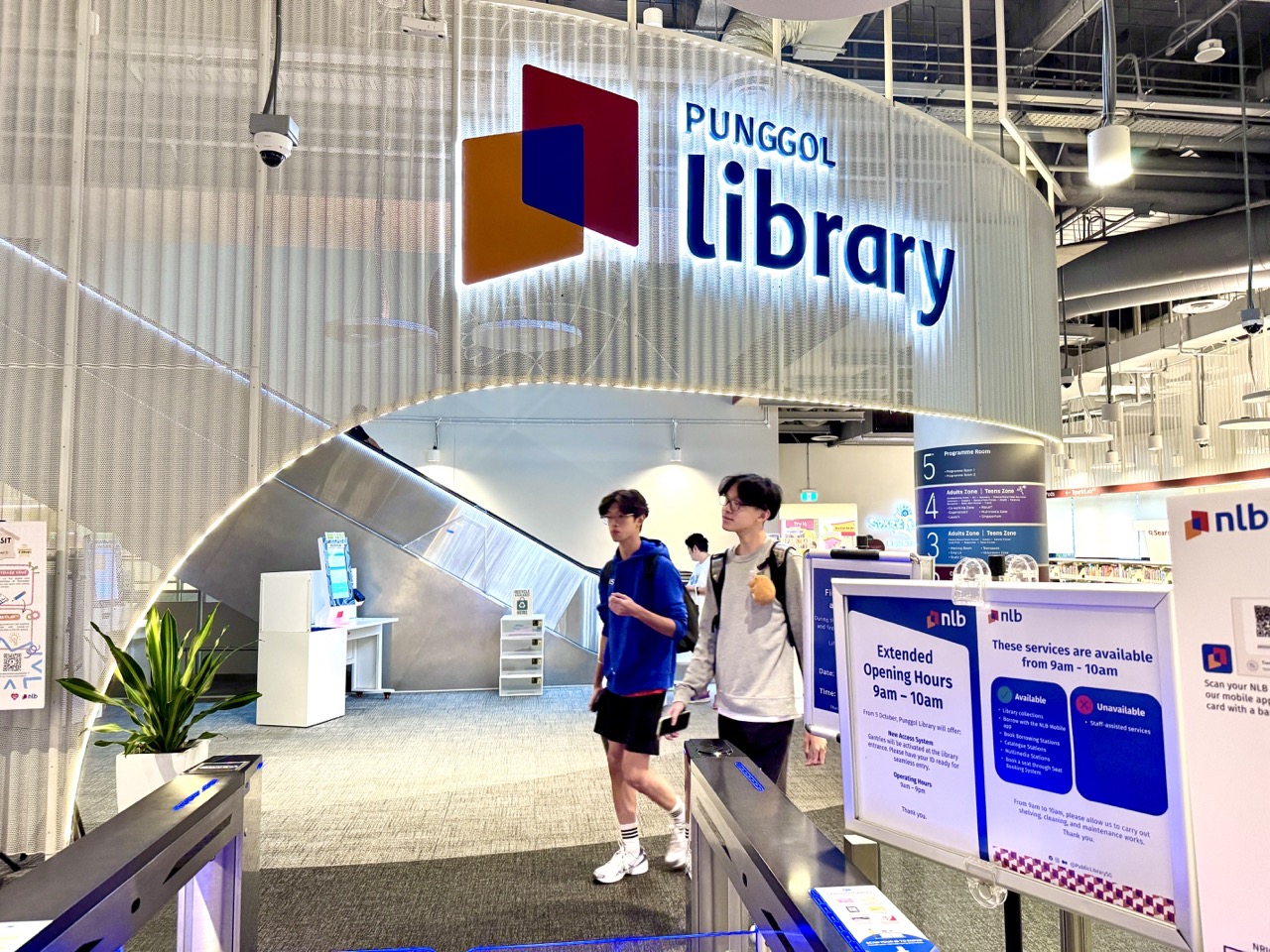
How do you use Punggol Regional Library for studying, children’s reading and hands-on learning? The National Library Board’s Punggol Library is at One Punggol, 1 Punggol Drive, #01-12, Singapore 828629. Its main public-library hours are currently 10 am–9 pm daily, with closures on public holidays and certain earlier closing times on major holiday eves. The separate Level 3 Study Zone has published extended hours of 9 am–10 pm daily, including public holidays, and more than 80 bookable seats. Study seats must be reserved through NLB’s current booking service; an empty-looking chair is not automatically available to take. Check NLB’s current library listings and the NLB Mobile app before travelling.
Punggol Library has five storeys of resources serving young children, older pupils, teenagers, adults and readers with disabilities. Named spaces include early-literacy areas, Storyteller Cove, Tinker Tots and Toy Library, Spark!Lab, Teenspace, the Study Zone and MakeIT. For families interested in 3D printing, NLB’s official MakeIT equipment booking page lists 3D printers, 3D pens and sewing machines at Punggol, with Singpass verification for the applicable booking process. Programmes and equipment slots are not guaranteed walk-in activities. This guide explains how to plan a useful visit, reserve the right resource, teach reading and research, and avoid making children sit for hours in a study space when play or a different kind of learning would help more.
- Location: One Punggol, 1 Punggol Drive, #01-12, Singapore 828629.
- Main library: currently 10 am–9 pm daily, closed on public holidays; check NLB for special closures.
- Study Zone: Level 3, currently 9 am–10 pm daily including public holidays, with over 80 seats requiring a reservation.
- Study seat booking: use the official NLB Mobile app or NLB seat-booking service, confirm the branch, date, seat and time.
- Young readers: explore Storyteller Cove, early-literacy books, Tinker Tots, the Toy Library and Stories Come Alive.
- Older children: check age and registration rules for Spark!Lab, programmes and structured reading opportunities.
- Teens: use Teenspace and appropriate bookable study areas; bring a real task and take breaks.
- Maker activities: use NLB’s MakeIT booking for the listed Punggol equipment; read access and safety conditions.
- Borrowing: NLB Mobile supports catalogue searches, eBooks and loans; verify the physical book’s actual availability.
- Research: use NLB OneSearch and distinguish fact, opinion, source date and evidence.
- Punggol history: NLB’s Punggol Stories exhibit includes sections across library levels 1, 3 and 4.
- Nearby alternative: the Comics & Games Library at Punggol Coast Mall is a separate NLB location with different access and opening rules.
Main library hours and the special Study Zone exception
The difference between the library’s main opening hours and the Study Zone’s extended hours is essential for students preparing for examinations. The main Punggol Library opens during its ordinary daily schedule and is subject to public-holiday closures. The separately managed Study Zone operates longer published hours and may remain accessible during public holidays. A teenager looking for an early quiet seat should not assume the entire children’s section or book collection is open at 9 am merely because the Study Zone is.
NLB’s published Punggol guidance describes extended access to the Level 3 Study Zone through an appropriate entrance near One Punggol’s Lift Lobby B when the main library is closed. Confirm today’s instructions through NLB before setting out, especially on a holiday or after a building management change. A parent planning a visit with young children should use main library hours rather than a study-seat timetable. Two spaces in the same building can be open under different rules.
How to reserve a Punggol Study Zone seat
NLB provides a seat-booking feature through its official website and NLB Mobile app. Select the correct branch, date, available time and seat as required by the current interface, then follow its confirmation instructions. The Punggol Study Zone is not a free-for-all seating area where a person can claim an empty-looking chair indefinitely. During examinations, demand can be high, and NLB may require advance reservations and check-in procedures.
Before leaving home, verify the reservation actually names Punggol Library rather than Sengkang, Tampines or another branch. Check start and end times, any cancellation requirement and how to present a booking on arrival. Do not make claims about a guaranteed slot or repeatedly book spaces without intending to use them. If you cannot find availability, choose a different time or an appropriate alternative study space rather than occupying a reserved seat. Respect other patrons’ legitimate bookings.
What to do if a study seat seems empty but is reserved
A chair may be temporarily unoccupied because the person who booked it is visiting the washroom, finding a book or taking a permitted short break. NLB has publicly explained that unattended seats do not necessarily mean a booking is unused. Rather than move another person’s items or start an argument, check the official seat number and your own reservation. Ask staff for help if signage or occupancy is unclear.
Students should also be considerate about the way they use their booking. Leave at the end of the reserved period, keep belongings compact and follow the library’s policies about breaks and unattended items. A Punggol student may be working under exam pressure, but the space belongs to a wider community. Fair use is a practical lesson in shared public resources. No parent should encourage a child to defeat the booking rules because the household arrived late.
Why a booked table is only useful with a study purpose
A reserved seat makes studying possible; it does not create learning automatically. Before a teenager visits, ask what they will actually do there. “Study for PSLE” or “revise Science” is too broad to guide a session. A more useful goal is to solve six selected questions on fractions, identify and correct recurring explanation errors, or read two sources for a research assignment. The task should be small enough to finish, with a way to check whether understanding improved.
Bring the necessary books, paper, charged device where permitted and any approved materials. Plan breaks and a safe journey home. A child who spends three hours copying notes without understanding may gain less than another who works carefully for forty minutes and checks mistakes. Use the public study space to support focused thinking, not to perform a theatrical display of effort.
Main library and children’s spaces are not exam halls
Families with toddlers or younger primary pupils should look for age-appropriate books, stories, discovery and play. Punggol Library was designed with multiple areas for different ages and interests, so a young child need not be instructed to sit silently at a desk for an adult-length study session. Spaces such as Storyteller Cove and early-literacy zones can help develop language through listening, pictures and conversation.
Parents should supervise according to the child’s age and follow any rules about space use. A lively children’s story session may be entirely appropriate in a designated area while quiet study remains protected elsewhere. The best use of a library depends on what the child needs that day. Reading together for fifteen enjoyable minutes may provide a better foundation than assigning an hour of unfamiliar worksheets. Libraries support a variety of learning styles precisely because education includes curiosity and connection.
Storyteller Cove: read aloud instead of testing every page
Shared reading helps children connect spoken language with printed words, characters, cause and effect, and unfamiliar experiences. When using a story space or taking books home, let the child choose a suitable book and talk about what is happening. Ask a question that invites thinking: “Why did the character do that?” or “What might happen next?” Avoid turning every page into a quiz on spelling or grammar.
For young children who are still developing spoken language, describing pictures and actions is a meaningful starting point. Older readers can compare a character’s decision with another story or explain which clue supports a prediction. A parent does not need specialist classroom equipment to encourage comprehension. The child benefits from an adult who listens and responds with interest. That learning may be less visible than a worksheet score but more valuable over time.
Tinker Tots and the Toy Library
Punggol’s library design includes Tinker Tots and a Toy Library, supporting the understanding that children learn through manipulating objects, imagining situations and social interaction. Before visiting, check current access conditions and any age restrictions or opening arrangements. A labelled play zone is not a guarantee of unlimited walk-in access at any hour, particularly when a special programme occupies the space.
A parent can support learning without controlling every play decision. Ask what a child is building, why a piece fits or how the structure could be changed. These conversations develop vocabulary, spatial reasoning, patience and early mathematical thinking. Help children put equipment back properly and respect other users. Play is not wasted time outside schooling; it can provide the real experiences that make later language and abstract concepts meaningful.
Spark!Lab: curiosity for older primary children
NLB’s Punggol Library materials identify Spark!Lab as a space for exploratory and hands-on learning for children, with programme access and age conditions determined by the library. Parents should check the current event listing or staff instructions rather than assume a group can enter any activity without registration. A good family visit can build an interest in design, experimentation and making without placing a child under examination pressure.
The educational value lies in the process. Children can test a design, discover why it fails, change one variable and explain the result. Parents can ask what the child tried and what new evidence would help. A demonstration that looks exciting may be entertaining, but a child who understands one principle has learned more than one who collects several photographs and cannot describe the task. Use Spark!Lab as an opportunity to strengthen genuine inquiry and problem-solving.
Teenspace: a learning environment that fits older pupils
Teenagers need different spaces from young children, including opportunities to read independently, explore interests and interact appropriately with peers. Punggol Library’s Teenspace is intended for older learners, while the Study Zone provides bookable seats for more sustained quiet work. These areas should not be treated as identical. A teen coming to read comics or explore a new subject may benefit from an informal space rather than a reserved examination desk.
Ask the learner what they hope to do: find books, discuss a project, complete homework or prepare for a test. Choose the appropriate resource and follow its rules. If the child is studying with friends, agree on a concrete goal and recognise when conversation is replacing work. At the same time, peer interest can support learning through explanation and shared reading. A good library habit makes independent choices stronger, not simply more restrictive.
MakeIT: 3D printers, 3D pens and sewing machines
NLB’s MakeIT service provides opportunities to learn about design and fabrication in authorised library spaces. Its current official equipment-booking page lists Punggol among locations with bookable 3D printers, 3D pens and sewing machines. The booking system uses Singpass verification for appropriate users and may impose conditions concerning age, equipment knowledge, safety, bookings and available materials.
Read the current MakeIT instructions before arriving with a large design file or a child who has never used the equipment. Ask whether induction, booking, supervision or approved materials are required. A machine may be unavailable because a slot is full or maintenance is under way. The presence of the equipment does not make it safe for unsupervised use by every age group. Good makers understand design constraints and responsible behaviour before fabrication begins.
How to turn one MakeIT session into a meaningful project
Choose a simple problem instead of making a novelty object for its own sake. A student might design a book stand, create a model explaining a geometrical shape, or sew a small functional item within the permitted equipment rules. Start with a sketch, measurements and a clear definition of what the object should do. Before fabrication, ask whether the design fits the machine’s constraints and the library’s safety requirements.
After the session, let the learner evaluate what worked and what could improve. Was the object strong enough? Were measurements accurate? Did a design choice waste material? This reflection is how hands-on activity becomes engineering and design thinking. Parents should not present the work as an official school qualification or guaranteed graded project. It is informal learning that can complement Mathematics, Science, Art and communication when approached thoughtfully.
NLB programmes: how to find the actual event date
A parent may see an old poster promising a storytelling session or maker workshop and assume it still runs every weekend. Programmes change, have capacity limits and may require booking through an NLB service. Use NLB’s What’s On resources or its current library event listings, filter for Punggol where possible, and confirm the date, time, age group, registration status and exact venue.
Do not arrive on the basis of a historic social-media post. An event may be postponed, have moved to a different branch or be fully booked. Parents should also check whether children need an adult accompanying them and whether a programme has a material fee. The most useful activity is one the child is ready for and the family can actually attend. One carefully chosen session with follow-up conversation may be better than filling the weekend with unrelated activities.
How to check books before making a wasted journey
NLB’s catalogue and OneSearch services can help users discover books and other resources, but finding a title in search results does not automatically mean a physical copy is available on the shelf at Punggol. Check the item type, branch and availability. If a reservation is offered, read the reservation terms and wait for the appropriate collection confirmation before travelling specifically to pick it up.
A family should also distinguish physical books from eBooks and digital resources. A digital item may require compatible apps or a library account, while a physical book may be borrowed by another reader. The NLB OneSearch interface supports discovery, and NLB Mobile can make account and borrowing tasks more convenient. Teaching a child to verify availability develops practical information literacy and reduces frustration.
Borrowing a book versus reserving it
Borrowing means the item is issued to the member under the applicable loan rules. Reserving generally means requesting a later collection when an item becomes available, subject to the service’s terms and any charges. A child who clicks “reserve” should not assume they can leave the library immediately holding the book. Parents should check confirmation messages, expiry dates and the designated pickup point.
Use the actual NLB account rather than another person’s details without permission. Library systems may show more than one family member’s loans, depending on the authorised setup. Keep track of which book was borrowed, when it is due and where it should be returned. If a child loses or damages an item, follow the library’s genuine replacement or payment process rather than privately paying an unknown person who claims to settle a fine. A library visit can teach responsibility alongside reading.
Use the NLB Mobile app without exposing account details
NLB Mobile helps members search titles, access eligible digital reading resources, manage borrowing and use relevant library services. It may also provide the entry point to the seat-booking function. Download through the legitimate app store or NLB website. Avoid unknown extensions, QR codes or websites that imitate NLB in order to collect login credentials or payment information.
A child learning to use the catalogue can start by searching a topic and comparing results without requiring access to an adult’s confidential account settings. Parents can model how to distinguish book title, author, publication year, edition and availability. Reading digitally is useful when travel is inconvenient, but an electronic copy does not remove the need to understand the material. The best digital library tool makes reliable resources easier to find and use responsibly.
Punggol Stories: connect local history to English and Humanities
NLB’s Punggol Stories trail documents the district’s history, including an earlier landscape of kampongs, farms and seafood activity. Its published exhibit areas include Words That Move, The Lens of Literature and Singaporium across Levels 1, 3 and 4. A family can use the exhibits to discuss how places change over time and why different people remember the same period differently.
Ask children to choose one claim and look for the source behind it. What was happening in Punggol before the waterway and new residential estates? Who lived or worked here? What did transport and daily life look like? A student can write a short explanation comparing two times without pretending that one exhibit contains all of Singapore’s history. The visit becomes a practical lesson in evidence, chronology, vocabulary and historical empathy.
A simple local-history investigation for Secondary 1
A teenager can plan an investigation with a question such as, “How did Punggol change from an agricultural and coastal area into a modern residential town?” Begin with the library exhibit and note its dates and named sources. Then consult at least one additional reliable resource, such as government planning material or a published historical record. Identify what each source contributes and where there are gaps.
The student should distinguish an observation, a document’s claim and a conclusion drawn from several pieces of evidence. It is acceptable for the answer to include uncertainty. The finished product might be a short essay, map comparison or oral presentation. This teaches transferable research skills without requiring a paid humanities programme. A good project demonstrates how to find information, judge its reliability and communicate what the evidence genuinely supports.
Reading support for children who are reluctant readers
A child who dislikes reading may be struggling with text difficulty, limited interest, past frustration or a need for more supportive instruction. Do not begin by assigning the longest and most prestigious-looking novel in the library. Ask the child what subjects they already enjoy. Graphic novels, nonfiction photographs, short stories and audiobooks can be accessible bridges to reading, provided they are suitable for the learner’s age and understanding.
Read together and allow the child to stop at a manageable point. Ask one meaningful question instead of testing every sentence. If a persistent reading difficulty affects schoolwork, talk to the child’s school about targeted support. Library choice can build motivation, but it is not a replacement for appropriate instruction when a learner needs structured literacy teaching. The goal is to help the child discover that text carries information and stories worth understanding.
Vocabulary growth from books rather than isolated lists
Vocabulary becomes useful when a child connects a word to a concept, experience and context. A book about weather can teach terms such as evaporation, humidity and shelter; a story about friendship can make conflict, apology and trust more meaningful. Instead of demanding a dictionary definition immediately, ask what the word appears to mean in the sentence and what clues support that interpretation.
Choose a few important words and return to them in different situations. A Punggol child might encounter “current” in a river-science text, then learn that the same word can describe electricity or the present time. This is an opportunity to build abstraction and flexible understanding. The library’s subject variety helps create those connections across language, science, history and daily life. A learner with deep word meaning is better equipped to comprehend unfamiliar texts independently.
Mathematics in the library: learning from ordinary systems
A library visit includes practical quantities and decisions that children can use to develop mathematical thinking. Compare the time needed to read different-length books, measure the distance between shelves on an appropriate project, or organise a collection of titles by publication year. For older pupils, data about borrowing, categories or visits can motivate graph interpretation when using hypothetical or publicly available figures.
Do not invent private statistics about real library users. A family can use toy numbers or record its own reading habits. The child might track pages read over four weeks and decide whether the average is meaningful, while recognising that page count is not the same as comprehension. Mathematics helps answer a real question; the point is not to turn the library into another test centre. Curiosity often creates a better reason to learn a concept than a worksheet heading alone.
Science and making: start with a question, not expensive equipment
Families sometimes assume STEM education requires robotics kits or 3D printers. These tools can be exciting, but scientific reasoning begins with a question, a prediction, careful observation and a willingness to change ideas. A child reading about plants can compare leaves outdoors safely; a teenager studying energy may use an authorised diagram or simple measurement exercise. A MakeIT session can extend a project once the design need is clear.
Protect safety and public spaces. Do not test electrical systems, collect wildlife or interfere with facility equipment without authorisation. Parents can ask how a particular material, structure or shape behaves and whether the child can explain the evidence. The strongest projects often use modest resources and thoughtful reasoning. A sophisticated-looking prototype without understanding is less educational than a simple model whose limitations the learner can describe.
Punggol Coast Comics & Games Library is a different venue
The National Library Board operates a Comics & Games Library at Punggol Coast Mall under its published pop-up arrangement, with a collection of comics, graphic novels, game-related books and board games. Its address, access method and hours differ from Punggol Library at One Punggol. Do not confuse the two when planning a visit or arranging for a child to meet a caregiver.
NLB’s current listing gives the Comics & Games Library at Punggol Coast Mall, Tower 7, 88 Punggol Way, #01-140, and describes self-service entry using appropriate library credentials or a day pass. Confirm that the pop-up is still operating on the intended date and whether the activity you want is available. For a family seeking a quiet exam revision seat, the regional library’s bookable Study Zone may be a better fit than a games-focused collection. Choose the venue according to the task, not the word “library” alone.
Accessibility and inclusive library participation
Punggol Library includes resources and design features intended to support users with different abilities, including assistive technologies, accessible collections and calmer spaces. A family whose child has sensory, communication or mobility needs can contact NLB about the current facilities and visit arrangements. Do not assume that every programme is suitable or that all equipment can be used without staff guidance.
Ask what would help the child participate comfortably. They may prefer a quieter visit, an accessible reading format or a short activity with a predictable timetable. A public library is valuable when people can use it in different ways, and parents should respect other users’ needs in shared spaces. A child who learns to ask for help and consider accessibility is also learning citizenship. Effective learning resources support dignity and independence, not just the ability to complete tasks quickly.
Library etiquette: what to teach before the first study session
A public library is shared by readers with different purposes. Teach a child to speak at an appropriate volume, respect designated quiet spaces, return books properly and follow equipment and seat reservations. Do not reserve seats that the household does not intend to use or leave belongings unattended for prolonged periods. The same consideration applies to workshops and toy spaces: materials should be handled carefully and returned for the next family.
These routines have educational meaning. Children learn that personal freedom exists alongside other people’s right to use the same public resources. A teenager who understands reservation systems and shared facilities is practising practical responsibility. Parents can model patience when the library is crowded rather than claiming that a paid tuition schedule makes their family’s work more important than another patron’s booking. Good behaviour helps make the library useful to everyone.
How to choose a 45-minute library visit for a younger child
A short visit can be enough for a preschooler or a Primary 1 child. Begin with a familiar section, let the child choose a book, read together and talk about one interesting idea. If a suitable public programme is available, consider it, but avoid attempting every space across five storeys in one afternoon. The family can return another time.
Watch for signs of fatigue and preserve time for food and travel. A child who remembers a story or asks a new question has had a useful experience. Parents do not need a portfolio of photographs to prove learning occurred. A calm, repeatable habit may produce more reading growth than an exhausting one-off expedition. The purpose is to make books and discovery feel available, familiar and enjoyable.
How to plan a two-hour study visit for a teenager
A longer visit should begin with the actual seat booking and a specific set of tasks. For example, spend the first block reviewing a Science topic, take a short permitted break, then complete a set of Mathematics questions and check mistakes. Avoid leaving every challenging task until the final minutes. Bring the necessary materials and have a realistic route home.
When a pupil is repeatedly distracted or exhausted, the family should review study quality rather than simply increasing booked hours. Libraries are environments for concentration, not machines that turn attendance into marks. A student can learn to set a goal, work independently, verify the result and recognise when help is needed. These habits transfer to school and university. Good study is measured in what the learner understands and can do afterward.
A four-week library habit for Punggol families
Week 1 — get familiar. Visit the main library, identify suitable age spaces and borrow one manageable book. Week 2 — practise responsible use. Check due dates, read together or independently, and try the catalogue to find another title. Week 3 — deepen one interest. Choose a book or programme related to a topic the child enjoys; explore a question and record what was learned.
Week 4 — choose a next step. A younger child might return to storytelling; a teenager might reserve a Study Zone seat; an older learner may investigate a MakeIT booking if eligible. Do not treat the four weeks as a mandatory course or promise of available programme places. The purpose is to develop a sustainable relationship with reading, research and making. A family can adapt the programme around school, work and rest.
Worked example: P5 Science research without copying from a website
A Primary 5 child receives a project about water. The parent considers buying an expensive experiment kit but instead begins at Punggol Library. The child finds a suitable nonfiction book and uses NLB search to check another source. They choose one question, such as how evaporation and condensation relate to everyday rain, and write down what each source actually explains.
Together they produce a simple diagram in the child’s own words and identify one remaining question. The parent resists writing the whole report or asking an AI tool to fabricate citations. The child learns to compare evidence and communicate an explanation independently. A free library resource becomes an educational advantage because it was used thoughtfully, not because it carried an impressive price tag.
Worked example: a Secondary 3 student who cannot study at home
A teenager in a busy Punggol household shares a desk with younger siblings and struggles to concentrate. The family checks Punggol Library’s Study Zone reservation system and books an appropriate session rather than arriving and hoping for a seat. The student brings a specific plan and required materials, travels safely and returns at an agreed time.
After the session, the parent asks what was understood and which problem remains, not simply how many hours the student sat down. If the pupil is still stuck on a concept, they may need a teacher’s explanation or targeted support. A quiet location can remove a major distraction, but it does not teach difficult ideas by itself. The family combines better study conditions with appropriate learning help, rather than assuming one solved the other.
Frequently asked questions about Punggol Library in 2027
Where is Punggol Library? One Punggol, 1 Punggol Drive, #01-12. When does it open? The main library currently opens 10 am–9 pm daily with public-holiday closures; verify current NLB notices. When does the Study Zone open? Published extended hours are 9 am–10 pm daily, including public holidays. Must I book a study seat? Yes, use NLB’s seat-booking service for the designated reserved area.
Can my child use MakeIT without booking? Do not assume so; check age, training, supervision and equipment booking rules. Can I borrow from the Comics & Games Library? It is a separate NLB service at Punggol Coast Mall with specific entry and borrowing arrangements. Does seeing a book online mean it is on the Punggol shelf? Not necessarily; check item availability and collection instructions. Are programmes free? Fees and registration differ; verify the specific event.
Official NLB sources and next reading
Official: NLB public library directory and opening information; NLB Mobile; NLB seat-booking and library services; MakeIT equipment booking; OneSearch catalogue; Punggol Stories; Comics & Games Library and Nodes.
More Punggol guides: Library hours and floor-by-floor facilities; MakeIT and STEM projects; Study seat planning; Complete 2027 Punggol education guide. Updated November 2026. This guide explains NLB procedures and published facilities; opening hours, programmes, prices, age limits, study-seat availability and booking interfaces may change before a 2027 visit. Check NLB’s live service at the point of action.


