
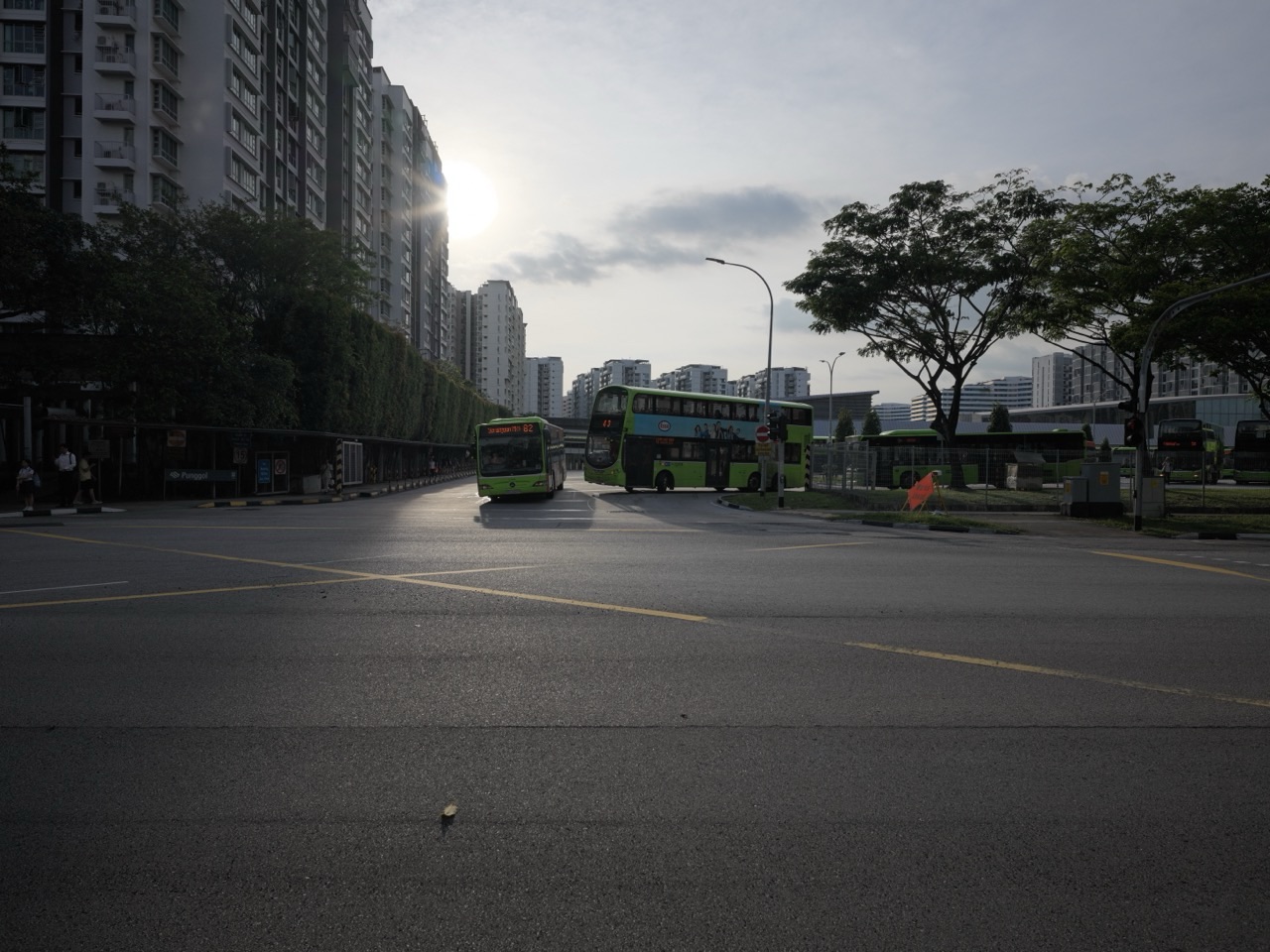
You reach the bus stop that your phone recommends, but the familiar pole is covered by a temporary notice and buses are no longer boarding there. A nearby board may point to a relocated stop, while the app still places its pin at the old location. In Punggol, the safe first move is to read the official on-site relocation notice, check the service number and operating direction, and identify the approved temporary boarding point. Do not try to flag a bus from the road, follow a construction vehicle through a barrier or assume that a map pin is a guarantee that a bus still serves that exact spot.
Singapore’s Land Transport Authority (LTA) publishes current bus stop and service changes on its Public Transport Service Announcements page. Road works and transport projects can require temporary stops, diverted routes or a return to a previous location. In its 2025 announcement about the Sengkang interchange works, LTA set out precise temporary locations and pedestrian access, illustrating why an official route map and effective date are more useful than an undated app screenshot. A digital service may take time to reflect a change, or the user may have opened an older saved journey.
- Confirm the service number, destination and direction before walking to any temporary stop.
- Read the current notice on the original bus-stop pole, construction hoarding or station information point.
- Cross roads only at legal pedestrian facilities and avoid closed footpaths.
- Compare the notice’s implementation date with today’s date; an upcoming diversion is not necessarily active yet.
- Check LTA’s Service Announcements and the relevant bus operator for the actual change.
- Treat travel-app results as planning tools, not proof that every temporary stop is currently in service.
- If the printed sign and official information conflict, ask nearby transport staff or use LTA’s official contact instead of guessing.
- If you report an incorrect app location, include the service, stop code, old and new locations, dates and screenshots taken safely.
1. Why a bus stop can move without the route disappearing
A service can continue operating while one or more of its stopping points are temporarily relocated. Construction may occupy the road reserve, narrow a footpath or make an existing stopping bay impractical. A diversion may replace one stop with another nearby stop or alter several parts of a route. These changes are not the same as suspending an entire bus service.
For commuters, the difference is important. A bus may still run at its ordinary frequency but no longer stop at the old pole. A parent who waits at the original location may think the service is late when the vehicle is already boarding elsewhere. The right response begins with checking the actual boarding point rather than assuming a vehicle never arrived.
2. What an official change notice should tell you
A useful bus stop relocation notice identifies affected services, the effective date, the old and temporary stopping locations, and any alternative boarding or walking instructions. Some notices include a map with arrows, stop codes and directions. A notice is especially helpful when a temporary stop lies around a corner or across a junction from the original one.
LTA’s Public Transport Service Announcements page groups bus service and bus stop changes, and transport operators may post their own advisories. Read the exact implementation date. A printed board left up before works start is not proof the change has already taken effect, just as an old notice should not override a confirmed later update.
3. Why a digital map pin can be outdated
Journey-planning applications combine locations, routes, live information and data updates. The map may retain an older point or direct a user to the usual stop even after temporary works begin. Another explanation is that the traveller selected a similarly named stop in the wrong direction. These causes are different, and a single wrong pin cannot establish that the entire app or LTA system has failed.
Compare the app’s stop code and displayed address with the official on-site notice. If two independent sources disagree, do not walk into traffic or a closed worksite to reconcile them. Verify through current LTA or operator information and seek a safe staffed point if needed. The fact that one phone is wrong does not necessarily mean every user’s app displays the same error.
4. The five-digit bus-stop code still matters
A Singapore bus-stop code identifies a particular stopping location. Opposite sides of a road typically have separate codes and may serve different directions. When a stop relocates, the temporary site may be identified using the relevant official instructions; do not guess whether its code remains unchanged. The exact operational arrangement depends on the relocation notice.
In a report, identify the stop code shown at the original location, the code or label at the temporary point if provided, and the services affected. If a temporary sign has no readable code, describe the location using a street and nearby fixed landmark. A good report helps the transport authority find the issue without expecting commuters to know its internal databases.
5. Direction is not optional information
A Punggol resident travelling towards the town centre may see the same service number on an opposite-side sign that heads away from the destination. That is not an alternative simply because it is geographically closer. Temporary route changes can make this more confusing when old boards remain visible and new ones are around a junction.
Check the service destination and direction of travel, not just its number. Where the operator provides an annotated diversion map, follow the arrows from the correct side of the road. Do not run across a median, under an LRT structure or through a construction site because you see the desired bus passing beyond the barrier.
6. Effective dates and temporary return dates
Some changes begin at a precise day or time. A route may be diverted during a road-closure phase and restored later. A resident who saved an announcement in January may use it months after the planned work has ended. That creates the opposite problem: the app or memory sends the commuter to a temporary stop that is no longer active.
LTA’s 19 December 2025 Sengkang notice documents a temporary interchanges arrangement from January 2026, including an alternative stop and later reinstatement plans. It is a dated illustration, not a current Punggol relocation claim. Always read whether a notice is prospective, active, completed or superseded.
7. Why an old route poster can still appear useful
Printed transport maps can remain physically present while a stop or service is being adjusted. A poster may explain the normal network rather than every temporary work. Conversely, a temporary arrow sign may be removed after the route returns. The presence of a familiar symbol alone is insufficient to identify the current boarding location.
Treat a current, specific operator notice as more authoritative than an old generic diagram. When the notices contradict each other, photograph the boards safely and ask for clarification. Avoid tearing down a supposedly wrong poster yourself; transport operators need to manage consistent signage across the actual route.
8. Look for official wayfinding around construction
Construction sites often use hoardings, temporary crossings and arrows to direct pedestrians around works. LTA has described placing circulars and wayfinding signs ahead of road closures and bus route changes in its Pasir Ris and Changi changes announcement. These signs are intended to replace unsafe shortcuts with approved routes.
Do not assume the shortest straight line on a navigation screen is an accessible path. A new temporary stop may require walking around a hoarding to reach the designated crossing. A child with a school bag or a wheelchair user may need more time than a fit adult, so the route plan should include the actual pedestrian approach.
9. What if the temporary stop is on the other side?
A notice may direct a commuter towards a different road section or a temporary stop nearby. Before crossing, verify whether it serves the same desired direction and whether a controlled pedestrian crossing is available. Never assume that a stop directly across the road is the correct replacement just because the original shelter is closed.
A family can pause at a safe location, read the notice and decide on the approved route. If the pedestrian diversion seems inaccessible or blocked, report it and ask the transport staff for a suitable way through. A bus stop cannot be considered practically accessible if its suggested path requires a mobility-aid user to navigate stairs or traffic without a safe alternative.
10. Do not stand in the old bus bay
If a familiar stop has been taken out of service, the driver may no longer be authorised to board passengers there. Someone who steps into the carriageway to wave down the bus risks being struck by traffic and may obstruct operations. The bus captain’s inability to stop at the former location should not automatically be interpreted as deliberate disregard for passengers.
The safer action is to use the official temporary stop. If a commuter believes the signage is inadequate, that can be reported after reaching safety. Complaints about missing wayfinding and complaints about driver conduct are not the same; a factual location report helps avoid accusing an operator of something the new route rules required.
11. Check the service destination on the actual vehicle
A temporary stop may serve several routes, while other services originally calling at the old point may be diverted elsewhere. Do not join the first queue without checking the route number and destination. A bus may display a short-trip service variation that does not travel as far as the familiar full-route service.
Confirm the number and the main destination sign before boarding. If uncertain, ask the captain from the safe boarding position. The route must be assessed against the actual stop and service; a phone’s ETA is only an estimate of arrivals, not a binding statement about where a temporary vehicle must halt.
12. MyTransport and other apps
LTA’s MyTransport.SG service is a sensible official starting point for bus routes and stop information. Third-party maps can also be useful, but different applications may use common underlying transport data, cached information or user-submitted place points. Seeing identical information in two apps does not necessarily mean two independent checks have confirmed it.
When a change is recent, supplement app results with LTA’s current service announcement and any operator notice. If the app shows a route through a closed road, do not follow it in defiance of barriers. Report the discrepancy so the provider can update the relevant data, including a screenshot with the date and selected stop.
13. Arrival predictions do not prove a stop exists
An estimated arrival shown for a code may be based on live bus data combined with a route database. A display of ‘three minutes’ does not guarantee that the vehicle will board at an old pole after a temporary relocation. Similarly, a blank estimate at an active temporary point does not prove the service has been cancelled.
Our Punggol bus arrival display guide addresses the reliability of ETAs. This article concerns the physical location of boarding. Keep those issues distinct when making an enquiry, although both can affect the same journey.
14. When the original stop is closed without clear directions
Occasionally a commuter may reach a construction area with no easily visible indication of the replacement stop. Do not improvise a route through barriers. Look for official site or transport staff, a safe public crossing and current LTA notices. If information remains unclear, contact LTA or the bus operator before entering a hazardous area.
A useful feedback message identifies exactly which sign was missing: ‘The closure board is visible, but there is no arrow or map to the replacement stop on the approach from [landmark].’ This is more actionable than declaring all transport information in Punggol defective.
15. A relocation and a stop permanently removed
Temporary changes have an expected project or operational context, while permanent changes modify the normal network. The public notice should help distinguish the two, but a user may need to check whether a temporary arrangement has been extended or ended. Do not treat the word ‘temporary’ as a guarantee of a short duration.
Infrastructure projects can be rescheduled. A notice issued when work begins may not be the final statement on completion. Check the latest official update rather than repeating an old announced date as if it remains certain. A resident can ask LTA for the current status if an intended reinstatement date has passed without an updated explanation.
16. Bus interchanges may have temporary boarding arrangements too
A change can occur inside a bus interchange rather than along a road. Services may use a different berth or an adjacent temporary facility during upgrading. The appropriate route to the temporary berth may include a pedestrian crossing, an overhead bridge or a designated sheltered connection.
LTA’s 2025 Sengkang interchange release provides an example with several temporarily relocated services and explicit pedestrian arrangements. That example does not establish any particular Punggol interchange move today. It shows why commuters need to read the precise service and date instead of simply following the usual interchange signage.
17. Accessibility is more than the distance between stops
An alternative bus stop may lie only a short distance away yet be difficult for a wheelchair user, senior or parent with a stroller to reach if the path has stairs, narrow turnings or construction obstacles. The operator should be told when an approved diversion lacks a usable step-free approach.
Do not assume a map’s straight-line distance describes the real effort involved. Check crossings, kerbs, ramps, lifts and weather protection where available. The LTA accessibility guide explains the importance of barrier-free public transport connections. If a diversion is unusable, ask for a site-specific alternative rather than attempting risky improvised movement.
18. What if the replacement stop lacks shelter?
A temporary stop can have a different layout from the original permanent shelter. The absence of seating or a roof does not automatically mean equipment was stolen or damaged; it may be a constraint of the temporary site. A resident can nevertheless report that the new arrangement creates hardship for waiting seniors or parents with children.
Separate the request for better shelter from a complaint that the stop was poorly signposted. A physical shelter upgrade, a temporary bench and a directional sign may need different responses. Do not promise that an extra canopy will be installed based on a single report or a social-media discussion.
19. School journeys need a revised plan
Children who take the same route every morning may depend on familiar visual landmarks. A sudden relocation can leave them waiting at an empty pole or following an old map. Parents should check official notices before the first affected school day and practise the safe walk to the new stop if the change directly affects the child.
Give the child the service, stop direction and a backup contact plan. A script such as ‘The stop is closed; I am by [landmark] and need to know where to go’ can help them ask an official for assistance without sharing unnecessary personal information. Do not tell a child to cross traffic simply because the bus is visible across the road.
20. The route for a senior living alone
A senior may not use a smartphone or be comfortable with app notifications. A dated paper notice, legible arrows and a recognisable replacement stop are therefore important. Family members can help by explaining the change in plain language and checking whether a safe route is available for the person’s mobility needs.
An operator report can identify missing large-print direction information without publicly naming the person affected. A public transport system serves people with different information habits; an accurate app alone does not make a poorly marked physical diversion easy for everyone.
21. The relocation may affect alighting differently
A service may board at one temporary location but use a different alighting arrangement, particularly near an interchange or during road works. Do not automatically use the boarding map to decide where the bus will drop passengers. Read the notice’s inbound and outbound directions carefully.
If the destination stop changes, think about the final walk to the clinic, school or home. An unfamiliar alighting point may require a new crossing or connecting path. Confirm that route before travel, especially for wheelchair users and families with young children.
22. If a diversion adds time to an appointment
When roadworks change the boarding location, commuters may need extra time to walk, wait and transfer. An estimate from last week’s commute may no longer be realistic. Plan a buffer for important appointments and check whether a different verified route is available.
If you miss a time-sensitive appointment because of a change, contact the destination and explain the travel disruption. A relocation notice is not a promise of financial compensation. Transport operators may review service complaints, while schools and clinics have their own policies for lateness or rescheduling.
23. Rain makes unclear signage more consequential
During heavy Punggol rain, people can be tempted to run from a closed sheltered stop to a temporary pole across the road. That increases risk when visibility is reduced and paths are slippery. Follow the signed crossings and use a safe sheltered route if one exists.
A current diversion might require more walking than the usual route. The inconvenience does not justify entering a worksite or crossing against signals. A precise report about an inadequate wet-weather or accessible connection can support a design review without declaring the whole relocation unlawful.
24. What if the hoarding has two conflicting arrows?
Different construction phases can require updated signs. An old arrow that remains after a new phase begins may confuse pedestrians. If two boards appear to direct the same bus service to different places, do not choose a route by guesswork when one goes through a closed area.
Document the exact boards, dates and locations from a safe position. Ask the operator or LTA to verify the current approved route and remove or update misleading information. Do not personally detach a contractor’s sign, since it may be serving another legitimate movement or safety purpose.
25. Why bus captains may not know every app error
A bus captain follows the service route and operating instructions. They may be able to confirm the current boarding point, but they do not control a third-party map database or every saved journey on a passenger’s phone. A commuter should not hold up boarding to demand a technical explanation of an app cache.
For an actual discrepancy, tell the transport operator or app provider with the stop code and screenshot. The captain’s immediate priority is operating the bus safely. A courteous question about where the temporary stop lies can be useful, but a formal data correction belongs to the relevant support team.
26. What LTA can investigate
LTA can review its official bus stop and service arrangements, wayfinding notices and public transport infrastructure. A report should include the exact location and effective date so the authority can distinguish an active diversion from a future proposal or a completed one. If the app is a third-party service, the publisher may also need the report.
The LTA contact page is a suitable official starting point for transport information and infrastructure feedback. Report the factual conflict and any safety problem; do not claim that LTA approved an unsafe crossing without establishing what the approved route actually is.
27. Report an inaccessible diversion clearly
A strong accessibility report does not merely say the temporary stop is inconvenient. It identifies the specific obstacle: a staircase without a usable lift, an unbridged kerb, an excessively narrow passage, a barrier across tactile paving or a detour requiring an unsafe road crossing.
Include the direction of travel and where the obstruction begins. If someone with a mobility aid cannot use the approved route, request the operator’s current safe alternative. Do not ask a wheelchair user to demonstrate the problem by entering a hazardous gap for a photograph.
28. What to photograph
A wide view of the closed stop and the relocation notice helps establish context. A second view can show the temporary stop and route arrow if they are visible from safe positions. A screenshot of the app pin with the selected service and date completes the comparison.
Keep other commuters and schoolchildren out of the image where practical. Avoid photographing a person’s phone or identity card. A factual, privacy-respecting record is more useful than a dramatic clip of someone running after a bus.
29. Make the correct route a family note
When a school or family journey is affected for several weeks, create a short note containing the service number, stop direction, current temporary location, official announcement link and a safe walking route. Update the note after a confirmed change rather than letting an old screenshot circulate indefinitely.
This is especially helpful when caregivers share collection duties or a grandparent occasionally accompanies a child. Everyone should use the same verified information. A family chat message saying ‘the stop has moved’ without a direction or date can be as confusing as the app it is trying to correct.
30. A Punggol resident sees an empty familiar stop
A worker arrives at the usual bus stop and sees a temporary closure notice. The phone still shows an arrival countdown there. Rather than waiting at the closed pole, the worker checks the notice and its effective date, confirms the replacement stop and uses the approved pedestrian route.
The worker later sends LTA or the app publisher a concise discrepancy report with screenshots. This hypothetical example shows how to separate a successful immediate journey from a later request to improve digital information. No active Punggol relocation is asserted by the example.
31. A parent approaching from the wrong direction
A parent with a stroller sees an arrow to a replacement stop but the most direct path has stairs. Instead of lifting the stroller unsafely while crossing a barrier, the parent searches for a signed step-free route or contacts transport staff for guidance. The report notes which approach fails and what accessible alternative was available.
The physical length of a route is less important than whether it can be used safely by the people who need it. A temporary stop can be nearby on a map yet impractical because the accessible approach is much longer or blocked. Those specifics help the operator assess the concern.
32. A temporary stop becomes permanent
Sometimes a transport change is revised or retained after its original plan. If a stop remains relocated longer than expected, the correct response is to check the latest official update. Commuters should not keep repeating the first project’s old end date as if it were guaranteed.
A resident can ask LTA whether the temporary route is still active and what replacement signage is planned. This is different from declaring that the project has broken a promise. A schedule can change for engineering, safety or operational reasons, and only current official information establishes the present arrangement.
33. What if the app shows a stop that never existed?
Sometimes a map pin may be misplaced or a stop name may refer to a nearby facility instead of the actual boarding pole. That is a data accuracy problem, but a resident should first rule out selecting the wrong stop code or travel direction.
A report can include the map URL, screenshot, selected service, code and physical location. For an app controlled by a commercial provider, submit the issue through its map-correction workflow as well as using official transport sources. Do not invent a corrected coordinate without verifying the exact stop.
34. When the problem is the bus stop sign itself
A notice may be missing, faded, torn or covered by construction advertising. This is not the same as an app carrying stale information, although the two can occur together. Describe the defective physical sign and the digital issue separately so that the responsible staff can assign different corrections.
The earlier Punggol bus-stop sign guide explains how to report an unreadable physical stop code. For a temporary relocation, the extra questions are the implementation date, alternate stopping point and accessible path to reach it.
35. A concise message to LTA
Use a simple report: ‘On [date] at [time], the bus stop at [old location and code] had a notice moving service [number] to [new site]. My travel app still directed passengers to the original stop. The notice’s walking route was [clear or unclear] from [approach]. Please confirm the current stop and update the relevant information or signage.’
This tells the authority what can be checked. Attach the official notice and screen captures if available. If you cannot verify which location is right, say so rather than making up a replacement code. The goal is accurate passenger information and a safe approach, not assigning blame.
36. The most important takeaway
The physical bus stop, the official service route, the pedestrian approach and the app’s data must agree for a journey to feel straightforward. A temporary relocation disrupts that alignment until all channels are updated. Commuters can reduce confusion by checking current notices, dates and stop direction instead of treating an old pin as authoritative.
When information conflicts, safety comes first. Use legal crossings, ask transport staff for the approved route and report the discrepancy. This method works whether the stop is in Punggol Central, Northshore or another estate, without assuming that any named location has an active diversion today.
Practical checklist before leaving the old bus stop
- Read any official closure board and check whether the change is already in effect.
- Confirm the service number and direction.
- Identify the intended replacement stop and any given code.
- Check LTA’s current service announcements.
- Use the signed pedestrian route, not a shortcut through traffic.
- Verify whether the new stop provides suitable wheelchair or stroller access.
- Allow extra travel time during changes.
- Check that the actual arriving bus displays the correct destination.
- Save the notice and app screenshot privately if a discrepancy needs reporting.
- Provide factual feedback to LTA or the app provider.
Frequently asked questions
Why does my bus app show the old stop?
It may use an outdated location, cached information or the wrong selected stop. Check current LTA announcements and onsite signs to establish the active route.
Does a closed bus stop mean the service is cancelled?
No. A route may continue while one stop is temporarily relocated. Read the affected service and alternative boarding point on the official notice.
Can I board where the old pole stands?
Do not assume so. Use the approved active stop and do not flag a bus from a road or closure area.
Does the temporary stop retain the same five-digit code?
The actual arrangement depends on the change. Check the official notice instead of assuming the old code must still apply.
What if the replacement stop is across the road?
Verify the direction and cross at an authorised pedestrian crossing. Do not use a traffic shortcut or climb a construction barrier.
Where does LTA publish current bus stop changes?
Its Public Transport Service Announcements page publishes bus stop and service changes. Operators may publish supplementary notices.
Do two matching apps prove the stop is correct?
Not necessarily. Apps can share transport data or old saved information. Compare against the current physical notice and official announcement.
What if the notice has an old date?
Check for a later announcement. The first project schedule may have been revised or the stop may have returned to its original site.
Can I rely on a bus ETA at a closed stop?
No. An estimated arrival is not proof that passenger boarding remains authorised at the old pole.
What if the temporary stop has no shelter?
Report any practical hardship or accessibility issue separately from a request to correct the stop location; temporary infrastructure can differ.
What if there is no safe step-free route?
Do not attempt an inaccessible or dangerous path. Ask transport staff for the approved alternative and report the access problem precisely.
Who should update a third-party map?
The app publisher may need a map correction, while LTA can confirm official bus service arrangements. Submit the factual discrepancy to the appropriate service.
Can the bus captain decide to stop at the old pole?
Do not presume so. Captains follow authorised routes and boarding points; changing the stop is an operator-level decision.
How should I report conflicting signs?
Photograph the notices safely, note their dates, location and affected services, then request confirmation through LTA’s official feedback channel.
What if my child has already gone to the old stop?
Ask them to remain on safe ground and contact you or transport staff. Do not instruct them to cross against signals or enter construction areas.
Is a bus interchange relocation the same as a roadside stop change?
They can involve different berth and pedestrian arrangements. Read the exact official map for the particular service and stage of works.
Do temporary changes affect where I alight?
They may. Check inbound and outbound instructions separately rather than assuming the replacement boarding and alighting points are identical.
What if a map pin is wrong but the signs are correct?
Use the verified physical boarding location for the journey, then report the app discrepancy with the selected stop and screenshot.
How long will the bus stop remain moved?
Use the latest official timetable or project update. Do not treat an old projected completion date as guaranteed.
What is the simplest report?
Provide the old stop, affected service, current notice, date, correct or uncertain temporary location, and exactly what the app displays.
Official sources and related Punggol reading
- LTA — Current Bus Service and Stop Changes
- LTA — Transport Feedback and Enquiries
- LTA — Example of Temporary Bus Interchange and Stop Relocation
- LTA — Road Closure Wayfinding and Temporary Bus Stops
- LTA — Barrier-Free Public Transport Access
- eduKate Punggol — Missing Bus Stop Signs and Codes
- eduKate Punggol — Bus Arrival Predictions and Blank Displays
Reviewed 10 November 2026. This guide explains how to verify and report temporary stop locations. It does not claim a particular Punggol stop is currently relocated. The latest LTA and operator announcements, site notices and legal crossing arrangements always take precedence.


