
Start with the Tang Shipwreck gallery if you have time for only one focused visit to Singapore’s Asian Civilisations Museum. The exhibition looks at a ninth-century shipwreck found near Belitung, Indonesia, and what its cargo can tell us about trade across Asia. Look for the Changsha bowls, the octagonal gold cup and the blue-and-white dish if they are on view. Check ACM’s current gallery and admission information before travelling in 2027.
ACM is at 1 Empress Place, beside the Singapore River. Its published regular hours are 10 am to 7 pm daily, with Friday opening until 9 pm and last admission 30 minutes before closing. Singapore citizens and permanent residents generally have free admission to the permanent galleries under NHB’s policy. Other visitors should check ACM’s current rates and concessions. Allow roughly 45 to 60 minutes for a focused visit and add time for the station approach.
- Use ACM at 1 Empress Place, with Raffles Place or City Hall as practical approaches.
- Choose permanent gallery admission for the Tang Shipwreck, and confirm the current display.
- Look for Changsha bowls, the gold octagonal cup and a blue-and-white dish if available.
- Check the live opening and admission information, especially near closing or on a special event day.
- A short river walk is an optional second stop, separate from the museum visit.
Choose one gallery and plan the admission
Check the kind of ticket you need
The Tang Shipwreck is part of ACM’s presentation of maritime trade. Begin with the museum’s current permanent gallery information. Check whether the gallery and objects you want are available. A special exhibition may have different admission arrangements. If you only want the shipwreck, confirm the admission product for the permanent galleries and avoid building the visit around a different ticket.
Under NHB’s published policy, Singapore citizens and permanent residents generally enjoy free admission to national museums’ permanent galleries, including ACM. Bring the identification the museum requires. A tourist or other visitor can use the current ACM admission page to check prices, age categories and any concession. An advertised free category for one person should not be applied to everyone in a mixed group.
Decide how much time you want to spend in the building before buying additional admission. A gallery visit built around three objects is useful on its own. If you want to add another exhibition, give it a separate time allowance and check any booking or ticket arrangements. A child who has looked closely at two objects may have had enough even if the museum has many more rooms open.
Work backwards from the last admission
ACM’s published visitor information lists 10 am to 7 pm daily, with Friday hours extending to 9 pm and admission ending 30 minutes before closing. Check the exact date before visiting. Last admission is a cutoff for entering. It is useful to arrive earlier if you want a comfortable look around, particularly if the group needs time for ticketing, lifts or a rest.
For a worked example, if the museum is closing at 7 pm, the posted 30-minute rule means a 6.30 pm last admission. An arrival close to that cutoff gives less time than a full 45- to 60-minute visit. Choose an earlier arrival if you want to see the three objects at a relaxed pace. Use the confirmed opening for your date rather than treating the example as a special schedule.
If your group arrives late, ask what is still possible. You may be able to make one room the main stop, or choose a public river walk and save the museum for another day. A short exterior outing can be useful, but it gives a different experience from seeing the recovered objects.
Get to Empress Place and find the gallery
From Raffles Place or City Hall
Raffles Place suits visitors coming from the financial district side. Follow a current public walking route to the river and use an open crossing towards Empress Place. City Hall works for a walk through the Civic District. Check the station exit, crossings and public approach from your actual starting point. A map that ends at a river crossing does not take you all the way to the museum door.
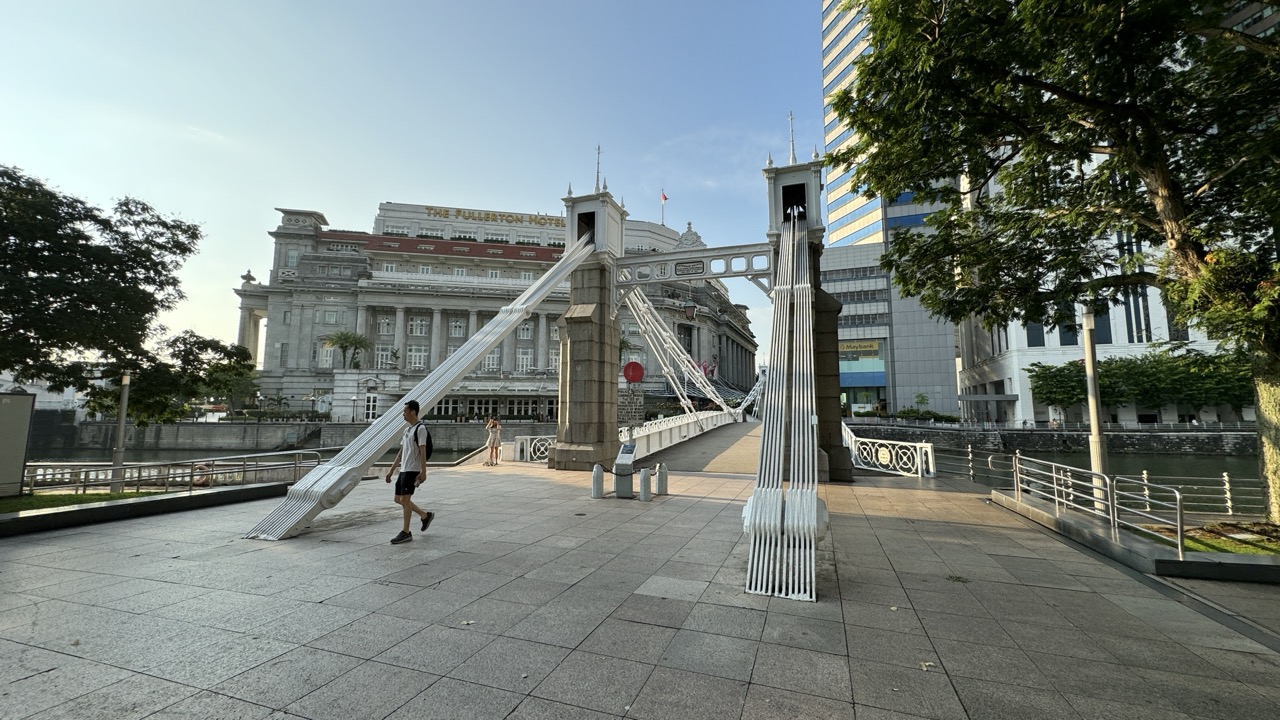
ACM is at 1 Empress Place. The photographs here show the nearby Anderson Bridge and Victoria Theatre. Use them as context for the district and use the museum’s directions for the exact entrance. Several venues are close together. Give a companion the museum’s full name, the entrance you intend to use and an agreed meeting time.
For someone coming from Punggol, choose the train route that suits both the approach and the rest of the day. A direct route to the Civic District may involve a transfer. Save the exact walking destination separately from the station. If the group finishes on the other side of the river, choose the station that is easiest from that point rather than returning only because it was the starting station.
Ask at the entrance for Tang Shipwreck
Use the current museum map or ask visitor services for the Tang Shipwreck display. Allow time to find the route, use any lift you need and read the first orientation panel. Someone arriving after the rest of the group can meet at the museum’s named public point before following the signs. Avoid asking a larger party to wait beside an object case.
If accessibility matters, check the complete route from station or drop-off to the gallery. Ask about the particular facilities your group needs and how to reach the room. For a wheelchair user or someone who needs frequent rests, plan a shorter route around one or two displays. The approach across the river can have different conditions from the interior route.
What the wreck tells us about maritime trade

Separate where the ship was found from where its goods came from
ACM describes the Tang Shipwreck, also known as the Belitung or Batu Hitam Shipwreck, as a vessel discovered in 1998. The museum interprets it as a ship made using a sewn-plank tradition associated with the Persian Gulf, with a large cargo from China. The wreck was found near Belitung in present-day Indonesia. Those details refer to different parts of the story: where the ship was found, what its construction suggests and where the cargo was produced or loaded.
Ask a child to place those points on a simple map afterwards. Start with the discovery area. Then locate China and the regions discussed in the museum’s interpretation. Use the objects and labels to see how a single find can show connections across a much larger area. A line on the map represents a possible trade route and should be read with the museum’s explanation rather than treated as a complete itinerary recorded by the ship.
The wreck helps visitors think about trade well before modern container ships. Goods travelled by sea, and a ship could carry items made for different uses and buyers. Look for signs of repeated production, objects that seem more elaborate and decoration that may reflect exchange. The strongest first question is what the objects show, followed by what else you would need to know to explain who ordered, carried or used them.
Use the gallery to distinguish observation and interpretation
An object label can tell you its material, approximate date and place of manufacture. A display panel can explain how researchers use several clues together. Look at the object first and say what you see. Then read the label and check how your first impression fits the information. This is useful for older students and for families who prefer a small number of stops.
A visitor can see a pattern or a repeated shape. Whether that shape was intended for a particular market is a separate question. The museum’s interpretation can help connect the object to trade. If the label offers a possibility rather than a certainty, keep the same distinction when retelling the story. Children can use a simple pair of phrases: I observed this, and the museum explains this.
Three objects to look for in the display
Changsha bowls and repeated production
ACM highlights Changsha bowls among the shipwreck finds. Begin with the repetition. Look at the way the bowls are shaped and compare the decoration on a few examples. Choose one feature that appears more than once and one that differs. This helps children see how goods can be made in quantity and still show variation. Follow current labels and display arrangements if the objects are grouped differently on your visit.
Ask why bowls might have been practical cargo. A ship could carry many similar objects, and their shapes affect how they can be packed. Treat packing as a question to investigate rather than guessing how these exact objects were loaded. Look at the museum’s explanation of the cargo. Compare the everyday-looking bowls with a more elaborate object elsewhere in the display.
If your time is limited, stay with this one group of objects. Find one bowl whose decoration you can describe clearly and read its label. A young child can draw an outline and mark where the design sits. An older child can compare that object with another example and write a short description. The aim is to make a careful observation rather than rushing to see every case.
The octagonal gold cup and the blue-and-white dish
The museum highlights a gold cup shaped with eight sides and decorated with musicians and a dancer. Look at the figures if you can see them and read the museum’s interpretation of the design. Then consider how different the cup feels from the group of bowls. The material, form and decoration offer three easy points of comparison. The display can prompt a question about who might have wanted such an object and why it travelled.
The blue-and-white dish gives you another way to compare the use of colour and surface. Start with what is visible, then read the label for its historical significance. If the dish or cup is not on view, choose a different highlighted object and keep the same method. A family can compare material, shape and decoration without depending on one specific object being available.
For a visitor who wants a memorable route, see the bowls first, then choose between the cup and dish. A third stop can be the shipwreck orientation panel or a nearby case that connects the objects to trade. Give the group time to discuss what it actually saw. Three well-chosen objects can tell a clearer story than a quick pass through every part of the museum.
Read the cargo as evidence of trade
Start with material, scale and repetition
A group of ceramic bowls gives you a chance to see how the cargo could include many examples of the same kind of object. Look at the rim, body and decoration of two or three bowls. Then look at the gold cup and ask which features would be harder to compare without its label. Material and shape are observations you can often make for yourself. Place of manufacture and estimated date come from the museum’s research.
A child can use the three-object route as a sorting exercise. Put a repeated ceramic shape, a gold object and a dish with a painted surface into three separate categories. Give one reason for each choice. An older student can then ask what the categories say about how objects were made and used. The point is to use the visible evidence before making a claim about trade.
Look at how a museum arranges objects in a case. A display can make similarities easy to see, but it may select only a part of what was recovered. Read the labels and description before assuming that a case represents the cargo exactly as it lay on the seabed. If you want to understand how things were packed or what else was recovered, use the museum’s larger account of the wreck.
Ask what the ship itself can tell you
ACM describes a vessel built using a sewn-plank tradition. That tells you something about its construction and is one reason the museum discusses connections with the Persian Gulf. It is a separate piece of evidence from the bowls and other goods. If a student is using the exhibition for an assignment, have them identify one statement supported by the ship’s construction and another supported by the cargo. Then ask what the location of the wreck adds.
A short explanation might begin with where the wreck was discovered, then move to where the ceramics came from and what the vessel’s construction suggests. Those points make a stronger account together than any one point alone. The fact that the wreck was found near Belitung does not by itself tell you who used the objects or where the ship would have finished. Keep uncertainty in the account where the museum’s explanation leaves it.
For an older child interested in geography, draw a rough map after leaving the gallery. Mark the discovery area, a point in southern China and the western region discussed in the museum’s interpretation. Give each mark a label explaining what it represents. Use dotted or separate lines if you are showing a possible route. The map should explain why the objects are evidence of a connection without implying that the complete voyage was recorded.
Look for the objects’ different stories
The museum’s description of the gold cup links its decoration with figures it identifies as Central Asian. That gives visitors a useful chance to distinguish where an object was made from the people or motifs it depicts. Look at one feature of the decoration and read how the museum interprets it. Then compare that with the information about the cup’s material and form. A child can understand that one object can carry more than one kind of clue.
For the blue-and-white dish, choose a detail such as the colour contrast or the placement of a design. Compare it with a bowl rather than treating it as a separate stop with no connection to the rest of the visit. Ask what stayed similar across the ceramics and what changed. Read the museum’s label for its historical account. A visitor who cannot see a detail from the case can use the official object page afterwards.
End the gallery visit with a question you can answer in a sentence. For example, what is one reason the wreck is useful evidence of trade? Choose a fact from the label and one observation from the display. That makes a stronger answer than repeating the name of the exhibition. It also gives a child a reason to remember the object they chose.
Make the visit work for a family or a student
Give each visitor one role
A younger child can look for a repeated shape. An older child can read one label and explain it in their own words. An adult can check the map and help relate the display to the ship’s wider route. Exchange observations after moving to a place where the group can talk without crowding the cases. A short shared conversation can make the objects easier to remember.
For a school assignment, start with a specific question. How does a group of bowls differ from a gold cup? What does finding cargo near Belitung tell us, and what does it leave uncertain? Take a note of the label and the museum’s source page. A student can use what they saw as one part of an answer and look for additional sources if needed.
Keep the visit easy to shorten
If a child is tired or the room is busy, choose one object and one label. You can finish after that and still leave with a clear example of maritime trade. If someone wants more time to read, agree on a public meeting point and a suitable time. Ask about photography and any gallery restrictions before taking pictures. When photos are allowed, one picture with a note about the label can be enough.
A visitor who wants to remember the differences can make three short notes on the way out. For the bowls, record a repeated form or pattern. For the cup, record how the figures sit on the surface. For the dish, record the colour contrast or placement of the design. Then use the museum’s object descriptions to check the details. A caption should distinguish the object you actually saw from an image you looked up later.
If someone wants to share the story with another family, suggest a starting point and one object rather than promising that every highlight will be on display. Send the museum’s address and current admission page. That gives the next group enough information to make its own short visit.
Three routes for different museum visits
A brief visit for one case
If you have a limited window, enter with the required admission and go directly to the Tang Shipwreck. Choose the bowls or another highlighted object that is available. Read one label and take enough time to look at the object itself. Then leave by the easiest public route. This works for someone already in the Civic District who wants a focused stop rather than a full museum afternoon.
When timing the visit, start the gallery estimate once you reach the museum and add any entry or approach time. If a child wants to talk about what they saw, find a suitable place away from the display cases. A short walk outside can be useful when the weather permits. Otherwise, go to a verified indoor finish.
A family visit with two or three objects
Choose one group of ceramics and one contrasting object. If time and energy allow, add the overview of the wreck or a third object. Let a child choose which detail to look at first. An adult can handle the route and keep the group together. If the youngest visitor needs a break, finish after the first two stops.
Give everyone a chance to say what they noticed. Some may remember a design, others how several similar bowls can look different when placed side by side. Make the exit or meal the next fixed point. An hour at the museum can be enough when the group spends most of it in one area. A broader collection visit can be a separate outing.
A student or adult visit with a second question
Start with the shipwreck and take notes on the construction, the cargo and the location of discovery. Then choose another available gallery only if it helps answer a question about maritime exchange, objects or materials. Check its access and admission first. An additional exhibition is more useful when it has a clear connection to what you just saw.
If you have more time outside than inside, use one public river stop to orient yourself before returning to the station. The river view helps place the museum in Singapore. The wreck’s story concerns a different place and period. Keep the two geographic settings separate when explaining the day to someone else.
Before leaving, save the official object page and make a note of what you could actually see. A display can change and an older picture may show a different arrangement. For a school task, distinguish the visit date, the source and your own observation. That makes a short museum visit useful after you get home.
Add a short river stop or return to the station
Use the river to compare settings
After leaving the museum, choose one public viewpoint near Empress Place. Look at the position of the museum building and the river. The modern city and the ninth-century shipwreck are different settings, but the river can help start a conversation about why people, buildings and trade often cluster around water. Use the museum information for claims about the wreck’s location and history.
If the group has time, use a public approach to Cavenagh or Anderson Bridge. Choose the one that fits your return. A visitor who mainly wants the museum can finish after one river view. A child who enjoyed the trade map may want to see another historic stop on a different day. Keep the route simple enough that the gallery visit remains the main subject.
Choose the finish before you leave
Save the museum address, current admission details and the station that fits the return. If you are meeting someone who is not visiting the museum, choose a separate public place or meal venue. Confirm the weather and current paths if the visit includes a river walk. A useful first trip can be a single gallery, a short conversation about one object and an easy train journey home.
Frequently asked questions
Is Tang Shipwreck part of ACM’s permanent galleries?
It is presented in ACM’s maritime trade galleries. Check current gallery access and admission for your date.
Is it free for Singapore citizens and PRs?
NHB’s policy generally provides free admission to permanent galleries for Singapore citizens and permanent residents. Check ACM’s terms and bring identification.
Where was the wreck found?
It was found near Belitung, Indonesia. ACM also calls it the Belitung or Batu Hitam Shipwreck.
What should I look for with children?
Start with the Changsha bowls and choose the octagonal gold cup or blue-and-white dish if available.
Which MRT is useful?
Raffles Place or City Hall can suit different approaches. Use ACM at 1 Empress Place as the exact destination.
How much time should I allow?
Allow about 45 to 60 minutes for a focused gallery visit, with more time for entry, rests or other exhibits.


