
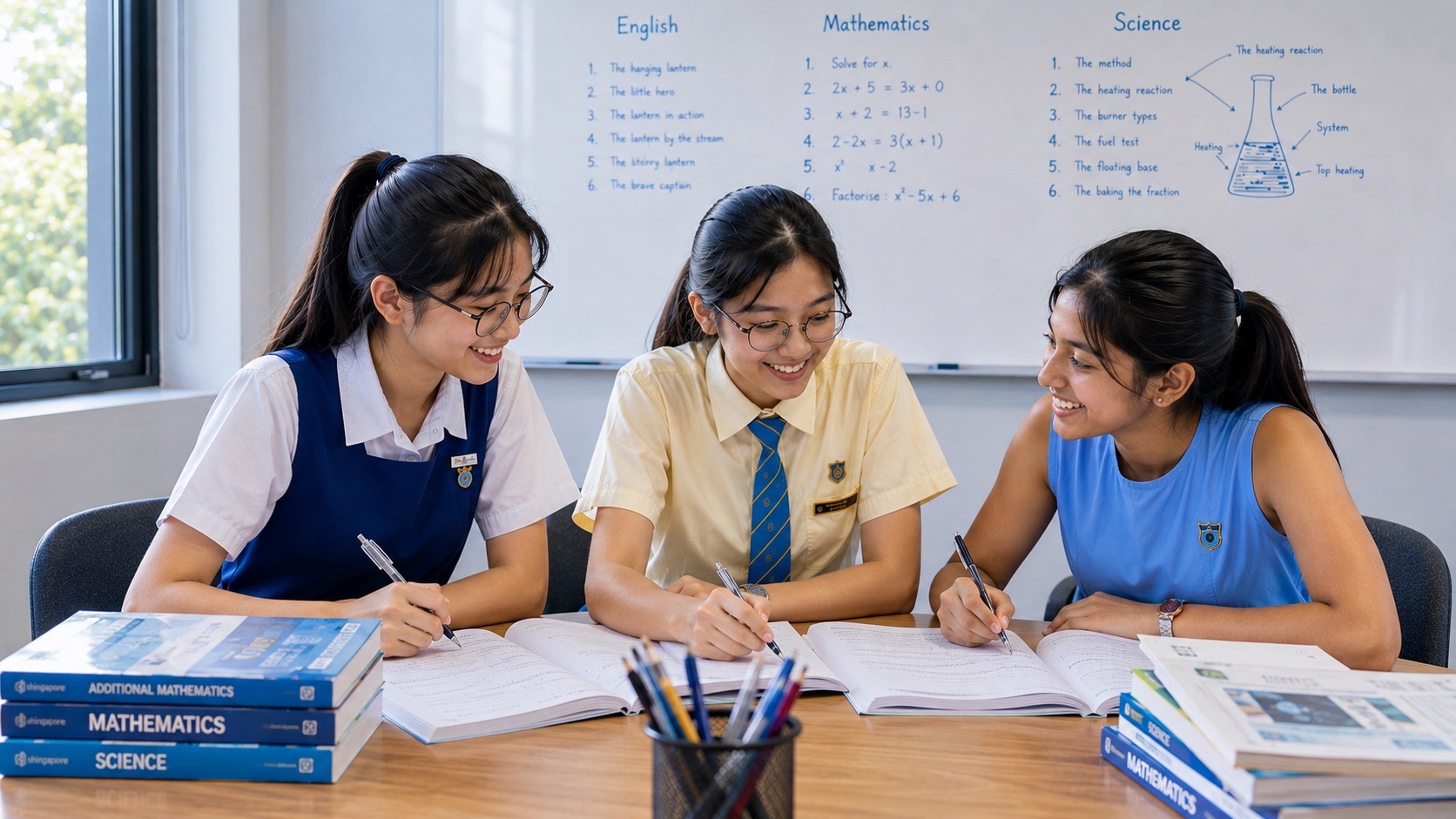
Secondary 3 G3 Mathematics small groups tuition in Punggol should strengthen numerical indices, quadratic and exponential function reasoning, equations, set notation, matrices, circle and triangle geometry, vectors and statistical interpretation. eduKatePunggol’s published format is a maximum of three learners in a 1.5-hour tutorial. The potential benefit is that each pupil’s first mathematical decision can be examined, corrected and tested again in an unfamiliar context—not a guaranteed A1.
MOE’s 2020 G3 Mathematics syllabus presents many upper-secondary topics together under Secondary Three/Four. It includes laws of indices, function sketching, quadratic equation methods, set notation, matrices, advanced circle properties, trigonometry, coordinate geometry, vectors and statistical measures of spread. Schools determine which topics are taught in Secondary 3 and which follow later. G3 Mathematics is also distinct from separately offered G3 Additional Mathematics. SEAB lists Mathematics K310 for the 2027 graduating G3 SEC cohort, not a national paper that every Secondary 3 pupil takes that year.
- **First confirm:** G3 Mathematics, not just the pupil’s Posting Group or an assumed Additional Mathematics entry.
- **Number and algebra:** powers, fractional indices, standard form, quadratic equations and valid symbolic transformations.
- **Graphs:** sketch quadratics and interpret power, exponential and tangent-gradient models.
- **Set and matrix notation:** read relationships, operate on permitted matrices and interpret representations.
- **Geometry:** circle theorems, trigonometry, coordinate geometry, vectors and dimensionally correct mensuration.
- **Learning check:** independent first solution, targeted repair, unfamiliar transfer and delayed retrieval in a compatible three-student group.
G3 Mathematics needs valid method selection
A pupil can expand and factorise correctly on a worksheet labelled Algebra but fail to recognise the same pattern when it appears in an equation, graph or application. Another may choose the correct theorem but apply it without its necessary geometric condition.
A tutor should examine the original reasoning rather than only the final numerical mark. The changed independent task after correction shows whether the learner recognises the structure without the first chapter cue.
G3 subject level is not the admission Posting Group
Full Subject-Based Banding distinguishes Posting Groups used for secondary admission from the G-levels of individual subjects. A pupil may study G3 Mathematics alongside other subjects at different levels under school arrangements.
Parents should bring the actual G3 schoolwork and current chapter. A suitable group of three needs compatible central objectives, and a private tuition provider cannot independently change school subject-level registration.
G3 Mathematics is not automatically Additional Mathematics
The MOE curriculum lists G3 Mathematics and G3 Additional Mathematics as separate syllabuses. A student taking the former may not be enrolled in the latter. Their equations, graphs and symbolic demands may overlap but are not interchangeable.
A tutor should select exercises from the correct registered course. Introducing an advanced additional topic as optional extension is different from describing it as compulsory G3 Mathematics. Parent decisions should follow real school offerings and eligibility.
The upper-secondary table covers two school years
MOE combines the G3 upper-secondary content in a Secondary Three/Four table. It does not mean every pupil must finish all listed topics in Secondary 3, and schools may sequence them differently around prerequisites and their assessment plans.
A tutor should ask which topics the class has completed and what will be assessed next. The final examination-year document becomes important for graduation; current school work remains the immediate teaching reference.
Indices have precise operations
For nonzero a, a³ × a² equals a⁵ because the factors combine. In contrast, (a³)² equals a⁶ because the outer exponent multiplies the powers. A pupil who applies the same numerical operation to all exponents may make repeated structural errors.
A tutor can expand a small expression into factors to explain the distinction. A changed problem with division or another base checks whether the correct law is selected independently.
Fractional exponents connect to roots
For positive a, a¹ᐟ² means the principal square root and a³ᐟ² means that root cubed. Thus 16³ᐟ² = 4³ = 64. The fraction in the exponent does not represent ordinary division of the base by two.
A tutor can ask the learner to verify the result using powers and roots, then try a changed positive base. Correct domain assumptions and explanation matter as well as calculator output.
Worked negative fractional index
For positive 16, 16⁻¹ᐟ² equals 1/√16 = 1/4. A student writing negative four has confused a negative exponent with a negative value, changing the quantity dramatically.
A tutor can compare 16¹ᐟ² and 16⁻¹ᐟ² and ask why they are reciprocals. A changed example such as 81⁻¹ᐟ² tests understanding without hints.
Standard form communicates numerical scale
The quantity 0.00062 is 6.2 × 10⁻⁴, while 620,000 is 6.2 × 10⁵. Their coefficients match but the exponents and magnitudes do not. A pupil who chooses a sign from the movement of a pen may misread the value.
A tutor can ask first whether the original is less than one or much larger than one. A changed quantity tests whether the exponent preserves the number’s magnitude.
Worked standard-form ratio
Compare 4 × 10⁶ with 2 × 10⁵. Dividing gives twenty, not two, because both coefficient and power of ten affect the ratio. The first quantity is twenty times the second.
A tutor can create a fresh comparison where the smaller coefficient has the larger power and ask for a sensible estimate. This checks understanding beyond printed digits.
A quadratic expression is not automatically a solved equation
The polynomial x² − 7x + 12 may be factored as (x − 3)(x − 4). Only when the task includes an equation, such as x² − 7x + 12 = 0, does finding roots follow.
A tutor can present the expression and equation side by side and ask what each question requests. A changed pair of tasks tests correct method selection before symbolic manipulation.
Quadratic factorisation should be verified
The identity x² − 5x + 6 = (x − 2)(x − 3) can be confirmed by expansion. A pupil who chooses two numbers that multiply correctly but have the wrong sum has not reproduced the original expression.
A tutor can ask for both conditions and check the result numerically, then provide another quadratic. Reliable verification can prevent mistakes from spreading into graph roots and applications.
The quadratic formula uses coefficients with signs
For ax² + bx + c = 0 with nonzero a, the quadratic formula is an appropriate method within the prescribed G3 course. The values of a, b and c retain their signs, and the discriminant helps determine the nature of real solutions.
A tutor should ask the pupil to identify coefficients before substituting and check a solution against the original equation. A changed polynomial tests the method independently instead of treating the formula as a decorative object.
Completing the square explains a turning point
The expression x² + 6x + 5 can be written (x + 3)² − 4. This makes it clear why the graph of the corresponding function has minimum at (−3, −4). The manipulation preserves the expression’s value.
A tutor can ask the student to expand the completed-square form, then work on a changed quadratic. The learner should recognise whether the task asks for a graph property or equation roots.
Quadratic graphs have identifiable features
For y = (x − 2)² + 1, the parabola opens upward, has axis x = 2 and minimum point (2, 1). These features follow from the nonnegative squared term, not from a curve drawn by eye.
A tutor can ask for a fresh function with negative leading coefficient and another horizontal shift. The changed result tests form-based reasoning without the original graph.
Graph roots and y-intercepts differ
For y = x² − 5x + 6, x-intercepts occur at x = 2 and x = 3 because y is zero. The y-intercept occurs at x = 0, giving y = 6. A pupil who swaps the two operations can report wrong points despite accurate algebra.
A tutor can ask what each intercept means and provide a new factored function. Independent graph interpretation is more important than memorising the first pair of roots.
Power functions vary with the exponent
The shape of y = x² differs from y = x³, y = 1/x and y = 1/x². Their signs, symmetry, intercepts and behaviour near excluded inputs differ. A pupil should not assume every power graph is a parabola.
A tutor can compare small value tables and ask which inputs are valid. A changed function tests recognition of structure without copying a standard picture.
Exponential growth differs from fixed increments
The model y = 2ˣ doubles when x increases by one, while y = 2x rises by a fixed two per unit. Both can increase, but their growth patterns are different.
A tutor can use a short table to show additive and multiplicative change and ask the pupil to classify another relationship. The model should not be represented as a guarantee that real processes double forever.
The tangent gives a local gradient estimate
A curved graph may not have one constant gradient. Drawing a tangent near a point gives an approximate gradient there, while a secant between two separated points gives an average slope across the interval.
A tutor can ask what the question requests and why the two constructions differ. A fresh curve with another marked point tests the concept without relying on one tangent position.
Fractional equations require domain checks
The equation 6/(x + 4) = x + 3 is undefined at x = −4. Multiplying by the denominator can produce a quadratic equation, but every proposed solution must still satisfy the original expression and its permitted domain.
A tutor can ask the pupil to list restrictions first and check obtained values afterward. A changed fractional equation tests method selection and exclusion of invalid roots.
Linear inequalities represent sets of answers
For 2x + 5 no greater than 13, the solutions satisfy x no greater than four. The answer is a range, not one unique number. A pupil who reports only x = 4 has solved the boundary equality without interpreting the inequality.
A tutor can ask the learner to test numbers on both sides of four and show the region on a number line. A changed inequality tests independent interpretation.
Negative multiplication reverses inequality direction
From −3x greater than 12, dividing by negative three gives x less than −4. Reversing the inequality preserves the set of numbers satisfying the original statement.
A tutor can check x = −5 and x = 0 and explain why one works and the other does not. A changed negative-coefficient inequality tests understanding beyond a mnemonic.
Set notation describes membership and relationships
A ∪ B denotes union, A ∩ B intersection and A′ complement relative to the stated universal set. A pupil who treats union and intersection as the same list of elements will misunderstand many Venn-diagram questions.
A tutor can define a small finite universal set and ask which items satisfy each condition. A changed set pair tests interpretation rather than memory for the symbols alone.
Worked Venn-diagram intersection
Let A = {1, 2, 3} and B = {3, 4, 5}. Their intersection is {3}, while their union is {1, 2, 3, 4, 5}. An element in both sets belongs once in the union.
A tutor can ask where three appears in a Venn diagram and then change the element lists. The learner should justify the answer from membership, not count printed appearances.
Complements require a universal set
If the universal set is {1, 2, 3, 4, 5} and A is {2, 4}, the complement of A is {1, 3, 5}. Without a defined universal set, the intended complement may be unclear.
A tutor can ask which universe the problem provides before listing elements. A changed example with another universal set tests careful interpretation.
Matrices organise information by rows and columns
A matrix can represent tabulated quantities, such as two classes’ numbers of participants across three activities. The position of each entry matters; swapping rows may change which class the data describe.
A tutor can ask pupils to state what each row and column represents and then interpret a changed matrix. Understanding the labels comes before numerical operations.
Matrix addition needs compatible dimensions
Two matrices of the same dimensions can be added entry by entry. A 2×2 matrix cannot be added directly to a 2×3 matrix using the ordinary rule, because corresponding positions do not match.
A tutor can show a small valid addition and then ask why another pair is invalid. A changed example tests the dimension condition, not merely arithmetic.
Scalar multiplication changes each entry
Multiplying a matrix by a scalar multiplies every entry. If a row contains [2, 3], doubling it produces [4, 6], not [4, 3]. The operation acts on the whole matrix.
A tutor can ask what the scaled entries mean in a simple table context and then give a new scalar. This supports meaningful use rather than memorisation of a bracket layout.
Matrix multiplication is not elementwise multiplication
For compatible matrices, a product uses row-by-column combinations. In general, AB need not equal BA, and their products may have different dimensions or one direction may be undefined.
A tutor can start with small permitted dimensions and show what one product entry counts. A changed pair tests dimension checks before computation. Treating matrices as ordinary single numbers can create invalid operations.
Circle properties must be established from the diagram
Circle theorems relate chords, tangents, radii and subtended angles under particular conditions. A pupil can memorise a theorem and still apply it when the diagram does not supply a diameter, tangent or common arc.
A tutor should ask the learner to mark the relevant geometric premise before calculating. A rotated circle or relabelled chord tests reasoning rather than visual familiarity.
Radius and tangent meet at right angles
At a point of tangency, the tangent to the circle is perpendicular to the radius joining the centre to that point. The theorem concerns the actual point of contact, not a nearby chord.
A tutor can ask which line is tangent and where it touches the circle. A changed diagram tests whether a right angle is justified before numerical work begins.
Worked angles at centre and circumference
An angle of 110° at the circle’s centre and an angle subtending the same arc at the circumference may relate as twice and half, giving 55° at the circumference under the theorem’s conditions.
A tutor can ask the pupil to identify the shared arc. A changed diagram with angles subtending different arcs tests whether the rule is applied only when justified.
Similar figures have dimensional scale relationships
If two similar triangles have length scale factor three, their areas scale by nine. Similar solids with the same length factor have volumes scaling by twenty-seven. A pupil who applies the linear factor directly to area or volume ignores dimensions.
A tutor can compare unit-square and unit-cube models, then give another scale factor. The changed task tests the reasoning without memorising one trio of numbers.
Sine and cosine rules apply to suitable triangles
The sine and cosine rules allow specified non-right triangle calculations when corresponding sides and angles are correctly identified. A student who pairs a side with the wrong angle can obtain a plausible-looking answer from the wrong setup.
A tutor should ask the pupil to label opposite pairs and included angles before substitution. A changed triangle tests whether the theorem is chosen from known conditions.
Worked cosine-rule calculation
For a triangle with sides 5 and 7 meeting at 60°, the side opposite that angle satisfies c² = 5² + 7² − 2(5)(7)cos 60° = 39, hence c = √39.
A tutor can ask whether this lies between the side difference and sum, then change the included angle. The pupil should identify the required quantities independently.
Angles of elevation and depression need a horizontal
In a line-of-sight diagram, elevation and depression angles are measured relative to a horizontal reference. A pupil may select the visually steepest angle rather than the one the question actually defines.
A tutor can ask the learner to draw the horizontal and sightline before using trigonometry. A changed diagram with another observer position tests accurate interpretation.
Radians connect circular geometry to arc length
A full turn equals 2π radians, while a quarter turn equals π/2. A radian is an angle unit, although it is defined using a ratio of arc length to radius.
A tutor can ask for conversions between familiar degree angles and radians, then provide another central angle. Correct representation prevents mixing degrees directly into a radian-only formula.
Sector formulae use the right units
For angle θ in radians, arc length is rθ and sector area is r²θ/2. The first measures a curved boundary; the second measures an enclosed region.
A tutor can ask the pupil to identify whether the task is about tracing or shading. A changed sector tests formula selection, not a fixed order of calculator operations.
Vectors describe displacement with direction
A vector can represent a directed movement, such as three units east and four north. Its magnitude is five units under the Pythagorean relationship, but the full vector includes direction as well as length.
A tutor can ask how the vector changes if its components reverse sign. A changed displacement problem tests interpretation instead of treating a vector as only a pair of printed numbers.
Worked vector addition
Adding displacement vectors (2, 3) and (−1, 4) gives (1, 7). The x and y components are added separately. The final direction and magnitude belong to the resultant, not the first vector alone.
A tutor can change the second displacement and ask the learner to sketch and calculate the new resultant. This connects algebraic pairs with spatial movement.
Position vectors are measured from a chosen origin
A position vector gives a point’s directed displacement from the designated origin. The vector from point A to point B can be found as the position vector of B minus that of A.
A tutor can ask which direction the subtraction describes and test a changed pair of coordinates. Reversing A and B gives the opposite vector, not the same displacement.
The data spread can matter more than an average
Two classes can have the same mean but very different variation. A small standard deviation suggests values more clustered around the mean than a much larger one, within the relevant statistical model.
A tutor can compare simple fictional datasets and ask what each measure describes. A changed sample tests interpretation rather than only calculation with a formula.
Cumulative frequency and box plots show distribution
Cumulative frequency records totals up to selected boundaries, while a box plot summarises median, quartiles and extremes. A pupil who confuses cumulative count with the number in one interval may misread the graph.
A tutor can ask how many observations lie between two boundaries by taking a difference and then compare another dataset. A changed scale tests accurate reading.
Combined probability requires event relationships
A fair coin showing heads and an independent fair die showing an even number has probability 1/2 × 1/2 = 1/4. The multiplication depends on independence; other questions may require different reasoning about overlap.
A tutor can ask the learner to list outcomes and decide how the events relate before choosing a rule. A new scenario tests the decision without a memorised ‘and means multiply’ shortcut.
Real-world models need stated assumptions
A journey model may assume constant speed, and a cost model may assume a fixed unit price. Without those conditions, a correct calculation could describe the wrong situation. Good Mathematics asks whether the model fits the story.
A tutor can identify what stays constant and what is being approximated. A changed practical context tests whether the pupil can formulate and interpret a result rather than merely enter numbers.
Three learners may need three different repairs
One G3 pupil knows algebra but confuses set union and intersection, another handles sets yet misreads vector direction, and a third understands coordinates but selects the wrong trigonometric angle. Their next exercises should reflect those distinctions.
A common explanation can precede separate independent tasks. Parents should ask what their own child now solves unaided rather than rely on the total pages completed by the group.
The ninety-minute lesson should end in independent transfer
An illustrative class begins with retrieval, inspects current schoolwork, models one difficult relationship and provides guided practice. Every learner then solves an unfamiliar problem without the tutor supplying a method or classmate’s answer.
The time balance changes across graphs, matrices and geometry. A small class becomes educationally valuable when it reveals genuine independent understanding, not simply because three pupils watch the same worked solution.
Four-week reviews need honest limits
A review can record an initial misconception, the explanation given, a changed independent task and a delayed revisit. It may show better set notation or quadratic graph interpretation without establishing a fixed improvement in overall Mathematics grade.
A school test can cover different material or use another difficulty. An honest tutor reports what is now reliable, what remains uncertain and whether the group still fits the learner.
Delayed retrieval tests deeper mastery
A pupil may correctly identify a quadratic turning point immediately after instruction but report reversed coordinates in another function weeks later. The later attempt reveals whether the mathematical rule is available without the original example.
A tutor can change the graph representation and ask the student to explain the coordinate order. More copies of the same solved diagram provide weaker evidence of learning.
Additional Mathematics is a separate school choice
Some G3 students study Additional Mathematics as a distinct subject, while others do not. A tuition article should never treat both courses as compulsory for every pupil or promise access to an elective based on private work.
Parents can check actual school course combinations and current eligibility. Strong G3 Mathematics reasoning is useful independently of the eventual subject selection.
The family timetable is part of academic readiness
Secondary 3 adds upper-secondary schoolwork, CCA, travel and other subjects to the week. A 1.5-hour tutorial plus homework can help when focused but may add fatigue if scheduled without realistic rest.
Ask which one unresolved gap the class addresses and whether short changed practice will be reviewed. A learner already progressing well through school may not need additional private tuition.
A consultation should result in an observable plan
Bring the current G3 Mathematics schoolwork, a correct response, a repeated mistake and the timetable. The tutor should identify the first invalid assumption, explain a suitable correction and name the unfamiliar task that will test it.
Confirm current fees, tutor expertise and group places directly with eduKatePunggol. No class-size model can guarantee live availability, A1 or a future school posting.
Case: a negative index changes the answer by scale
A learner writes 25⁻¹ᐟ² as negative five rather than one fifth. The mistake confuses reciprocal powers with negative numeric values. The tutor can ask what 25¹ᐟ² means and how a negative exponent changes it.
A changed example with 36⁻¹ᐟ² should produce one sixth without the first model. Parents can see whether the numerical reasoning, not merely the answer, is accurate.
Case: a set intersection is mistaken for union
A pupil lists all elements from A and B when the question asks for A ∩ B. The tutor asks which elements occur in both groups and uses a Venn diagram to distinguish intersection from union.
A new pair of sets tests whether the learner identifies shared membership independently. The goal is structural language, not a memorised visual pattern.
Case: a matrix operation ignores dimensions
The learner attempts to add a 2×2 matrix to a 2×3 matrix by padding a missing column with zero. Ordinary matrix addition requires equal dimensions; adding imaginary entries changes the task.
The tutor can ask what each row and column represents and present a changed compatible pair. A dimension check should precede calculation.
Case: a vector is reported in the wrong direction
A pupil calculates B − A when asked for the vector from B to A. The resulting magnitude may be correct, but the direction is reversed. The tutor asks which point is the start and which is the endpoint.
A changed coordinate pair tests whether subtraction order matches the requested displacement. This distinguishes spatial meaning from arithmetic.
Case: a circle theorem lacks its premise
A student applies a central-angle theorem to two angles that do not subtend the same arc. The numerical answer looks plausible, but the theorem’s condition was not established.
The tutor can mark the actual arc before using the rule, then give a rotated diagram with different chord labels. The child should recognise when a familiar theorem is inappropriate.
Case: progress does not demand permanent tuition
A learner originally cannot interpret quadratic axes or vector directions but later solves new examples independently, with a successful delayed check. The family wonders whether more lessons are automatically required.
A tutor can review other genuine difficulties and school support. The appropriate plan may be a new narrow target, a different format or no extra class. Independence is the intended outcome, not perpetual dependence on the tutor.
Secondary 3 G3 Mathematics parent checklist
- Confirm G3 Mathematics separately from G3 Additional Mathematics and the admission Posting Group.
- Check laws of indices, standard form and valid quadratic transformations.
- Read function sketches, roots, turning points and exponential or power models carefully.
- Understand set notation, Venn diagrams and matrix dimension conditions.
- Use circle theorems only when the diagram establishes their premises.
- Apply vector and coordinate methods with correct direction and units.
- Interpret spread and combined-event probability with stated assumptions.
- Require each pupil to complete a fresh changed task and delayed check without promised grades.
Frequently asked questions
What is Secondary 3 G3 Mathematics?
G3 Mathematics taught during Secondary 3 according to the school’s sequencing of MOE’s combined upper-secondary syllabus.
Is G3 Mathematics the same as Additional Mathematics?
No. G3 Additional Mathematics is a separate subject and should be matched separately.
Are fractional index laws part of G3 upper secondary?
Yes. Positive, negative, zero and fractional indices and their laws are included.
Are quadratic graph sketches part of G3 upper secondary?
Yes, including graph forms, roots, turning points and symmetry.
Do all schools teach the full upper-secondary table in Sec 3?
No. MOE groups the content across Secondary Three/Four and schools organise the actual sequence.
Does G3 Mathematics include set notation?
Yes. The upper-secondary syllabus includes sets, union, intersection and Venn diagrams.
Are matrices included?
Yes. Interpretation and specified matrix operations appear in the G3 Mathematics syllabus.
Are vectors compulsory?
Two-dimensional vector notation and applications appear in the combined G3 upper-secondary syllabus.
Why are denominator restrictions important?
An original algebraic expression is undefined where its denominator is zero, even after simplifying valid factors.
How should circle theorems be used?
Identify the given tangent, radius, chord or shared arc before applying the relevant relationship.
What does a tangent gradient mean?
An estimate of the local slope of a curve at a chosen point, rather than the average slope of a long interval.
Can a three-pupil group guarantee A1?
No. Class size creates opportunities for feedback, not a fixed examination outcome.
What is the 2027 G3 Mathematics subject code?
K310 for the graduating SEC cohort; not a Secondary 3 national examination.
How can parents review progress?
Compare the original independent error with a new unseen problem and a later retention test.
Punggol G3 Mathematics and official resources
- Secondary 3 G3 Mathematics Tutor: class-size companion
- Secondary 2 G3 Mathematics: earlier algebra and trigonometry
- Secondary 3 Mathematics: functions and geometry
- Secondary 3 Additional Mathematics: separate algebra syllabus
- Secondary 2-to-3 subject choice transition
- Secondary G-level tuition parent directory
- Tuition at eduKatePunggol
- Immutable eduKate small-group tutorial reference
- MOE G3 Mathematics: upper-secondary functions, sets, matrices and vectors
- SEAB 2027 G3 Mathematics K310 directory
- MOE Full SBB subject-level arrangements
Editorial note (7 November 2026): This is independent Punggol tuition guidance, not an MOE or SEAB publication. MOE groups G3 upper-secondary topics across Secondary Three/Four, and the actual school sequence governs timing. All worked examples are original and illustrative. Grades, subject combinations, fees and class seats cannot be guaranteed.


