
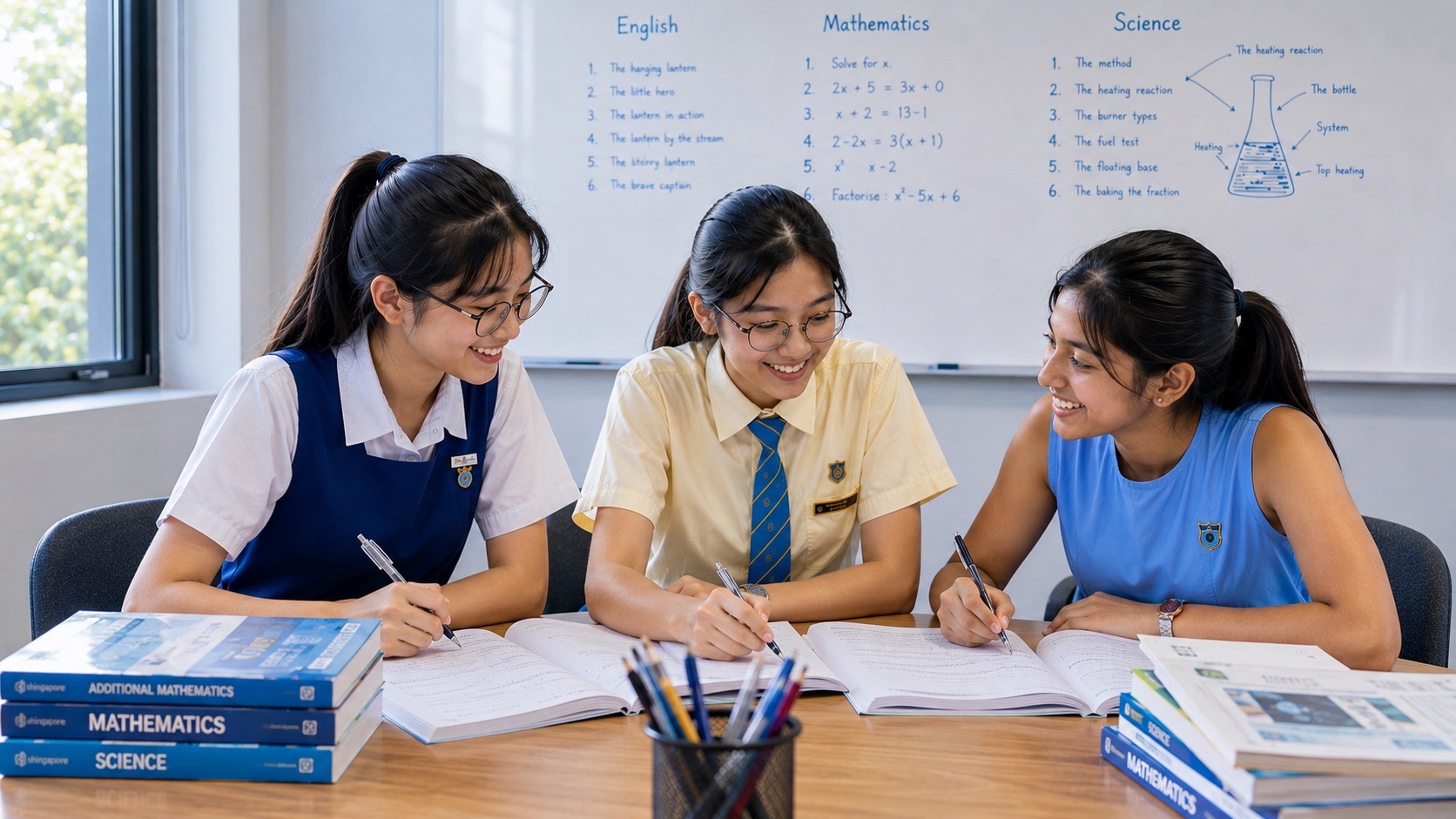
Secondary 2 G3 Mathematics small groups tuition in Punggol should help students explain quadratic factorisation and graphs, manipulate algebraic fractions correctly, interpret simultaneous equations and inequalities, and apply right-triangle trigonometry with valid conditions. eduKatePunggol publishes a 1.5-hour tutorial model capped at three learners. Effective instruction checks each student’s original working, repairs the first mistaken transformation and then uses a changed problem to test independence.
MOE’s 2020 G3 Mathematics syllabus lists algebraic identities, factorisation, algebraic fractions, quadratic functions, simultaneous linear equations, quadratic equations by factorisation, congruence and similarity, Pythagoras and trigonometry, solid mensuration and data analysis within Secondary Two. It has different depth and progression from G2. Under Full SBB, G3 refers to the actual Mathematics subject level, not automatically the admission Posting Group. SEAB’s K310 is a 2027 graduating SEC subject code, not a Secondary Two national exam.
- **Topic match:** identify the current G3 school chapter and the earliest repeated misconception.
- **Algebra:** expand, factorise, simplify expressions and fractions, and obey denominator restrictions.
- **Functions:** use quadratic graphs, turning points, symmetry, intercepts and equations.
- **Geometry:** require justified triangle properties before similarity or trigonometry.
- **Method selection:** solve changed mixed tasks without chapter-title hints.
- **Parent evidence:** original and revised independent work, a later retention check and a sustainable weekly plan.
The G3 syllabus is a specific school-level course
G3 Secondary Two Mathematics extends beyond routine calculation into recognising algebraic structure and choosing methods from less familiar information. A learner may know how to expand two brackets but fail to recognise the same structure when an expression is presented as an area or equation.
The tutor should begin with an original school example and ask what the learner thought the first operation meant. The correction should address the concept that failed, not simply make every following worksheet harder.
Posting Group is different from the Mathematics subject
Under Full Subject-Based Banding, Posting Groups serve secondary admission while individual subjects may be studied at G1, G2 or G3 according to school arrangements. Mathematics level should be verified separately from English and Science.
A tutor should not allocate G3 worksheets solely from an older admission label. Three learners benefit from common objectives only when they are studying compatible content and can all receive individual correction.
Quadratic graph depth differs from G2
The MOE content-by-levels tables explicitly place quadratic functions and graph properties in G3 Secondary Two. These include graph shape, symmetry and maximum or minimum points. G2 also develops algebra, but its specific content and timing are not identical.
A tutor can use a simpler factorisation example to repair an earlier gap, then return to the student’s actual G3 requirement. The purpose of differentiation is learning, not a ranking of pupils by worksheet difficulty.
The first diagnostic compares familiar and changed work
A child may factorise x squared minus five x plus six on a worksheet headed Quadratics, yet fail another factorisation when it appears inside a word problem or algebraic fraction. Such a pattern reveals method recognition rather than only arithmetic.
A tutor should preserve the first unassisted attempt and ask why the learner selected a particular operation. Another unfamiliar question after teaching checks whether the recognition transfers.
Expansion requires all cross-products
The product (2x + 3)(x − 4) expands to 2x² − 8x + 3x − 12, or 2x² − 5x − 12. A pupil who multiplies only the first and last terms misses interactions that produce the middle coefficient.
An area grid can make each term visible, followed by a changed product. A correct independent expansion is stronger evidence than copying an arrow pattern that the student cannot explain.
A squared bracket includes its middle term
The identity (a + b)² = a² + 2ab + b² can be verified by multiplying (a + b)(a + b). Writing only the two outer squares changes the value. For a = 2 and b = 3, the correct square gives 25, not 13.
A tutor can connect the algebra to a divided square area, then ask the pupil to expand (x − 4)² independently. The negative middle coefficient must come from the actual product.
Difference of squares has a recognisable form
The expression 9x² − 16 factors into (3x − 4)(3x + 4). The cross-products cancel, leaving the difference of two squared quantities. The same pattern does not automatically factor a sum of positive squares over real linear factors.
The tutor can ask why the signs are opposite and then provide 25y² − 1 as a changed example. A student should verify the factorisation by expansion.
Factorisation reverses multiplication
The quadratic x² − 7x + 12 factors into (x − 3)(x − 4), since the constants multiply to twelve and sum to negative seven. Factorisation should produce exactly the original expression when expanded.
A tutor can ask the learner to check both coefficient conditions and then factorise x² − 8x + 15 independently. Picking two numbers that satisfy only one condition is not enough.
An expression is not an equation
An expression such as x² − 5x + 6 can be factored without solving for x. The equation x² − 5x + 6 = 0 is a different task, requiring the values of x that make the expression zero.
The tutor should ask the child what the question requests before reporting roots. A changed expression-versus-equation pair tests whether the difference is understood rather than memorised.
The zero-product principle has a condition
If (x − 2)(x − 3) equals zero, at least one factor must equal zero, so x is two or three. If the same product equals five, setting each factor equal to zero would be invalid.
A tutor can compare the two cases and ask why the zero condition matters. A fresh quadratic set equal to zero tests independent use of the principle.
Common factors justify cancellation
The numerator x² + 2x factors as x(x + 2). Therefore (x² + 2x)/x simplifies to x + 2 for nonzero x. Canceling an x symbol from each term of an unfactored sum without preserving factor structure is an invalid shortcut.
A tutor can test numerical substitutions, then change the fraction to another factorable expression. The learner should explain what whole factor is canceled.
Original denominators restrict allowed values
The expression (x + 2)/(x² + 2x) is undefined when x is zero or negative two. It can be simplified to 1/x where the original expression is defined, but canceling x + 2 does not suddenly permit x = −2.
A tutor should ask which inputs make each original denominator zero before performing algebra. A changed fraction tests this checking habit.
Multiplication of algebraic fractions needs structure
The product (3x/4) × (8/(9x)) simplifies to 2/3 when x is nonzero. The cancellation is valid because the numerator and denominator are products of factors, not additions.
A tutor can show numerical factor cancellation and then ask for an unfamiliar example. A fraction containing a sum tests whether the child avoids inappropriate symbol deletion.
Adding algebraic fractions needs a common denominator
For x not equal to 2 or 3, 1/(x − 2) + 2/(x − 3) becomes [(x − 3) + 2(x − 2)]/[(x − 2)(x − 3)]. This simplifies to (3x − 7)/[(x − 2)(x − 3)].
The tutor should explain why denominators cannot simply be added. A changed fraction pair checks whether the student forms a common denominator and expands carefully.
Changing formula subject must preserve equality
From A = bh/2, multiplying both sides by two gives 2A = bh. Dividing by nonzero b gives h = 2A/b. A pupil who moves symbols without understanding the operations may produce a formula that fails when checked.
A tutor can ask for a numerical verification in both directions. A different formula with an unknown dimension tests whether equality-preserving transformations are independent.
Linear graphs and quadratic graphs behave differently
A linear graph y = 2x + 3 has constant gradient. The graph of y = x² is curved; equal steps of x generally produce changing increments in y. Two points alone are insufficient to establish that a whole function is linear.
A tutor can generate tables for both relationships and ask what pattern distinguishes them. A changed quadratic tests whether the student recognises curvature from structure.
A quadratic coefficient changes opening direction
The parabola y = x² opens upward and has a minimum, while y = −x² opens downward and has a maximum. The sign of the squared term’s coefficient controls the basic orientation in these examples.
A tutor can ask the pupil to predict the graph from the equation before plotting. A changed coefficient tests whether the sign is understood rather than merely associated with a familiar drawing.
Turning points connect algebra to a graph
For y = (x − 2)² + 1, the square is never negative, so the minimum value of y is one when x equals two. The turning point is (2, 1). This is not simply an arbitrary marked dot.
A tutor can change the function to y = −(x + 1)² + 4 and ask for the maximum at (−1, 4). The changed task checks both coordinate order and the sign.
The axis of symmetry is a useful graph check
The graph y = (x − 2)² + 1 is symmetric about x = 2. At x = 1 and x = 3 its y values are equal because those x values are equally distant from two.
A tutor can ask the pupil to use the relationship to check a plotted curve. A new quadratic graph tests whether symmetry is treated as a mathematical property rather than drawing decoration.
Graph roots are zeroes of a function
The quadratic y = x² − 5x + 6 crosses the x-axis where y equals zero, at x = 2 and x = 3. Factoring the polynomial and reading graph intercepts should agree.
A tutor can ask why setting x to zero finds the vertical intercept instead. Another factorable quadratic tests the relationship between roots and graphical zeroes.
Simple inequalities produce intervals
The inequality 2x + 3 at most eleven has solutions x at most four, shown as a region on a number line. Unlike a single equation, an inequality can have infinitely many permitted real values.
A tutor can ask the learner to test numbers on both sides of the boundary. A changed inequality checks whether the end point is included according to the symbol.
A negative multiplier reverses inequality order
From −2x greater than six, dividing by negative two gives x less than negative three. Failing to reverse the inequality changes the solution set. Substituting x = −4 confirms the original condition, whereas x = 0 does not.
A tutor can show why multiplication by a negative reverses number order and then change the coefficient. The learner should test a new answer independently.
Simultaneous equations are shared conditions
The system x + y = 10 and x − y = 2 has solution x = 6, y = 4. The pair must satisfy both equations. Eliminating y by adding them produces 2x = 12.
A tutor can ask why one equation alone does not usually fix both variables and then introduce a changed pair. Substitution into both originals is a useful verification step.
A ticket problem requires correct equation formation
Two adult tickets and one child ticket cost $22, while one adult and two child tickets cost $17. Defining a and c as prices gives 2a + c = 22 and a + 2c = 17, leading to a = 9 and c = 4.
The tutor should ask what each coefficient counts before eliminating variables. A changed price story tests whether the pupil forms equations independently instead of solving a supplied model.
Graph intersections can verify systems
Two straight lines meeting at one point represent simultaneous conditions with a common solution. A pupil who reads an intersection as (4, 3) when the correct axes show (3, 4) may have reversed coordinate order.
A tutor can substitute the plotted point into both equations and compare with algebraic results. Another graph tests whether the coordinates are interpreted correctly without the original figure.
Proportion and map scale require appropriate units
At map scale 1:50,000, one centimetre represents 50,000 centimetres, or 500 metres, of ground distance. Two centimetres represent one kilometre. A pupil who writes 50,000 metres has missed the unit conversion.
A tutor can ask what length the ratio compares and then use a changed scale. Area conversions require treating two dimensions, not simply multiplying by one linear factor.
Direct and inverse proportion are different
A directly proportional relation y = kx has constant ratio for nonzero x. An inversely proportional relation y = k/x has constant product under the model. A service fee plus an item rate is linear but not directly proportional if the fixed fee is nonzero.
A tutor can compare example tables and ask which condition remains constant. A new context tests whether the student identifies the relationship independently.
Congruence requires matched shape and size
Two triangles can be rotated or reflected and remain congruent when corresponding sides and angles match. Similar triangles may have a scale factor different from one, with equal corresponding angles but proportionally different lengths.
A tutor can ask the pupil to label corresponding vertices before using ratios. A changed orientation prevents shortcuts based only on where sides appear on the page.
Area scales differently from length
Similar squares with sides two and six have length scale factor three, but their areas are four and thirty-six, giving area factor nine. Reporting a one-to-three area ratio would treat two-dimensional coverage as a one-dimensional distance.
A tutor can use grids to show why the factor is squared. A changed pair of similar triangles checks whether the same reasoning transfers.
Pythagoras needs a right angle
For a right triangle with perpendicular sides eight and fifteen, the hypotenuse is seventeen. A student who uses Pythagoras in an arbitrary triangle without a right-angle condition is choosing a method that may not apply.
A tutor can ask what information proves the triangle is right-angled. A changed triangle with another orientation tests the prerequisite before calculation.
Sine, cosine and tangent depend on the chosen angle
In a right triangle, opposite and adjacent sides are defined relative to a specified acute angle. A side that is opposite for one angle becomes adjacent for the other. The hypotenuse remains opposite the right angle.
A tutor can ask the pupil to label all three sides before selecting a trigonometric ratio. A new rotated triangle checks whether orientation is irrelevant to the relationships.
Worked tangent interpretation
If the opposite side is six and adjacent side is eight, tan θ = 6/8 = 0.75. A calculator can obtain the angle under appropriate settings if requested, but the quotient describes the side ratio relative to θ.
The tutor can change the marked angle so that opposite and adjacent swap. A correct independent setup matters more than remembering one inverse tangent output.
A geometric diagram needs stated conditions
A drawn triangle may look isosceles or right-angled even when the question has not given or established that property. Applying a theorem from appearance alone risks a precise calculation based on a false premise.
A tutor can ask the learner to identify markings, written facts and justified deductions. A changed figure with similar visual appearance but different conditions tests valid method selection.
Mensuration needs correct dimensions and units
A cone with radius three centimetres and perpendicular height six centimetres has volume πr²h/3 = 18π cubic centimetres. Using slant height instead of perpendicular height without justification changes the quantity.
A tutor can compare a cone and a matching cylinder and then change the dimensions. The learner should state the volume’s cubic units and identify the necessary measurements.
Data summaries can be sensitive to outliers
For values 2, 3, 3, 6 and 11, mean is five, median three and mode three. The large last value raises the mean relative to the median. A correct formula alone does not decide which summary is most useful.
A tutor can change the outlier and ask how the summaries respond. Another dataset tests interpretation rather than copying a computed answer.
Basic probability needs a sample space
For a fair six-sided die, the probability of an even number is three out of six, or one half. The denominator counts all equally likely outcomes, not only the favourable ones.
A tutor can change the event to numbers greater than four and ask the pupil to list the possible outcomes. The new task checks mathematical meaning behind the fraction.
Mixed tasks test method recognition
A topical worksheet titled Quadratic Factorisation tells the learner which operation is expected. A mixed problem about a graph intercept or an area may require the student to recognise a quadratic structure independently.
A tutor can remove the chapter cue and ask what relationship the story describes. A changed task tests whether knowledge transfers beyond a rehearsed layout.
Three pupils may need three different corrections
One learner factorises accurately but cancels algebraic sums illegally, another simplifies fractions but reverses inequality signs, and a third solves equations yet misreads turning-point coordinates. Their similar marks would conceal different needs.
The tutor can teach a shared relationship and assign individual follow-up tasks. Parents should ask what their own child can now solve alone, not only how many pages the group finished.
A ninety-minute tutorial needs independent work
An illustrative lesson begins with retrieval of an earlier weak idea, analyses original schoolwork and models one new principle. Guided questions are followed by a changed exercise each pupil completes independently.
The sequence can vary by algebra, graphs or geometry. A good session is measured by a learner’s method selection without hints, not by the tutor’s speaking time or a thick stack of corrected papers.
Four-week reviews show narrower outcomes than grades
Week one records a baseline, week two teaches the missing principle, week three changes the task and reduces hints, and week four checks a different independent answer. A pupil may now factorise an unfamiliar quadratic correctly even if a school test covers several other topics.
The tutor should report the specific gain and what remains weak. No fixed SEC score increase follows automatically from four private lessons.
Delayed retrieval detects template dependence
A student may solve x² − 5x + 6 immediately after modelling and fail x² − 7x + 12 weeks later. The second task reveals whether the factorisation method is genuinely retrievable without the original example.
A tutor can revisit the relationship and give varied new forms. More repeated copying may improve familiarity without repairing the missing principle.
Upper-secondary choices are school decisions
Secondary 2 pupils may hope to study Additional Mathematics or a particular Science combination later. These options depend on school offerings and eligibility, not a tutoring company’s claims.
A tutor can help build algebra and reasoning but should not promise admission to a chosen subject. Families can compare real school guidance, interests and the pupil’s independent work before selecting extra lessons.
A sustainable timetable matters
Secondary 2 students balance schoolwork, CCA, travel, meals and sleep. A 1.5-hour tuition session adds home practice and transport. A student who arrives exhausted may not use the teaching effectively.
Parents should ask which short targeted tasks will be reviewed and whether a new class is genuinely needed. The right outcome can be improved independent work, a different support format or no further tuition.
Worked case: turning point coordinates are reversed
The graph y = (x − 2)² + 1 has minimum at (2, 1). A pupil writes (1, 2), confusing the role of x and y even though the graph’s shape is understood.
The tutor asks when the squared term is smallest and which coordinate records the input. A new function y = −(x + 1)² + 4 tests whether the maximum is identified at (−1, 4) without the original drawing.
Worked case: an algebraic fraction is canceled by appearance
The expression (x + 3)/(x² + 3x) has denominator x(x + 3). For x neither zero nor negative three, it simplifies to 1/x. The cancellation is of a whole factor, not separate x and three symbols across a sum.
The tutor changes the factor to x + 2 in another fraction and asks for restrictions. A correct independent result should preserve the original function for permitted values.
Worked case: a negative inequality is reported incorrectly
From −3x greater than 12, the correct solution is x less than negative four. A learner who reports x greater than negative four has divided by a negative without reversing the relation.
The tutor can test a value such as −5 in the original statement and then use a different coefficient. The goal is understanding the reversal, not just memorising an arrow movement.
Worked case: a quadratic looks linear from two samples
A pupil plots (0,0) and (1,1) for y = x² and concludes that the whole graph is the straight line through those points. Both points fit the quadratic, but many curves can pass through two points.
The tutor asks for values at x = 2 and x = 3, revealing four and nine. A changed quadratic tests whether the pupil uses enough information to infer its shape.
Worked case: trigonometric sides are misidentified
A triangle has an opposite side six and adjacent side eight for a marked angle. The tangent is 0.75. When the target angle switches to the other acute angle, those roles swap.
The tutor asks the student to relabel opposite, adjacent and hypotenuse before computing. A different rotated triangle checks whether the ratio is selected by the angle, not page orientation.
Worked case: the family confuses success with permanent tuition need
A G3 pupil originally needs constant hints to interpret quadratic graphs but later identifies turning points, symmetry and roots independently in changed tasks and retains the skill after a delay. That is useful narrow progress.
The family can review whether school feedback now provides enough support, or whether another repeated gap remains. A tutoring arrangement should support growing independence rather than promise grade outcomes or require lifelong attendance.
Secondary 2 G3 Mathematics parent checklist
- Check current G3 schoolwork and the MOE Secondary Two topic boundaries.
- Test quadratic expansion, factorisation and algebraic identities by reverse verification.
- Teach algebraic-fraction cancellation only through common factors with excluded-value checks.
- Connect parabolic shape, turning points, symmetry and roots to equations.
- Justify solutions of inequalities and simultaneous systems.
- Mark the target angle before trigonometric side ratios.
- Use realistic statistics, units and geometric conditions.
- Review an unfamiliar independent task for every pupil and check retention later.
Frequently asked questions
Does G3 Secondary Two include quadratic graphs?
Yes, including properties such as opening direction, maximum or minimum and symmetry.
Is G3 the same as G2 Mathematics?
No. Content-by-level tables differ in algebraic-fraction depth and quadratic requirements.
What does factorising a quadratic achieve?
It rewrites the expression as a product; solving roots additionally requires an equation.
When can algebraic factors cancel?
When a genuine common multiplicative factor exists and original denominator restrictions are observed.
Why are turning points useful?
They identify a maximum or minimum and help describe quadratic-graph behaviour.
What does a simultaneous solution represent?
A pair of values satisfying both original equations or their graph intersection.
Why do inequality signs sometimes reverse?
Multiplication or division by a negative reverses the order of real numbers.
Is right-triangle trigonometry part of G3 Secondary Two?
Yes, with appropriate ratios and geometrical applications listed in the official syllabus.
Why can a pupil get tangent wrong?
Opposite and adjacent sides depend on the specific acute angle selected.
Do similar shapes have equal areas?
Not generally. Their corresponding lengths are scaled, and areas vary by the square of the length factor.
Can a three-pupil group guarantee A1?
No. Small-group instruction can provide close feedback but cannot guarantee grades.
Should every pupil begin Additional Mathematics early?
No. Actual subject offerings and eligibility are school decisions; current foundations should be secure first.
What is the 2027 G3 Mathematics code?
K310 for the graduating SEC cohort, not a Secondary Two national examination.
What is the best progress check?
A new independent problem on the diagnosed misconception and a delayed retention task.
Punggol G3 Maths and official syllabus references
- Secondary 2 G3 Mathematics class-size companion
- Secondary 1 G3 Mathematics: prerequisite lessons
- Secondary 2 Mathematics: method selection
- Secondary 2-to-3 subject choices
- Secondary 3 Additional Mathematics: algebra first
- Secondary small groups G-level directory
- Tuition at eduKatePunggol
- Immutable Mathematics tutorial reference
- MOE 2020 G3 Mathematics, Secondary Two content-by-level table
- SEAB 2027 SEC G3 Mathematics K310 directory
Editorial note (7 November 2026): This independent Punggol learning article is not issued by MOE or SEAB. Worked questions and pupil cases are original illustrations. The applicable G3 syllabus and school sequence govern content. Exam grades, course allocations and tuition places cannot be guaranteed.


