
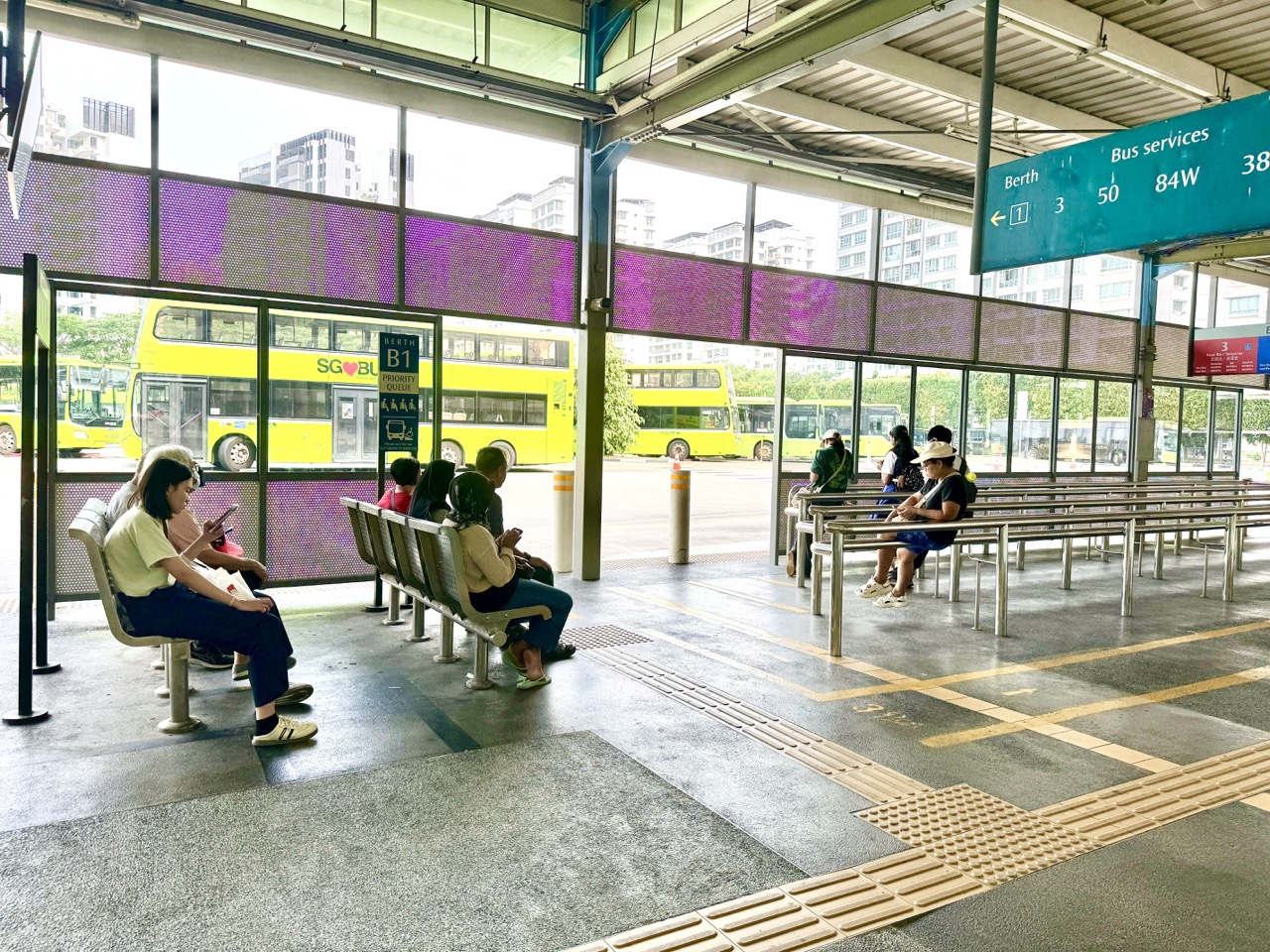
A bus stop seat in Punggol can appear normal until someone sits on it and feels it move. Cracked surfaces, loose brackets, exposed sharp fixings and unstable benches are legitimate safety concerns. If a seat looks damaged, do not test it by sitting or pulling on its supports. Move to a safe waiting place, leave wheelchair access and the bus boarding area clear, and report the exact stop to the Land Transport Authority (LTA). A useful complaint gives the five-digit bus-stop code, the damaged section and the observed condition.
LTA’s walking and cycling design guidance treats bus-stop seating as part of the waiting environment, alongside circulation space for wheelchairs and standing commuters. Its public infrastructure defect-detection work explicitly names damaged seats as a category for inspection. The obligation to report a potentially unsafe bench is therefore different from requesting a new seat at a temporary stop that was never fitted with one. This guide covers how to tell those situations apart, whom to contact and what to do if vulnerable passengers need a usable rest area.
- Avoid a seat that is visibly loose, cracked, sharp or pulling away from its mounting.
- Do not climb underneath it, tighten bolts, force broken pieces into place or conduct weight tests.
- Stay within the safe waiting zone, not the bus lane or kerb edge.
- Locate the correct five-digit bus-stop code and note the side of the road.
- Use LTA’s official contact service for ordinary public bus-stop infrastructure faults.
- Record whether the damage blocks accessible circulation or creates a risk to children or seniors.
- Take a wide location photograph and a detail photo only if safe and privacy-respecting.
- If someone is injured, seek appropriate medical help first, then report the incident facts.
1. Why seating is a public-transport facility
Seating helps people wait without unnecessary physical strain. Someone who can stand comfortably for ten minutes may barely notice a missing or damaged bench. An older person, a pregnant passenger, a parent carrying an infant or a commuter with a mobility limitation may experience the same fault as a significant barrier. A public seat therefore supports access as well as convenience. That does not mean every stop needs an identical layout, but it means the condition of an installed seat should be taken seriously.
A waiting area must also accommodate passengers who cannot use the bench, including people using wheelchairs or strollers. Seating that protrudes into a passage can be problematic even if no one sits on it. Maintenance of the bench and maintenance of the walking route are related responsibilities. Reporting should describe both the damaged fitting and any actual obstruction that it causes.
2. What LTA’s design information tells us
LTA’s Walking and Cycling Design Guide describes the typical bus stop as including a shelter, seats, a bus stopping area, information panels and other features. Shelter layouts provide space to sit, stand and circulate. The size and configuration depend on the stop’s usage and available site space, so there is no universal promise that two Punggol stops have the same bench design or seat count.
An LTA road-infrastructure brief specifically includes damaged bus-stop seats among defects that the authority wants to detect and monitor. This does not establish that any named Punggol bench is faulty. It does establish that a specific damaged seat belongs in the infrastructure-maintenance process, rather than being dismissed as an unimportant matter of personal comfort.
3. What loose mounting looks like
The bench may shift or tilt during ordinary use, a supporting leg may no longer meet the pavement properly, or a bracket may visibly separate from its intended position. These signs are enough reason to avoid the affected section. No one should be asked to sit on the bench to demonstrate that it is unstable. A person who has already noticed movement can describe it without repeating the experience.
The cause may involve an anchor, a support, a connecting part or another condition. A resident cannot determine which from surface appearance alone. A qualified maintenance contractor may need to isolate the bench and inspect the connections under controlled conditions. Avoid speculating about the exact metal, installation method or loading capacity without an assessment.
4. Cracked and broken surfaces
Some seat materials crack, split or develop jagged edges. Depending on the design, the break may catch clothing, pinch fingers or reduce structural strength. Even when the main bench remains attached, a loose outer piece may create a hazard for a child who leans against it or a senior using the seat to steady themselves. Distinguish a superficial scratch from a visible break, but do not conduct destructive tests to prove severity.
A repair team may be able to replace a component or may need to remove the entire bench. The correct decision depends on the approved asset, damage and condition of the supporting structure. A quick application of household adhesive or tape by a commuter can conceal the defect and make later inspection less reliable.
5. Sharp screws and exposed fasteners
A damaged cap, protruding screw or corroded edge can injure someone who merely brushes past, even without sitting. Check from normal standing distance for obvious parts sticking into the public route. If the hazard is immediately exposed to children or pedestrians, make that clear in the report and use a direct operator contact rather than waiting for a routine message to be reviewed.
Do not pull out the screw, place a child’s hand near it for scale, cover it with adhesive tape or attempt to bend it down. Such interventions can worsen the condition or produce an unreliable temporary fix. Let the infrastructure owner determine the appropriate protective barrier and repair.
6. An unstable bench is not a science experiment
A seat that rocks when another person stands should not be tested again for a video. A damaged support may fail under a different distribution of weight, and a volunteer who sits abruptly can be injured. The public’s observations during ordinary use are sufficient for an initial report. The operator’s technicians have controlled inspection procedures that do not require risking a commuter’s safety.
This principle also applies when there is no visible crack. If the surface suddenly shifts or sounds abnormal, step away and describe what happened, including the location of the movement. Avoid inventing a structural explanation from a single noise. A well-written observation often helps more than an alarming claim.
7. Finding the correct bus stop
Use the five-digit stop code found on the bus-stop pole or official route information where possible. The code matters because opposite sides of a road can serve different directions and have separate facilities. Record the street, travel direction and a nearby fixed landmark. Do not cross the road solely to take a picture of another code or guess that the code for the opposite stop is the same.
When the code is missing or obscured, say so and describe the site. A nearby HDB block, junction or major entrance can help identify it. For a damaged or unreadable sign itself, use the separate Punggol bus-stop sign guide. The problem with a bench must still be reported accurately even when other stop information is imperfect.
8. Which section of the bench is affected?
A shelter might have a continuous bench or multiple individual seat sections. The maintenance team needs to know whether the unsafe part is nearest the approaching buses, closest to the back wall, on the left when facing the road or at the centre. If several components are damaged, describe each without assuming they share a cause.
A safe overview image can show the seat relative to the stop pole and shelter. Avoid crouching beneath the bench to photograph hidden mounts or touching a protruding piece to show scale. A clear location description is a valid alternative when taking a close photograph would be unsafe.
9. Wet seating and structural damage are different
A bus bench can become wet during heavy rain because shelters have open sides. Water blown in from the road does not automatically mean a roof has failed. A damp surface may temporarily be unpleasant or slippery, while an actual fracture, a detached bracket or a sharp edge requires mechanical attention. Report what you saw, not a convenient explanation.
If water visibly drips through a roof seam onto the seating, describe that as a second condition. The existing bus shelter leak guide explains how to distinguish wind-driven rain, roof defects and pavement ponding. One fault does not prove the other.
10. What to do while the bench is unusable
Wait on stable ground inside the lawful bus-stop waiting area, away from the damaged fitting and the road. Do not move into the bus bay just to find somewhere to lean or sit. If the stop has other usable seats, use them without obstructing other commuters. Allow room for passengers to board and alight when the bus arrives.
Where no safe seat is available, a person with limited ability to stand may need a caregiver’s support or an alternative travel arrangement. Do not promise that another stop will have seating or that the opposite side serves the intended journey. Check the actual route and accessibility before changing travel plans.
11. Children at the bus stop
Children often swing their legs, sit heavily or lean across benches when waiting for school or activities. If a parent sees a crack or loose part, explain that the seat is not safe to use and guide the child to a proper waiting place. Do not ask the child to demonstrate how the seat moved or to reach beneath it.
Teach a simple routine: notice an unusual part, avoid contact, tell an adult and allow the authority to repair it. This makes the child observant without turning them into a maintenance worker. A real-world safety lesson should not require testing a hazard.
12. Seniors and people who need a rest
For an older resident, an out-of-service bench can affect the entire journey, especially when waiting for a clinic appointment or travelling after standing in a queue. The report can say that the seating loss particularly affects passengers who cannot stand for long. This explains the practical impact without exposing anyone’s medical history or identity.
If a family member needs a sitting option while waiting, consider whether another stable bench can be reached safely. Avoid placing a movable chair in a way that blocks the passage or wheelchair boarding space. A permanent replacement or authorised temporary arrangement belongs to the facility operator.
13. Wheelchair and stroller circulation
LTA’s bus-stop design guidance specifically considers circulation space for wheelchair users. A loose bracket protruding from the bench or temporary storage around a damaged seat may narrow the path. The defect can therefore affect passengers who never intend to sit on the bench. Describe the obstruction as an accessibility concern when reporting.
Do not solve the problem by placing a large homemade warning sign across the accessible route. A barrier must be properly positioned and managed by authorised staff. If a temporary repair cordon blocks the only step-free passage, inform LTA so the maintenance response can consider both safety and continued access.
14. Temporary stops and missing seats
A stop affected by development work may have different amenities from an established permanent shelter. LTA has publicly discussed cases where temporary stops were in use before a final shelter and seating could be provided because of construction constraints. The absence of seating at such a stop is not necessarily evidence that something was stolen or broken.
If seating is needed but absent, frame the request as an amenity or accessibility improvement. If a seat is actually present and broken, report it as a safety defect. A complaint becomes much easier to route when it separates a request for new infrastructure from the repair of an existing asset.
15. What if the seat appears to have been vandalised?
A scratched bench, missing cap or bent support may have been deliberately damaged, but a public observer often cannot establish intent. Report the physical condition without accusing a named person or group. If there is evidence of an active threat or an immediate criminal incident, use the appropriate authorities, but avoid speculating from an old photograph.
The maintenance requirement does not depend entirely on why the seat is damaged. An unstable bracket needs attention whether it resulted from wear, impact, misuse or another event. The operator can determine whether to review security records or raise a separate matter.
16. Litter or spilled drinks on the seat
A sticky or dirty surface is normally a cleanliness concern, not automatically a mechanical problem. Avoid touching unknown substances and report a spill that creates a hazard. If there are sharp objects or contaminated materials, keep clear and ask the responsible operator to arrange safe cleanup. Do not use household chemicals on public furniture.
When a seat is both dirty and physically damaged, describe both issues. A cleaning crew may address surface litter while a maintenance contractor checks the broken fitting. A complaint saying only that ‘the bench is disgusting’ may miss a dangerous loose support.
17. Which operator should receive the report?
For an ordinary public bus-stop seat, LTA is an appropriate first contact. Its Contact Us page lists 1800 2255 582 for relevant public transport and road-infrastructure concerns. The bus operator’s driver may raise an observation too, but the fixed stop seating is not the same asset as the bus interior.
A private condominium, workplace shuttle, school transport area or mall pick-up point can use different infrastructure and have another maintenance owner. Check signage and ask the property operator when the location is not a public-road stop. OneService can also route suitable municipal concerns when ownership is unclear.
18. An effective report needs facts, not engineering guesses
Write the stop code, street, direction, precise seat position, date and observed damage. If the rightmost bench section appears separated from its support, say that. If someone felt it move during ordinary use, describe that without staging another test. Explain a real accessibility or injury risk if one is evident.
Avoid stating the bench is ‘about to collapse’ when the condition has not been assessed. A report that exaggerates can confuse the urgency and mislead other commuters. The infrastructure owner is responsible for confirming the severity and selecting the repair.
19. A sample reporting message
You can adapt this: ‘At bus stop [five-digit code], [street] towards [destination], the bench section nearest [landmark] appears loose at its mounting and has a protruding metal edge. I noticed it at approximately [time] on [date]. Please inspect the seat and take suitable safety measures.’ Replace every placeholder with actual observations and omit details you do not know.
A short message is more useful than a lengthy account of unrelated traffic problems. If you have a photograph taken safely, attach it through the official form. Keep the reference number and add further details to the existing case if the problem worsens.
20. Taking photographs without creating risk
Take one picture that shows the bus stop and seat location and, where safe, another that shows visible damage. Do not step into traffic, crawl beneath the bench, climb on the seat or lean over a drain. If the damaged part is hidden, describe what happened during normal use rather than attempting to expose it.
People waiting at the stop may not want to be photographed. Try to exclude faces and other unnecessary personal details. OneService’s FAQ permits an image of the surroundings when directly photographing an issue is unsafe or inappropriate, accompanied by a precise description.
21. When the report should be urgent
A sharp metal piece sticking into a crowded path or a bench partly detached from its support can present an immediate safety risk. A call to the responsible operator may be more appropriate than a routine online form alone. Explain the visible condition and number of people exposed without inventing injuries.
A minor cosmetic scratch is different. The operator can assess it through its normal process. Do not use an emergency medical number for a chipped paint finish. If someone is genuinely hurt, obtain medical help first and provide responders with the actual bus-stop location.
22. If an accident has already happened
A person who has fallen from a bench may need first aid or medical attention depending on their condition. Move other passengers away from the dangerous section, but do not force the injured person to stand or walk if a serious injury is suspected. Follow appropriate emergency guidance when there is an immediate medical problem.
After medical needs are addressed, report the incident to the infrastructure owner with time, stop code, symptoms and visible damage. Do not publish the injured person’s photo or details online. Any claim about responsibility or compensation requires an evidence-based process separate from the immediate repair.
23. Why DIY repairs are unsuitable
A public bench may depend on specially designed fixings, anchors, surfaces and loading capacity. An untrained person tightening a visible screw could conceal a deeper problem or fail to restore the approved connection. Adhesive tape might temporarily hide a sharp edge while producing a false impression that the seat is safe.
The correct approach is to ask the infrastructure owner to assess the installation and appoint the right contractor. A qualified technician may need to inspect the foundation, bracket, seat surface or surrounding pavement. The public’s valuable contribution is an accurate report and avoidance of the unsafe fitting.
24. How a repair can affect the waiting area
Maintenance crews may install temporary barriers, remove a damaged bench or bring equipment near the shelter. Commuters should follow the posted instructions and give workers space. Do not move a barrier because the bench seems usable again or a shortcut would save a minute.
A safe repair arrangement should also preserve a clear route to the bus. If a cordon forces passengers into the road or blocks a wheelchair ramp approach, notify the operator immediately. Safety around the worksite is part of the repair outcome, not an unrelated inconvenience.
25. What happens after a complaint
The operator may inspect the bench, determine whether it needs cleaning, minor repair, part replacement or temporary closure, and schedule appropriate work. The time depends on the nature of the damage, parts and surrounding conditions. Do not assert that every broken bench must be repaired in one day without an official response.
Keep the case number and follow the operator’s updates. A report saying ‘thank you, case received’ confirms that the issue was logged, not necessarily that the seat is safe. Only the responsible team can determine when the installation is ready for normal public use.
26. Why an intermittent problem deserves attention
A bench may shift during ordinary use on one day and appear firm later. That does not prove the original movement was imaginary or that the condition has resolved. A loose fitting can behave differently under different loads. Describe exactly what was observed and avoid trying to reproduce the movement.
If you notice the same problem again after a previous repair, add the new date and condition to the old case. The maintenance team may need to review whether the original issue recurred or whether another part is affected. Be factual rather than accusing an individual contractor.
27. The difference between comfort and defect
A seat can be uncomfortable because it is hard, exposed to sun or lacks a backrest. Those concerns may support an amenity improvement request, but they do not necessarily indicate mechanical failure. A loose bracket, sharp edge or cracked seat is a defect and should be reported as such.
The distinction helps the authority decide what to do. A design improvement may require planning and assessment of space, while a damaged structure may require prompt maintenance. A complaint is stronger when it identifies which kind of problem is present.
28. A family waiting for school
A parent with a school-age child sees a crack across one of the shelter’s seat sections. The child is tired and wants to sit there, but the parent guides them to a safe standing space. They note the stop code, stay clear of the damaged section and report it after the journey.
This example is hypothetical. It teaches a simple response: notice the defect, do not test it, stay in the proper waiting area and inform the owner. A child does not need to handle the fixture or prove that someone can fall before action is justified.
29. A senior waiting for a medical visit
An older resident who normally rests on the bench finds the entire section marked out of service. The resident may need help arranging a safe wait or a more suitable journey. A relative can inform the operator that the loss of seating affects mobility, which is useful context for a repair priority.
The family should not assume another stop in the opposite direction is an accessible alternative. Check the route, walking distance and the person’s actual needs. The authority may provide information about repairs, but a guide cannot promise temporary seating or a fixed completion date.
30. A wheelchair user approaching the stop
A bracket from a damaged seat protrudes into the corridor between the shelter and boarding space. Although the wheelchair user does not need the bench, the protrusion may prevent clear movement. A report should mention its location relative to the accessible route and the ramp landing.
This illustrates why seating maintenance is not only about comfort for people who sit. Public furniture must coexist with barrier-free circulation. A technician should review both the broken bench and the safe path around it, rather than merely covering the sharp edge.
31. When a bus captain notices a fault
A bus driver may be the first to observe a broken seat while servicing a stop. Passengers can mention the issue respectfully, but should not demand that the captain repair infrastructure or stop the bus indefinitely. The driver’s primary duty is safe service operation.
For a reliable maintenance record, passengers should also submit feedback to LTA. An operator may coordinate with the authority, but the fixed shelter bench belongs in the infrastructure process. Keeping those roles clear helps the complaint reach the team with authority to act.
32. How observations should be written
A strong observation is concrete: ‘One bench leg is visibly separated from the footplate’ or ‘the plastic seating panel has a split edge’. A weak claim is speculative: ‘the seat was built using the wrong material and will collapse tomorrow’. Without technical inspection, the second statement cannot be supported.
The same rule applies when reporting through a neighbourhood group. Share the location and safe caution rather than naming people who supposedly caused the damage. Encourage neighbours to use official channels and avoid posting unrelated commuters’ images.
33. Why the stop code still matters after repair
A repair crew may have attended the wrong stop if two opposite-side shelters are described only by their road name. Later reports should include the same five-digit code and bench position so the history is consistent. This is especially useful when different sections of the same shelter need attention.
If the original post or message used an uncertain code, correct it transparently. Do not insist the authority should have known which stop you meant. A reliable maintenance trail begins with accurate physical location and dates.
34. Related problems should be separated
A shelter can have a cracked seat, a blank arrival display and a leaking roof at the same time. These may be serviced by different teams. Report each observed symptom in a clear part of the message instead of saying simply that the entire stop is broken.
Our Punggol bus arrival display guide and the shelter leak guide address those distinct issues. Separation helps readers and maintenance teams find the correct process quickly without duplicating the same information across articles.
35. The household’s practical takeaway
A public bench is a small piece of neighbourhood infrastructure that many people share. Reporting a clearly damaged seat can prevent an avoidable injury, especially for someone who depends on it for a safe wait. The most useful action is not a dramatic social-media video, but a precise report with the stop code and factual condition.
A resident need not know how to weld a support, identify a particular alloy or quote every design criterion. They only need to recognise something that does not look safe for ordinary use, keep others informed respectfully and let the responsible authority assess it.
Quick reporting checklist
- Avoid the unsafe section without testing it.
- Record the stop’s five-digit code, road and direction.
- Identify the exact bench section and observed defect.
- Include whether the issue affects wheelchair, stroller or pedestrian circulation.
- Take a safe, privacy-respecting photo if practical.
- Contact LTA through its official feedback channel.
- State any immediate hazard without inventing facts.
- Save the response reference and follow up if necessary.
Frequently asked questions
Can I sit on a cracked bus-stop seat if it looks firm?
Avoid a seat that is visibly cracked, loose or unstable. The public cannot evaluate its safe load from appearance, and attempting a weight test could cause injury.
Who maintains a public bus-stop bench in Punggol?
For ordinary public-road bus stops, LTA is an appropriate infrastructure contact. A private pick-up shelter or condominium facility may have another operator.
What is the LTA contact number?
LTA lists 1800 2255 582 for relevant public transport and road-infrastructure enquiries. Check its current official website.
What if the bench looks missing?
Confirm whether it was ever part of the stop, especially if the stop is temporary. Request seating as an amenity improvement rather than claiming an unverified theft.
Can I tighten a loose bolt myself?
Do not alter public infrastructure. The qualified maintenance team should determine whether the bench’s support, anchors or surface require repair.
Is a wet bench a broken seat?
Not necessarily. Open-sided shelters can admit rain. Surface wetness, roof drips and structural seat damage should be described separately.
Does a damaged seat mean buses are cancelled?
No. A bench fault is a facility issue, not proof of a service suspension. Check official bus information separately.
What if the damaged bench blocks wheelchair access?
Make that access consequence explicit in the report. Keep clear and avoid adding your own obstruction.
Can I photograph the damage?
Yes, if you can do so safely and without unnecessarily identifying commuters. A location view and visible-defect detail are useful.
What if someone was injured?
Seek appropriate medical help, then report factual details to the authority. An injury investigation or legal claim is separate from making the seat safe.
Can the bus captain repair the seat?
The captain may note an issue, but fixed shelter seating is infrastructure, not part of the bus’s own interior equipment.
Should I use OneService?
It can route suitable municipal reports, but LTA is a direct source for public bus-stop infrastructure. Include the five-digit code.
What if the seat is only uncomfortable?
That is an amenity or design concern rather than necessarily a defect. Describe what improvement would help and who is affected.
Is a sharp protruding screw urgent?
It may be an immediate injury risk. Avoid the area and contact the responsible operator promptly with the exact stop location.
How soon will LTA repair the bench?
There is no universal guaranteed time. The response depends on the defect, safety priority, site and repair requirements.
Can a senior request more seating?
A resident can provide feedback about seating availability and mobility needs. The feasibility of installing additional seats depends on the stop.
What if an earlier repair failed?
Quote the original report reference, describe the current condition and include when the problem reappeared.
Do all Punggol stops have exactly the same bench?
No. Layouts vary by location, passenger volumes and site constraints. Check the actual structure.
What is the strongest one-line report?
‘At stop [code] on [road], the [position] bench is [observed defect], noticed on [date/time]; please inspect for safety.’
What if I cannot read the stop code?
Describe the street, side of the road, direction and landmark. Do not invent an identifier; mention that the sign is unreadable.
Official sources and related Punggol reading
- LTA — Contact and Infrastructure Feedback
- LTA — Walking and Cycling Design Guide, Bus Stop Layout
- LTA — Identifying Damaged Bus Stop Infrastructure
- OneService — Municipal Reporting
- OneService — Precise Locations and Photos
- eduKate Punggol — Bus Shelter Roof Leaks
- eduKate Punggol — Missing or Unreadable Bus Stop Signs
- eduKate Punggol — Local Information Hub
Reviewed 7 November 2026. General public-infrastructure guidance only. No specific Punggol bus stop was inspected or alleged to be defective. Follow onsite safety notices and the responsible authority’s current instructions.


