
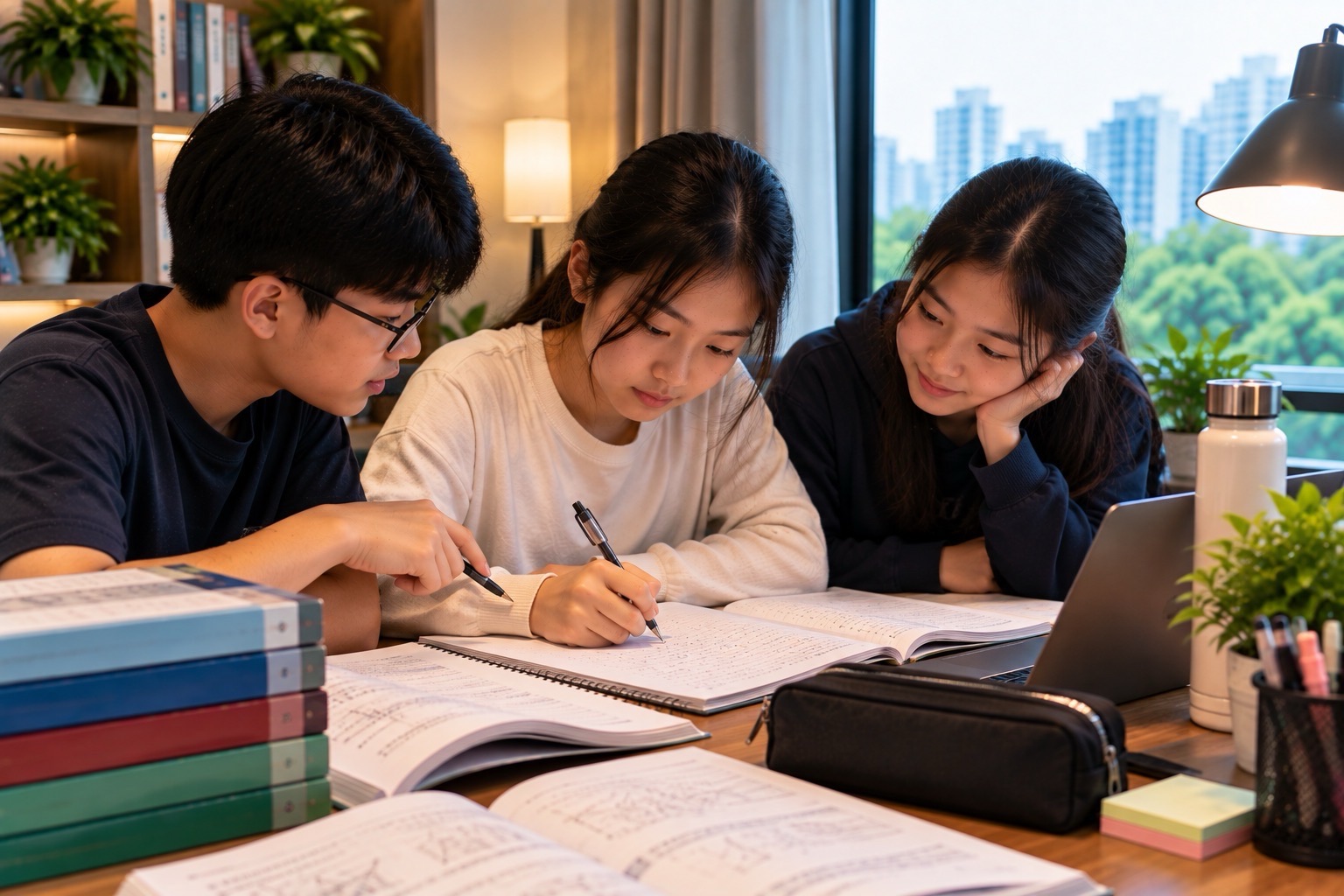
G3 Mathematics (SEC K310) and G3 Additional Mathematics (SEC K341) are two separate Singapore upper-secondary subjects. Mathematics K310 covers Number and Algebra, Geometry and Measurement, and Statistics and Probability, including problems in real-world contexts. Additional Mathematics K341 extends algebraic techniques, functions, trigonometry, coordinate geometry and calculus; it is **additional to**, not a substitute for, the regular Mathematics subject. Under the verified 2027 SEC scheme, each subject has two compulsory 2-hour-15-minute written papers, each carrying 90 marks and 50% of that subject’s grade. K310 Paper 1 has roughly 26 shorter questions and Paper 2 has 9–10 longer questions, including an extended real-world application at the end. K341 Paper 1 has 12–14 questions and Paper 2 has 9–11 questions. Approved calculators may be used in both papers of each subject.
For Punggol families selecting Secondary 3 subjects for **2027**, the pupil would normally take the final SEC in **2028**, so the published 2028 specifications will ultimately govern. The key question is whether the school’s current Year 3 combinations include Additional Mathematics and whether the child has demonstrated readiness for symbolic reasoning, algebraic transformations, graphs and multi-step problem solving. One G3 Mathematics grade alone does not establish readiness for every A-Math topic, and an A-Math label does not guarantee admission to JC, engineering or any particular diploma. Consult actual school prerequisites and future institutional requirements, then decide on a sustainable subject load that allows the pupil to learn both courses properly.
- Two separate 2027 SEC subjects: regular G3 Mathematics K310 (previously 4052) and G3 Additional Mathematics K341 (previously 4049).
- Mathematics K310 Paper 1: 2h15, 90 marks, 50%; about 26 short-answer questions, all compulsory.
- Mathematics K310 Paper 2: 2h15, 90 marks, 50%; 9–10 varying questions, with a final extended problem focused on real-world application.
- Additional Mathematics K341 Paper 1: 2h15, 90 marks, 50%; 12–14 varying questions; all compulsory.
- Additional Mathematics K341 Paper 2: 2h15, 90 marks, 50%; 9–11 varying questions; all compulsory.
- SEAB permits an approved calculator in both K310 papers and both K341 papers; essential mathematical working must still be shown.
- K310 strands: Number/Algebra, Geometry/Measurement, Statistics/Probability. K341 emphasises deeper Algebra, Trigonometry/Coordinate Geometry and Calculus.
- Additional Mathematics does not replace Mathematics; it increases subject content and weekly learning commitment.
- School availability, A-Math eligibility and actual subject combinations vary. Use the pupil’s real Year 3 options booklet.
- Secondary 3 in 2027 normally means SEC in 2028; verify the future examination-year syllabus and later course requirements.
From compulsory mathematics to deeper algebra and calculus
Definition lock | Mathematics and A-Math are two different qualifications
K310 is the broad secondary Mathematics subject. K341 is the Additional Mathematics subject that builds on strong prior mathematical understanding and introduces different techniques, including calculus. A pupil enrolled in both sits and receives results for both, according to the actual school registration. A-Math is not a hidden advanced part of K310 and should not be treated as a compulsory extra paper that every G3 Mathematics student must take. The school’s combination rules determine eligibility. Full Subject-Based Banding also means the pupil’s Posting Group does not define every academic level; the relevant detail is the specific registered Mathematics subject and its G level.
Why K310 is a serious course in its own right
Some families speak of regular Mathematics as though it were merely preparation for A-Math. That understates its purpose. K310 develops numerical fluency, algebra, geometry, measurement, data interpretation, statistics and probability, including applying these ideas to everyday scenarios. The syllabus values reasoning and mathematical communication as well as procedures. A child who can factor a quadratic may still struggle to interpret a misleading statistical diagram or make sense of a household-finance word problem. Those are not peripheral skills. K310 gives students mathematical tools to read quantities and models critically, check results and make reasoned decisions. Parents should therefore protect regular Mathematics learning rather than allow an A-Math tuition schedule to consume all mathematics study time.
Why K341 is genuinely additional rather than a superior label
Additional Mathematics demands deeper symbolic manipulation and conceptual work, with substantial emphasis on algebraic functions, trigonometric relationships and calculus. A student needs to understand what expressions represent before applying lengthy procedures. A-Math may suit pupils who enjoy abstract relationships and can persist with unfamiliar multi-stage questions, provided the school offers the course and the student meets its criteria. It is not a universal status marker, however. Another learner may make excellent progress in G3 Mathematics and a valued creative or technical elective instead. The right question is not whether every ambitious teenager should take A-Math. It is whether this particular student can benefit from the extra mathematical depth while managing the rest of the subject combination.
The official 2027 codes prevent a common resource mistake
SEAB’s G3 directory uses K310 for Mathematics and K341 for Additional Mathematics. Older O-Level resources may show 4052 and 4049 respectively. The reference numbers help families recognise older material but do not prove that an older paper has identical content or structure to the candidate’s exam year. If a student enters Secondary 3 in 2027, the final examination is normally in 2028. Parents should keep a simple list of registered codes and compare workbooks with the correct 2028 syllabus when it is released. An excellent A-Math integration exercise is not the right response to a K310 misconception about probability, and a basic algebra book may not cover all the demands of K341. Accurate resources matter more than large collections.
The two-subject commitment changes the weekly timetable
A student enrolled in K310 and K341 has two separate Mathematics syllabuses to learn while also studying English, Mother Tongue, Science, Humanities and possibly another elective. The overlap can be useful, but the courses have distinct assessed tasks and should not be expected to merge into one effortless study block. A timetable may also include projects, CCA and travel. Before accepting A-Math, ask the pupil’s actual school about available subject blocks, entry rules, workload and support. The child should have time to review difficult concepts after lessons rather than rush through every worksheet for the sake of completion. A sustainable plan can be ambitious without overwhelming. The best indicator is progress in independent thinking across both subjects.
The K310 assessment is two 90-mark papers with different emphasis
In the 2027 scheme, Mathematics Paper 1 lasts two hours fifteen minutes and contains about twenty-six shorter questions, all compulsory. Paper 2 lasts the same duration and has nine or ten questions with varying marks and lengths; its final question focuses specifically on applying mathematics to a real-world scenario. Each paper contributes fifty per cent. Candidates therefore need both accurate routine work and the ability to interpret a longer problem. The real-world question might draw on everyday numerical relationships, graphs or financial information in hypothetical circumstances. A student who knows a formula but cannot decide which details matter needs problem interpretation, not simply another formula sheet. Essential working must be shown.
The K341 assessment asks for sustained mathematical reasoning
The 2027 Additional Mathematics scheme also has two ninety-mark, two-hour-fifteen-minute papers, each worth fifty per cent. Paper 1 contains about twelve to fourteen questions, while Paper 2 contains roughly nine to eleven with varying marks and lengths. All questions are compulsory. Fewer questions does not imply less work; problems can require several related steps and careful proof or reasoning. A pupil may need to transform an expression, choose an identity and then interpret a result. If the method fails at step one, additional calculation rarely rescues the answer. Teachers should inspect where the reasoning diverged rather than merely tell the student to practise more difficult questions. A learner who can explain why a transformation is valid has made progress beyond memorising a worked example.
Calculators are permitted, but mathematics is not outsourced to one
The official 2027 K310 and K341 specifications allow approved calculators in both papers. That can help with numerical evaluation, but it does not replace setting up an equation, choosing a model, checking units or showing essential working. Students sometimes believe they have mastered a topic because the calculator gives the right decimal after numbers are entered in a familiar order. Ask what relationship was represented and whether the result is plausible. In an algebraic question the calculator cannot decide the entire mathematical argument for the student. Parents should verify SEAB’s current list of permitted models and other exam aids rather than assume any programmable device is allowed. A strong pupil uses technology to support, not conceal, mathematical understanding.
Number skills remain essential when algebra becomes complex
Negative numbers, fractions, indices and order of operations are foundations that reappear in both subjects. A student who can solve a difficult-looking equation may still make a sign error or mishandle a fraction while expanding brackets. Those mistakes should not be treated only as carelessness if the pattern repeats. Ask the child to explain why a negative multiplied by another negative is positive, or why division by a fraction changes the operation. Then use that understanding in an unfamiliar algebraic context. A short accurate foundation lesson can repair an obstacle that otherwise reappears throughout the year. The goal is fluency supported by meaning, not dependence on a verbal shortcut such as ‘move it across’ without considering the equation’s balance.
Algebraic expressions and equations are not interchangeable
An expression such as 3x + 7 can be simplified or evaluated, while an equation such as 3x + 7 = 22 asserts a relationship that may be solved for x. A pupil who confuses the two may perform invalid operations or invent an equals sign while simplifying. This difference becomes more important when working with quadratics, functions or calculus later. A good teaching method begins with the question: what is this mathematical object, and what operation is the task asking for? If solving an equation, each legal transformation should preserve its solutions. If factorising an expression, the result should be algebraically equivalent. Test with substitution or expansion rather than trusting a memorised pattern. The same discipline supports ordinary Mathematics and Additional Mathematics.
Functions connect algebra to graphs and meaning
A function describes a relationship between an input and an output under defined conditions. In both Mathematics and Additional Mathematics, a student may be asked to interpret a graph, manipulate a functional expression or connect the algebraic model with a situation. A common problem is treating a graph as only a picture whose shape must be memorised. Ask what its axes represent, what the gradient or intercept communicates where relevant, and which input values make sense. K341 takes this thinking further through more complex functions and relationships. A pupil who can explain why a graph rises or falls is often better prepared for an unfamiliar problem than one who recognises a familiar curve but cannot interpret it. Context and symbolic form should reinforce one another.
Quadratics test structure, not just formula recall
Quadratic expressions and equations appear in the mathematical foundations relevant to both courses, though the depth differs. Students may learn factorisation, completing the square, use of a formula or graphical interpretation. The question is which method fits a specific problem and why. An answer from the quadratic formula can be numerically correct but unsuitable if the task asks for exact factor form or an explanation of turning-point behaviour. Before choosing a method, inspect the expression’s structure and what the problem requires. Then check the solution by substitution or algebraic equivalence. A-Math students in particular benefit from reliable manipulation and a habit of testing domain or contextual restrictions. A formula remembered without understanding is fragile when a new question combines topics.
Trigonometry is reasoning about geometric relationships
In regular Mathematics, trigonometric ratios and related geometry help students solve problems involving sides, angles and spatial situations. Additional Mathematics develops the topic further through functions, identities, equations and transformations, according to the official syllabus. A student who can use sine, cosine and tangent in a right triangle may still struggle with trig functions for a wider angle range or proving an identity. The correct lesson starts with the geometric or functional meaning of the expression, not a guess based on which formula appears on the page. Sketches and units can help interpret the task. In identities, both sides must be connected through valid transformations rather than rearranged as though they were a one-off numerical equation. Understanding the concept makes unfamiliar problems more manageable.
Calculus introduces change and accumulation
Additional Mathematics includes differentiation and integration, which develop mathematical ideas about rates of change, gradients, areas and accumulation. These topics are not merely mechanical rules to memorise. A derivative describes how a quantity changes locally with respect to another, while integration can describe an accumulated amount under appropriate assumptions. For a teenager encountering calculus for the first time, useful preparation begins with functions and graphs. Ask what is changing, which variable is measured and what a positive or negative gradient would mean. Only then apply differentiation rules or solve a related problem. Integration likewise becomes clearer when related to a quantity’s area or total. A pupil who understands these interpretations can detect nonsensical results more reliably than one who performs procedures without checking meaning.
A-Math logarithms demand precise inverse relationships
Exponential and logarithmic functions appear in the 2027 K341 syllabus. Students may recognise logarithms as a calculator button but misunderstand what they express. The key concept is an inverse relationship: a logarithm asks which exponent produces a given value for a suitable base. Laws of logarithms depend on defined conditions and should not be applied to arbitrary negative expressions. A learner who memorises one expansion without understanding the domain may introduce invalid solutions. Start with small exponential examples and ask the student to convert between equivalent forms, then explore graphs and more general equations. Use the official problem scope and teacher advice for the actual exam year. Accurate conceptual understanding protects against the temptation to simplify any symbol using a familiar-looking rule.
Coordinate geometry builds a bridge between shape and algebra
Equations of lines and circles, gradients, midpoints and related coordinate relationships allow students to describe geometry algebraically. The A-Math syllabus includes more advanced coordinate work and transformations. A child may know a line’s gradient formula but select the wrong points, misread a negative sign or ignore what the gradient means for a pair of lines. Ask the learner to draw an approximate diagram, label given coordinates and explain how the equation relates to the geometry. If a result contradicts the sketch, investigate before accepting it. Coordinate geometry is a useful area for diagnosing transfer because it requires visual, symbolic and numerical thinking to agree. The school may also use these skills in Physics or Computing contexts, but the mathematics must first be sound.
Statistics and probability distinguish K310 from an algebra-only view
Regular Mathematics includes statistics, data handling and probability, none of which should be dismissed as minor topics. Students need to choose and interpret representations, describe distributions and reason about chance. An average can conceal unequal spread, and a graph with a misleading scale can exaggerate a difference. Probability questions require understanding the sample space and whether events are independent or mutually exclusive where relevant. These skills help readers evaluate real information and uncertainty. A pupil who spends all Mathematics revision on algebra because they are also taking A-Math may neglect a meaningful part of K310. A healthy plan includes periodic retrieval of data interpretation and statistical reasoning, using unfamiliar contexts rather than only familiar formula substitutions.
The Paper 2 real-world question measures modelling
The K310 Paper 2 final question is explicitly designed around applying mathematics to a real-world scenario. The syllabus discusses contexts such as travel, sports, household finance, plans and graphs. The candidate may need to identify assumptions, combine several topics and interpret a result rather than produce only a number. A student who solves algebra accurately can still fail if they model the wrong quantity or ignore a restriction. Teach a sequence: describe the situation in words, identify the variables and units, select relevant relationships, calculate, then interpret the answer back in context. Some questions may permit more than one reasonable strategy. The key is a defensible mathematical model with clear working, not a complicated formula inserted only because it appeared in last week’s chapter.
What a strong algebra-readiness diagnostic looks like
A useful readiness check for Additional Mathematics contains more than one routine computation. Ask the pupil to expand and factor an expression, solve an unfamiliar equation, interpret a simple graph and explain why the steps preserve meaning. Keep the task short enough that the teacher can observe the first hesitation. A child may lose marks because of fractions, negative signs, concept misunderstanding or poor reading. These call for different instruction. An A-Math offer should be discussed with the school using evidence from current work and the actual subject prerequisites. One high mark is encouraging but not a guarantee of readiness for every later topic. A student who can reason flexibly across these examples has a stronger foundation than one who simply reproduces memorised procedures.
Punggol school criteria cannot be inferred from a national code
The SEAB directory confirms K310 and K341 nationally, but does not announce the A-Math admission criterion for every Punggol secondary school. A particular school’s combination booklet may require a specific performance level or place A-Math in certain timetable blocks. Another school may structure its electives differently. The family should obtain the current official options, speak with the Mathematics department and ask whether the child would need any bridging. It would be misleading to state that every G3 Mathematics student automatically qualifies for A-Math or that the same percentage threshold applies nationally. The right choice should consider genuine interest and sustainable workload. A well-matched student can enjoy the additional challenge; another may thrive with a different elective that builds complementary strengths.
Post-secondary implications should be checked course by course
From 2028 the post-secondary admissions framework changes, and different JC, MI, polytechnic and ITE programmes have their own subject grade and aggregate requirements. Additional Mathematics can be relevant background for mathematically intensive future study, but a family should not promise that it is always compulsory for every engineering or computing route. Some institutions distinguish between meeting the minimum entry requirements and being competitive for a limited number of places. Parents can begin by identifying a few plausible courses and reading their actual criteria for the child’s intended intake year. A strong Mathematics education remains valuable across many fields regardless of one elective choice. The student should learn what both courses teach and why they might be useful instead of treating an A-Math label as an automatic passport.
A balanced study routine protects the compulsory Mathematics foundation
A child taking both subjects may be tempted to spend the entire week on difficult A-Math calculus while neglecting K310 statistics or real-world modelling. The opposite can happen when familiar regular Mathematics becomes a comfortable activity used to avoid unfamiliar A-Math functions. An effective routine protects time for both and targets the first repeated error. A teacher might find that one misconception about indices is causing problems in both subjects, allowing a short focused correction to have broad value. Another student may need separate practice interpreting a data chart and proving a trigonometric identity. Study time should be allocated according to evidence, not the perceived prestige of the subject.
An independent retry is the most useful evidence of understanding
A student may leave tuition with a beautiful corrected page but still struggle in an unfamiliar examination. The critical step is whether they can reconstruct the reasoning without the model visible. For a factorisation mistake, ask for a different expression. For a calculus interpretation, use a new graph. For an error involving units, change the scenario. If the child can explain the choice and check the result, the principle has begun to transfer. A small group may support discussion and feedback, but the number of pupils cannot guarantee marks or school eligibility. Parents should look for gradually increasing independence rather than a growing number of answer keys. This approach helps both Mathematics K310 and Additional Mathematics K341.
Official 2027 K310 and K341 paper specifications
SEAB 2027 G3 Mathematics K310 syllabus and SEAB 2027 G3 Additional Mathematics K341 syllabus set the actual two-paper formats and calculator allowances. The SEAB national G3 directory confirms that these are separate codes. Those national sources do not define every Punggol school’s entry threshold, so consult the school’s Year 3 options and Mathematics teachers before committing to A-Math.
A Secondary 3 pupil starting in 2027 normally sits SEC in 2028, so the final 2028 syllabus should replace the 2027 example when available. Families planning further study should read relevant institutions’ course-specific Mathematics requirements instead of assuming A-Math is always mandatory or that the absence of A-Math closes every progression route. The educational goal is accurate mathematical reasoning and a choice the pupil can sustain alongside all other school subjects.

Twelve Mathematics and A-Math mistakes with checkable repairs
A subject-selection misunderstanding and a mathematical misconception are different problems. One needs correct school information; the other needs an explanation of the first incorrect operation or interpretation. These examples provide practical diagnoses to discuss with the pupil’s Mathematics teacher.
1. A-Math is treated as a replacement for Mathematics
The family assumes K341 is a higher version that removes the need for ordinary G3 Mathematics. These are distinct qualifications. A student should know whether they are registered for one or both before planning revision.
Check the subject-combination record and confirm both distinct papers. The qualification map is correct. Test the idea on a different question without the original model answer visible. A neat correction alone does not prove understanding.
2. The wrong K-code is used when buying workbooks
A K310 student is assigned long K341 calculus exercises as the main exam preparation. An advanced topic may be educationally interesting without being the subject’s prescribed assessment. Match materials to the actual exam.
Compare every resource with the actual code and syllabus year. Revision remains relevant. Test the idea on a different question without the original model answer visible. A neat correction alone does not prove understanding.
3. The learner solves an expression as though it were an equation
An equals sign is invented or operations are performed without a relationship to preserve. Mathematical tasks name different objects and operations. Recognising the command avoids invalid steps.
Explain whether the task is simplify, factorise, evaluate or solve. The operation fits the object. Test the idea on a different question without the original model answer visible. A neat correction alone does not prove understanding.
4. Terms are moved across the equals sign without justification
A sign or coefficient changes incorrectly because the child follows a verbal shortcut. An equation represents balance. A legitimate transformation must preserve that balance, and an answer should be checked.
Apply equivalent operations to both sides and verify by substitution. The solution preserves equality. Test the idea on a different question without the original model answer visible. A neat correction alone does not prove understanding.
5. Negative indices and fractions are guessed
A familiar simplification rule is used where a denominator or sign changes the result. Basic number principles remain active inside advanced algebra. A correct rule is more reliable than a memorised surface pattern.
State the index or fraction rule, then check with a small numerical example. The transformation is valid. Test the idea on a different question without the original model answer visible. A neat correction alone does not prove understanding.
6. A quadratic formula is used without checking the task
The answer gives decimals when an exact expression or factor form is requested. Methods serve the task. A final answer can be mathematically true yet fail to meet the requested form.
Read the command and choose a method appropriate to the required result. The response is suitable. Test the idea on a different question without the original model answer visible. A neat correction alone does not prove understanding.
7. A trigonometric identity is treated like a numerical equation
The pupil alters both sides arbitrarily and never establishes equivalence. An identity is a relationship that holds for appropriate inputs. Its proof needs a valid chain of equivalences.
Work from valid identities and show each justified algebraic step. The proof is coherent. Test the idea on a different question without the original model answer visible. A neat correction alone does not prove understanding.
8. A derivative is calculated without interpreting the variable
The student obtains a gradient but cannot explain its unit or meaning in the scenario. A derivative is a rate with respect to a variable. Its physical or graphical meaning should be identified.
Identify what changes with respect to what before differentiating. The answer reflects the model. Test the idea on a different question without the original model answer visible. A neat correction alone does not prove understanding.
9. Logarithm laws are applied without valid conditions
An expression is simplified into an invalid domain or unsupported equality. Logarithmic laws have domain assumptions. Students should test whether the manipulated statement remains meaningful.
Explain the exponent relationship and check permitted input values. The solution is valid. Test the idea on a different question without the original model answer visible. A neat correction alone does not prove understanding.
10. A statistics chart is neglected for more algebra
The student avoids the compulsory K310 data strand because A-Math seems more important. Broad Mathematics includes data and probability. It should not disappear from revision when A-Math becomes demanding.
Allocate regular practice to interpreting axes, spread and probability. K310 preparation remains balanced. Test the idea on a different question without the original model answer visible. A neat correction alone does not prove understanding.
11. A calculator output replaces mathematical working
The pupil produces a number without a clear method or check of reasonableness. A calculator supports numerical work but cannot supply the mathematical explanation or validate the chosen model.
State the model, show essential steps, calculate and interpret. The explanation is assessable. Test the idea on a different question without the original model answer visible. A neat correction alone does not prove understanding.
12. An A-Math choice is made for social prestige
The student takes an extra demanding subject without checking algebra readiness or the full timetable. Curriculum load and genuine understanding matter. A prestigious label is not enough to make a subject a good fit.
Review school advice, interests, actual performance and later requirements. The decision is sustainable. Test the idea on a different question without the original model answer visible. A neat correction alone does not prove understanding.
An eight-week Mathematics versus A-Math readiness plan
This is a flexible foundation plan for home discussion, not the school’s official curriculum calendar or an examination guarantee. Select tasks appropriate to the child’s current level and have a qualified teacher check actual misconceptions. Keep time for the rest of the subject combination.
Week 1: Confirm K310 and K341 access
Check the school’s actual A-Math option, subject code, prerequisite and the expected 2028 exam year. An actual school option and prerequisite determine whether A-Math can be taken, not its national listing alone.
Independent check: The course decision is real. Keep one first attempt, the explanation of the repair and a fresh later task so transfer can be observed.
Week 2: Master number and symbolic foundations
Use independent signed-number, fraction, index and expansion questions with explanations. Algebra failures are often caused by earlier fraction or sign gaps. Repairing them has benefits across both courses.
Independent check: Operations are justified. Keep one first attempt, the explanation of the repair and a fresh later task so transfer can be observed.
Week 3: Equation and factorisation control
Solve unfamiliar linear and quadratic equations, verifying results by substitution. A solution should preserve the original equation and be demonstrably valid, not only resemble an answer key.
Independent check: Equality is preserved. Keep one first attempt, the explanation of the repair and a fresh later task so transfer can be observed.
Week 4: Connect functions to graphs
Interpret input-output relationships, coordinates, gradients and graph meaning. Graphs provide a bridge between symbols and meaning. Encourage students to explain what a calculated quantity represents.
Independent check: Visual and algebraic descriptions agree. Keep one first attempt, the explanation of the repair and a fresh later task so transfer can be observed.
Week 5: Try higher trigonometry meaningfully
Use appropriate identities and graphs to explain relationships before lengthy manipulations. Trigonometry becomes easier when the student understands identities and functional relationships rather than selects formulas by appearance.
Independent check: The method follows concepts. Keep one first attempt, the explanation of the repair and a fresh later task so transfer can be observed.
Week 6: Understand calculus ideas
Interpret rates and accumulation from new graphs, then attempt school-aligned differentiation or integration. Calculus is a language of change and accumulated quantities. Meaning should accompany technique.
Independent check: The results have meaning. Keep one first attempt, the explanation of the repair and a fresh later task so transfer can be observed.
Week 7: Protect broad K310 reasoning
Interpret a real-world numerical scenario and a statistics or probability task. A-Math should not displace data literacy or modelling, which remain part of the K310 paper.
Independent check: The compulsory foundation stays strong. Keep one first attempt, the explanation of the repair and a fresh later task so transfer can be observed.
Week 8: Review the complete combination
Compare original and fresh attempts, teacher guidance and the pupil’s overall workload. Final decisions should reflect independent evidence and a realistic schedule, not a comparison with another pupil.
Independent check: The next step is evidence-based. Keep one first attempt, the explanation of the repair and a fresh later task so transfer can be observed.
Frequently asked Mathematics questions from Punggol parents
Are K310 and K341 the same examination?
No. Regular Mathematics K310 and Additional Mathematics K341 are separate G3 subjects and grades. Individual school prerequisites, permitted aids and post-secondary requirements must be verified for the candidate’s actual cohort.
How long are their 2027 papers?
Both have two compulsory 2-hour-15-minute papers, each worth 50% and 90 marks. Individual school prerequisites, permitted aids and post-secondary requirements must be verified for the candidate’s actual cohort.
Can calculators be used?
An approved calculator may be used in both papers for both subjects under the 2027 specifications. Individual school prerequisites, permitted aids and post-secondary requirements must be verified for the candidate’s actual cohort.
Does regular Mathematics include statistics?
Yes. K310 includes Number and Algebra, Geometry and Measurement, and Statistics and Probability. Individual school prerequisites, permitted aids and post-secondary requirements must be verified for the candidate’s actual cohort.
Does Additional Mathematics include calculus?
Yes. K341 covers more advanced algebra, geometry/trigonometry and calculus. Individual school prerequisites, permitted aids and post-secondary requirements must be verified for the candidate’s actual cohort.
Is A-Math mandatory for all G3 pupils?
No. It is a distinct course selected according to actual school options and appropriate prerequisites. Individual school prerequisites, permitted aids and post-secondary requirements must be verified for the candidate’s actual cohort.
Is A-Math necessary for every polytechnic diploma?
No universal claim is reliable. Check the particular course’s current entry requirements. Individual school prerequisites, permitted aids and post-secondary requirements must be verified for the candidate’s actual cohort.
What is the exam year for Secondary 3 beginning in 2027?
Normally SEC 2028; the 2028 subject specifications will govern when available. Individual school prerequisites, permitted aids and post-secondary requirements must be verified for the candidate’s actual cohort.
Read the separate subject guides and the connected G3 hub
G3 Mathematics K310 guide · G3 Additional Mathematics K341 guide · G3 Secondary 3 subject combinations · Complete Punggol G3 subject directory. The immutable Clementi reference provides an instructional model of immediate facts, first-principles explanation, error diagnosis and independent retry. It does not establish an A-Math class vacancy or guarantee school eligibility.
Final parent decision checklist
- Ask the actual school whether K341 is offered and which pupil prerequisites apply.
- Confirm the current G3 Mathematics level, examination year and registered codes.
- Review independent algebra, graph and problem-solving evidence before accepting A-Math.
- Protect regular Mathematics Statistics/Probability and real-world modelling practice.
- Check future courses’ specific entry conditions rather than rely on prestige labels.
- Build a realistic timetable with time for English, Mother Tongue, Science, Humanities and CCA.


