
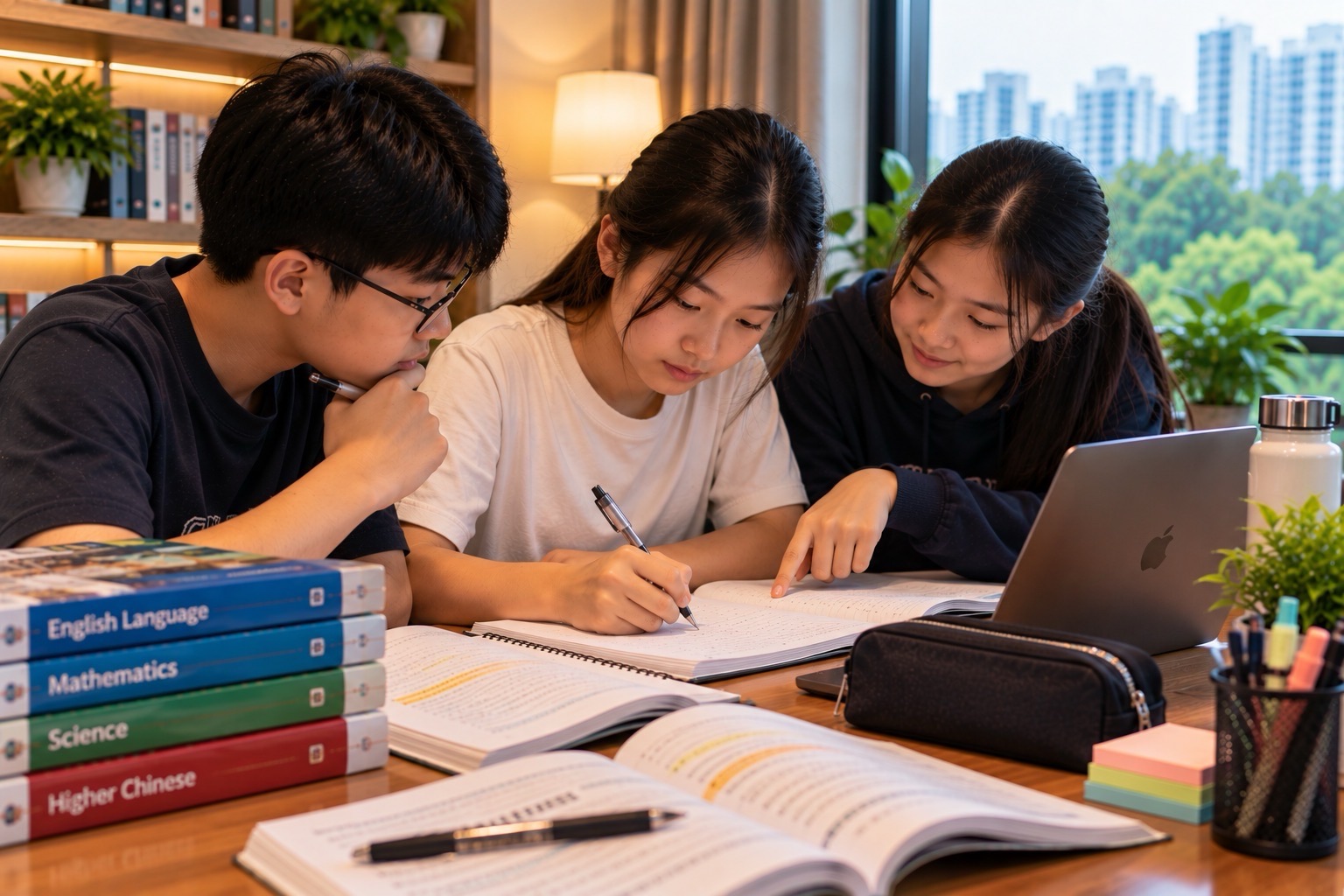
G3 in Secondary 3 means an individual upper-secondary subject taught at General 3 level under Singapore’s Full Subject-Based Banding system. It is not the same as Posting Group 3 or a promise that every subject in the pupil’s combination is G3. Secondary 3 is where students typically begin more specialised upper-secondary programmes—such as G3 Additional Mathematics, Pure or Combined Sciences, Humanities combinations, languages, business-related electives or creative and technical subjects—according to the actual school’s Year 3 options. The subjects and levels chosen shape the content and assessment the pupil works toward, but the national SEAB syllabus directory is broader than what any particular Punggol secondary school offers.
For Punggol parents with a child entering Secondary 3 in 2027, the normal final Singapore-Cambridge Secondary Education Certificate (SEC) year is **2028**, not 2027. SEAB’s published 2027 syllabuses are helpful planning references until the corresponding 2028 documents become available. Parents should check exact registered subject levels, school eligibility rules, prerequisites, coursework and practical arrangements, and any relevant post-secondary course requirements with the actual school. The 2027 list also includes **Applied Subjects Biotechnology K375 and Design Studies K376 whose final announced examination year is 2028**, requiring approved schools and agency-set fees; those options should not be treated as permanent for later cohorts. A workable combination is one the student can learn well across two years, not simply the largest collection of demanding titles.
- Secondary 3 begins the upper-secondary subject programme; G3 is a subject level, not a permanent child category.
- Posting Group 3 (PG3) is used in earlier school posting and should not replace the student’s actual subject-level record.
- A Secondary 3 pupil beginning in 2027 normally takes the final SEC in 2028; use the 2028 examination-year syllabuses when issued.
- Choose from the school’s real Year 3 combinations, not every subject published nationally by SEAB.
- Core skills: G3 English comprehension and writing, Mathematics reasoning, Mother Tongue, Science evidence, Humanities interpretation and appropriate electives.
- Pure Physics K323, Chemistry K324, Biology K325 are different qualifications from combined Science K326/K327/K328; check school prerequisites and later course requirements.
- Combined Humanities papers pair Social Studies with Geography, History or Literature, each at a specific examination code.
- Some G3 subjects include controlled coursework, practical assessment or supervised projects; outside helpers must not complete assessed work for candidates.
- Economics K343 and Business K344 are approved-school-only subjects; Applied Biotechnology K375 and Design Studies K376 additionally have 2028 as their announced final SEC exam year.
- Ask your school for the actual registered codes, subject-level bridging, examination-year papers and a realistic week-by-week workload.
What the Secondary 3 G3 transition really changes
Definition lock | G3 in Secondary 3 is a subject standard, not a stream
A student can study a G3 subject while following other subjects at different levels under the Full SBB arrangements relevant to their school. The term G3 broadly corresponds to the earlier Express/O-Level academic standard, but the cohort should be understood through individual subjects rather than the old stream labels. A Year 3 combination contains specific subjects, levels and assessment obligations. To interpret it correctly, write down the school’s registered code and level for each subject instead of relying on a generic phrase such as ‘the G3 course’. This is particularly important when buying revision material. A G3 Mathematics workbook and a G2 Mathematics workbook can develop overlapping concepts, but they do not necessarily cover the same assessment depth or national subject specification.
The Year 3 combination is a learning plan, not a trophy collection
Parents often ask whether the child should choose the most challenging number of subjects available. A more productive question is what the pupil will actually learn, how the assessments work and whether the combination remains sustainable across two school years. Every subject requires regular contact with its content. A creative elective with extensive coursework may take time at the same moment that Pure Sciences demand practical reports or Additional Mathematics introduces difficult symbolic work. There is no automatic benefit in selecting more titles when the schedule leaves too little time for understanding. A pupil who enjoys fewer subjects deeply can develop stronger independent learning than one exhausted by a crowded timetable. The correct combination should follow strengths, interests, teacher advice, actual school availability and plausible later pathways.
The 2027 and 2028 SEC syllabuses must not be confused
SEAB’s 2027 directory is a list for students sitting SEC in 2027. A Secondary 3 pupil beginning in January 2027 normally studies in Secondary 3 during 2027 and Secondary 4 during 2028, then takes SEC in 2028. Therefore, the 2028 final examination syllabus is authoritative when issued. Some subject content may continue with little change, but the family should not assume that specific prescribed literature, project timings or paper schemes remain identical. The correct habit is to use the 2027 documents for initial understanding, note where details could change, and ask the school to confirm the 2028 version. A source with a newer upload date is not necessarily the relevant examination year. Dates should be interpreted precisely rather than copied from general promotional material.
School option booklets define the actual choices
National G3 subject listings are not a promise of local classrooms. Punggol Secondary, Edgefield, Greendale and Yusof Ishak Secondary can have different subject combinations, facilities, staff and eligibility requirements. A subject may exist nationally but not be offered at the pupil’s school or in a particular timetable block. Ask for the official Year 3 options form, allowed subject clusters and selection results. If the pupil is considering an unusual elective, request specific confirmation rather than infer availability from a school’s CCA or learning programme. Another school’s combination chart is not binding on your school. The practical question is whether the child has an approved option in writing and can access its actual teaching and assessments. No private tutor can create formal examination registration for an unavailable subject.
Core Mathematics and Additional Mathematics have distinct roles
G3 Mathematics covers a broad mathematical foundation, while Additional Mathematics K341 involves further algebraic and calculus-related reasoning under its separate syllabus. A strong Grade in standard Mathematics is helpful but does not automatically mean the student is prepared for every A-Math concept. A pupil may manipulate fractions accurately yet struggle with algebraic transformations, or solve familiar equations but not know why an operation is valid. A readiness check should ask the child to explain an unfamiliar expression or equation from first principles. If a prerequisite is weak, address that gap rather than merely increase the difficulty of every worksheet. A teacher can also explain where A-Math is helpful for possible future courses; do not promise it is universally compulsory or an automatic admission advantage.
Pure Science choices involve distinct concepts and assessment
Physics K323, Chemistry K324 and Biology K325 are separate SEC G3 disciplines. A pupil might be interested in how forces and energy behave, how materials interact or how living systems function. Those interests are useful, but each course has its own body of knowledge and practical or data-oriented tasks. A child may perform well in one Science area but need greater support in another. Subject selection should examine teacher feedback, the school’s actual permitted Pure Science combinations, available laboratories and later course prerequisites. Avoid the assumption that a timetable with the greatest number of Pure Science papers must be best. Quality of scientific reasoning matters: students must interpret evidence, handle units, explain mechanisms and recognise limitations, not simply reproduce definitions from a familiar chapter.
Combined Science is not a lesser copy of the Pure Science code
The G3 Combined Science syllabuses have their own codes and component structures: Physics/Chemistry K326, Physics/Biology K327 and Chemistry/Biology K328 in the 2027 reference directory. A pupil studying one pairing should not practise another pair’s complete set of papers as though the names were interchangeable. Pure and Combined Science have overlapping concepts but different breadth and assessment requirements. Parents should compare actual school options, the child’s interests and likely post-secondary prerequisites. A student who takes Combined Science can still develop strong experimental reasoning and scientific literacy. The right question is whether the specific course fits the learner and provides an appropriate foundation for potential next steps, not whether a generic label sounds more prestigious. Check current institution criteria before asserting an academic pathway.
Humanities include Social Studies and a distinct paired discipline
The combined G3 Humanities options pair Social Studies with Geography, History or Literature in English, Chinese, Malay or Tamil. Each has a specific code and two different kinds of assessment. Social Studies uses sources and structured responses about citizenship, diversity and globalisation. Geography may work with spatial and environmental information, History with chronology and source interpretation, while Literature examines how language and narrative choices create meaning. A child who enjoys one style of reasoning may not enjoy every Humanities option equally. Parents should ask what the school actually offers and whether the student is choosing standalone Geography or History, or a combined Humanities code. Preparing a standalone Literature novel paper for a combined Literature route could be a major error. The course name and code should be confirmed before purchasing texts.
Language subject levels are not determined by the child’s home conversation alone
Regular Chinese K320, Malay K321 and Tamil K322 differ from Higher Mother Tongue subjects K355, K356 and K357. A pupil may speak the language well at home but struggle with formal essay structure, or read accurately while finding oral conversation difficult. The school’s language department should clarify actual level allocation and eligibility. Higher Mother Tongue is a substantive educational choice with its own paper formats and workload, not just a name added to a standard language result. Parents can support reading and meaningful conversation, but a student needing formal writing feedback should have the specific weak component taught. The entire subject combination matters; adding a demanding language alongside projects and science laboratories can create timetable pressure. Discuss genuine readiness rather than treat a higher label as inherently appropriate for all pupils.
Principles of Accounts is different from Economics and Business
Principles of Accounts K342 develops financial recording, principles and interpretation, while Economics K343 studies resource allocation and economic decision-making, and Business K344 examines enterprise decisions in its own curriculum. These subjects may sound closely related to a parent interested in finance, but their examination tasks are different. SEAB’s 2027 school-candidate directory marks Economics and Business as subjects for schools approved to offer them. A student who watches financial news cannot assume either is in the school’s combination booklet. Ask about formal availability and then inspect a sample task. Some learners enjoy precise accounting procedures, others prefer analytical arguments or case-based organisational reasoning. The best choice reflects actual learning interests, teacher advice and later course requirements rather than a broad belief that all business-labelled subjects are identical.
Computing and Electronics have different technical foundations
Computing K349 uses computational and programming ideas, while Electronics K353 studies circuits, components and the design of electronic systems. A coding or robotics CCA may combine these interests but is not a substitute for either national syllabus. A pupil who enjoys programming may need to learn why an algorithm works and how to test it systematically; another who enjoys circuit kits may need electrical quantities, analogue principles and logic reasoning. The school should confirm whether each subject is offered and what practical equipment is supervised. Families should not attempt unsafe electrical experiments at home in the belief that hands-on practice is always better. Teacher-approved simulation, diagram interpretation and careful debugging can build understanding without bypassing the school’s safety arrangements. The goal is evidence-based reasoning across systems.
Art, Higher Art, Drama, Music and Higher Music are distinct courses
Creative subjects may attract students who enjoy drawing, performance, composition or theatre. But a school CCA in one area does not guarantee examination entry in the corresponding G3 subject. Art K347 and Higher Art K348, Music K350 and Higher Music K351, and Drama K352 have distinct syllabuses and assessment structures. Some include coursework, practical performance or documented processes that cannot be replaced by a polished final product. Students should ask whether they enjoy the technical and analytical side of the discipline as well as the visible activity. A musician who loves performing may need to engage deeply with theory; an art student may need sustained visual investigation and evaluation. Parents should confirm actual school provision, controlled assessment requirements and the time needed for authentic independent work.
D&T, Nutrition and Food Science and ESS are not interchangeable practical electives
Design and Technology K345 considers user-centred design and making, Nutrition and Food Science K346 combines food-related knowledge with appropriate applied work, and Exercise and Sports Science K354 connects physical performance with physiology, motor learning, biomechanics and reflective coursework. A teenager may enjoy practical activity without understanding the examination’s written theory demands. Ask whether the pupil is ready to explain the scientific or design principles behind the work, and whether the school has the necessary facilities and supervision. Controlled practical and project assessments should not be completed by parents or external tutors. The child can benefit from conceptual practice and safe school-supervised activity, but authentic work remains essential. A sensible combination accounts for the practical calendar as well as written exams.
Projects are part of the examination, not optional enrichment
Several upper-secondary subjects assess coursework, design development, physical performance or laboratory skills. The exact proportion and conditions differ and must be checked for the actual subject and examination year. A student may appear to be thriving because they enjoy the project while neglecting the written paper, or vice versa. Parents should ask about supervision, originality, deadlines, permitted equipment and the student’s responsibility for documenting the process. Outsourcing a design journal, coding practical or assessed experiment can undermine academic integrity and the pupil’s learning. At home, families can support time management and the underlying concepts without producing controlled assessment artefacts. A genuine project records decisions, evidence, errors and improvements—not just a perfect photograph of the final outcome.
Applied Subjects with a published 2028 endpoint need special caution
Biotechnology K375 and Design Studies K376 are listed in the 2027 G3 directory as Applied Subjects available to approved schools, with subject fees quoted by the examining agencies. SEAB states that **2028 will be the last year of examinations** for those Applied Subjects. A Secondary 3 entrant in 2027 would normally sit SEC in 2028, the last published year. That does not guarantee the school offers K375 or K376 to that cohort; approval, class organisation and timetables still apply. A learner beginning Secondary 3 in 2028 normally finishes in 2029, after the announced endpoint. Families should ask schools to explain alternatives and transition arrangements instead of treating the subjects as permanent options. Genuine interest in biotechnology or design can continue through other educational routes.
Third languages involve eligibility beyond academic curiosity
Chinese and Malay Special Programmes, Arabic and Bahasa Indonesia as third languages, and foreign-language choices such as French, German, Japanese and Spanish have official MOE Language Centre or school arrangement requirements. The national syllabus does not let every pupil enrol automatically. Some third-language routes have prior PSLE subject or citizenship-related criteria, while recognised Non-Tamil Indian Language arrangements in lieu of Mother Tongue have different rules. A student may need to travel to an assigned centre and complete additional lessons and independent work. Parents should verify the actual formal offer, timetable and examination registration, not infer a place from a private tutor’s advertisement. Language curiosity can remain valuable even when the particular formal route is unavailable. Correct administrative information prevents an interested teenager from preparing for the wrong qualification.
The SEC code and current school entry protect against revision errors
The 2027 SEC directory translates many previous O-Level subject codes into K-codes, such as Mathematics K310 and Chinese K320. This helps families recognise older materials, but a code comparison does not prove that every old paper has the same assessment scheme. Revised syllabuses may have specimen papers, and school-candidate versus private-candidate lists serve different purposes. A pupil should keep a simple record of registered subject names, levels, codes and expected examination year, checked by the school. Then choose revision materials aligned to those details. There is no need to collect past papers for every possible subject in the national directory. A smaller accurate set with deliberate corrections is more useful than a giant library of mismatched examinations.
Secondary 3 academic habits differ from lower-secondary routines
The jump to specialised subjects creates a need to link concepts across chapters. In Mathematics, algebra may support later functions and calculus; in Chemistry, particle ideas underpin reactions; in Humanities, evidence-based reasoning appears in new cases. A pupil who revises only the next day’s worksheet may struggle to keep earlier prerequisites available. A sustainable routine revisits difficult concepts after a delay and uses one unfamiliar problem to test transfer. An error log should record the first incorrect step, not merely the right answer. Students can also plan coursework milestones with school guidance and ask questions promptly when a concept is unclear. The objective is active control of learning across the two upper-secondary years rather than a last-minute attempt to memorise everything.
The first Secondary 3 term should diagnose, not catastrophise
When a pupil receives the first upper-secondary result, the family may be tempted to add multiple tuition classes or demand an immediate subject change. A lower mark may reflect unfamiliar content, poor time management, weak foundations or a genuine mismatch in subject load. These require different responses. Ask the student to show one independently attempted problem and explain where it became uncertain. Speak with the teacher about patterns across tasks, not just one grade. If the child cannot explain a concept, teach it clearly and check a fresh example. If they can solve problems but run out of time, practise organisation and pacing after accuracy is secure. The school should advise on any permitted changes in level or combination. A calm, specific response helps more than automatic pressure.
Post-secondary plans should be considered but not overpromised
SEC results will contribute to applications to JC, Millennia Institute, polytechnics and ITE according to the rules applying to the relevant admissions exercise. MOE announced a new Post-Secondary Admissions Exercise beginning in 2028, alongside revised JC admission criteria and greater flexibility for some polytechnic admissions. A child sitting SEC in 2028 will typically apply for post-secondary education in 2029, and should use that year’s published criteria. An article should not promise that selecting one subject guarantees an institution or course. Parents can instead identify possible fields, check actual entry prerequisites and select a combination that preserves realistic options. The student’s strengths, motivation and whole educational experience should guide choices, rather than a narrow competition to accumulate the most demanding subjects.
A good Secondary 3 decision uses actual evidence and the child’s voice
Teenagers have interests, abilities and concerns that may not be visible in one school report. A pupil may enjoy Humanities discussion but worry about formal Chinese literary writing; another may love Science yet find three specialised courses too heavy together. Parents should invite the child to explain what they genuinely want to learn and where they feel uncertain, then compare those views with teacher feedback and official options. The family should not treat one online list as a command to choose a particular combination. A sustainable plan can still be ambitious, but ambition should appear as curiosity, persistence and good reasoning rather than unnecessary overload. The outcome is a child who begins upper secondary understanding their subjects, their responsibilities and where to seek help.
Punggol parent action | Verify every school option and exam year
SEAB’s 2027 G3 school-candidate directory lists national codes and identifies approved-school restrictions and the 2028 Applied Subject final year. It does not certify that every Punggol school offers every code. Ask the pupil’s school for the actual Year 3 options and their 2028 cohort documents. Edgefield’s Year 3 information provides one school-specific example; other schools have their own current options.
Parents should review at least one independent sample from each likely challenging area: symbolic Mathematics, Science data, Humanities inference, language composition and any elective with controlled coursework. This helps distinguish a missing prerequisite from simple lack of familiarity with a new format. A subject selection is not the end of planning; it is the beginning of a two-year learning programme that will need review and support. Under the 2028 PSE framework and future intake rules, admissions should be checked from current MOE and institution sources rather than older O-Level brochures.

Twelve Secondary 3 G3 mistakes and exact repairs
Subject selection and first-year learning can fail because of an incorrect code, a misunderstood project, a weak prerequisite or an overly crowded timetable. The following examples isolate different mistakes so that parents and teachers can make one useful correction at a time.
1. G3 is treated as the entire pupil’s identity
Parents assume the student must take every upper-secondary subject at G3. The student’s formal subject-level mix matters more than a social label. A correct record is the basis of preparation.
Check the actual school-approved subject-level entries. The mix is described accurately. Retest the conclusion on a new task or by consulting the actual current school record. Independent evidence matters more than a familiar corrected answer.
2. A national elective is assumed available locally
A family buys materials for a course absent from the school’s Year 3 options. School access is an administrative fact. A national curriculum cannot create a local class or timetable slot.
Confirm the school’s real booklet and candidature. No unavailable subject is promised. Retest the conclusion on a new task or by consulting the actual current school record. Independent evidence matters more than a familiar corrected answer.
3. The pupil is prepared for the wrong SEC year
A 2027 Secondary 3 student studies 2027 literary texts as if they necessarily govern 2028. Examination-year publications may change. A 2027 PDF is not automatically the final syllabus for a 2028 candidate.
Check the 2028 documents when issued and maintain a clear cohort timeline. The syllabus matches the candidate. Retest the conclusion on a new task or by consulting the actual current school record. Independent evidence matters more than a familiar corrected answer.
4. Pure and Combined Science are mixed up
The student practises the wrong Science pairing or a Pure paper as though it were Combined. Pure and Combined Science have distinct learning scopes. Study materials should be selected from the actual code.
Record the actual code and paper scheme before choosing resources. Preparation is appropriate. Retest the conclusion on a new task or by consulting the actual current school record. Independent evidence matters more than a familiar corrected answer.
5. Standalone Humanities is mistaken for a combined subject
A pupil studies an additional novel paper rather than the registered Social Studies combination. Combined Humanities and standalone Literature use different papers. The right source prevents avoidable mispreparation.
Compare the exact Humanities and Literature codes. The required questions are known. Retest the conclusion on a new task or by consulting the actual current school record. Independent evidence matters more than a familiar corrected answer.
6. Additional Mathematics is chosen for prestige alone
A teenager is assigned harder work without a stable algebraic foundation. Mathematics foundation matters when advanced content becomes symbolic. A title alone cannot create readiness.
Diagnose symbolic manipulation and follow school prerequisites. The challenge is meaningful. Retest the conclusion on a new task or by consulting the actual current school record. Independent evidence matters more than a familiar corrected answer.
7. A CCA is assumed to create SEC subject eligibility
A student loves Drama or robotics and assumes the corresponding formal subject exists. An enrichment or CCA interest does not imply formal examination entry. Verify the actual school option.
Ask the school for confirmed examinable subject offerings. Enrolment is real. Retest the conclusion on a new task or by consulting the actual current school record. Independent evidence matters more than a familiar corrected answer.
8. Controlled coursework is outsourced
An adult or tutor produces assessed portfolio or project content for the pupil. Coursework integrity is essential. Authentic student decisions and school supervision are part of the assessment.
Respect the teacher’s authorised supervision and original authorship. The work remains authentic. Retest the conclusion on a new task or by consulting the actual current school record. Independent evidence matters more than a familiar corrected answer.
9. A project is treated as the whole assessment
The learner enjoys practical work but ignores the theory paper or reflection component. Practical and written learning support each other, but the exam may assess both separately.
Map the entire subject scheme and set time for each component. Preparation is balanced. Retest the conclusion on a new task or by consulting the actual current school record. Independent evidence matters more than a familiar corrected answer.
10. An Applied Subject is planned beyond its last year
A family assumes K375 or K376 will be examined in 2029. Discontinuation is a hard planning constraint. An announced final year should not be ignored for a future cohort.
Use SEAB’s 2028 final-year note and ask about alternatives. The timeline is correct. Retest the conclusion on a new task or by consulting the actual current school record. Independent evidence matters more than a familiar corrected answer.
11. A bad first-term mark produces indiscriminate tuition
Several lessons are added without identifying the actual misunderstanding. Extra hours do not always repair conceptual error. A diagnosis of the first wrong decision should come first.
Examine the first wrong step and test a precise correction. Support is targeted. Retest the conclusion on a new task or by consulting the actual current school record. Independent evidence matters more than a familiar corrected answer.
12. Admission guarantees are inferred from one elective
Parents assume one difficult subject ensures JC or polytechnic entry. Admission depends on full results and current criteria, not an automatic reward for choosing a subject name.
Check current MOE and institution prerequisites for the relevant intake. The pathway plan is realistic. Retest the conclusion on a new task or by consulting the actual current school record. Independent evidence matters more than a familiar corrected answer.
Eight-week Secondary 3 G3 foundation plan
This is an illustrative study sequence, not a school’s official timetable or approval to complete assessed coursework outside supervised conditions. Align learning with current school lessons, cohort-specific syllabuses, teacher advice and the child’s sustainable routine. Each task should lead to a specific independent check.
Week 1: Confirm codes and combinations
Collect the school’s actual SEC level and subject entries, deadlines and key assessments. An accurate first-week subject map prevents the entire revision routine from following the wrong code.
Independent progress check: The family knows the real curriculum. Keep the original attempt, teacher guidance and a later unfamiliar example showing transfer.
Week 2: Test Mathematics foundations
Review algebraic manipulation, signs and one unfamiliar problem with explanation. A meaningful algebra question should reveal whether the pupil knows why each operation is valid.
Independent progress check: The first weak prerequisite is identified. Keep the original attempt, teacher guidance and a later unfamiliar example showing transfer.
Week 3: Interpret Science or Humanities evidence
Use a new graph, experiment or social source to practise a supported conclusion. Evidence-based explanation is useful in Science and Humanities but requires appropriate subject-specific conventions.
Independent progress check: The method transfers. Keep the original attempt, teacher guidance and a later unfamiliar example showing transfer.
Week 4: Understand elective workload
Map coursework, practical, performance and written papers using school documents. A project deadline may compete with written tests. Early awareness helps a pupil manage the real workload.
Independent progress check: The timetable is realistic. Keep the original attempt, teacher guidance and a later unfamiliar example showing transfer.
Week 5: Strengthen language communication
Practise one purposeful English or Mother Tongue text and an unfamiliar comprehension question. Language learning should be purposeful. A task must fit the reader and use textual evidence.
Independent progress check: Expression fits the task. Keep the original attempt, teacher guidance and a later unfamiliar example showing transfer.
Week 6: Review possible pathways
Check broad JC, polytechnic or ITE prerequisites without promising admission. Consider several possible routes instead of treating one future career as the only acceptable outcome.
Independent progress check: The pupil knows relevant conditions. Keep the original attempt, teacher guidance and a later unfamiliar example showing transfer.
Week 7: Revisit weak concepts
Return to one corrected topic after a delay and attempt a new question without notes. A later fresh example shows whether the learner can apply the corrected concept without a model.
Independent progress check: The skill persists. Keep the original attempt, teacher guidance and a later unfamiliar example showing transfer.
Week 8: Consult teachers and adjust routines
Review school evidence, deadlines and any genuine changes needed with the subject teachers. Teacher feedback and manageable routines should guide adjustments, not a single stressful early result.
Independent progress check: The plan is sustainable. Keep the original attempt, teacher guidance and a later unfamiliar example showing transfer.
Frequently asked Secondary 3 G3 questions for Punggol families
Is Secondary 3 G3 the same as being in PG3?
No. G3 is an individual subject level and PG3 is a Secondary 1 posting category. Actual school approval, exam-year rules and later admissions are determined by the relevant authorities and should be confirmed individually.
Does G3 mean every elective is available?
No. Each school offers its actual approved combinations and may apply eligibility criteria. Actual school approval, exam-year rules and later admissions are determined by the relevant authorities and should be confirmed individually.
What SEC year applies to Secondary 3 in 2027?
Normally 2028, after progressing to Secondary 4 in 2028. Actual school approval, exam-year rules and later admissions are determined by the relevant authorities and should be confirmed individually.
Are Pure and Combined Science interchangeable?
No. They have distinct codes, content scopes and assessment structures. Actual school approval, exam-year rules and later admissions are determined by the relevant authorities and should be confirmed individually.
Must a student take Additional Mathematics for all careers?
No universal requirement applies. Check real school options and course-specific prerequisites. Actual school approval, exam-year rules and later admissions are determined by the relevant authorities and should be confirmed individually.
Can parents complete a design or coding project for a student?
No. Controlled assessed work must follow school instructions and be authentically the pupil’s own. Actual school approval, exam-year rules and later admissions are determined by the relevant authorities and should be confirmed individually.
What is special about K375 and K376?
They are approved-school Applied Subjects with SEAB’s stated final SEC examination year of 2028. Actual school approval, exam-year rules and later admissions are determined by the relevant authorities and should be confirmed individually.
How should parents respond to a lower early mark?
Identify the specific cause using independent work and teacher feedback before arranging targeted support. Actual school approval, exam-year rules and later admissions are determined by the relevant authorities and should be confirmed individually.
Effective help is specific and respects assessed work
School lessons and self-study may be enough for many pupils. When extra tuition is appropriate, a capable teacher begins with a real attempted problem and diagnoses the first misunderstanding rather than assigning more unrelated work. A learner may need algebra explanation, a Science graph interpretation or support organising a literary paragraph. Small-group discussion can help when the teacher checks each student’s thinking, but class size cannot guarantee marks or entry to a particular subject. External tutors must not produce assessed portfolios, coding projects or laboratory reports on the candidate’s behalf. The outcome should be better independent reasoning under the actual syllabus and a more manageable learning experience.
The eduKateSG Clementi immutable teaching reference provides an instructional model of direct useful information, precise definitions, careful error diagnosis, guided explanation and independent retry. This guide adapts those standards for Secondary 3 subject choices rather than making promises about local classes or guaranteed future pathways.
Connected subject directory and official SEC references
The connected 59-subject G3 Punggol directory · Secondary 2 G3 progression and selection · SEAB SEC overview · MOE 2026 post-secondary admissions announcement. A Secondary 3 student starting in 2027 normally requires the 2028 SEC syllabus and will typically apply to post-secondary education in 2029. Dates and rules should be checked for the actual cohort.


