
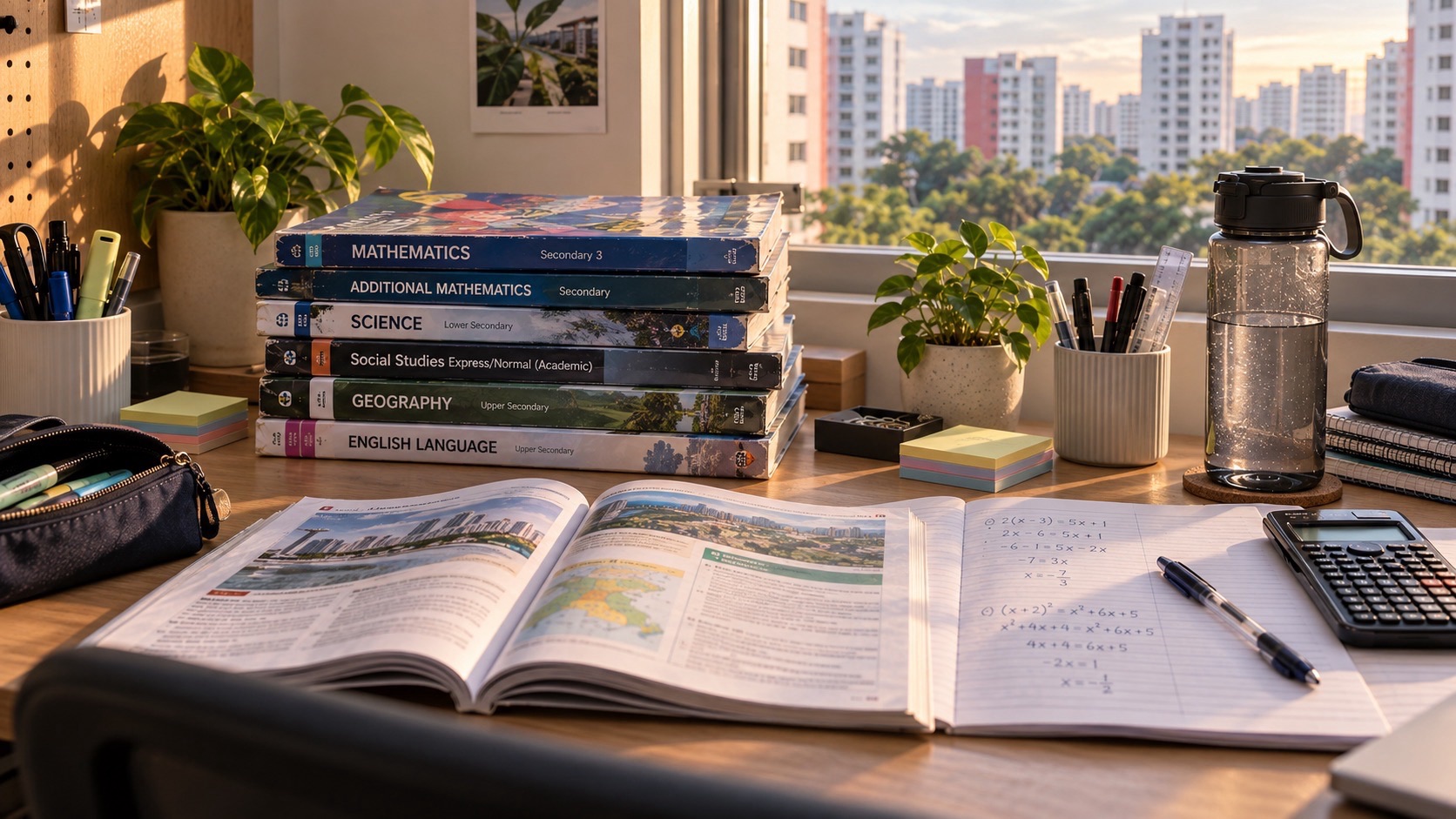
G2 Mathematics is the General 2 Mathematics subject level taught under Singapore’s Full Subject-Based Banding system. For the 2027 Singapore-Cambridge Secondary Education Certificate (SEC), its syllabus is K210. The national examination has two papers of two hours each, worth 70 marks and 50% apiece. The syllabus covers Number and Algebra, Geometry and Measurement, and Statistics and Probability. Students are expected to apply routine methods, solve unfamiliar problems and explain mathematical reasoning.
Quick answer for Punggol parents: the right preparation starts with identifying what the student actually misunderstands. Some students need stronger number operations before algebra; others know a formula but cannot choose it in a word problem; others lose marks through units, graphs, unnecessary rounding or omitted working. Start with the child’s actual G2 subject level, schoolwork and official K210 topic list. Then practise a small number of representative questions, diagnose the precise error, and retry a different example without hints.
- Official 2027 SEC G2 Mathematics subject: K210; earlier comparison code: 4045.
- Paper 1: two hours, about 23 short-answer questions, 70 marks, 50%; all questions compulsory.
- Paper 2: two hours, 70 marks, 50%; Section A includes an extended real-world task and Section B has one choice of two questions.
- Section B’s two options concern specified content in Geometry and Measurement or Statistics and Probability.
- Assessment objectives: standard techniques approximately 60%, problem solving 30%, reasoning and communication 10%.
- Approved calculators are permitted for both papers and relevant mathematical formulae are provided.
- Essential mathematical working matters; a final answer alone does not always earn the available marks.
- Unless a question specifies otherwise, non-exact answers are generally to three significant figures and angles to one decimal place.
- The subject level G2 is not the same thing as Posting Group 2 used for Secondary 1 admission.
- Examples below are invented teaching illustrations, not 2027 examination questions or a school-specific assessment forecast.
First understand the word G2: a level, not a permanent stream
Under Full Subject-Based Banding, Singapore secondary-school students offer subjects at G1, G2 or G3 as appropriate. Posting Groups 1, 2 and 3 guide secondary-school admission and initial arrangements. They are not synonyms for every subject level on a student’s timetable. For instance, a teenager admitted through Posting Group 2 might offer Mathematics at G3 if eligible while continuing to study other subjects at G2. Families should confirm the actual Mathematics level before choosing a revision book.
Beginning in 2024, the older secondary streaming arrangements have been replaced by the Full SBB structure for the relevant cohorts. The point is flexibility: learners can develop at different paces in different subjects. That flexibility should not turn into a race to increase every G level immediately. A more demanding Mathematics class may be suitable when fundamental reasoning is secure and the student’s overall workload remains manageable.
The G2 designation tells teachers and examiners what knowledge and skills a particular paper assesses. It does not describe the child’s intelligence, worth or career ceiling. A student who needs support with negative numbers can also be exceptionally good at design, communication, practical problem solving or leadership. Those talents may support the mathematics rather than compete with it.
Ask the class teacher about opportunities for subject-level adjustments and the evidence the school uses. School readiness is a broader question than one test mark: independent work, conceptual understanding, recent performance, learning confidence and the ability to sustain the subject alongside other commitments all matter.
The 2027 SEC examination: why the code K210 matters
SEAB’s 2027 Secondary Education Certificate replaces the separate N(T), N(A) and O-Level certificates for the first graduating SEC cohort. Students sit the papers at the G1, G2 and G3 levels they actually offer; their certificate records those subjects and levels. SEAB has said that the overall standard is not being relaxed merely because the qualification name is changing.
For 2027, the G2 Mathematics syllabus is K210. Some older assessments and practice materials use code 4045, associated with the preceding N(A) examination system. Those papers can still be valuable for skill practice, but the official 2027 syllabus is the authority on topic boundaries, assessment scheme and permitted resources. If a website publishes a G2 Mathematics chart without saying which year, confirm it before relying on the details.
Mathematics is among the SEC written subjects scheduled in the October-to-November examination period; English and Mother Tongue written papers are scheduled for September. This describes the broad national framework, not the child’s confirmed reporting date. The school and SEAB provide precise examination timetables. Avoid arranging revision around a date taken from an outdated online calendar.
In the 2028 post-secondary admissions arrangements, individual subject levels and course requirements continue to matter. A good Mathematics grade can support future choices, but cannot alone guarantee a particular diploma, institute or course. Students need to consider the whole subject mix, including English and other prerequisites.
G2 Mathematics K210: Paper 1 and Paper 2 at a glance
| Exam | Time | Marks | Weighting | What students do |
|---|---|---|---|---|
| Paper 1 | 2 hours | 70 | 50% | About 23 compulsory short-answer questions |
| Paper 2 | 2 hours | 70 | 50% | Section A 9–10 questions; Section B choose one of two extended questions |
Paper 1: short answers still demand complete thinking
Paper 1 contains approximately twenty-three short-answer questions. Candidates answer every question, and the paper represents half the subject result. That number of items means the student must move comfortably between different ideas: calculations, algebra, geometry, measurements and data. It also makes a useful diagnostic. A wrong answer can reveal a misunderstood symbol, a copied sign, a rounding problem or the wrong method.
Suppose a student reads a ratio question, performs the division correctly but uses the wrong total. The calculator did not cause the error; the interpretation did. Another student may form the correct equation and then lose control of signs when simplifying it. These are distinct learning problems. Repeating ten more random worksheets without analysing the cause is often less efficient than repairing the exact rule or representation.
The official K210 instructions caution that missing essential working can lose marks. Encourage pupils to show the key equation, meaningful substitution, transformations and answer with appropriate units. There is no need to write a paragraph explaining every single arithmetic step. The goal is enough written reasoning to make the solution understandable and mathematically defensible.
An approved calculator is allowed on both papers, but it does not decide which formula applies. Learners should be able to make an estimate before using the calculator so that unreasonable results are easier to catch. A supposed adult-height answer of 170 metres, for example, should trigger immediate review even if the typed arithmetic returned a number.
Paper 2: why the real-world question changes how students study
Paper 2 also lasts two hours and contributes 50%. Section A has nine or ten compulsory questions of different lengths and marks. Its final question focuses on applying mathematics to a real-world context. Section B offers two questions and requires candidates to answer only one. According to K210, the choices draw from specified underlined content in Geometry and Measurement and Statistics and Probability, with each choice carrying seven or eight marks.
This design makes it unwise to study mathematics as disconnected chapters. A real-world task might combine a timetable with distance, speed, a budget and interpretation of a graph. A student may remember the formula for speed and still fail because the question asks for the whole journey, including a waiting period. Successful problem solving begins by identifying the decision the question is asking for.
Imagine a fictional family trying to compare two transport plans to a Punggol activity. Plan A has a lower fare but a longer journey; Plan B costs more but leaves earlier and reduces waiting. The mathematical task is not simply to pick the cheapest number. The student might need to calculate total travel time, combine fare components, compare a stated constraint, and explain which plan meets that constraint. The examiner can test interpretation as well as arithmetic.
Section B offers a genuine choice but not permission to ignore one entire mathematical strand for years. Candidates need enough familiarity to judge which of the two questions they can answer accurately under examination conditions. A useful practice session involves reading both choices, listing the ideas each requires and explaining the selection before calculating.
The three strands: understanding the architecture of the syllabus
Number and Algebra provides the language and tools used elsewhere. Students work with operations, ratios, rates, percentages, indices, algebra, relationships and equations. Geometry and Measurement turns lengths, areas, angles, shapes and spatial relationships into arguments that can be checked. Statistics and Probability helps learners describe data, interpret visual information, judge patterns and understand uncertainty.
A weakness in one strand often appears inside another. A learner who cannot manipulate fractions confidently may struggle with a gradient in a graph. A learner who misreads axes may understand averages but misinterpret a chart. A student who cannot explain a percentage change might handle the calculation in isolation yet fail an unfamiliar household-finance scenario.
Use a three-column revision map. In the first column place the topic or skill. In the second, record what the student can do independently. In the third, write the specific error that still occurs. ‘Geometry is bad’ is not useful; ‘confuses the perpendicular height with a sloping side when finding area’ is actionable. The same diagnosis can guide a teacher, tutor or parent.
The official topic list, not a guess based on popular worksheets, should determine coverage. Schools may teach themes in different sequences. A child in Secondary 1 need not be told to master every final-year SEC question immediately, but the family can understand the direction in which present foundations are building.
Numbers, negatives, fractions and percentages: foundations with consequences
Many early secondary Mathematics problems are described as algebra problems when the real obstacle is numerical structure. Before tackling lengthy expressions, check that the student can place negative values on a number line, order fractions, interpret powers and estimate a result. These operations become ingredients in almost every later topic. An error such as treating negative five as greater than negative two can break an entire chain of reasoning.
Ratio and proportion are more than recipes for splitting a whole. A ratio compares quantities, while a fraction may describe a part of a whole or another relationship. Students need to understand which total is being divided, which parts are being compared and how the ratio changes when all quantities scale together. Ask why the method works, not just which button to press.
Percentage questions are especially practical. A 20% rise followed by a 20% fall does not return to the original amount, because the second change applies to a different base. A teenager who can explain that difference is learning a transferable skill for discounts, fees and financial claims. Reverse-percentage questions require starting from a final value and reasoning backwards rather than subtracting an arbitrary percentage.
Rates and units deserve equal care. A number expressed in kilometres per hour cannot be used indiscriminately with seconds. Teach students to label the quantity and the unit before substitution. For a transport example, include walking time and waiting time separately so that ‘average speed while moving’ is not confused with ‘average speed for the whole trip’.
Algebra is a language of relationships, not a collection of tricks
In a simple equation such as 3x = 21, the letter represents a quantity and the equality sign states that two expressions have the same value. To solve, the student applies valid operations while preserving equality. The familiar instruction to ‘move the three across’ may help someone remember a procedure, but it becomes dangerous when used without understanding balance. Fractions, brackets and negative values expose the weakness of such shortcuts.
Start with substitution and expression structure. Students should distinguish a coefficient from a constant, an expression from an equation, and an unknown value from a number that may vary. If an expression describes the cost of x identical items plus a fixed charge, each part has a meaning. Removing the context too early can make algebra feel arbitrary.
Expansion and factorisation ask learners to understand equivalent forms. An expression may look different while representing the same quantity. That idea helps later with quadratic expressions, simultaneous equations and changing the subject of a formula. It also explains why checking a solution by substitution is not a waste of time: it is a method for testing whether an operation preserved the relationship.
When a child becomes stuck, ask them to translate the expression into a sentence and then back into symbols. If they cannot explain what a variable means, more speed drills are unlikely to solve the underlying problem. A strong explanation may be short, but it should connect symbols with quantities.
Graphs and coordinates: reading the story told by axes
Graphs are representations of relationships. The same graph can communicate useful information or mislead when its axes are misunderstood. Students should inspect the quantity, unit, scale and direction on each axis before drawing a conclusion. A rise on a graph might mean an increase in temperature, cumulative frequency or cost, depending on the labels.
Consider an invented line graph showing a family’s electricity use across several months. A student should not immediately attribute a rise to air-conditioning without additional evidence. The graph displays a change, but a causal explanation needs supporting information. This is mathematics meeting media literacy: data can describe a pattern without proving why it happened.
Coordinates and gradients also require attention to ordering and units. A student who swaps x and y may get a neat but incorrect plot. A student who reads the gradient numerically but ignores its units may misrepresent what the change means. Practise explaining one point and one interval in ordinary language before performing calculations.
Graphs are useful throughout secondary school and beyond: Science investigations, transport planning, public health charts, economics and personal budgeting. A strong Mathematics student should be able to say what the visual data permits us to conclude and what it does not.
Geometry and measurement: from diagrams to justified answers
Geometry tests how shapes, lengths and angles relate. Learners need accurate diagrams, familiarity with notation and the ability to select relevant properties. A line that looks horizontal in a not-to-scale diagram is not automatically parallel to another line. A student should rely on the information stated or indicated, not on visual appearance alone.
Measurement questions may involve area, perimeter, volume, surface area and compound figures. The common error is applying the correct formula to the wrong dimension. Encourage students to mark the perpendicular height of a triangle, identify which faces of a solid are exposed, and keep units consistent before calculation. Conversion should happen deliberately, not midway through a rushed solution.
Ratios, similar figures and scale drawings show how geometry supports real decisions. A map scale gives a relationship between drawing and actual distance; an area scale is not identical to a length scale. This is useful for floor plans, accessibility routes and understanding how large a space really is. It also gives a parent an intuitive way to discuss why a factor applied to lengths may behave differently when areas are involved.
The question worth asking after a geometrical solution is: what properties were necessary? If the child can point to an angle rule, a congruence reason or a measurement relationship, understanding is stronger than a remembered answer that happens to match the marking key.
Statistics and probability: why numbers need context
Statistics begins with describing a set of observations but becomes more meaningful when the learner asks what the description hides. A mean can be affected by extreme values; a median conveys a different kind of centre; a range shows spread but not how the data are distributed inside it. The correct choice depends on the question and the data, not on whichever formula the student remembers first.
Visual displays can mislead. A bar chart with a shortened vertical axis may make a small difference look dramatic. A cumulative-frequency graph answers different questions from a bar chart of categories. The student should identify the type of graph, the scale and the claim before calculating or interpreting. A well-drawn graph is not automatically a fair comparison.
Probability concerns uncertainty, not certainty disguised as a fraction. If a probability is one quarter, the event is neither impossible nor guaranteed in four trials. Repeated experiments may behave unpredictably in the short run. Students should distinguish a theoretical model, an observation and a conclusion that is warranted by the evidence.
Connect these ideas to school and civic life. A headline about an average travel time may be useful but not describe everyone’s commute; a survey may have a biased sample; a sports statistic may not explain individual performance. These examples make the Mathematics syllabus valuable well beyond the last examination.
Household finance and transport: Mathematics in ordinary Punggol life
The official K210 syllabus explicitly allows real-world contexts involving travel, transport schedules, recreation, recipes, floor plans and household finance. It mentions ideas such as interest, taxation, instalments, utility bills and currency exchange. These contexts are not an invitation to give a teenager professional financial advice. They are opportunities to read quantitative information carefully and use appropriate mathematical methods.
Take a fictional monthly budget with a fixed allowance, several recurring expenses and a planned saving target. The student can classify fixed and variable costs, add totals, calculate a proportion and explain how a change in one expense affects the balance. A strong solution recognises constraints. It does not assume every dollar saved is available for any other purpose if the question states a committed payment.
Consider a utility statement with two pricing components. A student should notice whether a charge is fixed, usage-based or subject to another stated fee. If the question gives a price per unit, multiply by the appropriate amount; if the same unit appears in different formats, convert first. This is the numerical side of reading contracts and comparing services accurately.
With transport, use a fictional route from a Punggol neighbourhood to a library event. Include two travel legs, a transfer and an arrival deadline. Ask which combination is feasible, and have the student state why. The exercise develops time calculation, interpretation, decision-making and the habit of checking an answer against the actual question.
A reliable seven-step method for unfamiliar word problems
Step 1: Read the final instruction first. Establish what quantity, comparison or decision is required. Step 2: Identify given data. Mark relevant numbers, conditions and units. Step 3: Make a representation. Use a diagram, table, equation or labelled sketch. Step 4: Choose the relationship. Decide why a particular formula or operation applies.
Step 5: Calculate without losing units. Keep intermediate work clear. Step 6: Check reasonableness. Estimate the size of the expected result and substitute where possible. Step 7: Interpret. Answer in the language of the situation, respecting the required degree of accuracy. The final interpretation is especially important when two valid numerical results lead to different real-world decisions.
Students who struggle should practise these steps on short problems first. A long question can place demands on reading comprehension, working memory and numerical calculation all at once. Reduce complexity temporarily: ask the child to represent the situation without calculating, or choose a formula and justify it before performing arithmetic. Recombine the tasks when the components are stable.
Parents can assist by asking questions rather than giving the next step. ‘What is changing?’, ‘Which quantity is fixed?’, ‘What units do we have?’ and ‘Could the answer be this large?’ preserve the learner’s ownership. Providing every equation may produce a correct worksheet but can conceal the fact that the child cannot begin independently.
Why students lose marks despite knowing the topic
One common problem is incomplete reading. The student sees familiar numbers and starts calculating before noticing a condition or exception. Another is representation: the learner does not convert a situation into a correct diagram or equation. A third is execution, such as a sign error. A fourth is communication: the answer may be plausible but important working, units or reasoning are missing. These four failure types require different instruction.
A useful correction ledger should have four columns: question demand, attempted method, point of failure and corrected reasoning. If a child repeatedly misreads a condition, the next practice task should target reading and marking conditions. If the method is correct but arithmetic unstable, short focused exercises may help. If the final answer is right but unsupported, improve mathematical explanation rather than merely checking the calculator.
Practice under time limits is useful only after core methods are sufficiently secure. Timed tests should reveal pacing, not become the default setting for every learning session. A student who is frightened of making an error may need untimed explanation practice before gaining confidence in examination conditions.
Monitor progress by looking for transfer: can the student solve a related question with different numbers, a different diagram or a new context? The ability to recognise the underlying relationship is more valuable than memorising the page from which yesterday’s question came.
The difference between a formula sheet and mathematical fluency
SEAB provides relevant formulae in K210, and an approved calculator is allowed. This reduces some demands on memorising isolated expressions, but does not remove the need to understand the variables, conditions and units. A formula may be available and still be useless if the child cannot identify which measurements belong in it.
Ask the learner to describe what happens when one variable doubles while others remain fixed. In a simple direct proportion, the dependent quantity changes in one way; in an inverse proportion, it changes differently. A child who can explain the relationship has a stronger foundation for choosing between superficially similar procedures.
Use formulas after conceptual discussion rather than before it. For instance, show a shape and ask what measurement an area formula must depend on. Use a simple example to test the expression. Once the student knows why the relationship makes sense, recalling and applying it becomes less fragile.
Keep a short list of formulas the student repeatedly misapplies. For each, record the context, the meaning of variables, acceptable units and one example where the formula should not be used. This ‘boundary example’ is especially helpful for avoiding errors that ordinary repetitive practice fails to expose.
How a student’s Mathematics journey changes across four secondary years
In Secondary 1, students are learning the language of secondary Mathematics: expressions, negative quantities, formal notation, algebraic reasoning and the relationship between a word problem and an equation. Primary-school arithmetic remains essential, but its role changes. Pupils must increasingly justify operations rather than simply recognise familiar question patterns.
In Secondary 2, concepts begin to connect more densely. Graphs, proportional relationships, geometry and algebra become parts of larger problems. A student who was comfortable with a single procedure can feel unsettled when two methods must be chosen in sequence. The teacher’s explanation should help the child see the link between ideas.
In Secondary 3, course selections and more demanding applications can make gaps visible. A student may enter with the right answer habits for straightforward calculations but poor planning for multi-step situations. Build an independent routine for annotating, representing and checking questions. Small daily work done consistently is usually more sustainable than dramatic revision bursts.
In Secondary 4, learners prepare to demonstrate their knowledge in the published SEC paper structure. They need content coverage, accurate working, sensible time allocation and familiarity with choosing Paper 2 Section B questions. Practise with the correct syllabus and reflect on errors; a thick pile of completed papers is not itself proof of readiness.
What a sensible weekly revision schedule looks like
At the start of the week, pick one fragile skill and one strong skill. The fragile skill receives explanation and slow practice; the strong skill receives a few retrieval questions so it stays available. Mix those topics later in the week. This protects confidence while developing the ability to select methods when topics are not labelled.
A fifteen-minute session can be enough for a narrowly defined goal such as identifying what a gradient means, fixing a recurring negative-sign error or checking three percentage-change solutions. Another day can be devoted to a longer real-world question. The quantity of homework should fit the student’s current load, especially during CCA periods and other weighted assessments.
Use a weekly ‘teach-back’: the child explains one concept in ordinary language to a parent or sibling, without merely reciting the steps. Ask for an example where it applies and a near-example where it does not. This demonstrates abstraction: the learner can distinguish the principle from the surface appearance of a particular worksheet.
At the weekend, review error patterns rather than only the total score. If the same mistake has disappeared in unfamiliar problems, the learner has made measurable progress. If the mistake remains, adjust the method or seek targeted explanation. Do not increase the workload automatically in response to every disappointing mark.
A four-week Mathematics repair-and-growth plan
Week 1 — Check foundations. Use recent schoolwork to identify the exact operation or representation that is failing. Sample negative numbers, fractions, ratio, percentage and a simple equation. Correct one misconception and revisit it using a different problem two days later. Create a realistic starting baseline without implying that a single quiz defines ability.
Week 2 — Build concept connections. Choose an algebra topic and connect it to a graph, table or real context. Ask the student to explain why a transformation preserves equality. In geometry, mark given facts and the reason each rule applies. Begin an error ledger that distinguishes interpretation, setup, calculation and explanation.
Week 3 — Use everyday problems. Try fictional examples involving a transport schedule, a shopping price comparison, utility consumption or an event budget. Ask the learner to label units and state the decision the calculation supports. Include a statistics display and a probability explanation so that the student learns not to read every graph as proof of cause.
Week 4 — Rehearse SEC-type demands responsibly. Complete representative Paper 1-style short answers and a longer Paper 2-style task. Practise choosing between two Section B-style topic options without treating invented exercises as official papers. Compare results with the original baseline and identify the next high-priority skill. Conclude by protecting rest and a manageable school-week schedule.
Three invented student situations and what support actually helps
Situation A: ‘I understand in class but get half the paper wrong.’ A teenager can follow the teacher’s demonstration yet struggles to choose a method independently. Test one familiar problem with the headings removed. If the student cannot identify whether it is a ratio, equation or geometry task, practise interpretation and representation before speed.
Situation B: ‘The calculator gives answers, but my workings lose marks.’ A student has correct numerical results but uses unsupported shortcuts. Ask for the governing equation, meaningful substitutions, units and one check. Compare with the official requirement to show essential working. A short explanation may improve marks more than additional calculation drills.
Situation C: ‘I know the chapters but panic at long questions.’ A student becomes overloaded when reading a dense real-world scenario. Begin by listing the quantities and conditions, drawing a small diagram, and isolating the decision required. Delay calculations until the structure is visible. Over several sessions, rebuild the ability to solve the whole task without help.
These examples are teaching scenarios, not descriptions of named students or schools. They show why a useful learning plan must be diagnosis-led. Two children with the same mark can require completely different interventions, and a good teacher should be willing to change the approach when the evidence changes.
Choosing resources and asking about tuition in Punggol
Check the syllabus year and subject level before purchasing worksheets. A package marked only ‘Secondary Mathematics’ may mix G2 and G3 questions or use an old examination code. Mixed-level practice can sometimes support learning, but it should be deliberate. A difficult question is useful when the prerequisites are present, not when a child is expected to guess a method from unfamiliar notation.
For some students, classroom teaching, textbook examples and feedback from teachers are enough. Others benefit from a smaller environment in which an educator can watch the point where their reasoning changes direction. eduKate offers small-group tuition in Punggol, and families can enquire about a suitable Mathematics level and current availability without assuming every class fits every child.
Ask how the tutor decides what to teach first. Does the session examine actual errors, or immediately add more questions? Will the student receive feedback on the representation and reasoning, not only the final number? How is revision coordinated with school topics? A productive small group should make the student’s thinking visible so that small errors can be repaired before they become habits.
Tuition is an educational resource, not a guaranteed grade or automatic route to a higher subject level. Sign up for Mathematics tuition only after the student’s starting position is clear. Families should also consider travel time, homework, CCA, sleep and the child’s willingness to practise independently.
Do these skills matter outside school? Yes, in more ways than a worksheet shows
A student who can interpret percentages and base rates is better prepared to understand advertised discounts, finance-related claims and statistics. A student who can inspect a graph is less likely to be persuaded by a dramatic but misleading axis. A learner who can express a relationship with symbols develops tools useful for coding, engineering, design and data work.
Mathematics also trains a distinctive kind of honesty. When assumptions are unknown, a correct method may lead only to a conditional result. A useful solution states those conditions rather than pretending to know the answer to every real-world question. That habit matters when people interpret surveys, forecasts and models.
In the home, numerical understanding helps families compare cost and time, understand bill components and read service information more carefully. These are not reasons to pressure a thirteen-year-old into adult financial responsibility. They are reasons to teach the subject as a tool for thoughtful participation in everyday life.
Educational success is broader than examination performance, but examination preparation can be better when the student sees the point of the subject. Mathematics becomes less mysterious when operations have meaning, graphs tell interpretable stories and problem solving produces defensible decisions.
Mistakes parents can avoid when helping with Mathematics
Avoid saying that all questions from the same chapter must use the same formula. A syllabus topic names a family of concepts; it does not remove the need to read the particular problem. Encourage the learner to justify the selected rule.
Avoid using a child’s best friend’s grades as a target. The more useful comparison is with the child’s previous reasoning and accuracy. A learner who repairs a persistent misconception has made progress even when the next paper is more difficult.
Avoid letting the answer key become the lesson. If the child reads the model solution, closes the book and can repeat the method only on the same numbers, the concept may not yet be secure. Test transfer with a new problem.
Avoid mistaking a quiet completion for understanding. Ask one neutral question about why a step is valid. Also avoid turning every evening into a tutoring session. Trust and recovery time are part of sustainable learning.
Frequently asked questions about G2 Mathematics
What is the official G2 Mathematics syllabus for 2027?
The SEC G2 Mathematics syllabus is K210, listed in SEAB’s 2027 G2 school-candidate directory. Check this source for the current assessment scheme and full topic list.
Are G2 Mathematics and Posting Group 2 the same?
No. Posting Group is used for secondary-school entry and initial arrangements, while G2 identifies the level of the Mathematics subject. Eligible students can offer different subject levels.
How long is Paper 1?
K210 Paper 1 is two hours, 70 marks and worth 50% of the subject result. It includes about twenty-three compulsory short-answer questions.
How long is Paper 2?
K210 Paper 2 is also two hours, 70 marks and worth 50%. It includes compulsory Section A questions and a Section B choice between two options.
Does Paper 2 include a real-world problem?
Yes. The official specification says the final Section A question focuses on applying Mathematics to a real-world scenario, potentially combining ideas from several syllabus topics.
Are calculators allowed?
The official K210 syllabus permits approved calculators for both papers. Candidates should comply with SEAB’s calculator requirements and bring needed geometrical instruments.
Do students have to memorise every formula?
Relevant mathematical formulae are provided in the SEC examination. Students still need to interpret the variables, know when a formula applies and show essential reasoning.
Which strand should a weak G2 student study first?
Start with diagnosis. Number operations, fractions, negative values and algebraic meaning often underpin later topics, but a student’s actual work should determine priority.
Can G2 students move to G3 Mathematics?
Full SBB allows eligible subject-level adjustments with school guidance. Readiness involves understanding and overall workload, not simply a parent’s request or a single mark.
When is the SEC Mathematics exam in 2027?
The broad SEC schedule places most non-language written subjects in October and November. The official timetable will provide the precise Mathematics dates.
Can a G2 Maths grade be used for polytechnic entry?
Rules depend on the route and intake. From 2028, MOE allows one G2 subject in the ELR2B2 computation for Polytechnic Year 1 under specified conditions, while the other four subjects must be at G3. Check the current full requirements.
Should a child do a full paper every day?
Usually not. Full papers are useful for periodic rehearsal; most learning time should repair identified errors and strengthen transfer. The child’s school workload and health also matter.
What is one useful activity for parents this week?
Ask the learner to choose one recent error, explain the incorrect assumption, solve a different example correctly, and state a checking rule for the next test.
Verified references and next reading
Use the official SEAB G2 syllabus index and 2027 K210 Mathematics syllabus PDF to check the full paper structure, 2027 topic details and examination instructions. For the national transition see the SEC overview and MOE’s post-secondary admissions update.
On eduKatePunggol, continue with the G2 Mathematics Paper 1 guide, Paper 2 and its real-world question, interpreting data and graphs and Secondary 4 G2 Mathematics support in Punggol.
The purpose of this guide is to help parents see how the whole subject works and where the next useful action lies. Policies and examinations can be updated; follow the dated official notice when it differs from an older article. A calm diagnostic plan today is more effective than chasing every possible new worksheet tomorrow.


