
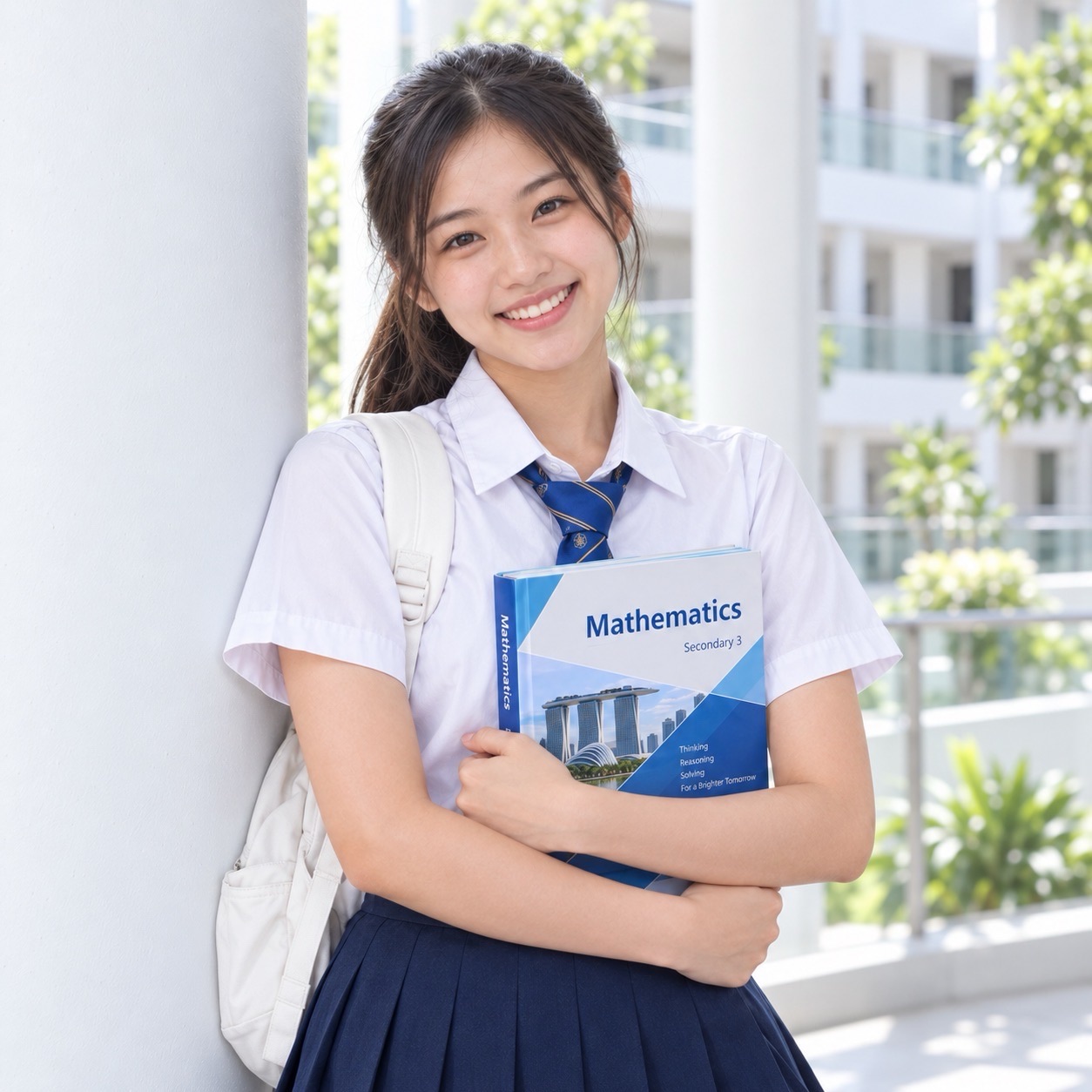
G2 Mathematics Paper 2 is the longer problem-solving paper of Singapore’s 2027 Secondary Education Certificate (SEC) syllabus K210. It lasts two hours, carries 70 marks and contributes 50% of the Mathematics result. Section A contains 9–10 compulsory questions, with the final question focusing specifically on applying mathematics to a real-world scenario. Section B presents two questions based on specified underlined syllabus content; candidates answer only one, choosing between a Geometry and Measurement question and a Statistics and Probability question. Each Section B option is worth either seven or eight marks. Essential working must be shown, and approved calculators and geometrical instruments may be used as allowed.
For Punggol families, Paper 2 is not simply a slower version of Paper 1. Students must translate words, diagrams, tables and conditions into mathematics, decide which relationships matter, solve multi-step problems and interpret the results in context. The first task is to examine the child’s recent working and identify whether the difficulty lies in algebraic structure, reading, unit conversion, graph interpretation, geometry or decision-making. Parents researching Edgefield Secondary, Greendale Secondary, Punggol Secondary and Yusof Ishak Secondary can also ask how the school supports reasoning and mixed-topic questions at G2. This guide focuses on K210 Paper 2’s decisions and real-world applications rather than repeating a general Mathematics syllabus overview.
- Official subject: G2 Mathematics 2027 SEC K210; Paper 2.
- Paper 2 lasts 2 hours, carries 70 marks and contributes half the overall Mathematics result.
- Paper 1 is also 2 hours, 70 marks and 50%, but mainly contains around 23 short-answer questions.
- Section A of Paper 2 includes 9–10 compulsory questions with varying lengths and marks.
- The final Section A question focuses on real-world mathematical application.
- Section B has two options; answer only one: Geometry and Measurement or Statistics and Probability.
- Each Section B option carries an equal 7 or 8 marks, based on the content specifically identified in the official syllabus.
- Approved calculators may be used in both K210 papers; relevant formulae are provided.
- Essential mathematical working is required and may be marked independently of the final answer.
- Real-world contexts may involve travel, transport, games, recipes, floor plans, household bills, taxation, interest and data.
- A sound solution moves from understanding the situation to representation, calculation, interpretation and checking.
Definition lock: G2 Mathematics Paper 2 is an application paper
K210 is the official General 2 Mathematics syllabus in the 2027 SEC. Paper 2 is half of that subject’s examination, not a separate subject or proof that the student belongs to one fixed school stream. Its emphasis includes solving problems in context, combining mathematical topics and communicating reasoning. Students need reliable foundational skills, but they must also select appropriate methods without the comfort of a chapter heading that announces the formula. The ability to choose is part of what makes the paper challenging.
Under Full Subject-Based Banding, G2 denotes the subject level and differs from Posting Group 2, which relates to secondary-school admission. A child may learn different subjects at different levels under school arrangements. Parents can support mathematics without treating a missed question as a judgement about overall ability. The useful diagnosis is the first unstable step: interpreting the text, identifying relevant data, building a diagram, forming an equation, handling arithmetic or explaining the result. Once that is known, practice becomes far more purposeful.
The exact 2027 K210 paper scheme
SEAB specifies two two-hour K210 papers of 70 marks each, weighted equally. Paper 1 consists of about 23 short-answer questions and requires candidates to answer all. Paper 2 contains a compulsory Section A with 9–10 questions, followed by a Section B choice between two equally weighted options. The final compulsory Section A question focuses specifically on a real-world scenario. The second section draws from marked syllabus content in Geometry and Measurement or Statistics and Probability, not from an arbitrary topic picked on the day by the teacher.
These details are practical rather than decorative. A teenager who spends Paper 2 practising only straightforward algebraic calculations may not prepare for multi-step contextual work. Another who concentrates on the real-world final question may neglect the substantial compulsory material earlier. Families should plan balanced revision and remember that the exact numbers apply to the 2027 document; later cohorts should check the relevant annual syllabus. Accurate information helps students prepare calmly and avoids rumours about surprise changes.
Why Paper 2 demands a different way of reading
A long Mathematics question may contain background information, several quantities, constraints and a specific final instruction. Students sometimes begin calculating as soon as they see a number. That can produce a perfectly correct calculation answering the wrong question. Paper 2 preparation should teach the learner to identify what is known, what is required and how the two are connected before writing the first equation. Context is not merely decoration around arithmetic.
Ask the child to read an invented problem and summarise it in one sentence without using numbers. What decision or quantity is the question really about? Then underline essential information and circle a condition such as ‘at most’, ‘after discount’ or ‘for each person’. Only then begin mathematics. This small pause often saves time because it prevents several lines of working based on an incorrect interpretation. The approach is useful across algebra, geometry and probability.
Translating ordinary language into mathematical symbols
Expressions such as twice a quantity, three less than a number and a percentage of a total describe different operations. Students who translate them mechanically may reverse a subtraction or confuse a percentage change with the resulting amount. G2 Mathematics expects learners to move from words to equations and back. The translation should preserve meaning. A correct symbol chosen for the wrong relationship is no better than an arithmetic error.
Use a fictional example: a club charges a fixed fee of $5 plus $3 per session. If the student attends n sessions, the cost is 5 + 3n, not 8n. Ask the learner why the fixed fee is not multiplied by the number of sessions. Then change the story to include a per-person charge. This reveals whether the pupil understands what each number represents. Mathematical literacy improves when symbols remain attached to a real relationship.
Algebra is not a ritual of moving terms
When solving an equation, students may say ‘move it to the other side’ without explaining the operation. That shortcut sometimes survives easy examples but breaks down when fractions, negatives or brackets appear. An equation expresses a relationship that must remain balanced. Solving it means applying valid operations and keeping track of the unknown’s meaning. Paper 2 can hide an algebraic requirement within a longer context, making strong foundations essential.
Ask the learner to solve a short equation and justify each line. If x + 7 = 19, subtracting 7 from both sides maintains equality and gives x = 12. The same principle extends to more complex equations. After finding a solution, substitute it into the original relationship. If it does not satisfy the conditions, revisit the work. Checking is not a luxury reserved for students with extra time; it is part of mathematical reasoning.
Brackets and negatives: small errors cause long chains of loss
A learner who expands 3(x + 4) as 3x + 4 may have misunderstood distribution. Someone who treats subtraction of a negative as ordinary subtraction may reverse a sign. These mistakes are especially costly in Paper 2 because a wrong intermediate value may influence multiple later calculations. It is better to repair the underlying structure than assign another large set of mixed examination questions where the same misconception remains hidden.
Use short targeted examples before returning to the long problem. Ask the student to explain what the bracket means and which terms are affected. For negatives, a number line or simple numerical check can restore meaning. Then give the child a fresh contextual question where the same idea appears without being announced. A corrected worksheet demonstrates exposure; independent use in a different setting is stronger evidence of learning.
Ratios and proportional relationships
Ratios compare quantities, while proportions describe relationships that may remain constant as quantities change. Paper 2 can place them in recipes, maps, mixtures or shared costs. Students must first identify which quantities are being compared and whether the situation is direct or inverse proportion. Applying a remembered cross-multiplication rule without checking the relationship may produce a plausible but false result. The labels and units matter.
Imagine a fictional classroom recipe requiring two parts of one ingredient for three parts of another. If the first ingredient measures 200 grams, the second should be 300 grams when the ratio is maintained. Ask what changes if the recipe is doubled, and what would remain the same. Then introduce a question involving total mixture mass. This builds flexible reasoning instead of teaching one isolated procedure for every ratio word problem.
Percentages: distinguish a change from a final amount
A percentage is a ratio expressed per hundred, but a real-world question may ask for the increase, the decrease, the final price or the original value. Students often confuse these targets. For example, a hypothetical $80 item discounted by 15% costs $68; the reduction is $12. If the question asks for the original price from a $68 discounted amount, the method reverses the percentage relationship. The context decides which result is appropriate.
Ask the teenager to explain what 100% refers to before calculating. Is it the initial price, the reduced price or a comparison base? Then use a diagram or equation to represent the relationship. If a solution claims a discount increased the price, a simple reasonableness check should catch the inconsistency. Percentage fluency supports many Paper 2 scenarios, including tax, interest and household finance, but only when the base quantity is understood.
Reverse percentages: work backward carefully
Reverse percentage questions are difficult because the known amount is often after a change. Some students subtract the percentage again or divide by the wrong factor. The correct method identifies which percentage of the original the known amount represents. If a fictional discounted price of $68 is 85% of the original, the original value is 68 divided by 0.85, giving $80. The logic matters more than memorising the calculation.
Ask the student to draw a simple bar where the full length represents the unknown original amount and the shorter portion is 85%. Then express the relationship as an equation. A second example involving an increase can test whether the learner generalises the principle correctly. Good Paper 2 work begins by naming the reference quantity. A student who can explain the reasoning is less likely to reverse a factor incorrectly when the story changes.
Rates, speed and unit conversion
Rates compare quantities measured in different units. Speed relates distance and time, but real-world questions may include minutes, hours, kilometres and metres in one description. The student needs to make units compatible before calculating. A speed of 60 kilometres per hour cannot simply be inserted beside a time expressed in minutes without an appropriate conversion. Unit discipline is not decorative notation; it protects the relationship from error.
Use a hypothetical journey of 60 kilometres taking 1.5 hours. The average speed is 40 kilometres per hour. Then ask what changes if the time is given as 90 minutes instead. The answer should remain the same after conversion. This helps the learner see units as part of mathematical meaning. Later, introduce graphs or multi-stage journeys where average speed cannot be found by simply averaging two displayed speeds without considering durations.
Travel plans: a real-world context without invented fares
SEAB explicitly lists travel or excursion plans and transport schedules among possible real-world contexts. That does not mean the national paper will contain a particular Punggol MRT fare or bus timetable. A practice question should therefore use clearly invented figures or verified current information. The mathematics concerns comparing alternatives, converting time, recognising constraints and explaining a decision. The student’s job is to justify a choice according to the supplied data.
Imagine two fictional travel options. Option A takes 35 minutes and costs $4, while Option B takes 50 minutes and costs $2. A family must arrive before a specified time and has a limited budget. Which option is feasible? The answer depends on the stated constraints. Ask the learner to distinguish a mathematical requirement from personal preference. This teaches the important Paper 2 habit of reading the decision rule before calculating.
Household budgets: don’t confuse an example with a real bill

The K210 syllabus permits contexts involving utilities, household finance, interest, money exchange and other practical decisions. A student may be asked to compare costs using tables, percentages or rates. Such examples can feel familiar, but the challenge is identifying which charges are fixed, which vary with usage and which assumptions are given. A practice scenario should not pretend to quote a live utility tariff unless it has been verified for the relevant date.
Use invented data: a plan charges a fixed $8 plus $0.20 per unit of usage. For 50 units, the total is $18. Now compare it with a second invented plan with a different fixed fee and rate. At what level of usage might the preferred choice change? The learner can express and compare two linear relationships. This is a direct connection between algebra and everyday decision-making, without relying on real prices or unsupported claims.
Interest and financial decisions: read the terms
Simple and compound interest can appear in the real-world context strand, as specified by the official syllabus. Students must distinguish which amount is the principal, how the rate applies and whether the interest calculation involves repeated periods. A story about savings or borrowing may also include instalments or other conditions. The mathematical task is to interpret those conditions correctly rather than use whichever financial formula the student remembers most readily.
Provide a fictional savings example with a clearly stated rate and duration. Ask the child to describe what changes after each period before calculating. Then compare simple and compound patterns in an appropriate syllabus-level example. Students should not treat an invented rate as a current bank offer or financial recommendation. The exercise teaches modelling and numerical reasoning; any actual financial decision requires current product terms and adult judgement.
Maps and scale: the diagram represents distances, not reality itself
Map scales describe relationships between distances on a representation and corresponding distances in the world. A student may confuse a scale ratio with a direct measured distance or forget to convert centimetres and metres. Area scales require especially careful reasoning because a linear enlargement affects area differently. Paper 2 can combine a floor plan, route map or measurement diagram with cost or time questions. The exact scale must be read before using the ruler.
Ask the learner to solve one invented scale problem and then estimate whether the answer is plausible. If a room appears to be thousands of metres long, a conversion probably went wrong. A diagram helps when it is labelled carefully. Remind the student that maps simplify the world; a line on a plan may not reflect every practical travel constraint. The exam answer should use the assumptions given, not invented local terrain details.
Geometry diagrams: don’t assume what is not stated
A geometry diagram may look symmetric, rectangular or proportional without explicitly saying so. Students sometimes rely on appearance and infer that two lengths are equal or an angle is right-angled. A mathematical conclusion requires a given condition or a valid theorem. The learner should distinguish what is marked or stated from what merely looks likely. This is especially important in longer questions where an incorrect assumption affects several subsequent results.
Practise with a diagram that appears nearly symmetrical but has only limited stated information. Ask which facts can be justified and which would require additional markings. Then encourage the teenager to write a reason beside each significant geometric step. This develops proof habits without demanding lengthy essays. Precise diagrams and valid reasons make working more reliable than visual guessing.
Perimeter, area and volume: identify the quantity requested
Perimeter, area, surface area and volume describe different measurements. A practical Paper 2 question may ask for material required to cover a surface, capacity inside a container or length of an edge. If a student selects the formula based solely on the shape’s name, they may calculate the wrong quantity. Units are an immediate clue: metres for length, square metres for area and cubic metres for volume, subject to context.
Use a hypothetical rectangular planter with clearly stated length, width and height. Ask what the question would mean if it requested edging, soil capacity or surface covering. Then choose the relevant formula and check units. A good learner can explain why a method fits the practical need. This reasoning is more transferable than memorising isolated geometry exercises where the heading already identifies the desired formula.
Pythagoras and trigonometry: choose a relationship from the diagram
Geometry can involve right-angled triangles, length relationships and trigonometric ratios as specified by K210. Students often confuse which side is opposite, adjacent or the hypotenuse, especially when the triangle is rotated. A reliable approach starts by marking the known angle and the right angle, then identifying which sides the question involves. The orientation of the page should not determine the method.
Ask the learner to solve a right-triangle question, then rotate the same diagram and ask why the mathematical relationship is unchanged. If the student reverses the ratio, check whether the side labels were understood. A rough estimate can help determine whether the result is plausible. In long applications, the triangle may be hidden within a floor plan or diagram, so recognising the structure matters more than the appearance.
Graphs: read scales and relationships before finding numbers
K210 includes linear and quadratic functions, coordinate graphs and interpretation of statistical displays. A Paper 2 question may provide a graph with an unusual interval or ask students to connect the slope or shape to a real situation. Students should inspect labels, scales and units before reading off values. A rising line can represent many different quantities; the vertical and horizontal axes determine what the change means.
Use a fictional bar chart with a zero baseline and intervals of five. Ask how many units each bar represents and whether the difference is displayed honestly. Then switch to a line graph and discuss how the type of variable affects interpretation. The goal is to make the representation meaningful. A student who knows how to read a scale can adapt to unfamiliar displays rather than rely on the layout of one memorised textbook graph.
Functions: from an expression to a graph and back
A function describes a relationship between variables. In K210, students encounter linear and quadratic relationships among others in the specified syllabus. An equation can reveal a pattern, while a graph shows how values change. A student may be able to solve a linear equation yet struggle to interpret its gradient in context. The next step is to connect the symbolic, graphical and verbal representations of the same relationship.
Consider the fictional cost rule C = 5 + 3n. Plot several ordered pairs and ask why the graph starts above zero and rises by the same amount per session. Then describe the relationship in words. Change the fixed fee and compare the new graph. This is valuable Paper 2 practice because it requires the teenager to move between forms without losing meaning. The equation is not merely a formula to be copied; it is a model of the invented situation.
Quadratics: understanding the turning point
The K210 syllabus includes quadratic functions and their graph properties, including symmetry and maximum or minimum points. Students who see a U-shaped graph may remember that it has a minimum but forget to consider the sign of the squared term or the context. A quadratic relationship can help model a constrained optimisation problem, but the result must be interpreted using the information supplied. A graph alone does not tell us which quantity the vertex represents.
Use a simple quadratic sketch and ask where the function is increasing or decreasing and which coordinate marks the turning point. Then connect it to an appropriate fictional scenario. If the graph’s domain is restricted, check whether the turning point lies inside the permitted values. This trains a powerful habit: a mathematically valid feature may not be relevant to every real-world interpretation. Context determines which conclusion answers the question.
Statistics: a chart is only as sound as its data
Statistics and Probability forms one of K210’s major strands. Students learn to organise information, interpret measures and draw conclusions carefully. A graph may show a pattern but cannot automatically establish the cause. Averages can conceal variation, and a sample may not represent an entire population. Paper 2 questions may combine tables, graphs and narrative information, requiring the learner to compare rather than simply calculate a single value.
Ask the teenager to compare two fictional groups with different distributions of scores. If the means are similar, do the groups necessarily have the same variation? What other information would help? Then examine whether a bar chart’s axis scale makes a difference seem larger than it is. Such exercises teach statistical reasoning and prepare the student to explain what data actually support. This is more valuable than memorising the formula for mean without understanding its use.
Probability: define the event before calculating
Probability questions require clear identification of possible outcomes, events and any conditions given. Students sometimes multiply or add fractions because an earlier example used that operation, without checking whether events are independent, mutually exclusive or related through a sequence. The correct model depends on the situation described. A tree diagram or organised list can help, but its branches must correspond to the actual experiment or selection process.
Use a fictional coloured-counter bag with simple, explicitly stated counts. Ask for one event and identify the total number of equally likely outcomes if that assumption applies. Then modify the question to include a second draw or a condition. The learner should explain what changes in the probability model. The aim is to select a valid representation and reason from it, not to apply a remembered recipe blindly.
Section B: a genuine choice, not an invitation to answer both
Paper 2 Section B contains two options drawn from designated underlined syllabus content: one Geometry and Measurement question and one Statistics and Probability question. Both options have the same mark value, either seven or eight marks. Candidates answer only one. The strongest choice is the question for which the student can build a valid path to a complete solution, not necessarily the topic that seems easier from the first line.
During practice, ask the teenager to read both options briefly, identify what each requires and make a reasoned choice. A good student does not automatically select Geometry because diagrams feel familiar or Statistics because it looks less algebraic. They compare the actual demands. The decision should be made efficiently, leaving enough time to show essential working. Answering both can waste valuable examination time if only one response is required.
The underlined content rule: why the syllabus detail matters
SEAB’s K210 document marks certain material that is assessed only in Section B of Paper 2. Parents and tutors should consult the actual syllabus rather than guess which topics can appear there. That marking is part of the published assessment design. A revision pack that ignores it may misunderstand how the optional questions are assembled. The broader Geometry and Statistics knowledge remains important across Paper 2, while the underlined parts have their specified placement.
Ask the child’s Mathematics teacher which of the relevant underlined topics have been taught and what practice matches the latest examination. When selecting an optional question, the student should recognise the particular skill, not rely on vague chapter titles. A carefully labelled practice folder is more useful than an enormous unsorted collection of past questions. Examination preparation works best when it respects both the curriculum and the student’s actual readiness.
The real-world final question: organise the scenario
The final compulsory question in Paper 2 Section A specifically focuses on applying mathematics to a real-world situation. The problem may combine multiple strands rather than remain within one neat topic. A student can encounter a table, a graph, pricing rules and a condition that influences which option is suitable. The challenge is to decide what information matters at each stage and how earlier results support later conclusions.
Teach a simple representation table with columns for information, mathematical relationship, calculation and interpretation. A child might begin by comparing two travel options, then use a percentage to adjust costs or interpret a graph of timing. They should understand why each step is included. If the question asks which option is more practical, a raw cost calculation may not be a complete answer. The final statement must return to the scenario.
An original worked example: a fictional Punggol class outing
Imagine a fictional group choosing between two excursion packages. Package A has a fixed booking charge of $20 plus $6 per student. Package B has no fixed charge but costs $8 per student. For ten students, A costs $80 and B costs $80. For fifteen students, A costs $110 while B costs $120. These amounts are invented purely for Mathematics practice; they are not local transport or venue prices. The example shows how a fixed term and variable term combine.
Ask the learner to write the general expressions A = 20 + 6n and B = 8n, then solve when they are equal. The equation 20 + 6n = 8n gives n = 10. Discuss what happens below and above that number. The teenager should explain in words why the preferred option changes rather than merely report the crossover. Then add a fictional budget constraint and ask which package is feasible. This illustrates a multi-step real-world question without pretending to predict the actual SEC examination.
Essential working is explicitly marked
SEAB notes that omission of essential working results in loss of marks. This matters particularly in Paper 2 because a longer question may involve several valid intermediate steps. A calculator display cannot establish why an equation was formed or whether a geometric relationship was justified. Students should show the reasoning that links the given facts to their result, with appropriate units and final interpretation. Clear working also makes errors easier to find during review.
Ask the child to explain each line of a solution: what changed and why was that step allowed? If a line cannot be justified, it may be a memorised shortcut hiding a misconception. A short, clear set of essential steps is preferable to a page of disconnected arithmetic. Parents should praise valid reasoning even when an arithmetic slip occurs, because it reveals a teachable difference between method and calculation.
Calculator use: allowed, but judgement remains the student’s job
An approved calculator may be used in both 2027 K210 papers. It helps with arithmetic, but cannot decide which relationship models a real situation, whether a denominator should be nonzero or whether a percentage base was chosen correctly. Students should be comfortable with the permitted device, yet also know how to estimate a plausible result. A numerical output that conflicts with the scenario should trigger a review of inputs and assumptions.
Teach the learner to state an approximate expected size before calculating. If a discounted price emerges larger than the original price, something is probably wrong. If a journey of a few kilometres produces a time of several days under ordinary assumed conditions, recheck units. These rough checks are not substitutes for exact working. They are safeguards that help students recognise an incorrect method before presenting the final answer confidently.
Accuracy: significant figures and units
The official K210 notes specify that non-exact numerical answers are generally given to three significant figures, while angles in degrees are generally given to one decimal place, unless the question directs otherwise. Questions asking for proof of a specific rounded value may require higher-accuracy intermediate work. Students should not round every intermediate result prematurely, because cumulative rounding can change the final answer. Correct notation and units matter alongside the number.
Practise carrying sufficient precision through a multi-step calculation and rounding at the end. Ask the child to explain why an exact value might be preferable to an early decimal approximation. For units, check whether the result is a length, area, volume, rate or monetary amount. A plausible number with an incompatible unit indicates a reasoning problem. Precision is not about decorating the answer; it is about communicating what has been calculated.
A two-hour practice strategy that respects real weaknesses
Paper 2 lasts 120 minutes. An illustrative approach might reserve a short opening period to scan question demands, then work steadily through compulsory Section A, make the Section B choice with enough time remaining and leave a modest final review. This is not an official minute allocation, and the sequence may differ by student. The key is avoiding long hesitation on an early question that prevents later compulsory work from being attempted.
Use a practice attempt to record where time was actually lost. Did the student need too long to understand a word problem? Were calculations repeated because earlier working was unclear? Was Section B left until the final minutes? Diagnose the cause before demanding greater speed. If the child understands the mathematics but is disorganised, a working layout can help. If the concept is missing, more timing pressure will likely make the situation worse.
A Mathematics error log with five useful categories
The first category is question interpretation: the learner answered something other than what was requested. The second is mathematical model: the equation or diagram did not represent the situation. The third is algebra or arithmetic: a valid method was executed incorrectly. The fourth is representation: a scale, graph or unit was misread. The fifth is communication: essential working, reasons or final context were missing. These categories are much more useful than writing careless beside every mistake.
For each recurring error, record one corrected explanation and one fresh test. If the student confused the original price with the discounted price, give a new percentage question with different numbers. If a graph was misread, present a different scale. Revisit the idea after several days, not only immediately. A student who can recognise the correct method independently when the chapter heading is absent is developing the flexible control that Paper 2 demands.
A twelve-week learning pathway toward K210 Paper 2
Weeks one and two establish a baseline across algebra, geometry, statistics and one real-world question. Weeks three and four repair any recurring fraction, negative-number or equation weaknesses. Weeks five and six develop ratios, percentages and rates through contextual tasks. Weeks seven and eight strengthen diagrams, geometry reasoning and functions. Each week should revisit earlier ideas so students cannot rely solely on remembering the method used in the previous worksheet.
Weeks nine and ten target statistics, probability and the ability to select Section B options. Weeks eleven and twelve integrate multi-strand real-world questions and gradually timed Paper 2 practice. Adapt the order to the child’s actual school programme and starting point. At the end, compare independent work with the baseline. Can the learner choose a valid model, explain a calculation and interpret a result more consistently? That is better evidence of improvement than a high mark on a familiar question seen twice.
An illustrative three-student Mathematics tutorial
A matched three-student tutorial can provide frequent opportunities to explain methods. One student may propose an equation, another check the units and a third challenge whether the interpretation fits the scenario. A tutor can use this discussion to reveal misconceptions before each child completes independent work. Small-group format may help with feedback, but it does not automatically guarantee quality. This description is a teaching model, not a claim that a particular Punggol programme is available.
Parents should ask whether the teacher teaches why a method is suitable, not just how to reproduce it. Are error types recorded? Are mixed questions revisited after earlier lessons? Does the tutor respect K210’s actual Section B choices and real-world assessment? Some children can manage with school support and regular independent review. Others benefit from targeted teaching for a specific gap. A good programme should gradually reduce the child’s dependence on prompts.
School options and local fit in Punggol
Edgefield Secondary, Greendale Secondary, Punggol Secondary and Yusof Ishak Secondary are relevant local schools to research using current official information and MOE SchoolFinder. Confirm the child’s subject level and the school’s approach to mathematical reasoning, mixed-topic problems and support for changing readiness. Do not confuse the student’s Posting Group with the level of every subject. The national SEC syllabus describes examinations, while actual school programmes and student placement require school confirmation.
Parents should also consider commuting time, co-curricular activities, wellbeing and the student’s overall timetable. Mathematics improves with regular retrieval and thoughtful correction, which can become difficult when every evening is filled with hurried exercises. A manageable plan may include several short sessions rather than a single long one. The central question is whether the child can explain more, make fewer repeated errors and solve a fresh problem with greater independence.
Frequent misconceptions and the next useful step
Is Paper 2 simply more difficult Paper 1 questions? It includes longer and varied questions, a compulsory real-world application and a Section B choice, so its demands differ. How long is it? Two hours. How many marks? Seventy, worth 50% of K210. Must candidates answer both Section B questions? No, only one. Are calculators permitted? Approved calculators may be used in both papers. Does the last Section A question always use a real-world context in the 2027 scheme? Yes, the published assessment states that it focuses specifically on that application.
For authoritative details use the SEAB G2 directory and the official K210 2027 Mathematics syllabus. Read What is G2 Mathematics in Punggol for the general course. This week, choose one longer marked question and locate the first wrong decision. Practise that specific reasoning step with a different scenario before attempting another full paper.


