
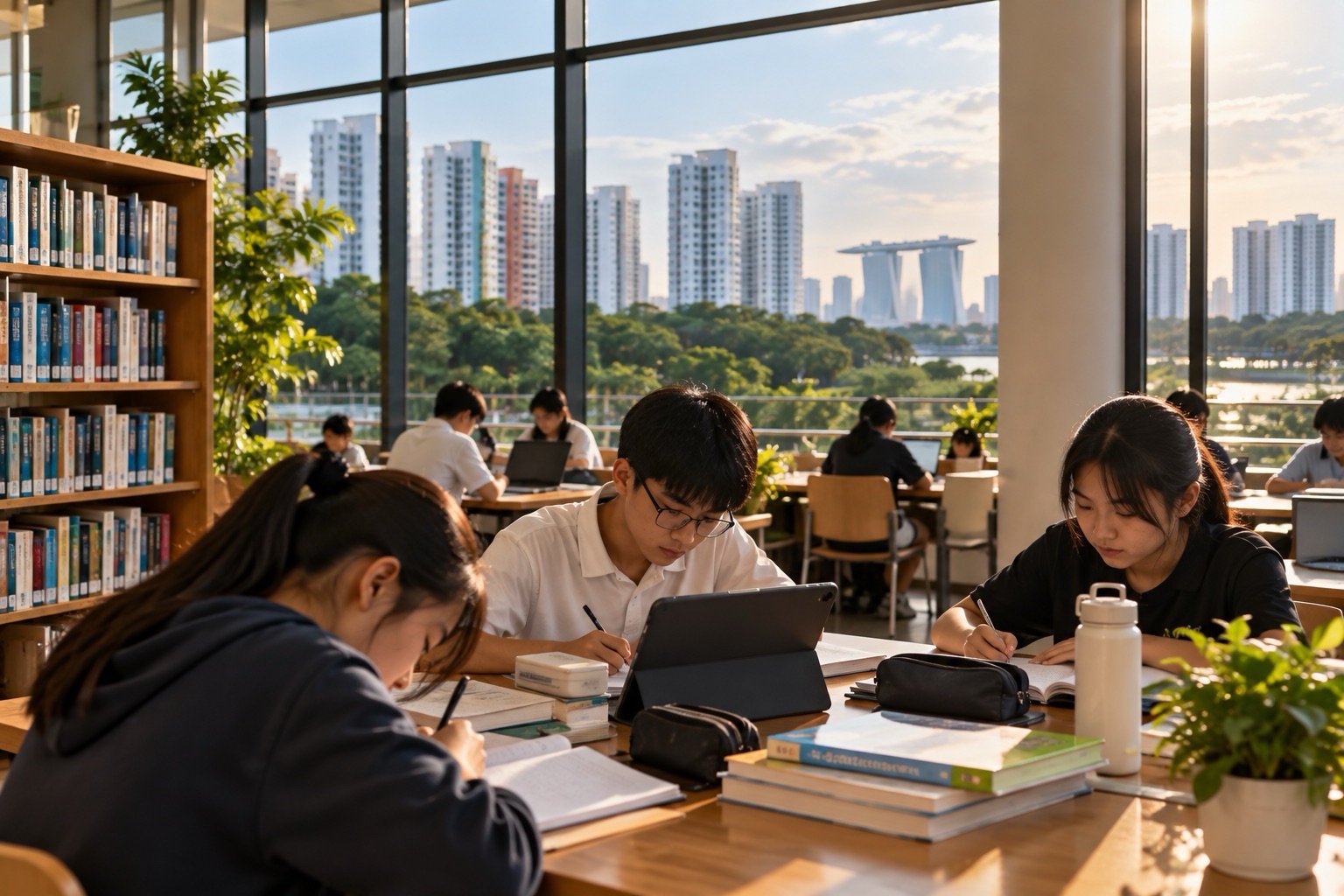
Looking for an international school in Punggol? Start with two distinct school options at Global Campus Village, 27 Punggol Field Walk, Singapore 828649: Global Indian International School (GIIS) SMART Campus and One World International School (OWIS) Digital Campus. GIIS lists Montessori-style kindergarten, IB Primary Years, Cambridge programmes, IGCSE, CBSE and IB Diploma pathways; OWIS lists inquiry-led early childhood and IB PYP, Cambridge lower-secondary and IGCSE, and IB Diploma pathways. They share a wider campus environment but have separate admissions decisions, contracts, fees and programme details. Neither should be chosen merely from a photograph of the buildings.
For parents searching “international schools near me”, the first three decisions are whether the child is eligible for that route, which curriculum fits the family’s likely future, and what the whole-year cost will be. Singapore Citizen children of compulsory primary-school age must comply with Singapore’s compulsory education framework; a school marketing itself as open to all nationalities is not by itself proof that a Singapore Citizen child can enter without the required official arrangements. For 2026–27, OWIS publishes annual Digital Campus totals from S$31,449 for early years and Grades 1–6 to S$40,459 for its IB Diploma grades, before any separate application or optional costs. This is dated fee information, not a live quotation or an estimate for another academic year.
- Punggol options: GIIS SMART Campus and OWIS Digital Campus, at Global Campus Village, Punggol Field Walk.
- GIIS publishes CBSE, Montessori/GMP, IB PYP, Cambridge Lower Secondary, IGCSE and IBDP options; check availability by grade and intended intake.
- OWIS publishes IB PYP, a modified Cambridge lower-secondary pathway, Cambridge IGCSE, and IB Diploma; confirm any A-Level offering separately.
- Use the official OWIS fees page and GIIS admissions team for written, cohort-specific quotations.
- For a Singapore Citizen child of compulsory primary age, clarify legal eligibility and any exemption requirement with MOE before making a financial commitment.
- Compare annual tuition, building or development charges, application fees, registration, technology, uniforms, extracurricular activities, transport and withdrawal terms.
- Ask whether your child’s grade corresponds to the child’s age and previous education; “Grade 6” does not automatically equal Singapore Primary 6.
- Tour the relevant teaching areas and ask how teachers assess reading, Mathematics, learning support, language and transition into later qualifications.
- Test arrival and pickup from your actual Punggol home: direct walk, Coral Edge LRT area, school bus or caregiver route.
- Never treat a vacancy advertisement, scholarship promotion or old discount as a guaranteed enrolment offer.
What is actually located at Punggol Field Walk?
The two schools are connected to the Global Schools Group ecosystem and use facilities within Global Campus Village in Punggol. GIIS describes its SMART Campus as a large purpose-built learning environment with classrooms, laboratories and sports amenities. OWIS describes a Digital Campus whose learners may use teaching spaces and shared facilities within the same wider development. That shared location can make online maps confusing: one pin may refer to an operator, an entrance or the overarching development rather than a child’s actual classroom.
When contacting admissions, write the exact legal school name, grade, campus, intake date and school office. A parent who has toured GIIS has not thereby completed an OWIS admissions process, and vice versa. Confirm whether the child would be taught under a programme registered at the particular campus. Request a named contact and official payment instructions. A simple two-column comparison prevents the same attractive building from standing in for two very different educational offers.
GIIS SMART Campus: what the school’s official page describes
GIIS SMART Campus publishes several pathways: its Global Montessori Plus programme for nursery and kindergarten, IB Primary Years Programme for younger primary years, Cambridge Lower Secondary, Cambridge IGCSE, Central Board of Secondary Education (CBSE) and International Baccalaureate Diploma Programme. This breadth can matter to families who may move internationally or wish to retain a particular national-curriculum connection. It also means that “GIIS curriculum” is too broad to describe every pupil’s classroom experience.
Ask admissions which programmes are available for the child’s age and intended entry year, whether entry is possible midstream, how subject choices are organised and what transitions exist between tracks. A student in a CBSE programme and another in an IB inquiry programme may use the same campus but follow different assessment structures and later qualifications. Parents should review official grade-level syllabuses rather than assume the labels can be exchanged at will. See the GIIS campus and curricula page.
OWIS Digital Campus: the published pathway in 2026
OWIS Digital Campus describes an inquiry-led early-childhood and IB Primary Years approach, followed by a modified Cambridge curriculum in Grades 6–8, Cambridge IGCSE in Grades 9–10 and the IB Diploma Programme in Grades 11–12. It also discusses a preparatory academic-English route for selected secondary students. These descriptions come from the operator’s current campus page and should be verified at enquiry because particular year groups, subjects and admissions conditions can change.
Parents who value continuity should ask what assessment data the school uses at each transition. Inquiry-based learning does not mean children never learn fundamental literacy or Mathematics; good inquiry still involves deliberately taught skills, careful questioning and evidence. Conversely, having a technology-rich room does not tell you how a particular teacher responds when a child misunderstands fractions. The most useful school tour asks to see actual student work and hear the teacher explain how progress is checked.
Why IB, IGCSE and CBSE are different decisions
The International Baccalaureate Primary Years Programme centres its primary approach on inquiry, concepts and learner development. Cambridge IGCSE is an examination qualification usually taken in the middle secondary years after subject-specific study. The IB Diploma Programme is a later, two-year pre-university qualification with its own subject and core requirements. CBSE is the Indian national curriculum framework, with a different sequence and examination structure. These are not four brand names for one interchangeable school syllabus.
For a mobile family, ask which country or higher-education system the child is likely to enter next. For a family intending to remain in Singapore, ask how the qualifications lead to recognised post-secondary choices and what institution-specific conditions apply. A student can thrive under more than one curriculum, but transfer between them can require bridging in content, language or assessment. Read the actual programme outline for the relevant grade before choosing the acronym that sounds most prestigious.
Is an international school automatically open to every Singapore Citizen child?
No. Singapore’s Compulsory Education Act places attendance requirements on Singapore Citizen children of compulsory primary-school age residing in Singapore unless an exemption applies. International-school admissions materials may say they welcome many nationalities, but the school’s willingness to consider an application does not by itself settle the child’s legal educational route. This distinction is important for families returning from overseas or contemplating a change from a government primary school.
Before paying an application or enrolment fee, ask the prospective school to explain what Singapore Citizen cases it can accept and check the relevant MOE exemption requirements directly. Do not assume that an application letter, a valid student pass for another nationality or a school administrator’s informal assurance is equivalent to an official exemption. The child’s citizenship, age and educational stage need to be considered accurately. An admission offer and compliance with Singapore’s primary-education rules are related but distinct matters.
International families arriving in Punggol: make the first week count
A family relocating to Singapore can feel pressured to choose a school immediately while organising housing, transport, immigration documentation and work. Instead, create a practical sequence. Establish the child’s previous grade, curriculum, language proficiency, learning records and intended start month. Ask the school what admissions evidence it needs and whether a placement assessment or interview applies. A school offering a similar programme may still organise year levels differently from the child’s previous country.
Keep the school visit and the immigration process separate: a place is not an immigration entitlement, and a successful admissions assessment is not proof that every required pass is granted. Reach the relevant official agencies and the school for instructions. A clear start plan should explain the first weeks, classroom expectations, English support if needed and where the child can find help. The child needs belonging as much as the adults need administrative certainty.
Annual fees: separate tuition, building fees and application charges
The official OWIS 2026–27 fees page lists its Digital Campus totals as S$31,449 for Early Childhood 1–3 and Grades 1–6, S$35,065 for Grades 7–10, and S$40,459 for the IBDP Grades 11–12, including a stated building-fee component. The school also lists an application fee of S$1,420 at the time of the cited schedule. These are historical published annual amounts for the named year, not prices to copy into an offer letter for 2027–28.
Ask admissions for the fee sheet applicable to the exact new intake and obtain a contract identifying tuition, building or development charges, any technology purchases, uniforms, field trips, extracurricular activities, bus transport and the payment schedule. For GIIS, obtain the corresponding GIIS programme-specific schedule from its own admissions office. Comparing the cheaper headline tuition fee against another school’s all-in total is misleading. Families need an itemised, same-year, same-grade comparison.
Worked budget example: why the lowest line item can mislead
Imagine that School A advertises an annual tuition figure, while School B publishes one combined total. The family concludes A is cheaper. After receiving full quotations, it discovers that A separately charges for certain development, technology and optional activities, while B includes some items. The relative cost changes. This example uses fictional schools because a real fee calculation requires the current invoices, not assumptions about what “included” means.
Make a spreadsheet with recurring tuition, compulsory annual charges, one-off non-refundable fees, refundable deposits, transport, equipment, uniforms and chosen extracurricular activities. Add GST treatment as shown on the official invoice. If an offer advertises a sibling discount, verify the grade, number of children, which fee components qualify and how long the offer lasts. A small discount on tuition may not cover a larger separate building fee. Annual affordability should be reviewed before the family signs a multi-term obligation.
The contract and withdrawal policy are part of the school choice
An international-school enrolment agreement may impose application charges, notice periods, deposits or other payment obligations. Before signing, ask for the written withdrawal procedure and the rules if a family relocates, a child changes curriculum or the school cannot offer the intended programme. A parent comparing schools on educational value alone can overlook a contractual detail that later becomes expensive.
Do not treat an admissions employee’s verbal estimate as the final contractual term. Ask for the current written schedule and the school’s exact policy on refunds, late payment and unconsumed services. Verify that the institution named on the invoice matches the school you intend to use. Where a problem arises, retain receipts and correspondence. Families can seek consumer guidance from the Consumers Association of Singapore where the matter falls within its remit. Clear paperwork is not distrust; it is how responsible parents avoid preventable disagreements.
Transport: living in Punggol does not guarantee a short school day
OWIS Digital Campus identifies the Coral Edge LRT area as a possible public-transport approach from the North East Line. But a family in Northshore, Sumang, Punggol Point or Waterway may need quite different local routes. A young child might depend on a school-bus provider or an adult’s walking journey, while an older pupil may travel independently. The best arrangement can change after CCAs, especially when dismissal is later than normal.
Check the actual school gate and designated pick-up area, not only the street address. Ask whether school-bus service is offered to your exact home, how the driver and attendant manage handovers, whether costs change during the year, and what happens when a child is sick or a bus is delayed. Test the route in rain and at school arrival time. A shorter journey can leave more room for sleep and play, and may matter more than a minor difference in facilities.
The difference between school brands and teaching quality
Campuses with attractive design can encourage curiosity, movement and collaboration, but architecture is not a substitute for instruction. Ask how teachers recognise a misconception, respond to a pupil who is silent and help a student progress from understanding to independent work. A school may display robotics studios and sports facilities; the more important question is how often a pupil uses them and how learning is assessed.
Parents can ask for an anonymised or permission-cleared example of classroom work, a description of feedback routines and the approach to students who require extra language or learning support. Compare the actual academic programme and daily experience against the child’s needs. For a child who loves art, a performing-arts space may be valuable. For another who needs intensive language support, the structure of that support may matter more. Neither family’s priorities create an absolute ranking of the schools.
IB Primary Years: what parents should expect children to do
An effective inquiry-led primary programme can ask children to observe, question, compare evidence, speak and write about their discoveries. It should still deliberately teach reading, handwriting, language conventions and numerical relationships. When touring an IB PYP setting, ask how skills are sequenced and how parents know whether their child’s foundation is becoming secure. “Student-led” should not mean adults cannot describe what is taught.
Look for examples showing movement from an initial question to a better explanation. A child investigating local water systems might measure quantities, record observations, read nonfiction text and present a conclusion. Those tasks connect subject learning, but a teacher still needs to help the child recognise units, organise data and use precise vocabulary. A parent can support this at home through everyday conversations. The key is whether the child is making durable connections, not whether every wall is covered in colourful projects.
IGCSE transition: subjects and assessment become more specific
Students entering the later Cambridge secondary years face formal subject choices and eventual IGCSE assessments. A parent should verify which subjects a campus offers for the child’s anticipated year, whether a desired combination can be timetabled and which prior knowledge is expected. A student transferring from another country’s Grade 8 might not have encountered topics in the same order. A bridging plan may be useful before beginning examination-focused courses.
Ask whether English is taught as a first or additional language in the relevant programme, which examination syllabuses are used and how science practicals and Mathematics options are structured. Cambridge course titles can resemble Singapore secondary subjects without matching every syllabus requirement. Do not assume that results or levels can be converted one-to-one into the MOE Full Subject-Based Banding system. Admissions and progression rely on the receiving institution’s published equivalence rules.
IB Diploma: decide with the university pathway in mind
The IB Diploma Programme involves subject choices at different levels and core requirements that shape two years of study. It is a substantial academic commitment, not simply a graduation certificate earned by attending an international school. Students should understand the specific subjects available, the languages and Mathematics pathways, the expected workload and how results may meet university admissions conditions in their intended destination.
A family planning a possible university application abroad should research qualification recognition and programme prerequisites early. A student who wants engineering may need particular Mathematics and science preparation. Another leaning toward humanities may need different subject depth. The school can guide choices, but the university programme ultimately determines its own requirements. Do not accept a blanket claim that any IB Diploma combination unlocks every degree. Plan the subject choices around real possibilities without forcing an inflexible career decision on a younger child.
CBSE as a continuity option for some internationally mobile families
GIIS includes a CBSE pathway in its published options. This may appeal to families connected to the Indian national education system or expecting a possible move where continuity with CBSE schooling is useful. Yet continuity should be checked at the child’s actual age and programme stage. A family may need to compare language requirements, syllabus sequencing, examination years and transfer arrangements.
Ask which CBSE grades the Punggol campus currently admits, which languages and subject streams are available and how the school supports a student changing from another curriculum. Do not infer identical teaching or admissions procedures merely because both schools on a shortlist are based in Singapore. A curriculum is a structured progression of knowledge and assessment. The right choice is the one that the child can enter appropriately and use to move toward realistic next-stage education.
School culture: belonging, language and friendships
International schooling can give children daily contact with classmates from many backgrounds. This can be educationally rich, but the child still needs a supportive classroom, meaningful friendships and adults who know when something is wrong. Ask how the school welcomes new students and how teachers respond to a child who is finding communication difficult. A family relocating from overseas may need an especially clear settling-in plan.
Language is central. A child who speaks English confidently in casual conversation may still need help with academic vocabulary, extended writing or subject-specific explanation. Another might be developing English while keeping a strong home language. Good support recognises these differences rather than treating a single standard test score as the whole learner. Parents should ask whether the programme contains appropriate English-language development and how progress is monitored after the first term.
Learning support and accessibility need specific answers
Children may have different learning, communication, attention, sensory or mobility needs. A parent should not assume that a campus can provide every service because its brochure says it values inclusion. Ask the admissions and support teams what the campus actually offers for the child’s identified needs, what assessments are relevant, how the plan is reviewed and whether extra costs or limitations apply.
The same principle protects families in mainstream Singapore schools: the child’s specific needs matter more than the label on the institution. Where specialised support is necessary, compare providers based on professional provision and access. Do not disclose a child’s confidential medical or learning history in public review comments to obtain general advice. Share relevant information with the school through secure channels when a genuine admissions discussion requires it.
Singapore-school return: plan the possible exit before entry
An international-school family may later wish to enter a Singapore government school. That move is not necessarily automatic or available at the child’s preferred level or school. Entry routes differ by citizenship, age, current qualification and vacancies. International students may face admission exercises such as AEIS or S-AEIS where applicable, while Singapore Citizens and returning Singaporeans have different considerations. Read the current MOE rules for the exact case.
Ask the prospective international school how its curriculum aligns with the child’s likely future and what documents will be available for transfer. Do not assume an IGCSE result is automatically identical to SEC subject-level entry, or that a PYP year can be mapped solely by matching grade numbers. Where a transfer is foreseeable, parents can protect continuity by maintaining strong literacy, Mathematics and language foundations. Early research prevents a surprise after several years of schooling.
A four-week international-school comparison plan
Week 1 — establish eligibility. Confirm citizenship, compulsory-education requirements if relevant, child’s age, previous grade, language needs and intended intake month. Week 2 — request information. Contact GIIS and OWIS separately for current programme availability, admissions criteria and complete fee schedules. Retain the dated written replies.
Week 3 — visit and test. Tour the appropriate grade areas, ask about teaching, subject progression and support, and test the actual commute or school bus. Week 4 — make a whole-family decision. Compare annual costs, curriculum continuity, probable future moves, contractual commitments and the child’s experience. If you still cannot obtain a clear answer about eligibility or a compulsory fee, do not sign solely to preserve a promotional offer. A good decision is informed and reversible until the formal conditions are understood.
Worked example: a family moving to Punggol with two children
Imagine a family relocating with a seven-year-old who has studied in an inquiry-led programme and a fourteen-year-old preparing to enter an examination pathway. One school might suit the younger child’s existing approach, while another provides a subject combination that suits the older child. The parents are tempted to choose one operator for both purely to simplify transport.
They instead verify the programme available to each child, admissions requirements, fees and future qualifications. They ask how each learner would be placed and what academic bridging might be needed. Only then do they assess whether one campus can accommodate both without compromising either student’s education. A shared family journey is a genuine advantage, but it is not a reason to ignore an unsuitable curriculum at a critical stage.
Worked example: a Singapore Citizen child whose parents prefer an international curriculum
Another family has a young Singapore Citizen child living in Punggol. They admire the international teaching approach and assume they can simply pay for a school place. Before doing so, they read the Compulsory Education Act and ask MOE about the child’s specific eligibility and whether any official exemption is relevant. They separate this legal question from the school’s willingness to interview the child.
The family may also explore educational experiences within the national school system, including CCAs, libraries, inquiry projects and language enrichment. Their preference is not dismissed, but the admission route must be lawful. If an exemption or other formal arrangement is not approved, an international-school brochure does not override national attendance requirements. The safest educational choice respects both the child’s learning needs and the family’s obligations.
Questions to take to the admissions office
Ask the school to specify the exact curriculum and grade, available place for the intended month, age-cut-off rules, placement assessment, language expectations, learning support, course transitions, IGCSE or IBDP subjects where relevant, annual total price, mandatory one-time fees, optional costs, transport, withdrawal conditions and official admission procedure. Record the answer with a source and date.
A polite request for a written fee breakdown and subject list is normal. Do not feel obliged to commit while an important question remains unanswered. A compelling building tour may make the family excited, but it cannot settle whether the child can enter legally, whether the desired subjects are taught or whether the household can afford the full path. Those are the questions that decide a useful educational outcome.
School holidays and academic calendars need separate planning
International schools may operate an academic year, term schedule and holiday calendar different from Singapore’s MOE mainstream primary and secondary schools. A family that has children in different systems should not assume both will have the same March, June, September or December break. This matters for working parents, travel plans, student care and sibling relationships. A school bus contract may also cover different operating days from a government school’s route. Ask each institution for its official calendar for the exact intake year, including staff development days, examination periods, orientation, half-days and other closures.
Consider a Punggol household where one child attends an MOE primary school and another is being considered for international schooling. If the holiday weeks overlap only partly, the family may need two separate care arrangements. Similarly, a parent changing schools midyear needs to ask how the first and final terms, assessments and fee obligations align. The most useful comparison includes the child’s educational continuity and the adults’ ability to provide care on the actual dates. A beautiful brochure cannot resolve a childcare gap caused by mismatched calendars. Request the current school-specific documents before booking flights, camps or leave.
Frequently asked questions
Are GIIS SMART and OWIS Digital the same school? No. They are distinct school programmes and admissions entities in the Global Campus Village environment. Where are they? Both publish Punggol Field Walk addresses; confirm the correct reception and pick-up entrance. Which is better? Compare the actual programme, teacher approach, support, cost and family needs; no universal ranking follows from the campus name.
Are fees the same? No. Request separate current quotations; OWIS publishes dated programme-specific tables. Can Singapore Citizens apply? Citizenship, age and compulsory-education rules must be checked with MOE and the prospective school. Do all international schools offer IB? No, and the IB has different stages; check the campus and year group. Can my child move back into a MOE school later? Possible routes depend on the child’s situation and current admissions rules; no automatic transfer should be assumed.
Official sources and further reading
School sources: GIIS SMART Campus curricula and location; OWIS Punggol Digital Campus programmes and visitor information; OWIS 2026–27 fees and additional charges. Legal and education sources: Compulsory Education Act; MOE compulsory education guidance; Ministry of Education.
More for Punggol families: International curricula explained; AEIS and mainstream admission; Punggol mainstream primary-school choices. This guide reflects information checked in November 2026. School fees, programme offerings and eligibility can change; the binding documents are the current official approvals and school contract.


