
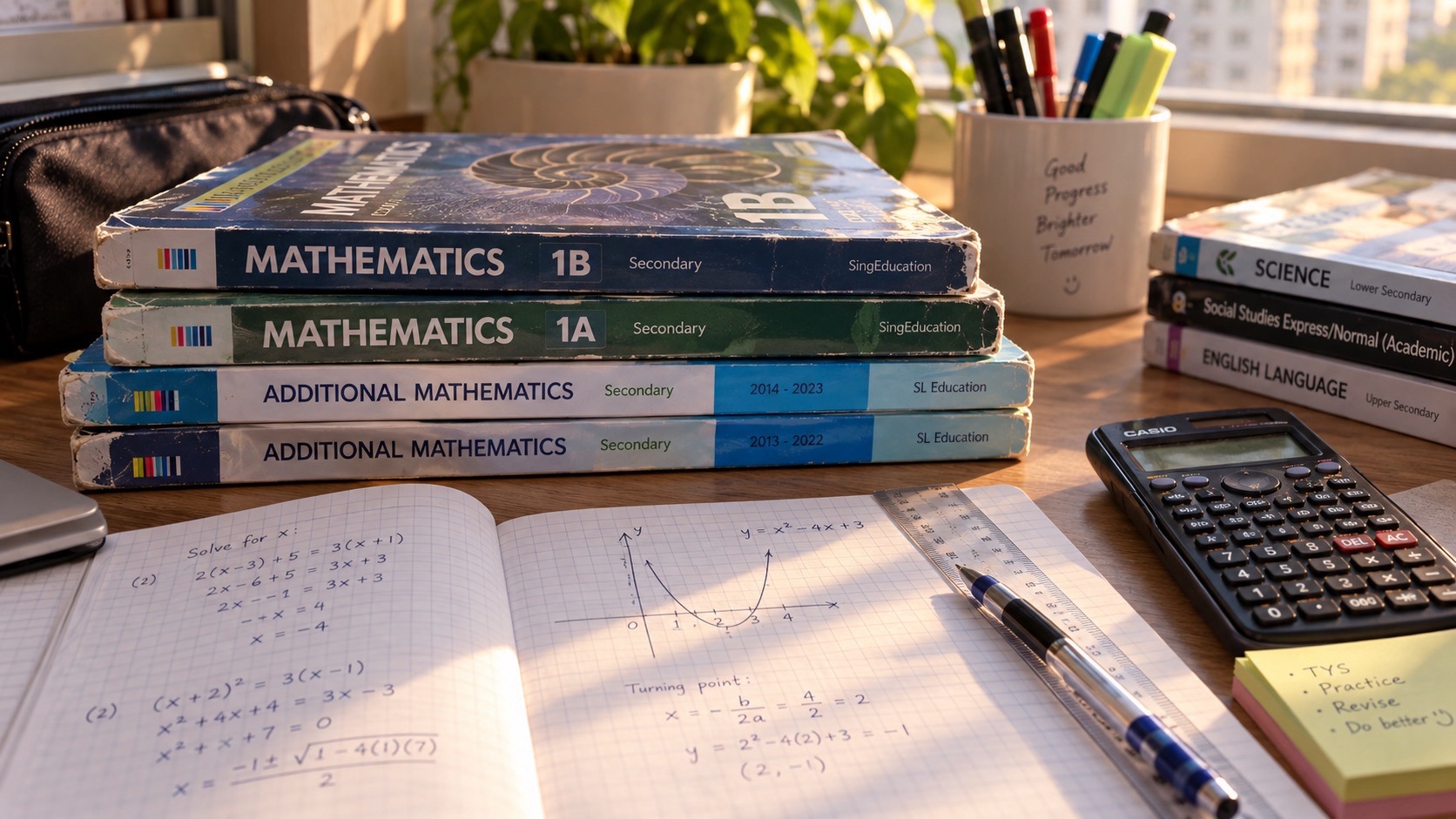
PG3 is Posting Group 3, the Secondary 1 admission route under Singapore’s Full Subject-Based Banding, normally associated with starting most academic subjects at G3. It does not mean a pupil must already solve two-variable systems before entering school. MOE’s G3 Secondary Two Mathematics syllabus includes graphs of linear equations in two variables, solving simultaneous linear equations using substitution and elimination, and forming pairs of equations from word problems. The main idea is that two conditions describe the same unknown quantities and both must hold simultaneously.
For example, x+y=11 and x−y=3 have the common solution x=7, y=4. The first equation allows many pairs, but the second narrows them to one. Algebraic substitution and elimination solve the system through equivalent expressions, while a graph shows the intersection of the two lines. For Punggol families, the useful starting point is defining variables clearly, selecting a method for a reason and checking the result in both original equations. Every price, club count and journey in this article is a fictional mathematical scenario rather than an actual local fact.
- PG3 is a school-admission group; G3 is an individual Mathematics subject level.
- MOE places simultaneous linear equations in two variables in Secondary Two G3 progression.
- One linear equation in two variables normally has many ordered-pair solutions.
- A simultaneous solution satisfies each original equation at the same time.
- The graph’s intersection is the shared ordered pair when two lines meet once.
- Substitution uses an equivalent expression from one equation inside the other.
- Elimination combines complete equations to remove a variable while preserving equality.
- Multiplying an equation requires multiplying every term on both sides.
- Two distinct parallel lines have no common solution; coincident lines have infinitely many.
- Negative or fractional answers are possible but word-problem constraints may restrict them.
- Verify both original equations and the units of the interpreted answer.
- Actual school term order and assessment conventions come from the receiving teacher.
Definition lock: all possible two-line outcomes
| Situation | Graph | Example |
|---|---|---|
| Unique solution | Lines intersect once | x+y=11, x−y=3 |
| No solution | Distinct parallel lines | x+y=8, x+y=12 |
| Infinitely many solutions | Coincident lines | x+y=5, 2x+2y=10 |
| Substitution | Express one variable and replace it | x=11−y |
| Elimination | Combine whole equations | 2x=14 |

Guide chapters
- Why Secondary One algebra comes first
- PG3 is not an extra algebra examination
- Definition lock: a system is two simultaneous constraints
- A variable’s definition belongs in the answer
- One equation can describe infinitely many pairs
- The second condition may identify one common pair
- A table of values makes the graphical meaning visible
- An intersection is the shared graphical solution
- Axis labels and scale affect graph accuracy
- Parallel lines provide a meaningful no-solution result
- Coincident lines do not identify a unique pair
- The graphical answer may be approximate
- Substitution uses an equation as a replacement rule
- Choose an equation with an easy variable coefficient
- Brackets protect a substituted expression
- Signed numbers must remain attached to coefficients
- Elimination is an operation on entire equations
- Opposite coefficients suggest addition
- Matching coefficients with the same sign suggest subtraction
- Multiplication of equations must include every term
- Sometimes both equations need to be scaled
- Fractional solutions are not automatic mistakes
- Negative solutions are possible in Mathematics
- Check both original equations, not the last working line
- Translate a ticket-count story into two equations
- Two purchasing totals can determine two prices
- Age questions require consistent reference times
- Geometry word problems depend on the correct formula
- One apparent fact can repeat another
- An inconsistent story may have no practical answer
- Graph and algebra should reach compatible conclusions
- Choose the method that fits the coefficients
- Do not confuse a linear system with a nonlinear one
- An error log should name the mistaken principle
- Why fictional Punggol contexts must be labelled
- A four-week Secondary Two learning routine
- What parents should ask their Punggol Mathematics teacher
Why Secondary One algebra comes first
A child who cannot confidently solve 3x+4=19 will struggle to manipulate two equations with signed coefficients. The new topic combines earlier algebraic skills, so the best preparation may be strengthening those fundamentals rather than memorising more complicated elimination patterns.
MOE lists one-variable equations and linear functions earlier in the G3 progression, then simultaneous equations in Secondary Two. The sequence provides a logical foundation; it is not a universal Punggol school timetable.
Parents can ask the pupil to explain inverse operations and substitute a solution back into a simple equation. If that explanation is unstable, repair it before introducing two unknowns.
PG3 is not an extra algebra examination
Posting Group 3 facilitates admission under Full SBB, while the individual subject is studied at its assigned G level. A pupil can have different learning strengths across subjects, and posting does not prove they have mastered every future Mathematics outcome.
A school may teach simultaneous equations at a particular point in Secondary Two or revisit it alongside graphs and word problems. A 2025 Yishun Secondary outline provides an example of a school sequence, not a binding Punggol timetable.
Parents should use the current class notes and marked work to decide what support is relevant, rather than impose upper-secondary content during an incoming Secondary One holiday.
Definition lock: a system is two simultaneous constraints
A system of two equations describes conditions to be met together by the same variables. In a typical linear two-variable problem, the task is to determine one ordered pair satisfying both. The equations are related rather than two separate sums.
For x+y=11 and x−y=3, the pair (7,4) works because 7+4=11 and 7−4=3. The pair (8,3) satisfies only the first condition and therefore fails the system.
Ask the student to check any proposed pair against the two statements. The definition becomes practical once they see that satisfying only one is insufficient.
A variable’s definition belongs in the answer
Variables represent quantities, and their meanings come from the problem. A letter may describe a count, a price, an age or an abstract coordinate. Defining x and y clearly makes the equations interpretable and prevents accidental changes of meaning.
In an original fictional purchasing problem, let x denote the cost of one notebook in dollars and y the cost of one pen. The term 2x means the cost of two notebooks under a constant unit price, not two unrelated expenses.
Parents can ask what the final x-value means in words and what units apply. A pair of numbers with no interpretation may not finish the task.
One equation can describe infinitely many pairs
The equation x+y=10 allows pairs such as (0,10), (3,7) and (8,2). Every pair satisfies one relationship, so it cannot identify both unknowns uniquely without another independent restriction.
Rearranging to y=10−x is a valid equivalent equation but does not eliminate the freedom to choose x. Graphically, it describes a straight line containing all relevant ordered pairs.
Ask the child to produce three different valid pairs. This helps them understand why a second condition matters and how the graph represents possibilities.
The second condition may identify one common pair
Adding another independent linear constraint can reduce the possible pairs to a single intersection. For x+y=10 and x−y=2, adding the equations gives x=6 and then y=4. Both original conditions hold.
This process is not the same as finding an answer to the first equation and separately choosing an answer to the second. Both equations use the same x and y in the same interpretation.
Parents can ask the pupil to explain how the second equation rules out (3,7) and other pairs that satisfied the first.
A table of values makes the graphical meaning visible
Choose several x-values for a linear equation and calculate corresponding y-values. Each row is an ordered pair on that equation’s graph. A second table for the other line can reveal a shared point.
For x+y=11, the values x=0,4,7 give y=11,7,4. For x−y=3, x=3,7,9 give y=0,4,6. Both tables include (7,4).
Parents can ask the child why that pair appears in both tables and whether other pairs in one table satisfy the other equation.
An intersection is the shared graphical solution
Each nonvertical linear equation can be shown as a straight line in a coordinate plane. A shared point must lie on both lines and therefore satisfy both algebraic statements. That is why the intersection represents the system’s solution.
A correct graph of y=11−x and y=x−3 meets at (7,4). The graph can provide a visual check on algebra, while exact substitution establishes the pair’s numerical validity.
Ask which line belongs to which equation and how the point meets their definitions. Geometry should reinforce rather than replace the algebra.
Axis labels and scale affect graph accuracy
A coordinate grid must have clear axes, tick intervals and consistent values. A student who treats one tick as one unit on one side and five on the other without reading labels may place the lines incorrectly.
The intersection can appear between grid points if exact values are fractions. A drawn estimate should not be presented as an exact pair when the question demands algebraic precision. The two methods have different strengths.
Parents can ask the pupil to read one tick on each axis and substitute the visually estimated intersection into both originals.
Parallel lines provide a meaningful no-solution result
Distinct parallel lines do not meet in the usual coordinate plane. Their equations have equal gradients but different intercepts, so no ordered pair satisfies both constraints. The absence of a solution is itself a mathematical conclusion.
For x+y=8 and x+y=12, subtracting the equations would imply 8=12. That contradiction shows the conditions cannot hold together. Trying arbitrary numerical pairs will not fix the inconsistency.
Ask the learner to explain in words why one sum cannot simultaneously be both eight and twelve. This builds understanding beyond a mechanical rule.
Coincident lines do not identify a unique pair
Two equations can represent exactly the same line when one is an equivalent multiple of the other. The second equation adds no independent information, so there are infinitely many common pairs in the real-number model.
For x+y=5 and 2x+2y=10, every pair satisfying the first satisfies the second. Elimination may produce 0=0, a true identity rather than a command that x and y both equal zero.
Parents can ask whether the second equation eliminates any possibilities. Recognising duplicate constraints is useful in real data problems.
The graphical answer may be approximate
A graph is valuable for showing the type and location of a solution, but a small plotted grid may not support exact fractional coordinates. Reading off a line intersection requires attention to scale and the question’s allowed precision.
Suppose the actual intersection is x=2/3 and y=5/2. A pupil may estimate x≈0.7 and y≈2.5 from the graph. The decimal reading can be helpful but is not identical to an exact algebraic answer.
Parents can ask whether the result is read from a graph or derived by solving. The wording should match the method’s precision.
Substitution uses an equation as a replacement rule
Substitution begins by expressing one unknown in terms of the other, then replacing it within the second equation. The replacement must be equivalent to the original relation, so the solution set is preserved.
From x+y=11 write x=11−y. Substitute into x−y=3 to obtain (11−y)−y=3. The result is y=4, followed by x=7. Rearranging x=11+y would be a different and incorrect condition.
Parents can ask which equation justifies the substitution. A valid operation needs an understandable reason.
Choose an equation with an easy variable coefficient
If a variable already has coefficient one, it can often be isolated without fractions. That usually makes substitution efficient and reduces arithmetic risk. A solution method should be selected based on the structure, not because the pupil always starts with the first line.
For x=2y+1 and x+y=13, put 2y+1 into the second equation. It becomes 3y+1=13, so y=4 and x=9. No extra rearrangement was needed.
Parents can ask which available expression is easiest to use and how the choice reduces steps.
Brackets protect a substituted expression
A coefficient multiplying the variable must multiply the entire replacement expression. Writing brackets before expanding avoids the common mistake of applying the coefficient to only one term.
If x=7−2y and 3x+y=11, substitution produces 3(7−2y)+y=11. Expanding gives 21−6y+y=11, so y=2 and x=3. Omitting brackets can change the original meaning.
Parents can ask the pupil to identify what the coefficient three multiplies. The distributive law is the same principle encountered in earlier algebra.
Signed numbers must remain attached to coefficients
Negative coefficients are part of the quantity they multiply. When rearranging or combining equations, the minus sign must not be treated as punctuation that can disappear. A single lost sign changes the constraint.
For x−y=3, rearranging to y=x−3 is correct. Writing y=3−x gives a different line. A short substitution check can reveal the problem before more calculations follow.
Parents can ask the child to circle entire terms including signs, then explain the operation that produced the new expression.
Elimination is an operation on entire equations
Elimination adds or subtracts equivalent equations so one variable cancels. The operation applies to full left and right sides, preserving the consequences of the original system rather than selecting convenient parts.
For x+y=11 and x−y=3, add both entire equations to obtain 2x=14, giving x=7. Substitute into x+y=11 to find y=4. Both conditions must then be checked.
Parents can ask what cancelled and why. A letter disappearing should be a consequence of equal-and-opposite coefficients, not unexplained magic.
Opposite coefficients suggest addition
When one variable’s coefficients are equal in magnitude and opposite in sign, adding the equations removes that variable. Recognising the pattern before calculating can make a solution both shorter and clearer.
For 2x+3y=19 and 5x−3y=30, adding gives 7x=49 and x=7. Then 14+3y=19, so y=5/3. The fraction is acceptable if it checks both originals.
Parents can ask which coefficients produce zero on addition. Choosing the cancellation deliberately is a sign of mathematical understanding.
Matching coefficients with the same sign suggest subtraction
If a variable has the same coefficient in each equation, subtracting one full equation from the other can eliminate it. The subtraction must affect the entire second equation, including its constant.
For 2x+3y=19 and 2x+y=11, subtraction yields 2y=8, so y=4. Substitution into the second equation gives x=3.5. Both values must be checked.
Parents can encourage parentheses around the complete second expression in an early working line. That makes sign changes explicit.
Multiplication of equations must include every term
Sometimes the coefficients do not line up for immediate cancellation. Multiplying an equation by a nonzero factor can create equal or opposite coefficients, provided every term on both sides is multiplied.
For 2x+3y=17 and 3x−y=6, multiply the second by three to obtain 9x−3y=18. Add to get 11x=35. Multiplying only the y term would not preserve equality.
Parents can ask which coefficient the student intends to align and whether the multiplier was applied to the constant as well.
Sometimes both equations need to be scaled
A system may have coefficients such as 2x and 3x, where multiplying one equation by three and the other by two creates matching coefficients. This is an application of equivalent equations, not a special new algebraic law.
Suppose 2x+y=8 and 3x−2y=5. Multiplying the first by two gives 4x+2y=16; adding the second as originally written would not eliminate x. A better choice is multiplying the first by two and leaving the second to eliminate y, giving 7x=21 and x=3, then y=2.
Parents can ask the child to inspect both variables before choosing which to eliminate. Efficient selection reduces work while retaining correctness.
Fractional solutions are not automatic mistakes
Some systems produce exact fractions. Their validity depends on satisfying both equations, not on whether the numbers look tidy. Premature rounding may make verification appear imperfect, especially after several steps.
For 2x+3y=17 and 3x−y=6, the exact solution is x=35/11 and y=39/11. These fractions satisfy both statements even though neither is an integer.
Parents can ask when a decimal is an approximation and whether the problem’s real-world units permit fractional values. Mathematical and practical validity are separate checks.
Negative solutions are possible in Mathematics
A system can produce negative coordinates or signed changes. They should not be rejected simply because a school child expects all arithmetic answers to be positive. The question’s definitions decide whether a negative result is meaningful.
For x+y=1 and x−y=5, the solution x=3, y=−2 is correct algebraically. But if y represents a count of participants, the scenario may be impossible under the given assumptions.
Parents can ask what the sign means for the specified quantity and whether the actual context imposes a nonnegative domain.
Check both original equations, not the last working line
Verification substitutes the final pair into each original equation. It is more informative than checking a simplified intermediate result because a sign or scaling error may have entered before the last step.
For (7,4), the statements x+y=11 and x−y=3 become 7+4=11 and 7−4=3. The pair satisfies both and has a clear graphical interpretation.
Parents can make two short substitution checks a regular closing habit. A correct answer should be demonstrated rather than only asserted.
Translate a ticket-count story into two equations
Imagine a fictional performance with 30 tickets at invented prices of $8 and $5, yielding $210 in total revenue. Let a and s be the two ticket counts. Their number satisfies a+s=30 and their cost satisfies 8a+5s=210.
Solving gives a=20 and s=10. The totals check: twenty plus ten is thirty, and $160 plus $50 is $210. The values are fictional and not real Punggol event prices.
Parents can ask which sentence supplies each equation and why both are necessary. The setup is the core of modelling.
Two purchasing totals can determine two prices
A fictional purchase of two notebooks and one pen totals $11, while one notebook and three pens totals $12. Let n be the price of a notebook and p the price of a pen. Then 2n+p=11 and n+3p=12.
Substitution yields n=$4.20 and p=$2.60. These values satisfy both receipts. The exercise assumes identical unit prices across both purchases; a promotion or different product would require different information.
Parents can ask whether the variables describe prices or item counts and whether the shared-price assumption is stated.
Age questions require consistent reference times
Two people’s ages can be described through a sum and a difference, but both variables must refer to the same date unless explicitly adjusted. A common mistake is mixing a present age with a future age in one equation.
For fictional siblings whose ages sum to 27 and differ by three, let a and b be their current ages. Then a+b=27 and a−b=3, producing ages 15 and 12. A timeline can check the interpretation.
Parents can ask ‘At what time is this age measured?’ before the pupil writes each relationship. Clear time references prevent modelling errors.
Geometry word problems depend on the correct formula
Simultaneous equations can connect dimensions, perimeter and other geometric constraints, but the first formula must describe the quantity in the problem. Area and perimeter cannot be swapped merely because both contain lengths.
A fictional rectangle has perimeter 30 cm and length 3 cm more than its width. Its equations are 2l+2w=30 and l−w=3. The solution is l=9 cm and w=6 cm.
Parents can ask the child to draw the rectangle and verify the perimeter. A mathematically correct solution to a wrong model is not a correct real-world answer.
One apparent fact can repeat another
Not every word problem with two sentences contains two independent constraints. If one states that x+y=10 and another states that 2x+2y=20, the same line is described twice. A unique pair cannot be determined.
A pupil should recognise this before inventing arbitrary values or claiming the calculator failed. Algebra may correctly simplify to a true identity, revealing the missing information.
Parents can ask what the second statement rules out that the first allowed. If nothing is ruled out, the data may be insufficient.
An inconsistent story may have no practical answer
Two conditions can also contradict each other. If a fictional inventory is described as containing exactly ten items and exactly twelve items at the same time in the same scope, no count satisfies both statements.
Algebraically, inconsistent linear systems produce no intersection. The right answer is to identify the conflicting assumptions rather than force a pair of numbers.
Parents can teach children to view an impossible result as useful diagnostic information. Not every calculation question has one neat positive integer answer.
Graph and algebra should reach compatible conclusions
Graphical methods offer a visual interpretation of the solution count and approximate location. Algebraic methods often produce exact values, including fractions. Both represent the same constraints and should agree when applied correctly.
If a graphical intersection appears far from the algebraically calculated pair, check the table, scale, equation rearrangement and plot. The discrepancy provides a clue about the error.
Parents can ask which method is more precise for the given question and how each checks the other.
Choose the method that fits the coefficients
Substitution is often efficient when a variable is isolated or has coefficient one. Elimination can be easier when coefficients already match or can be aligned with simple multiplication. Graphing helps interpret the system and the number of solutions.
There is no universal rule that the first equation must always be substituted or that elimination always takes fewer lines. A student should inspect the particular system and choose a valid, convenient route.
Parents can ask for a one-sentence justification of the chosen method. The explanation shows the pupil is thinking about structure.
Do not confuse a linear system with a nonlinear one
A pair of equations with x and y is not automatically linear. A squared term such as x², a product xy or a nonlinear function can produce curved graphs and different solution methods. The current G3 Secondary Two topic specifies simultaneous linear equations.
An advanced Additional Mathematics question may combine a line and a parabola. Its solutions and methods differ from two straight lines, and it should not be treated as identical preparation for a new Secondary Two pupil.
Parents can ask whether both equations describe straight lines. That classification should come before method selection.
An error log should name the mistaken principle
Simultaneous-equation errors may involve sign changes, brackets, applying a multiplier to only part of an equation, misdefining a variable or checking only one original condition. Each requires a targeted conceptual correction.
A student who expands 3(7−2y) as 21−2y needs the distributive law, not a longer lesson on graph scaling. After explaining the property, test it through an unfamiliar substitution example.
Parents can record the first invalid step, a correct explanation and a new problem solved independently a few days later.
Why fictional Punggol contexts must be labelled
Club tickets, shopping, transport routes and CCA groups offer relatable word-problem contexts, but invented prices or counts are not local reporting. A mathematics model may use realistic-looking numbers solely to practise translating two constraints.
A fictional journey may use speed and distance to produce equations, but it should not be presented as the current travel time between Punggol stations or schools. Live transport information changes and has its own official sources.
Parents can teach honesty through simple labelling: ‘Assume the following fictional quantities.’ Mathematical usefulness does not require pretending every scenario occurred.
A four-week Secondary Two learning routine
Week one revisits signed arithmetic, linear equations, ordered pairs and graph scales. Week two focuses on simple substitution and checks. Week three develops elimination with coefficients, brackets and fractions. Week four combines word problems and graphical reasoning while asking for independent explanations.
Keep practice aligned with the receiving school’s actual classwork. A student still struggling with one-variable equations should repair those before adding more complexity, while a confident learner can explore no-solution or infinitely-many-solution cases.
Progress means the teenager can define unknowns, preserve equations and verify both constraints without copying an answer key.
What parents should ask their Punggol Mathematics teacher
Ask which G3 Secondary Two simultaneous-equation methods and applications are currently assessed, and whether graphical answers require exact or approximate values. MOE establishes the learning outcomes but schools control their teaching calendar.
Bring a marked example that shows the pupil’s specific mistake: wrong equation setup, negative signs, scaling, substitution or graph interpretation. Each suggests different support. Additional tuition may help persistent gaps but is unnecessary when school feedback and independent practice suffice.
PG3 is an entry route. Mathematical confidence grows through clear modelling, legal transformations and checks that explain why the final pair is valid.
Frequently asked questions
Is this taught in Secondary One?
MOE places simultaneous linear equations in the G3 Secondary Two progression, although schools decide actual pacing.
What does simultaneous mean?
The same ordered pair satisfies both equations.
What is a system’s graphical solution?
The common point where the corresponding lines intersect.
What is substitution?
Replacing a variable in one equation with an equivalent expression from the other.
What is elimination?
Combining whole equivalent equations to remove one unknown.
What if the coefficients do not match?
Multiply complete equations by suitable nonzero factors before eliminating.
What if two lines are distinct and parallel?
There is no shared solution.
What if the equations describe exactly the same line?
There are infinitely many common solutions in the ordinary real model.
Can the result include fractions?
Yes; do not round early unless the question requires it.
Are negative answers always wrong?
No. Context determines whether a negative quantity is allowed.
How can a parent check the work?
Substitute the pair into both original equations and interpret the variable units.
What is the most useful first exercise?
Solve x+y=11 and x−y=3 by both elimination and substitution, explaining each step.
Continue the What is PG3 Punggol guide series: PG3 G3 Geography Housing and Punggol Northshore | PG3 G3 Geography Transport Networks and Punggol Coast | PG3 G3 English Narrative Composition and Story Structure
Official Mathematics syllabus and related PG3 guides
- MOE G2/G3 Mathematics Syllabuses, Secondary Two N7.8 simultaneous linear equations
- Yishun Secondary School 2025 Secondary Two G3 Mathematics content outline
- What is PG3: G3 Linear Equations and Word Problems
- What is PG3: G3 Linear Functions, Graphs and Gradient
- What is PG3: Secondary Two Quadratic Equations and Factorisation
- Immutable eduKateSG Secondary One Mathematics teaching reference
Your next step
Ask your teenager to solve x+y=11 and x−y=3 by adding both equations, then repeat by substituting x=11−y. Have them verify (7,4) in both originals and explain the graphical intersection. If they have not yet reached Secondary Two, begin with one-variable linear equations and coordinate graphs from their actual school lessons.


