
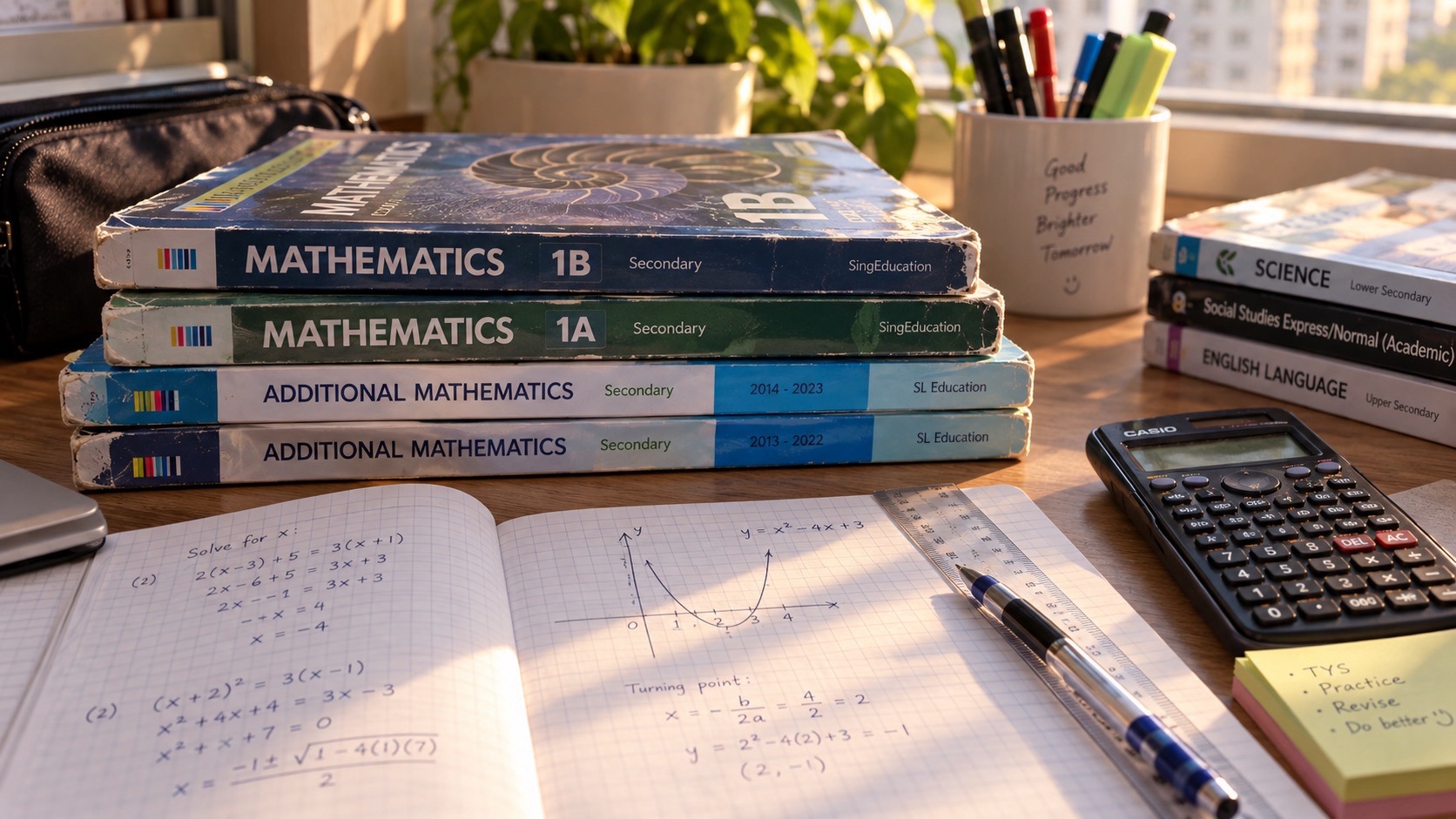
PG3 means Posting Group 3, the Secondary 1 admission route under Full Subject-Based Banding that usually starts most academic subjects at G3. It does not mean every pupil must solve quadratic equations before entering Secondary 1. MOE’s G3 Mathematics syllabus develops the product of algebraic expressions, factorisation of quadratic expressions, quadratic functions and graphs, and solving quadratic equations by factorisation in Secondary Two. Punggol parents can help by making the progression clear: first understand algebraic expressions and linear equations, then learn why a squared variable produces a curved graph and sometimes two solutions.
A quadratic expression such as x² + 5x + 6 can be factorised as (x + 2)(x + 3), while the equation x² + 5x + 6 = 0 has solutions x = −2 and x = −3. The expression is not itself a question to solve, and the two factors are not two unrelated guesses. The connection between products, zeros and a parabola is the central understanding. The school controls the actual Secondary 2 sequence; any cost, travel or design scenario in this guide is fictional and should not be read as a factual claim about Punggol.
- PG3 describes admission; G3 Mathematics is an individual subject level, and quadratic work is placed in Secondary Two in MOE’s published content.
- Quadratic expressions contain a squared-variable term; linear expressions do not.
- Expanding two brackets uses distributivity across every term.
- Factorisation rewrites an expression as a product, the reverse of an appropriate expansion.
- The identities (a+b)², (a−b)² and a²−b² can simplify work but must be applied with exact signs.
- A quadratic function y=ax²+bx+c produces a parabolic graph when a is nonzero.
- The sign of a determines whether the parabola opens upwards or downwards.
- Roots or zeros occur when y=0, while the y-intercept occurs when x=0.
- A quadratic equation solved by factorisation uses the zero-product principle, not an arbitrary ‘move the bracket’ rule.
- Some quadratic equations have two distinct real roots, one repeated real root, or no real roots.
- Graphical interpretation, exact algebra and a reasonableness check should support one another.
- Quadratic formulas and more advanced methods belong to the applicable later syllabus and are not necessary for every Secondary 2 task.
Definition lock: quadratic algebra and graphs
| Concept | Explanation | Example |
|---|---|---|
| Expression | An algebraic quantity without an equality assertion | x²+5x+6 |
| Factorised form | An equivalent product | (x+2)(x+3) |
| Equation | An equality to solve | x²+5x+6=0 |
| Roots | Values satisfying y=0 | x=−2, −3 |
| Parabola | Quadratic function graph | y=x² |
| Turning point | Maximum or minimum depending on opening | (0,0) for y=x² |

Chapters
- Why quadratics are a Secondary 2 progression
- Definition lock: expression, equation, function and graph
- Linear and quadratic relationships are fundamentally different
- What a squared variable actually means
- Expansion means applying distributivity to every term
- Negative signs require careful expansion
- Factorisation reverses a verified expansion
- Find a common factor before advanced methods
- Factorising x²+bx+c with positive factors
- Mixed signs change the factor search
- Difference of two squares is a distinctive identity
- Square identities involve a middle term
- Factorising a general quadratic with a nonunit coefficient
- A quadratic function draws a parabola
- The sign of a determines the opening direction
- The y-intercept is a substitution question
- Roots are the x-values where y equals zero
- The zero-product principle explains solving by factorisation
- Not every quadratic has two different real roots
- Symmetry provides a powerful visual check
- Maximum and minimum points have different meanings
- Completing the square is a useful later connection
- Quadratic equations appear in geometry problems
- A mathematical model is not a local prediction
- Graphs should be checked with at least three points
- Common errors need different corrective explanations
- A four-week Sec 2 quadratic learning sequence
- Questions for the receiving Punggol Mathematics teacher
Why quadratics are a Secondary 2 progression
MOE’s published G3 Mathematics content divides learning across Secondary One to Four. Secondary One includes basic algebraic expressions, equations and linear functions. Secondary Two builds toward products of algebraic expressions, special identities, quadratic factorisation, graphs and equations. That order matters because a child who is still confused by signed multiplication or brackets needs those foundations before abstract curves.
Parents sometimes find an older sibling’s workbook and assume every topic in it belongs to a new PG3 pupil immediately. A Secondary 2 topic is a useful preview, not an admission requirement. School pacing and actual assessments may differ across Edgefield, Greendale, Punggol Secondary and Yusof Ishak Secondary.
Ask what algebra the child can already explain independently. If they cannot expand 3(x+2) accurately, begin there rather than jump to the quadratic formula.
Definition lock: expression, equation, function and graph
A quadratic expression is an algebraic expression with highest variable power two, such as x²+5x+6. A quadratic equation asserts equality, for example x²+5x+6=0. A quadratic function associates input x with an output y under a rule such as y=x²+5x+6. Its graph shows the ordered pairs satisfying the function.
These are related mathematical objects but answer different questions. Factorising the expression yields another equivalent form, whereas solving the equation identifies x-values satisfying equality. Plotting the function shows how the output changes across a selected input domain. A pupil should not announce ‘x=−2’ when merely asked to simplify an expression.
Parents can ask which word the task uses—expand, factorise, solve or draw—and what kind of result each demands.
Linear and quadratic relationships are fundamentally different
A linear function y=2x+3 changes by a constant amount for each unit increase in x. A quadratic function y=x² changes differently as x changes, because squaring creates an effect that depends on the current input. Its graph is curved rather than a straight line. Both are functions but cannot be analysed using one constant gradient throughout.
For x values −2, −1, 0, 1 and 2, the outputs of y=x² are 4,1,0,1,4. The successive differences are not constant. A student who automatically draws a straight line through the first and last values would miss the intermediate pattern.
Ask the teenager to produce a table for one linear and one quadratic rule. Comparing how the differences behave is a useful conceptual bridge.
What a squared variable actually means
The symbol x² means x multiplied by itself. It does not mean twice x, and when x is negative its square is nonnegative in ordinary real arithmetic. For x=−3, x²=9 while 2x=−6. This distinction becomes central when solving equations and interpreting curves.
Students who write (−3)²=−9 may have ignored brackets or the meaning of multiplication. A signed coefficient introduces another issue: −x² normally means the negative of x², while (−x)² equals x². The notation changes the result.
Parents can ask the child to substitute positive, zero and negative inputs into the same expression. Correct reasoning should survive all three.
Expansion means applying distributivity to every term
To expand (x+2)(x+3), multiply each term in the first bracket by each term in the second. The products are x², 3x, 2x and 6, giving x²+5x+6 after combining like terms. Missing a cross-product is a common mistake because pupils assume only the first and last terms need multiplication.
A two-by-two area grid can show four partial products, and a conventional algebraic expansion can verify the same result. The diagram works because total area is the sum of the component rectangles under the algebraic model.
Ask the learner to explain where every resulting term came from. A memorised ‘FOIL’ mnemonic is less reliable if the child cannot account for the products.
Negative signs require careful expansion
Consider (x−4)(x+2). The products are x², 2x, −4x and −8, yielding x²−2x−8. A pupil who writes a positive eight has lost the product of a negative and a positive. A pupil who combines 2x and −4x as 6x has confused magnitudes with signed sums.
Checking with x=0 offers a quick test: the original product is (−4)(2)=−8, so the expanded constant term must also give −8. The same substitution can catch several errors without solving the whole expression again.
Parents can ask children to identify the signs of the four individual products before combining them. This targets the root of the error.
Factorisation reverses a verified expansion
Factorising an expression rewrites it as a product of simpler expressions. If expansion shows (x+2)(x+3)=x²+5x+6, factorisation reverses the equality. The two forms have the same value for every allowed x, so the choice of form depends on the mathematical task.
An expression with several terms is not automatically ‘less correct’ than a product. The expanded form makes coefficients visible; the factorised form makes zeros and product structure visible. A competent pupil can move between them and knows which is useful.
Ask the child to expand any proposed factorisation back to the original. This provides an independent check rather than trust in a guessed pair of numbers.
Find a common factor before advanced methods
An expression such as 6x²+9x has a common factor 3x, giving 3x(2x+3). Identifying a shared numerical or variable factor is a basic and powerful step. Students sometimes overlook it because they expect every quadratic to become two brackets beginning with x.
The most useful form depends on the question, but extracting the greatest convenient common factor often simplifies later solving. If 3x(2x+3)=0, the factors immediately reveal two possible root conditions under the zero-product principle.
Parents can ask what all terms share before looking for other patterns. This develops algebraic structure recognition.
Factorising x²+bx+c with positive factors
For a monic quadratic x²+bx+c, factorisation into (x+p)(x+q) requires p+q=b and pq=c. For x²+7x+12, the numbers three and four have sum seven and product twelve, so the factorisation is (x+3)(x+4).
The method should not be a random race to find two numbers. Pupils can list pairs multiplying to the constant and test their sums. The process becomes more dependable when they know why expansion produces those two conditions.
Ask for a multiplication check. If the result fails to reproduce the middle term, the pair is not suitable.
Mixed signs change the factor search
Consider x²+x−12. We need two numbers with product −12 and sum 1. Four and negative three satisfy the conditions, giving (x+4)(x−3). The signs carry information: a negative constant in this monic example means the two factors have opposite-signed constants.
A pupil who selects positive four and positive three because they see 12 ignores the negative sign and produces x²+7x+12 instead. The check should be carried out with the original expression, including signs.
Parents can ask for the required product and sum before choosing a pair. This is more meaningful than repeating a factor list.
Difference of two squares is a distinctive identity
The identity a²−b²=(a−b)(a+b) allows expressions such as x²−25 to be written as (x−5)(x+5). This works because the cross terms cancel during expansion. There is no equivalent real linear-factor identity that turns a²+b² automatically into (a+b)(a−b).
Students often apply a remembered square identity to the wrong sign. Before using it, ask whether both relevant terms are squares and whether the sign between them is subtraction. For 9x²−16, the factors are (3x−4)(3x+4).
Parents can ask the child to expand the result and explain cancellation of the middle terms. The identity then becomes understandable rather than magical.
Square identities involve a middle term
The identity (a+b)²=a²+2ab+b² has three terms in the expansion, not merely a²+b². The corresponding difference identity (a−b)²=a²−2ab+b² has a negative middle term. Students who square each component separately miss the two cross-products.
For (x+3)², the expansion is x²+6x+9. For (x−3)², it is x²−6x+9. Substituting x=1 provides a reality check: the first original expression is 16, matching 1+6+9.
Ask where the middle coefficient came from. If the pupil can explain it as two copies of a product, the identity is more likely to transfer.
Factorising a general quadratic with a nonunit coefficient
A quadratic such as 2x²+7x+3 can be factorised as (2x+1)(x+3). The factors must multiply to give the leading coefficient, middle term and constant correctly. The search is more involved than a monic expression because several coefficient combinations are possible.
Expanding gives 2x²+6x+x+3, confirming 2x²+7x+3. The student should not choose factors solely by matching the constant three; the middle coefficient must also be reproduced.
Parents can let the receiving teacher introduce the preferred factorisation method. The central standard is that the product expands exactly to the original expression.
A quadratic function draws a parabola
For nonzero a, the function y=ax²+bx+c has a parabolic graph. The curve may open upward or downward, has an axis of symmetry and can have a minimum or maximum value. These features help pupils interpret the function as a whole rather than treat it as scattered points.
MOE’s Secondary Two G3 content includes quadratic functions, their graphs, the sign of a, maximum and minimum points and symmetry. An article should not pretend every school tests the same algebraic techniques in an identical term.
Parents can ask the student to produce a small value table and sketch the general curve before identifying its important features.
The sign of a determines the opening direction
If a is positive, the parabola y=ax²+bx+c opens upwards; if a is negative, it opens downwards. This holds in the ordinary school coordinate model with a nonzero. The graph can be shifted sideways or vertically without changing that basic opening direction.
Compare y=x² and y=−x². The first has a minimum at the origin; the second has a maximum there. The negative sign reflects the outputs in the x-axis under this simple pair of functions.
Ask the pupil to predict opening direction before plotting. If the sketch contradicts the sign, recheck the table or the axes.
The y-intercept is a substitution question
The y-intercept occurs at x=0. For y=2x²−3x+5, substituting zero gives y=5, so the graph crosses the vertical axis at (0,5). This is distinct from finding roots, which requires y=0.
Students sometimes confuse the constant term with the horizontal intercept. A quadratic can have a positive constant and still cross the x-axis elsewhere or not at all. The y-intercept gives one specific point, not the entire curve’s behaviour.
Parents can ask which variable is set to zero and why. This small habit prevents confusion across linear and quadratic graphs.
Roots are the x-values where y equals zero
An x-intercept, or real zero, of a quadratic function occurs where its output is zero. If y=(x+2)(x+3), the zeros are x=−2 and x=−3. On the graph, those are the points where the parabola crosses the x-axis under the usual model.
A function is defined across its permitted inputs, while the corresponding equation y=0 asks for particular values. A student should not treat the roots as the only points on the curve. There are infinitely many other ordered pairs for a real-domain quadratic function.
Ask how the factorised expression tells the pupil where the graph meets the horizontal axis. This connects algebra and geometry.
The zero-product principle explains solving by factorisation
If two real-number factors multiply to zero, at least one factor is zero. Thus (x+2)(x+3)=0 gives x+2=0 or x+3=0. The solutions are −2 and −3. This is a logical property of multiplication, not a rule about ‘sending brackets across the equals sign’.
Students sometimes write x=2 and x=3 because they read the bracket constants without undoing their signs. The correct step solves each linear factor equation. Substitution back into the original quadratic checks the answer.
Parents can ask the child why each separate factor may be zero and then expand the product to verify the original.
Not every quadratic has two different real roots
A quadratic equation can have two distinct real solutions, one repeated real solution or no real solutions, depending on its coefficients. For (x−2)²=0, x=2 is a repeated root. For x²+1=0, there is no real x because x² cannot be negative in ordinary real arithmetic.
The degree alone does not guarantee two different x-intercepts on the real graph. A parabola might cross the axis twice, touch once or stay entirely above or below it. A sketch can help explain the possibilities.
Ask the student what the graph shows, then distinguish repeated roots from two different solutions. Precision matters more than a blanket ‘quadratics have two answers’ statement.
Symmetry provides a powerful visual check
A parabola has a vertical axis of symmetry in the usual Cartesian graph of y=ax²+bx+c. Points equally far to either side of this axis have matching y-values. This property helps pupils check plotted tables and recognise the position of the turning point.
For y=(x−1)²+2, the axis is x=1. The outputs at x=0 and x=2 both equal three, while x=1 gives the minimum two. The symmetry follows from squaring opposite deviations of equal magnitude.
Parents can ask for two paired inputs rather than drawing the curve by eye. Correct values support an accurate sketch.
Maximum and minimum points have different meanings
An upward-opening parabola has a minimum, while a downward-opening parabola has a maximum. The turning point’s position can be understood through symmetry, a value table or an appropriate algebraic form. The y-value at that point is not necessarily zero.
For y=(x−2)²+1, the smallest output is one at x=2. The graph stays above the x-axis and has no real roots. A child who assumes a quadratic minimum must occur at the origin will misread this example.
Ask the pupil to distinguish where the curve turns from where it crosses each axis. These are different geometric features.
Completing the square is a useful later connection
Rewriting a quadratic in a square-based form can reveal its turning point and minimum or maximum. For instance, x²−4x+7=(x−2)²+3. This is an exact identity that can be checked by expansion. However, formal completing-the-square methods and their assessment may be developed in later Mathematics courses, so parents should not impose them as a universal Secondary Two requirement.
A child who knows the square identities may understand the example without mastering a full algorithm. The link demonstrates why equivalent forms can make different features visible.
Ask whether the original and rewritten expressions give the same output for two test values. This reinforces equivalence.
Quadratic equations appear in geometry problems
A rectangle with unknown side lengths can produce a quadratic area expression. Suppose a fictional rectangle has width x and length x+3, with area 40 square units. Then x(x+3)=40, so x²+3x−40=0=(x+8)(x−5). Algebra gives x=5 or x=−8, but only x=5 fits the nonnegative physical length.
The rejection of the negative root is a contextual decision, not a claim that negative numbers are mathematically forbidden. The equation has two algebraic solutions; the real-world problem restricts which represents a valid width.
Parents can ask the child to check both the original area relationship and the physical units before stating the final dimensions.
A mathematical model is not a local prediction
Quadratic models can describe particular geometric or physical relations under suitable assumptions, but a model does not become a measured fact because a Punggol location is mentioned. Actual travel time, land area, service pricing or environmental change requires current trustworthy data. Fictional classroom numbers are useful when clearly labelled.
An imaginary school project might use a quadratic formula to estimate a designed arch shape. That does not mean a real Punggol footbridge exactly follows that expression. The difference between design models and observed structures should remain explicit.
Parents can ask what the formula assumes, what inputs are meaningful and which conclusions would require real measurement.
Graphs should be checked with at least three points
A student can plot a few coordinate pairs and sketch a curve, but one wrongly calculated point may distort the drawing. Choosing values on both sides of a suspected axis of symmetry helps test whether the graph is plausible. The intended curve should pass through the listed accurate points under the chosen scale.
For y=x²−4, the points (−2,0), (0,−4) and (2,0) already show symmetry, roots and a central low point. Additional points such as (−1,−3) and (1,−3) improve the sketch. The graph should be smooth rather than connected with a sharp ‘V’ at the vertex.
Ask the pupil to substitute one plotted coordinate into the original rule. A visual check and algebraic check reinforce each other.
Common errors need different corrective explanations
Expanding only the first and last terms is a distributive-law error. Factorising with the wrong signs is a product-and-sum error. Reading the y-intercept as a root is a graph-concept error. Choosing a negative physical length is a modelling error. These are different weaknesses and do not all improve through the same worksheet.
A useful correction log records the mistaken step, the principle and an independent new example. After fixing (x+2)(x+3), ask the child to expand (x−1)(x+4) rather than copy the same answer repeatedly.
Parents can judge progress by whether the pupil explains a changed problem. This is more valuable than the total number of completed pages.
A four-week Sec 2 quadratic learning sequence
Week one revisits signed algebra, brackets and expansion of two linear expressions. Week two develops common factors, special identities and factorising simple quadratics. Week three uses factorisation to solve equations and interpret roots. Week four studies graphs, symmetry and turning points, using realistic but explicitly hypothetical word problems.
The sequence should not replace a school timetable. A pupil whose Secondary One linear equations remain unstable should strengthen them before advanced factorisation. A student with strong foundations may benefit from comparing algebraic and graphical solutions without adding unnecessary time pressure.
Progress appears when the teenager can choose a useful form, verify it and explain the role of each solution.
Questions for the receiving Punggol Mathematics teacher
Ask which Secondary Two G3 factorisation identities and quadratic-graph features are being taught, how much algebraic working is expected and which methods are considered appropriate for current assessments. MOE describes the syllabus progression, but individual schools determine term timing and support.
If the child loses marks, identify whether the problem is expansion, sign handling, selecting factors, using zero-product reasoning or translating a real-world model. Those need different feedback. A teacher or tutor can be most useful when the difficulty is defined accurately.
PG3 is an entry point, not a guarantee of instant mastery. Quadratic competence develops through understanding how products, equations, tables and parabolic graphs express related information.
Frequently asked questions
Are quadratics a compulsory Secondary One G3 topic?
MOE places quadratic functions, factorisation and equations in Secondary Two G3 Mathematics rather than the initial Secondary One linear-equation unit.
Is a quadratic expression the same as a quadratic equation?
No. An expression has no equality assertion; an equation asks which values satisfy a stated equality.
What does factorisation mean?
Rewriting an expression as an equivalent product of factors.
Why is (x+3)² not equal to x²+9?
Because expansion includes the middle term 6x.
What is a difference of squares?
A²−B², which factorises as (A−B)(A+B) under the identity.
Why do quadratic equations sometimes have two solutions?
Different x-values can make the quadratic expression equal zero, corresponding to graph intercepts.
Does every quadratic have two real roots?
No. It may have two distinct real roots, one repeated root, or no real roots.
What does the sign of a in y=ax²+bx+c determine?
For nonzero a, whether the parabola opens upwards or downwards.
Where is the y-intercept?
At x=0, so the output is the constant c in standard form.
Does a negative root always need to be rejected?
No. It is a valid algebraic solution unless the word-problem context forbids it.
Is the quadratic formula mandatory for every Sec 2 task?
Follow the current MOE year-level learning outcomes and the receiving school’s actual teaching; factorisation is explicitly included.
How can a parent help without doing assessed work?
Ask for a verified expansion, a zero-product explanation and a graph check using new examples.
Continue this Punggol PG3 Mathematics and Science series: PG3 G3 Science Physical Properties and Density | PG3 G3 Science Atoms, Elements and Molecules | PG3 Secondary 2 G3 Congruence, Similarity and Enlargement
Official syllabus and related Punggol Mathematics chapters
- MOE G2/G3 Mathematics Syllabuses (2024), G3 Secondary Two algebra, quadratic graphs and equations
- Yishun Town Secondary Maths Portal: Secondary Two topic examples (historical school sequence)
- SEAB Secondary Education Certificate syllabus directory
- What is PG3: Linear Equations and Word Problems
- What is PG3: Linear Functions, Graphs and Gradient
- What is PG3: Number Lines, Integers and Rational Numbers
- The immutable eduKateSG Secondary 1 Mathematics teaching reference
Your next step
If the child has reached the relevant G3 algebra lessons, ask them to expand (x+2)(x+3), factorise x²−25 and solve x²+x−12=0 by factors, checking each step. Then sketch y=x²−4 with five input values and identify its turning point and roots. If the pupil is still in Secondary One, prioritise the actual teacher’s linear-algebra foundations instead of racing ahead.


