
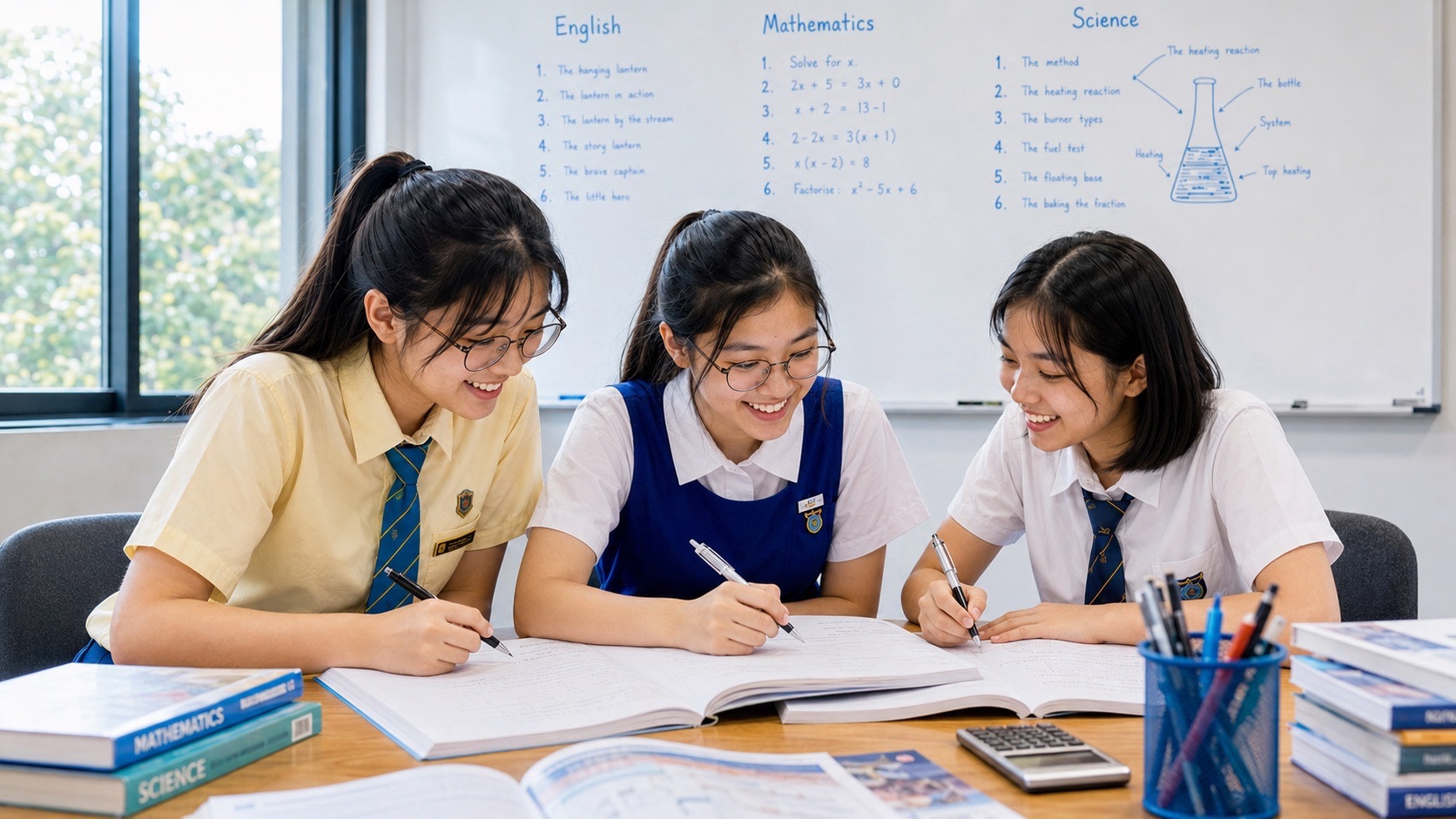
Deyi Secondary School is at 1 Ang Mo Kio Street 42, Singapore 569277, and its historical 2026 Secondary 1 Posting Group 1 (PG1) admitted score range was 25–30*. The asterisk matters: places remained available in PG1 after the 2026 allocation of pupils who took PSLE in 2025. The upper figure does not guarantee that every eligible child will be admitted in 2027. A Punggol family should verify its child’s actual Posting Group eligibility and Deyi’s current information on MOE SchoolFinder, then test the trip to Ang Mo Kio. The school’s official site confirms its campus at Ang Mo Kio Street 42, separate from Ang Mo Kio Secondary School at Street 22.
Deyi’s distinctive educational combination is Active Voice Broadcast Journalism and Arts Alive, supported by a four-year Servant Leadership programme. Its 2026 Applied Learning Programme teaches storyboarding, filming, audio layering, green-screen production, editing and responsible media literacy to pupils from Secondary 1 to 4. Advanced podcasting and livestreaming are developed through the Young Journalists’ Club, while selected talents can train for competitions. Arts Alive provides drama, dance, music and creative opportunities, including the Secondary 2 K-pop Dance programme and Deyi’s Got Talent. Leadership moves from self-management for all students to selected school and CCA responsibilities. Under Full Subject-Based Banding, PG1 is an admission route and G1, G2 and G3 describe actual individual subject levels. This guide explains what is universal, what is selected and how to choose a suitable school for 2027.
- School: Deyi Secondary, 1 Ang Mo Kio Street 42, Singapore 569277
- Historical 2026 PG1 admitted range: 25–30*, meaning unfilled places in that year’s exercise
- The asterisk does not guarantee that vacancies will remain for 2027 applicants
- ALP: Active Voice Broadcast Journalism, using media to understand social issues
- Tier 1 Explore teaches all Sec 1–4 media production basics and critical thinking
- Media techniques include storyboards, green screen, sound layering, filming and subtitling
- Tier 2 Excite adds podcasting and livestreaming for Young Journalists’ Club members
- Tier 3 Excel develops selected multimedia talent and competition work
- LLP: Arts Alive, nurturing confident communicators and gracious citizens
- Secondary 2 dance programme includes K-pop movement and expression
- Deyi’s Got Talent includes class participation and separate audition competition routes
- Arts and Innovation Centre combines arts, design and science experiences
- Servant Leadership is taught through a four-year programme
- All students have Self-Leadership to Serve; selected older leaders join Team Leadership to Serve
- Leadership opportunities include Student Council, Peer Support Board, CCA leadership and class committees
- Official 2026 open house is 21 November, 9am–4pm, subject to latest school notice
- PG1 and the level of each academic subject are distinct under Full SBB
- Wait for the actual school allocation and 2027 subject list before buying books
Research checked 4 November 2026. The 2026 PG1 range and prior activities do not guarantee 2027 admission, precise programmes or selected CCA places. Follow current school and MOE directions.

Contents: Deyi Secondary PG1 School Guide
- 1. Definition Lock: PG1 and G1 Are Not the Same
- 2. The Historical 2026 PG1 25–30* Range
- 3. Why the Asterisk Is More Important Than a Number Alone
- 4. Score 25 and the PG1/PG2 Boundary
- 5. The Campus at Ang Mo Kio Street 42
- 6. Deyi’s Vision: Active Learners, Servant Leaders, Gracious Citizens
- 7. Active Voice Broadcast Journalism
- 8. Tier 1 Explore Is for Secondary 1 to 4
- 9. Storyboarding Before Filming
- 10. Filming and Camera Choices
- 11. Green Screen and Chroma-Key Technology
- 12. Audio Layering and Sound Design
- 13. Subtitles and Accessible Communication
- 14. Animation and Transitions
- 15. The Augmented Reality Journalism Trail
- 16. Researching Sustainability and Social Needs
- 17. AI and Synthetic Media
- 18. Tier 2 Excite and Advanced Media Platforms
- 19. Podcasts and Responsible Interviewing
- 20. Livestreaming and Real-Time Decisions
- 21. Tier 3 Excel and Selected Talent
- 22. Young Journalists’ Club as a CCA
- 23. The Arts Alive Learning for Life Programme
- 24. The Arts and Innovation Centre
- 25. Deyi’s Got Talent
- 26. Secondary 2 K-pop Dance
- 27. The Aesthetic Assembly Programme
- 28. Arts Fiesta and the 2025 Anniversary Concert
- 29. Learning From Professional Stage Productions
- 30. Four-Year Servant Leadership
- 31. Self-Leadership to Serve for All Pupils
- 32. Team Leadership to Serve for Selected Pupils
- 33. The Five Practices in Deyi’s Language
- 34. Student Council and the Student Voice
- 35. Peer Support Board
- 36. CCA Leaders and Class Executive Committees
- 37. Selected Servant Leadership Trip to Vietnam
- 38. Integration Programme for Newcomers
- 39. Deyi’s Full SBB Pilot History
- 40. English Language and Journalism
- 41. Mathematics in Media and Reporting
- 42. Science and Responsible Journalism
- 43. Mother Tongue and Distinct Subject Strengths
- 44. DSA and Ordinary PG1 Entry Are Different
- 45. The 21 November 2026 Open House
- 46. 2027 Booklists and Family Preparation
- 47. A fictional pupil interested in broadcasting
- 48. A fictional student grows through dance
- 49. Choosing Deyi from Punggol
- 50. Your next step for the 2027 intake
Definition Lock: PG1 and G1 Are Not the Same
PG1 is a national Secondary 1 entry category based on PSLE eligibility. G1 is the standard at which an individual academic subject may be offered under Full Subject-Based Banding. G2 and G3 are other academic levels, and pupils can have individual profiles across subjects. Deyi’s mixed form classes and common-curriculum lessons allow students to share school experiences while academic subjects use appropriate groupings.
Parents should keep the official PSLE notice, final school allocation and Deyi’s individual timetable distinct. A pupil may enjoy broadcasting but need help organising written explanations, while another might have a strong Mother Tongue profile and find Mathematics difficult. Both deserve specific teaching rather than an assumption that PG1 describes every strength. School programmes should help children develop capability at an appropriate pace.
The Historical 2026 PG1 25–30* Range
Deyi’s reported PG1 admitted range for the 2026 Secondary 1 intake was 25–30*. The star indicates the group did not fill completely in the previous posting. It is important to preserve the notation: the eligible upper boundary of 30 is not the same as a competitive cut-off established by the last contested seat. The figures refer to pupils who completed PSLE in 2025.
A parent should not promise a place in 2027 merely because the school had spare places in 2026. The next cohort has different preferences and may encounter a different number of vacancies. MOE’s current posting rules govern the actual result. Record the historical year and asterisk when sharing the figure, and prepare several schools the student would genuinely attend.
Why the Asterisk Is More Important Than a Number Alone
An online comparison table may display the PG1 cut-off as 30 without showing the asterisk or explanation. A family could then assume that precisely the same score was the last contested place. In reality, schools can have vacancies after the posting exercise, in which case MOE records the group’s upper possible score as the displayed cut-off.
Parents need to understand that a vacancy mark is a historical description rather than a continuing entitlement. The school may be more popular in the following year, or the number of places may change. Do not tell the child that acceptance is certain until an official posting result confirms it. Accurate uncertainty prevents unnecessary disappointment.
Score 25 and the PG1/PG2 Boundary
The current national system can make pupils with PSLE Score 25 eligible to select either PG1 or PG2. The choice changes the school-entry route and broad starting academic demands. It is not simply a prestige decision in which the larger group number always wins. The child’s actual subject strengths and available schools should guide the family.
When researching Deyi, compare the previous admission range for the group the pupil will use. The PG1 25–30* result cannot predict a PG2 allocation. Follow the actual official notice and national instructions rather than switch categories beside each of the ordinary school preferences. A suitable curriculum is more valuable than a label chosen to impress others.
The Campus at Ang Mo Kio Street 42
Deyi’s official address is 1 Ang Mo Kio Street 42, Singapore 569277. Ang Mo Kio Secondary School is a different institution at Street 22, and Yio Chu Kang Secondary is at Ang Mo Kio Avenue 5. A family comparing these campuses must keep the names and postcodes distinct when planning visits, SchoolFinder choices and transport.
From Punggol, the journey depends on the real home location and connections to Ang Mo Kio. Test the morning trip and the later return after CCA. Include waiting and walking rather than rely on a straight-line distance. The school should be a place the teenager can attend reliably while sleeping enough, completing schoolwork and participating in a suitable activity.
Deyi’s Vision: Active Learners, Servant Leaders, Gracious Citizens
Deyi’s official vision combines active learning with service and gracious citizenship. Its mission emphasises inspiring lives, nurturing talents and realising dreams. This reflects a belief that students develop through academic knowledge and ethical contribution, rather than one examination score alone. Its current programmes offer media, arts and leadership as ways to experience that approach.
Parents should ask how ordinary pupils receive feedback, whether new students know whom to approach when confused and how school culture supports inclusion. A vision is useful when translated into daily teaching and respectful relationships. A child’s entry Posting Group should not become a limit on their willingness to try new learning.
Active Voice Broadcast Journalism
Deyi’s ALP is called Active Voice Broadcast Journalism. Its official 2026 description connects media work with real social challenges involving sustainability, emerging technology and community needs. Pupils can develop critical thinking, collaboration, adaptive reasoning and the ability to advocate responsibly. The programme is not merely training for television presenting or making videos that look professional.
A PG1 pupil may be able to notice an important issue while needing help reading source material accurately. The school can use authentic media tasks to practise formal English and thoughtful communication. Ask what evidence the child gathered before making a claim. A compelling story should be clear, fair and supported rather than sensational.
Tier 1 Explore Is for Secondary 1 to 4
Deyi’s ALP uses a three-tier structure. Tier 1, called Explore, gives pupils from Secondary 1 through 4 foundational media-production and journalism experiences. The school lists storyboarding, filming, animation, audio mixing, chroma-key green-screen work, editing, transitions and subtitles among its practices. This is broad curriculum learning rather than a selected broadcast team.
Parents should ask what the new cohort actually learns and how beginners are supported. An introductory lesson does not mean every child receives professional camera equipment. The educational purpose is understanding how messages are constructed and how choices influence an audience, while each academic subject continues with its syllabus.
Storyboarding Before Filming
A storyboard helps a student decide which scenes belong in a message and what the audience needs to understand first. It can reveal when a video has an attractive opening but no clear explanation. Deyi’s media ALP provides an opportunity to plan the sequence before recording, linking creativity with logical organisation.
Ask the pupil to explain the purpose of each major scene and what evidence it communicates. A concise accurate story often works better than one filled with unnecessary effects. Do not supply a complete adult-written script and then call the result independent learning. The pupil should be able to explain and revise the plan.
Filming and Camera Choices
Filming teaches students that framing, location and timing can shape what viewers believe. A shot may be visually genuine but still misleading if it hides important context. The school’s journalism focus makes this ethical question as important as operating equipment. A pupil should know why a particular scene is included and what it cannot prove.
Parents can ask what lies outside the camera frame and whether the caption reflects the event accurately. Respect school rules about recording classmates or staff. A well-composed image is not permission to publish personal information. Responsible media work combines technical skill with judgment and care.
Green Screen and Chroma-Key Technology
Chroma-key techniques allow a background to be replaced in video production. Deyi lists green-screen work as part of Tier 1 exploration, giving pupils a way to understand how media can construct visual environments. That is useful creatively but also prompts questions about what viewers may wrongly assume is real.
Ask whether the student can identify which elements of the production were recorded and which were digitally added. A school project can use effects honestly when its purpose is clear. The same capability should not be used to fabricate evidence or impersonate people. Media literacy includes being transparent about alteration.
Audio Layering and Sound Design
A video or podcast can contain speech, ambient sound, music and effects. Editing these tracks influences tone and comprehension. Deyi’s ALP includes audio-track layering, showing students that an apparently simple recording involves choices about clarity, emphasis and the listener’s experience.
Parents can ask whether the voice can be understood and whether added sound changes the meaning of the interview. An expressive soundtrack should not create a false impression of an event. The student can learn that quality communication depends on accuracy and restraint, not just adding more technical features.
Subtitles and Accessible Communication
Subtitling is one of the techniques named in the programme. Accurate subtitles can help people follow a video when audio is unclear or when the viewer needs text support. Poor subtitles can misrepresent what a speaker actually said. This makes the task a practical exercise in close listening, spelling and responsible interpretation.
Ask the child whether the subtitles match the words and whether the pace allows reading. The work can connect media skills with English literacy. A simple reliable caption may be more important to users than a complex animation. Accessibility is part of understanding the audience.
Animation and Transitions
Animation and transitions can improve the way information moves between parts of a story. Deyi gives pupils opportunities to try these production tools. However, moving graphics do not guarantee that a message is accurate or understandable. A transition should help show the relationship between ideas rather than distract viewers.
Parents can ask why the pupil selected a particular effect and whether removing it would make the point clearer. A good communicator chooses technology for a purpose. The programme encourages exploration, but the learner should remain responsible for the reasoning in the final artefact.
The Augmented Reality Journalism Trail
The school’s Tier 1 mentions an Augmented Reality Journalism Trail. AR can combine digital material with the physical environment, providing a way for pupils to encounter information through an unfamiliar medium. A trail can be engaging while also illustrating how technology affects what people notice.
Ask the teenager which information was provided and how it could be verified. A visually impressive virtual layer is not itself evidence that a claim is true. The goal is active inquiry and critical perspective-taking rather than simply completing a technology scavenger hunt.
Researching Sustainability and Social Needs
The ALP connects journalism with contemporary challenges such as sustainability and social needs. Reporting on such issues requires distinguishing observation, expert evidence and opinion. A pupil may be motivated by an environmental concern but should not invent dramatic statistics to make the report seem important.
Parents can ask where each claim came from and whether another perspective should be included. Responsible advocacy makes the public conversation clearer rather than exaggerating uncertainty. A student’s ability to support a sentence with evidence is a valuable academic habit, even before they attempt a more advanced media project.
AI and Synthetic Media
Deyi’s 2026 ALP explicitly references technology and AI among issues pupils may explore. AI-generated text and altered images can look convincing without being accurate. A journalism programme is a useful setting for learning how to check the origin of a claim and explain the limits of digital evidence.
Ask the child whether a video could have been edited or whether a chatbot’s answer cites a reliable source. Encourage careful use of personal information. Submitting fabricated interviews or false statistics as genuine school research would defeat the programme’s purpose. Responsible media literacy requires independent judgment.
Tier 2 Excite and Advanced Media Platforms
The second ALP tier, Excite, is linked to students in the Young Journalists’ Club CCA. It extends foundational skills into broadcasts, podcasts and livestreaming for real audiences. The school describes opportunities to communicate with the wider student and community population. This is distinct from Tier 1 exposure for all pupils.
Parents should not promise a new PG1 entrant automatic club membership or equipment access. Ask about CCA selection, training and the actual work. A pupil who enjoys the foundation may seek further practice, while another may choose a sport or performing-arts group. Both can benefit from basic media literacy.
Podcasts and Responsible Interviewing
A podcast requires the pupil to plan a question, gather information, listen carefully and edit responsibly. It can help a student practise sustained speech without relying on visual effects. An interviewer’s goal should be to understand what someone actually says, not obtain a dramatic quote supporting a predetermined conclusion.
Parents can ask whether the child obtained suitable permission and whether the editing preserved context. A short thoughtful conversation may be more informative than a long recording with weak structure. Journalism should train curiosity and fairness rather than simply the desire to be heard.

Livestreaming and Real-Time Decisions
Livestreaming adds practical challenges because content is shared as it happens. Pupils may need to check audio levels, coordinate speakers and respond calmly to unexpected changes. A supervised school activity can teach planning and responsibility as well as technical operation. It is different from unsupervised streaming on a personal social-media account.
Parents can ask what information is appropriate for public broadcast and when a student should stop or seek teacher guidance. Protecting classmates’ privacy is part of responsible media work. The school determines who may operate a live feed and under which conditions.
Tier 3 Excel and Selected Talent
Tier 3, Excel, develops pupils who demonstrate particular aptitude for multimedia production and may enter national or international competitions. These are selective opportunities requiring commitment and more advanced practice. A successful competition entry is evidence of that team’s work rather than a promise that every pupil will receive the same experience.
Parents should ask what skills a motivated beginner needs to build before seeking advanced participation. A well-supported child may enjoy general media production without competition. The educational goal is growing independent skill, not treating selected recognition as the only measure of a worthwhile school programme.
Young Journalists’ Club as a CCA
Deyi’s Young Journalists’ Club page describes photography, videography, broadcasting and event-support roles. Members may serve as reporters or emcees during appropriate school functions. The group can help pupils practise practical communication and responsible team roles, but it is distinct from the English-language ALP experienced by the broader student population.
Ask about auditions or selection, regular attendance and the return journey to Punggol. A teenager who wants to learn should understand the practice, not just the possibility of appearing at an event. A CCA can build friendships and reliability without guaranteeing public recognition.
The Arts Alive Learning for Life Programme
Deyi’s LLP is called Arts Alive – Live, Work, Learn and Play with the Arts. The school describes the arts as a way to develop confident communicators and gracious citizens. Its programmes include drama, dance, music, visual arts, creative expression and appreciation of different performance traditions. This is a character and cultural-learning programme, not solely a competition pathway.
A PG1 pupil who initially hesitates to perform may develop through guided rehearsal or reflective discussion. Another may be enthusiastic but still need to learn how to listen to teammates. The important outcomes include expression, collaboration and the ability to respond to feedback.
The Arts and Innovation Centre
Deyi’s Arts and Innovation Centre brings together Arts, Design and Technology and Science, according to its official July 2026 LLP page. A shared creative environment can help pupils explore how a design uses materials, communicates meaning and responds to practical constraints. The school’s public photographs show examples, but do not guarantee every pupil unrestricted access to all equipment.
Ask what the student created and why a particular approach was chosen. A strong project should be explained independently. Do not buy specialist equipment for the household without an actual school requirement. The goal is thoughtful, safe creativity rather than expensive technology ownership.
Deyi’s Got Talent
The LLP describes Deyi’s Got Talent as a creative platform for dance, music, vocals, digital art and other skills. Its 2026 description distinguishes a class participation category from an audition-based category for more competitive performance. This is another example of how broad participation and selected talent extensions serve different educational purposes.
Parents should celebrate a pupil who contributes reliably to the class even if they do not enter a final. A child may discover interest in performing only after experiencing it with peers. Formal awards or selected roles are school decisions, not consequences of the PG1 admission route.
Secondary 2 K-pop Dance
Deyi’s July 2026 LLP page describes a Secondary 2 K-pop dance experience intended to build confidence, expressive movement, communication and social-emotional competencies. It states that every Deyi student in the relevant cohort participates and performs. This offers a chance to try a popular creative form while learning discipline and teamwork.
A pupil entering Secondary 1 in 2027 would normally reach this programme later, so actual 2028 arrangements should be verified. Parents should avoid body comparison or forcing instant stage confidence. Ask what the child learned from practising and responding to corrections. A meaningful improvement is valuable without a talent award.
The Aesthetic Assembly Programme
Deyi offers assemblies designed to broaden appreciation of traditional and contemporary artistic practices. Students may encounter unfamiliar creative forms and reflect on how the arts express different experiences. Such exposure can strengthen cultural literacy without requiring every pupil to pursue a specialist performing-arts CCA.
Parents can ask what the teenager noticed and whether a performance changed their assumptions. Encourage respectful curiosity rather than dismissal of an unfamiliar style. School assemblies vary, so a previous performance is not a guarantee of an identical 2027 event.
Arts Fiesta and the 2025 Anniversary Concert
The school describes an Arts Fiesta held on 25 April 2025 for its forty-fifth anniversary, with the theme PULSE. It brought together band, dance, drama, choir and arts activities. The event shows how a school community can celebrate pupils’ creative work, but it is a historical example, not a standing annual performance timetable.
A family should ask what ordinary students receive through the LLP and what selected performers commit to. A successful concert cannot by itself prove that every incoming pupil will have the same opportunity. Learning is also built through routine rehearsals and classroom feedback.
Learning From Professional Stage Productions
Deyi’s LLP mentions arts leaders attending a professional stage production to observe stagecraft, including lighting, sound, choreography and set design. Such visits can help pupils understand the technical and collaborative work behind a performance. They are selected experiences under the actual year’s arrangements.
Parents should not promise an overseas show or a particular theatre visit. Ask what the pupil learned about the work required and which school subjects support it. A useful learning journey broadens understanding of creative careers without guaranteeing a future professional role.
Four-Year Servant Leadership
Deyi’s official student leadership page describes a four-year development programme grounded in Servant Leadership. The principle is that a leader serves the people and community, rather than viewing a role as a privilege above others. Pupils learn through common CCE, camps and projects, while selected leaders take on additional responsibilities and training.
A PG1 pupil can demonstrate leadership through honest work, listening and a willingness to help classmates. Parents should notice specific actions rather than demand a badge. Formal roles are earned through the school’s selection process and involve responsibilities beyond personal recognition.
Self-Leadership to Serve for All Pupils
The first leadership track, Self-Leadership to Serve, reaches pupils from Secondary 1 to Secondary 4. It is integrated with Character and Citizenship Education, level camps and school programmes. Students learn to manage themselves, think critically, communicate, collaborate and consider their role as citizens.
A new Secondary 1 pupil may need basic habits first: arriving prepared, following a timetable and asking for help appropriately. Parents can support those routines without demanding advanced council responsibility immediately. Small reliable improvements prepare the child for later opportunities to support others.
Team Leadership to Serve for Selected Pupils
The second track, Team Leadership to Serve, is intended for selected student leaders from Secondary 2 to 4. Teachers identify pupils according to leadership potential, attitudes and willingness to serve, then provide camps, workshops and opportunities for project planning. The school distinguishes this from the broad self-leadership education that every pupil receives.
Parents can ask what commitment and selection criteria apply if the child is interested. A teenager can still contribute meaningfully without joining the selected track. Genuine readiness matters more than the number of formal roles on a portfolio.
The Five Practices in Deyi’s Language
Deyi adapts the Five Practices of Exemplary Leadership into Embody, Envision, Enable, Encourage and Strive for Excellence. These correspond to modelling the way, inspiring a vision, helping others act, encouraging peers and challenging an ineffective process. They give students a useful way to reflect on how leadership is demonstrated.
Ask the teenager to describe one time they helped the group rather than merely recite the words. Did they listen before deciding, accept feedback or support someone who was discouraged? Responsible leadership grows through practice. A title alone does not demonstrate these behaviours.
Student Council and the Student Voice
The school’s Student Council represents pupils and organises appropriate events and initiatives. The official leadership page describes selection, training and the responsibilities of the president, vice-president and other student officers. Their work involves communicating with peers and school management, not simply wearing a badge.
Parents can encourage the child to share ideas respectfully even without becoming a councillor. A class suggestion backed by evidence can be valuable. The school decides formal positions under its criteria. A PG1 student should neither be excluded in principle nor promised automatic appointment.
Peer Support Board
Deyi’s Peer Support Board focuses on creating a caring and enabling school environment. Peer Support Leaders promote positive behaviour, help classmates feel included and support wellness activities. They are students with defined responsibilities and guidance, not professional counsellors or substitutes for school staff in serious situations.
Ask whether the child knows a trusted adult and how they would report bullying or distress. Peer encouragement can help with everyday belonging, but safeguarding concerns require appropriate teacher and professional intervention. Effective school culture combines kindness with clear support procedures.
CCA Leaders and Class Executive Committees
CCA leaders manage responsibilities within their activities, while class committees help organise classroom communication and cooperation. Deyi also has Programme Ambassadors for National Education, Values in Action, environment, health and safety. These provide varied ways for pupils to contribute without forcing every student into the same leadership style.
Parents can ask which practical task appeals to the teenager and what they could reliably handle. A student with strong organisational skills may serve a class well without being a public speaker. Contribution should be recognised through actual behaviour and teamwork, not solely formal titles.
Selected Servant Leadership Trip to Vietnam
The official 2026 student leadership programme describes a Servant Leadership Trip to Vietnam for selected student leaders from the council, peer support, CCAs and Gear-Up. It includes service-learning, cultural interaction and reflection. This is a selected extension, not a guaranteed overseas trip for every PG1 pupil.
Parents should ask about the actual year’s selection, safety, cost and educational goals if the opportunity becomes relevant. Ethical service requires listening and avoiding stereotypes. Cross-cultural understanding can also develop through local experiences and careful study without travelling abroad.
Integration Programme for Newcomers
Deyi’s Integration Programme supports international and permanent-resident students in Secondary 1 to 3, using cultural activities, buddy relationships and learning journeys. The school describes traditional games and heritage-site visits as examples. These help pupils develop a sense of belonging and understand local culture, while respecting different backgrounds.
A family should not assume every student has the same support need. Ask the school about the actual entry arrangements and whom a newcomer can approach. Classmates can help by being welcoming and avoiding stereotypes. Such habits reinforce gracious citizenship across academic subject levels.
Deyi’s Full SBB Pilot History
The school’s Full Subject-Based Banding page explains that Deyi was an FSBB pilot school and introduced mixed form classes and common-curriculum subjects. Its public list includes Art, Character and Citizenship Education, Design and Technology, Food and Consumer Education, Music, Physical Education and Drama. Some historical wording still mentions older Express and Normal course names.
For a 2027 entrant, the actual G1, G2 and G3 levels and current timetable take precedence over old labels on a website. Parents should consult the child’s official allocation and ask about specific subject readiness. Mixed classes allow common experiences, while academic lessons can be adjusted appropriately.
English Language and Journalism
Deyi’s English department integrates Broadcast Journalism with language teaching, including writing, oracy and visual communication. A pupil taking G1 English may enjoy a video task but still need explicit help with vocabulary, comprehension or paragraph structure. A polished video is not evidence that a student can independently explain a written source.
Ask the child to identify the claim, evidence and conclusion from a short report. If a link is missing, repair that step rather than write an adult-polished script. The practical topic can motivate formal English learning, but academic standards are still assessed through relevant schoolwork.
Mathematics in Media and Reporting
Broadcast reports may use percentages, charts, time, comparisons and measurements. A student at G1 Mathematics needs to interpret these correctly to avoid presenting misleading information. Even a dramatic news graphic can be wrong if it uses unclear axes or mismatched quantities.
Parents can ask what a number measures and whether the claim follows from the data. A child who confuses percentages needs focused practice at the appropriate level. Producing a strong media project does not automatically qualify them for more demanding Mathematics; formal subject decisions depend on actual eligibility and sustained readiness.
Science and Responsible Journalism
A student reporting on the environment or technology should distinguish observation from explanation. A scientific demonstration may be interesting, but one trial does not prove a general claim. Journalism and Science reinforce each other when pupils learn to verify facts and state the limits of available evidence.
Ask what source supports a claim and whether another explanation is possible. Avoid sensational or fabricated statistics. A thoughtful report can include uncertainty without becoming less useful. Scientific honesty and media literacy are both essential skills for a teenager navigating online information.
Mother Tongue and Distinct Subject Strengths
A PG1 pupil may be stronger in Mother Tongue than in English or Mathematics, or have another uneven academic profile. Full SBB can accommodate different levels under the school and MOE criteria. A child’s skill in presenting a video in one language does not automatically determine formal writing proficiency in every language.
Support suitable home reading and conversation and ask teachers about actual gaps. A more demanding subject should fit readiness and the complete timetable rather than serve as a family status marker. The student also needs time for CCAs, friends and growing independence.
DSA and Ordinary PG1 Entry Are Different
Deyi’s 2026 DSA fields include Broadcast Journalism, arts, sports, robotics and leadership-related talents. Its official annual selection uses a separate application, performance or portfolio assessment and the relevant academic Posting Group eligibility. A pupil who joins general media lessons after posting has not retroactively been offered DSA.
By November, the regular DSA application window for 2027 entry has passed. Families with real DSA outcomes should follow MOE’s preferences and commitments; otherwise ordinary posting applies. Avoid paying someone promising to guarantee a place through a polished journalism portfolio.
The 21 November 2026 Open House
Deyi’s official homepage announces an open house on Saturday, 21 November 2026, from 9am to 4pm. Prospective families can explore programmes, CCAs and speak with students and teachers. The event is useful for learning how journalism, arts and leadership are experienced in the ordinary school week.
Ask which activities every Secondary 1 pupil receives and which depend on selection. Let the child ask about a genuine interest or concern. Check event details before visiting. Attending an open house informs preference but does not reserve a school place.
2027 Booklists and Family Preparation
The school’s parent resources include textbooks, uniform, financial assistance and device information. A new Secondary 1 pupil should wait for the formal posting and actual individual subject levels before buying the correct books. The October 2026 page is a useful starting point but not a substitute for the joining instructions.
If school costs or travel create difficulty, seek guidance through official channels. PG1 is not an income test or automatic financial assistance approval. Practical preparation is the right materials, a sustainable journey and habits for managing a new timetable, not buying equipment to imitate a school media studio.
A fictional pupil interested in broadcasting
Imagine a Punggol child who likes interviewing relatives but struggles to summarise written information. The family researches Deyi’s ALP and correctly interprets the historical 2026 PG1 30* as a vacancy notation, not a guaranteed 2027 place. They test travel and talk about suitable school choices.
If posted there, the pupil might learn through a supervised audio project why listening closely and checking a quotation matters. A teacher helps improve written summaries. This is a fictional example, not a real testimonial or guarantee of a particular school activity. It shows how an interest can motivate independent English learning.
A fictional student grows through dance
Another imaginary pupil is reluctant to participate in group dance but discovers that repeated practice and supportive peers make the task less intimidating. The family celebrates the ability to accept feedback and work cooperatively rather than demand a competition award. Formal academic learning continues alongside the creative experience.
The example illustrates the aims of Arts Alive without asserting that a particular 2027 class will perform the same routine. Personal progress may be visible in improved participation and confidence rather than a trophy. Every pupil can develop at a suitable pace.
Choosing Deyi from Punggol
A family can compare Deyi with other schools in Ang Mo Kio, Hougang and the north-east using consistent factors. Look at the child’s actual PG1 eligibility, historical range marked by year, the journey, academic feedback and interests in media, arts or service. The best match is not necessarily the school with the most awards on a website.
Ask what an ordinary student receives and which programmes are selective. A strong CCA option should fit the teenager’s interests and ability to manage travel. No school can guarantee the child’s future course or career from a Secondary 1 programme alone.
Your next step for the 2027 intake
Confirm the official Posting Group eligibility and Deyi’s current MOE SchoolFinder profile. Keep the 2026 PG1 25–30* notation intact and read the school’s official broadcast journalism, Arts Alive and student leadership pages. Consider attending its 21 November open house after verifying the latest details.
After posting, follow the real school-issued subject, booklist and reporting information. Encourage good routines, positive relationships and independent work. PG1 was the admission route; the lasting purpose of education is a teenager who can learn accurately, communicate thoughtfully and contribute responsibly.
Frequently Asked Questions
Where is Deyi Secondary School?
1 Ang Mo Kio Street 42, Singapore 569277.
What was the 2026 PG1 cut-off?
The historical range is 25–30*; the asterisk means PG1 was not filled in the 2026 intake.
Does PSLE Score 30 guarantee Deyi in 2027?
No. Historical vacancies cannot guarantee the next year’s allocation.
What is the ALP?
Active Voice Broadcast Journalism, teaching media production, critical thinking and communication.
What does Tier 1 Explore include?
Storyboards, filming, animation, green screen, audio layering, editing, subtitles and AR journalism.
Is Tier 1 for all pupils?
The 2026 programme describes it for Secondary 1–4 pupils.
What is the Tier 2 CCA?
Young Journalists’ Club, extending media production into podcasts and livestreams.
What is the LLP?
Arts Alive, with drama, dance, music and creative learning.
Is Secondary 2 dance offered to all?
The school’s current LLP describes cohort participation in a K-pop dance programme; check future arrangements.
What is Servant Leadership?
The school’s four-year approach to leading through service and responsibility.
Does everyone join the Student Council?
No. Self-Leadership to Serve is broad; Team Leadership to Serve and board roles are selected.
When is the 2026 open house?
Saturday 21 November 2026, 9am–4pm, on the school’s official homepage.
Does PG1 fix all academic subjects at G1?
No. Subject levels follow Full SBB eligibility and school arrangements.
What should Punggol families check first?
Official posting eligibility, real commute, current programmes and the child’s interests.
Official Sources and Further Reading
- Deyi – Official Address and Contact
- Deyi – Active Voice Broadcast Journalism ALP
- Deyi – Arts Alive LLP
- Deyi – Servant Leadership and Student Boards
- Deyi – Young Journalists’ Club
- Deyi – Full SBB Implementation
- Deyi – Parent Resources, Books and Assistance
- Deyi – Open House, 21 November 2026
- Historical PG1 2026 Scores (independent reference; verify with MOE)
- MOE SchoolFinder
- MOE – Secondary 1 Posting
- Related: Ang Mo Kio Secondary PG1
Your next step: Verify the child’s PG1 eligibility, review Deyi’s current school profile and media-arts programmes, and test the journey to Ang Mo Kio Street 42 before making ranked preferences.


