
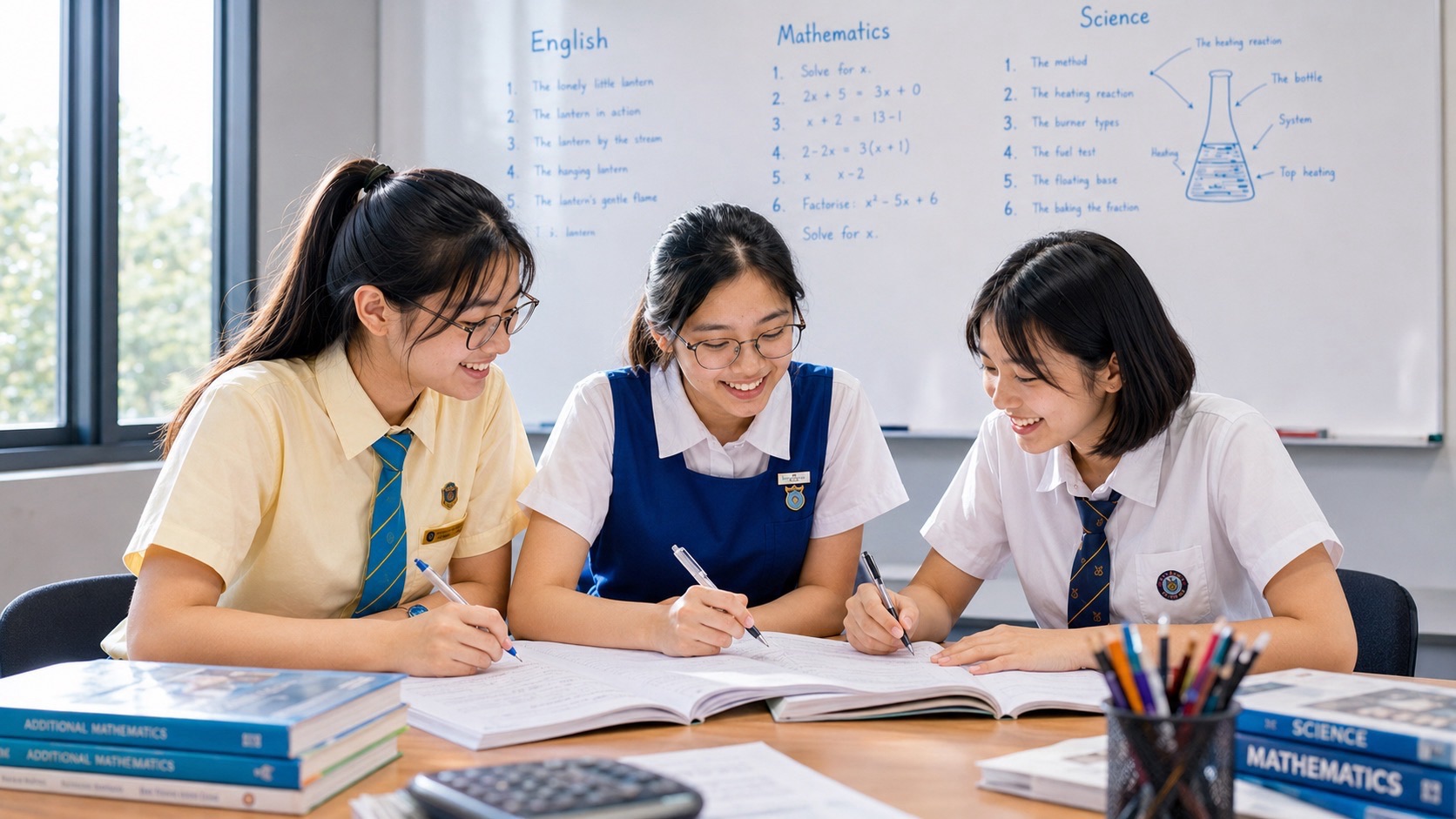
Ang Mo Kio Secondary School is at 6 Ang Mo Kio Street 22, Singapore 569362, and its historical 2026 Secondary 1 Posting Group 1 (PG1) admitted PSLE Score range was 25–28. The last admitted score of 28 reflects the 2025 PSLE cohort entering Secondary 1 in 2026; it does not guarantee entry for pupils starting in 2027. Families in Punggol should check the child’s official Posting Group eligibility, review the current MOE SchoolFinder profile and test the actual journey to Ang Mo Kio, rather than rely on a previous cut-off. The school has occupied its current street since returning from its temporary Hougang campus in 2002.
The school’s signature programmes combine Environmental Sustainability through STEM with an Integrated Arts Learning for Life Programme. Its August 2026 ALP covers biodiversity surveys, renewable and non-renewable energy, coding, microcontrollers, sensors, smart irrigation and an AI/Data Science pilot. Its LLP introduces every pupil to drama, dance, music and visual arts, with opportunities for deeper practice and selected performances. Student leadership follows the ARC approach—Assignments, Relationships and Courses—and develops from Self-Leadership to Team and Thought Leadership. PG1 is a school-entry group under Full Subject-Based Banding, whereas G1, G2 and G3 are individual subject standards. This guide explains which opportunities are broad, what may be selected and how to compare the real educational experience for 2027.
- Address: Ang Mo Kio Secondary School, 6 Ang Mo Kio Street 22, Singapore 569362
- 2026 historical PG1 admitted range 25–28; the final posted score is not a 2027 guarantee
- Established in 1979, Ang Mo Kio’s first secondary school
- ALP: Environmental Sustainability through STEM
- Main ALP areas: biodiversity, energy resources, electronics and coding
- Examples include biodiversity fieldwork, renewable-energy models and smart irrigation
- August 2026 ALP notes an AI and Data Science pilot, but individual participation requires confirmation
- LLP: Integrated Arts, introducing all pupils to drama, visual art, dance and music
- Secondary 2 offers deeper interest in dance or drama under the actual school programme
- Lunchtime Performances, performing arts CCAs and biennial NOMAD are distinct extension platforms
- Student Leadership ARC: Assignments, Relationships and Courses
- Leadership sequence: Self from Sec 1, Team from Sec 2 and Thought from Sec 3
- 2027 current booklist links on the school’s October page cover Sec 2–4, not yet an incoming Sec 1 list
- Use the child’s actual G-level subject allocation before buying materials
- Test travel, CCA, learning support and current school instructions before making choices
Updated 4 November 2026. The admitted score range belongs to the 2026 intake, and future subject and programme arrangements must be checked from current official notices.

Contents: Ang Mo Kio Secondary PG1 guide
- 1. PG1 is a posting route, while G1 is a subject standard
- 2. Interpreting the 2026 PG1 range of 25–28
- 3. Score 25 and two possible Posting Groups
- 4. The campus at Ang Mo Kio Street 22
- 5. School history and present educational quality
- 6. Environmental Sustainability through STEM
- 7. Biodiversity and the relationships among living things
- 8. Fieldwork and nature-reserve surveys
- 9. Why a small sample has limitations
- 10. Energy resources and conservation
- 11. Constructing renewable-energy models
- 12. Smart irrigation systems
- 13. Coding as precise instructions
- 14. Electronic sensors and limitations
- 15. AI and Data Science pilot opportunities
- 16. Learning journeys and applied modules
- 17. Integrated Arts for every pupil
- 18. Drama and language understanding
- 19. Visual arts and experimentation
- 20. Dance, teamwork and confidence
- 21. Music and cultural literacy
- 22. Secondary 2 drama or dance extension
- 23. Lunchtime Performances and NOMAD
- 24. CCA and examined Arts options
- 25. Every AMKsian a Leader
- 26. The ARC leadership approach
- 27. Self-Leadership begins in Secondary 1
- 28. Team Leadership from Secondary 2
- 29. Thought Leadership from Secondary 3
- 30. Class committees, CCA leaders and student council
- 31. Cohort camps, NYAA and VIA
- 32. Full SBB academic subjects and common experiences
- 33. English, Science and Mathematics in applied learning
- 34. Mother Tongue strengths can be different
- 35. DSA and ordinary PG1 posting are different
- 36. School books and joining instructions for 2027
- 37. A fictional Punggol pupil interested in biodiversity
- 38. A fictional pupil finds confidence through drama
- 39. Comparing school fit rather than school names
- 40. Your next step for the 2027 intake
PG1 is a posting route, while G1 is a subject standard
Posting Group 1 is used during the national Secondary 1 admission process after the PSLE. G1 is the level at which a particular academic subject is taught under Full Subject-Based Banding, alongside G2 and G3. A pupil can enter Ang Mo Kio Secondary through PG1 while showing stronger capabilities in some subjects and practical activities than others. A school’s form class and shared programmes provide experiences beyond the individual academic subject groups.
Parents should keep the PSLE eligibility notice, final posting result and actual subject-level timetable distinct. They determine the eligible schools, the allocated campus and the correct books respectively. A pupil who loves coding may need language support, while another with strong reading may be unfamiliar with an electronics task. Subject-specific feedback is more accurate than treating PG1 as a permanent personal label.
Interpreting the 2026 PG1 range of 25–28
The historical 2026 Secondary 1 PG1 admitted score range was 25–28 for Ang Mo Kio Secondary. Those pupils sat the PSLE in 2025. The final posted score of 28 is commonly called the cut-off, but it describes one completed exercise with its own applicants, ranked choices and places. It is not an admission requirement that must remain unchanged for a pupil entering in 2027.
A family should label the intake year beside every range it records. At a contested last place, MOE’s citizenship, preference and balloting rules may affect the outcome among equal scores. A pupil with the same score as the previous year’s last entrant cannot be promised a place. The sensible approach is to list several eligible schools the child would genuinely attend.
Score 25 and two possible Posting Groups
MOE’s current framework can make a pupil with PSLE Score 25 eligible to choose between PG1 and PG2. That choice affects the ordinary school-posting route and broad initial academic demand. A parent’s decision should reflect the child’s individual subject strengths and realistic options, not simply the prestige adults attach to a larger group number.
When comparing Ang Mo Kio Secondary, look at the historical row for the actual group selected. Its PG1 cut-off cannot be substituted for PG2 entry. Follow the national instructions for applying one chosen group across the six ordinary preferences. Where the subject implications are uncertain, consult the primary school’s guidance rather than guess.
The campus at Ang Mo Kio Street 22
The school’s current contact page lists 6 Ang Mo Kio Street 22, Singapore 569362. Its school history explains a temporary relocation to Hougang Street 93 in 1999 and a return to Ang Mo Kio in 2002. An old map or school story may contain the former location, which must not be used for a 2027 school visit.
From Punggol, the correct travel route depends on the family’s exact home and daily timetable. Test the journey at the likely reporting time and allow for the final walk, waiting and a possible late CCA. An attractive programme is worthwhile only if the pupil can attend reliably, eat adequately, complete essential work and sleep enough.
School history and present educational quality
Ang Mo Kio Secondary began operating in January 1979, the first secondary school in the new town. Institutional history can give pupils a sense of belonging and provide context for changing Singapore education. It cannot prove that one child will automatically thrive or receive a place because an older cohort achieved notable results.
Parents should investigate the current learning environment: how teachers give feedback, how new pupils settle in and how academic and non-academic programmes work together. A school is experienced daily through lessons, relationships and routines. Heritage is meaningful when it contributes to a supportive contemporary culture rather than serving as a substitute for practical questions.
Environmental Sustainability through STEM
The school’s August 2026 Applied Learning Programme aims to equip students to consider environmental challenges through Science, Technology, Engineering and Mathematics. It links biodiversity, energy resources, electronics and coding with sustainability. This is not simply a sequence of gadget demonstrations; the pupil should learn how evidence and human decisions affect the environment.
A PG1 learner can be highly curious about a practical system while needing explicit help with its written explanation. Parents can ask what the student observed and which conclusion is justified. The ALP gives academic concepts a visible purpose, but it does not remove the need for formal subject teaching or make every child a qualified engineer.
Biodiversity and the relationships among living things
The biodiversity part of the ALP examines ecological balance and the connections between organisms and their surroundings. Students may discover that a species depends on food, habitat conditions and other living organisms. Learning to recognise a relationship is more demanding than memorising the names of plants or animals from a presentation.
Ask the teenager what would happen if one part of the ecosystem changed and what evidence could support the prediction. A useful explanation distinguishes a direct observation from a possible effect. Such reasoning supports formal Science and teaches the pupil to be careful before making confident environmental claims.
Fieldwork and nature-reserve surveys
The official ALP describes field trips to local nature reserves and biodiversity surveys. Students can use planned observation methods to gather information and learn why the location, timing and method matter. A survey can be engaging, but one visit does not reveal every organism present in an entire reserve.
Parents can ask what the class counted and how it recorded the data. Was one area compared with another fairly? What might have been missed? The school determines which 2027 trips are actually arranged and what supervision is needed. The transferable outcome is scientific observation, not a guarantee of a particular destination.
Why a small sample has limitations
A child may record five species in one area and seven in another and assume the second entire ecosystem has more biodiversity. Yet the area surveyed, observer attention and time spent can influence the result. The ALP context is useful for teaching that a sample is not a complete census.
Encourage honest statements such as which observations were made and which explanation remains uncertain. A carefully qualified result can demonstrate more thought than an exaggerated headline. This is a foundational skill for reading Science graphs, understanding news reports and making responsible judgments outside school.
Energy resources and conservation
The ALP also explores renewable and non-renewable energy resources, their environmental effects and the importance of conservation. A good lesson should explain that a source of energy has operating conditions, costs and trade-offs. Technology that works during one demonstration may not be available or efficient under all conditions.
Ask what resource a system depends on and when its performance could change. Sustainability decisions should be based on measured use and practical needs rather than an appealing label. The student learns to weigh evidence rather than simply assume that the newest renewable-energy device is always the most appropriate answer.
Constructing renewable-energy models
Students can use models to explore energy production, conversion and conservation under the school’s supervised ALP. A device may respond when exposed to light, movement or a particular input. The pupil should understand why the model behaves that way rather than merely repeat a construction sequence.
Ask which component mattered and what could be tested if the result failed. Avoid buying electrical tools or recreating hazardous workshop procedures at home without qualified guidance. A simple, clearly understood model is educationally more valuable than a polished device assembled by adults while the pupil watches.
Smart irrigation systems
The school lists smart irrigation as a practical application of microcontrollers and sensors. Such a project can illustrate how a system monitors environmental information and uses logic to decide whether an action is needed. The choice of sensor, threshold and response can affect resource use and the plants involved.
Ask what the system actually measured and what might happen if the sensor were inaccurate. A working pump does not automatically prove efficient water use. The child should learn how technical decisions connect with living systems and maintenance needs. School supervision remains essential around electricity, pumps and other equipment.
Coding as precise instructions
Coding helps make a student’s thinking visible because a system follows the instructions it receives rather than guessing intention. A sequence that appears sensible may fail when one condition is incorrect. Finding that mistake and testing a correction builds computational thinking, persistence and clarity.
Parents can ask the child to describe the program’s intended behaviour before pressing Run. If the result differs, trace the first wrong step. The pupil need not own a personal robot to practise logic. Understanding a small procedure independently is an achievement that can support Mathematics and the organisation of other schoolwork.
Electronic sensors and limitations
A sensor produces information about a condition, but that reading must be interpreted correctly. Students may learn that a device can provide a misleading result if it is poorly positioned, damaged or used outside the conditions for which it was designed. Electronics therefore offers practical opportunities for discussing reliability and uncertainty.
Ask what another measurement could confirm the result and what would make the project unsafe or unsuitable. Do not encourage unsupervised construction of devices involving mains electricity. The important outcome is scientific responsibility and the ability to explain a system, not simply collecting technical vocabulary.
AI and Data Science pilot opportunities
Ang Mo Kio Secondary’s official 2026 ALP mentions participation in an AI pilot intended to expand learning opportunities. Artificial Intelligence and Data Science can help learners see how patterns in data inform decisions, while also teaching that an automated result may be wrong or incomplete. The existence of a pilot does not guarantee every Secondary 1 student identical specialist access.
Parents can ask how the pupil checked an output, where the data came from and what information should remain private. A confident AI-generated paragraph is not evidence by itself. The child should remain responsible for sources, reasoning and the final school submission.
Learning journeys and applied modules
The ALP describes exposure to research institutions, sustainable businesses, expert workshops and Applied Learning Modules offered at polytechnics. These can introduce real professions and show pupils the value of school knowledge beyond examinations. A visit can reveal the importance of accurate measurement, communication and responsible collaboration in technical work.
Such experiences may involve selected pupils, timing or availability, so do not promise a particular 2027 visit or future course place. Ask what the student discovered about the work and which foundational subjects support it. Exploration should broaden informed possibilities rather than force a career decision at twelve.
Integrated Arts for every pupil
The school’s Learning for Life Programme introduces drama, visual art, dance and music to every student. Broad arts education can help teenagers communicate ideas, understand another perspective and try something outside familiar strengths. An introductory workshop is not the same as membership of a selected performance group.
A PG1 pupil may find it easier to interpret a story through drama while still needing help with written comprehension. Another may be interested in visual design but dislike public performance. Both should be able to learn through appropriate experiences. Arts education complements academic teaching rather than replacing it.
Drama and language understanding
Drama can make a character’s motives and conflicts visible through voice, movement and interaction. A pupil who performs a short scene may understand why another person acted in a way that seemed surprising on the page. The teacher can then connect the experience with reading evidence and respectful discussion.
Ask the pupil what the character wanted and which part of the story supports that interpretation. Performing confidently is not the same as writing a correct comprehension answer. The educational value comes from reflection and the child’s ability to communicate independently after receiving useful feedback.

Visual arts and experimentation
Visual arts can introduce pupils to colour, texture, composition and different materials. Ang Mo Kio Secondary’s LLP page gives examples of workshops such as marbling and paper quilling. A learner may initially be uncertain about unfamiliar tools or techniques and grow through patient, guided practice.
Parents can ask what the student wanted to communicate and what changed after feedback. Avoid comparing a beginner’s first work to an artist’s exhibition. Progress may consist of making a more deliberate choice or learning to describe the technique. The school decides actual materials and safe workshop arrangements.
Dance, teamwork and confidence
Dance requires awareness of rhythm, space, coordination and other people in the group. A student who has never taken a dance lesson may still gain from suitable introductory experiences. The aim is not simply to identify elite performers but to cultivate expression and appreciation of how practice improves a shared result.
Parents should encourage confidence without comparing bodies or insisting on immediate stage success. Ask what the pupil learned about timing and cooperation. A child can develop resilience through a small improvement even if they never join a performance CCA.
Music and cultural literacy
Music activities can encourage attentive listening, understanding of cultural context and the ability to recognise patterns. The school’s assembly programme has included different musical performances. These experiences can help students discover forms of expression they had not encountered before and understand why collaboration matters in performance.
Ask what sounded unfamiliar and how the pupil would explain it respectfully. General arts exposure and a specialist music subject or CCA have different purposes and requirements. Families should not assume that every child will perform at a large concert or need to buy an instrument.
Secondary 2 drama or dance extension
The Integrated Arts LLP provides opportunities in Secondary 2 for pupils to pursue interest or talent more deeply in dance or drama. This offers a progression from broad introductory learning to more focused practice, subject to the actual school timetable and arrangements. A pupil entering in 2027 would normally reach Secondary 2 in 2028.
Parents can ask how interests are identified and what regular practice is involved. Do not promise a specific advanced role in advance. A student may change preferences after discovering an unfamiliar art form, and that flexibility is part of meaningful exploration.
Lunchtime Performances and NOMAD
Ang Mo Kio Secondary lists Lunchtime Performances and the biennial Night of Music, Arts and Dance, known as NOMAD, as performance platforms. These can encourage pupils to share creative work and appreciate the efforts of others. Participation as a selected performer differs from the broad LLP experiences available to the cohort.
A family should ask whether the teenager enjoys rehearsing as well as the idea of appearing on stage. The actual event calendar changes and cannot be guaranteed by a historic photograph. A meaningful arts education can benefit a pupil who listens thoughtfully without seeking a public performance role.
CCA and examined Arts options
The school offers Performing Arts CCAs and relevant Art or Music subject opportunities for pupils who qualify and wish to pursue the area further. A formal examined subject is not the same as enjoying a lower-secondary workshop, and a CCA selection is different from studying a common-curriculum arts lesson.
Parents should request the correct 2027 CCA information and, later, the current upper-secondary subject booklet. Appropriate challenges depend on interest, timetable, aptitude and actual academic requirements. A student need not join every arts opportunity to gain from the school’s creative culture.
Every AMKsian a Leader
The school presents its leadership vision as Every AMKsian a Leader, with a Mindset for Excellence and a Spirit of Service. The official programme treats leadership as skills developed over several years, not an inherited personality trait. Class responsibilities, CCAs, service and selected council appointments provide different contexts for learning.
A PG1 student can practise leadership by preparing for school reliably, helping classmates or asking an important question respectfully. The school selects formal representatives according to its processes. Parents can value dependable action without promising a title or treating an absent badge as evidence of failure.
The ARC leadership approach
The school’s student leadership framework uses Assignments, Relationships and Courses, abbreviated ARC. Assignments provide real responsibilities; Relationships develop through mentoring, peers and a culture of care; Courses offer structured learning in areas such as goal-setting and stakeholder engagement. A pupil may need different amounts of each.
Ask what responsibility the child took and who helped them improve. A young person who speaks confidently might need help planning, while a dependable organiser may need to learn how to listen to others. The framework recognises that leadership is developed through experience and useful feedback.
Self-Leadership begins in Secondary 1
The programme describes Secondary 1 as a time to understand and manage oneself. This is relevant to the transition from primary school because new pupils must learn a timetable, prepare different books and travel more independently. A child who can identify a problem and ask the right teacher for help is developing responsibility.
Parents can support one or two achievable habits rather than demand immediate prefect status. Does the teenager pack correctly and know when an assignment is due? Small improvements reduce daily stress and prepare the pupil to take more responsibility in later years.
Team Leadership from Secondary 2
In Secondary 2 the framework emphasises working with others, managing disagreements and contributing to the community. The pupil may need to understand different perspectives and help a group finish a task without doing all the work alone. A positive team role is not always the loudest or most visible position.
Parents can ask what changed after classmates gave feedback and whether the child acknowledged others’ contributions. Good communication helps academic group projects as well as CCAs. A student can demonstrate responsibility before holding an elected or selected formal role.
Thought Leadership from Secondary 3
From Secondary 3 the programme adds greater emphasis on critical thinking, advocacy and mentoring younger students. These responsibilities require understanding a problem and supporting an appropriate response rather than simply announcing an opinion confidently. A student may need to research, collaborate and consider the consequences of a proposal.
A child entering Secondary 1 in 2027 would reach this stage later. The actual activities may change, but the developmental direction is useful. Parents can encourage accurate reasoning now without forcing a teenager into an adult public campaign or career identity prematurely.
Class committees, CCA leaders and student council
Ang Mo Kio Secondary provides several kinds of leadership roles. Class committees help organise everyday class activities; CCA leaders support teams and training; the Student Council represents pupils and helps with school events. The roles involve different responsibilities and selection processes.
Parents should discuss which experience genuinely appeals to the child and whether it fits academic work. A pupil can contribute without a title and later seek an appropriate challenge. School communities need reliable students in many ordinary roles, not only elected officers whose names appear on a stage.
Cohort camps, NYAA and VIA
The leadership page also identifies level camps, the National Youth Achievement Award and Values-in-Action as experiences helping pupils develop responsibility. These can involve personal goals, supervised activity, service and reflection. Completion of a formal award, where applicable, depends on the actual criteria rather than attendance at one event.
Ask what the pupil learned and how other people benefited. Avoid treating service as a certificate-collecting exercise. School experiences matter when the teenager can transfer good habits to daily life and recognise the value of contributions that receive no public recognition.
Full SBB academic subjects and common experiences
The school’s public 2026 Secondary 1 information describes academic languages, Mathematics, Science and Humanities at appropriate subject levels, alongside common-curriculum lessons and distinctive ALP and LLP sessions. This helps parents see that academic subject placement and wider school experiences are organised for different purposes.
For the actual 2027 intake, follow the school’s current class and timetable instructions rather than purchase old stream textbooks. Full SBB provides flexibility where national and school conditions are met. A child should study the approved level with genuine understanding and use shared school programmes to develop broader capabilities.
English, Science and Mathematics in applied learning
Environmental projects require pupils to read instructions, describe observations and interpret numbers correctly. A child at G1 English may need to practise clear scientific explanations; a pupil at G1 Mathematics may need support with units and graphs. These gaps are real but teachable and do not erase curiosity about sustainability.
Parents can ask the child to state the question, evidence, calculation and conclusion in their own words. If one connection is wrong, repair that specific step rather than assign an entire stack of unrelated worksheets. Real progress is independent understanding and the ability to check an answer.
Mother Tongue strengths can be different
A PG1 pupil may be stronger in Mother Tongue than English or Mathematics, or show another uneven profile. Full Subject-Based Banding can respond to such differences under actual eligibility criteria and timetable arrangements. Participation in arts or STEM should not be used to predict language capability or entitlement to a higher level.
Encourage appropriate reading and meaningful home conversation, then ask the teacher about formal comprehension or writing gaps. A more demanding subject should match readiness and the whole school week, not family expectations about status.
DSA and ordinary PG1 posting are different
The school’s 2026 DSA programme included sports and performing arts, with applications held earlier in the year. DSA uses a distinct talent-selection process and still involves academic Posting Group eligibility. A final allocation also carries a commitment under the official scheme.
Parents should not confuse a school arts workshop with an admission offer, nor regard an old DSA application window as currently open in November. A child without a valid final DSA place should prepare ordinary school preferences through the national process, then follow actual CCA selection after school allocation.
School books and joining instructions for 2027
Ang Mo Kio Secondary’s October 2026 announcements page contains 2027 booklists for Secondary 2, 3 and 4 but does not yet provide a complete incoming Secondary 1 list on that page. Parents should wait until the school is formally allocated and the pupil’s subject levels are confirmed before making purchases.
Check the actual 2027 instructions for books, uniform, devices, reporting and financial assistance where relevant. Buying every possible G-level textbook is costly and confusing. A family is better prepared when it has the correct essentials and a reliable transport plan.
A fictional Punggol pupil interested in biodiversity
Imagine a pupil from Punggol who enjoys observing wildlife but struggles to organise Science explanations. The family investigates Ang Mo Kio Secondary and correctly recognises that the 2026 score range does not guarantee a 2027 seat. They test the commute and compare the ALP with other eligible schools.
If posted there, a supervised nature survey might teach the student why a sample cannot support a sweeping claim. The family encourages a short independent explanation using evidence. This is a fictional example rather than a report about a real pupil or a promised activity.
A fictional pupil finds confidence through drama
Another imagined pupil reads well but feels nervous speaking in groups. During an appropriate drama experience, the child rehearses with classmates, considers a character’s motives and learns to respond to feedback. A patient teacher can help connect the experience to more precise written communication.
Parents notice one specific improvement rather than demand a leading performance role. This example illustrates the Integrated Arts educational purpose without guaranteeing a chosen class activity or award. Confidence and formal subject learning can develop at different speeds.
Comparing school fit rather than school names
A Punggol family may compare Ang Mo Kio Secondary with options emphasising food science, engineering, media or service. This school’s blend of environmental STEM and arts can appeal to a teenager with both practical and creative interests. Another pupil may prefer a different combination or a shorter daily journey.
Use consistent questions at each school: what ordinary pupils learn, which activities are selected, how academic feedback works and whether the timetable is manageable. Keep cut-offs accurately dated. A suitable school is one the child would genuinely attend, not one an online ranking calls universally best.
Your next step for the 2027 intake
Verify the child’s actual Posting Group and the current Ang Mo Kio Secondary SchoolFinder profile. Read the school’s official ALP, LLP and leadership pages, ask what applies to the 2027 cohort, and test travel to 6 Ang Mo Kio Street 22. Keep the prior score of 28 clearly labelled historical.
When a school is formally allocated, use the actual subject booklist and joining instructions. Help the pupil practise independence, understand feedback and participate in an activity they enjoy. PG1 was the admission route; the lasting value of secondary school comes from knowledge, judgment, relationships and the capacity to contribute responsibly.
Frequently asked questions
Where is Ang Mo Kio Secondary?
6 Ang Mo Kio Street 22, Singapore 569362.
What was the PG1 2026 cut-off?
The historical last posted score was 28 in the admitted range of 25–28.
Does 28 guarantee entry in 2027?
No. Prior-year posting results do not guarantee a future place.
What is the ALP?
Environmental Sustainability through STEM, including biodiversity, energy, coding and sensors.
What is smart irrigation?
A system using environmental information to guide a watering response; the school describes it as a coding application.
Does the school teach AI?
Its 2026 ALP page mentions an AI and Data Science pilot. Verify actual cohort participation.
What is the LLP?
Integrated Arts, with general exposure to drama, music, visual art and dance.
What is NOMAD?
A biennial Night of Music, Arts and Dance.
What is ARC in student leadership?
Assignments, Relationships and Courses.
Can a PG1 pupil study a particular subject at G2?
Eligibility and school arrangements determine individual subjects under Full SBB.
Does every pupil become a councillor?
No. Class and cohort leadership learning differs from selected formal council roles.
Is a 2027 Secondary 1 booklist ready on the October announcements page?
The displayed 2027 lists cover Sec 2–4; incoming Sec 1 families should await joining information.
Is DSA the same as ordinary PG1 posting?
No. DSA has separate talent selection and academic eligibility conditions.
What should a Punggol parent check first?
Actual eligibility, official school information, programme fit and the daily journey.
Official sources and further reading
- Official school address and contact
- Official Environmental Sustainability ALP, August 2026
- Official Integrated Arts LLP, August 2026
- Official ARC leadership framework
- Official school history
- 2027 school books and uniform notices
- Historical 2026 PG1 scores (independent; verify through MOE)
- MOE SchoolFinder
- MOE Secondary 1 posting rules
- Related Yio Chu Kang PG1 school guide
Your next step: Check current SchoolFinder eligibility, compare the environmental and arts programmes with the child’s interests, and test the Punggol-to-Ang Mo Kio journey before ranking schools.


