
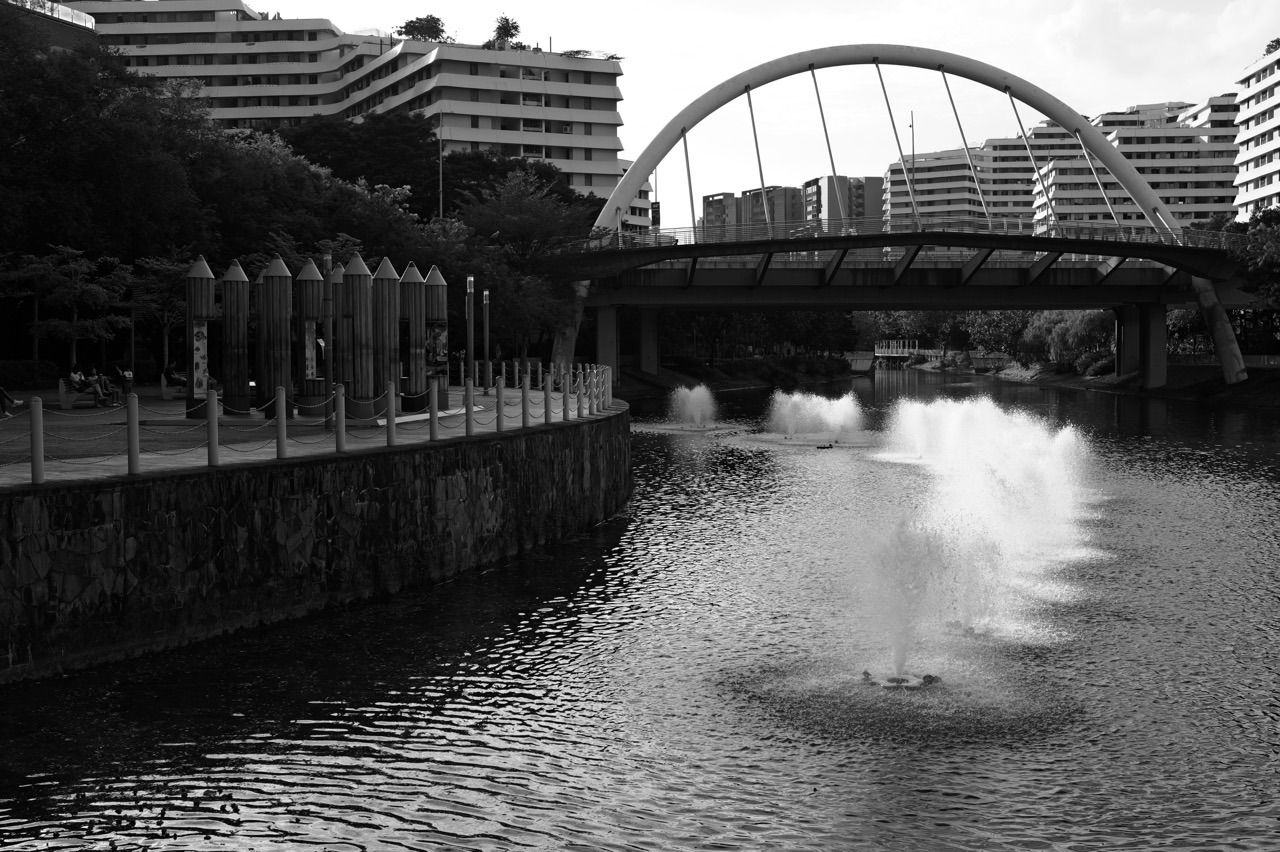
Why are some plants in Punggol Waterway growing on floating honeycomb-like platforms, rather than in ordinary soil along the banks? Housing & Development Board engineers developed a system of connected hexagonal floating modules so they could add wetland greenery to the surface of a man-made waterway, improve its ecological functions and maintain the planted areas safely. The choice of hexagons was not just decorative: a modular honeycomb arrangement allows platforms of different shapes and sizes to be built from repeatable units.
HDB’s account in NParks’ CityGreen journal explains how its team developed a patented interlocking system with protrusions, recesses and stainless-steel connecting pins. Working with the National University of Singapore, the team tested how floating platforms supported plant loads, maintenance crews and movement from waves caused by passing boats. Its published study describes a four-by-three module platform designed for 360 kilograms of plant load plus up to 600 kilograms of human load under specified modelling and test conditions. That is an engineering design result, not permission for the public to walk, climb or jump onto these wetlands. HDB’s green-innovation page confirms that its floating modules remain a signature feature of Punggol Waterway.
- Where: floating wetland installations on My Waterway@Punggol, the 4.2-kilometre man-made waterway.
- Why floating: create planted habitat and water-quality benefits where conventional land planting is not the only option.
- Construction: repeatable hexagonal buoyant modules, assembled through interlocking connections.
- Engineering: HDB developed a patented fastening system and studied stability, deflection and loads with NUS.
- Planting: HDB’s research report records fifteen selected wetland species established across floating installations.
- Water quality: appropriate wetland plants and root systems can contribute to removing nutrients and supporting ecological processes.
- Critical difference: these are Punggol Waterway’s modules, not the separate Sengkang Floating Wetland in Punggol Reservoir.
- Safety: public visitors must not enter the platforms; maintenance access is for trained authorised workers.
- Sources: HDB’s Green Innovations page and HDB’s research narrative in NParks CityGreen issue 15.
Why a waterway can support living plants
Punggol Waterway was built to connect the Punggol and Serangoon reservoirs while providing a recognisable public landscape. Its water surface creates an opportunity for more than scenery.
Suitable aquatic and wetland plants can contribute to local biodiversity and water-management processes, depending on the species and installation.
A floating garden takes advantage of space above water without assuming that every metre of bank must become a conventional planter. The challenge is creating a stable base for living plants in a moving water environment.
Why ordinary land planting was not enough
An urban waterway has a finite bank and promenade area. Planting only along its edges may not provide the same opportunities as adding suitable floating habitats at chosen locations.
HDB’s environmental programme considered how to introduce wetland vegetation within the waterbody itself.
This was not a decision to replace every land-based tree or shoreline plant. The floating system complements the existing banks and public landscape, adding another type of habitat where it can be properly supported.
Why the word floating can be misleading
Something floating may look lightweight or free to drift anywhere. The HDB platforms instead form designed structures that need buoyancy, stability, connections and controlled positioning.
Floating does not mean they are toys, boats for visitors or removable gardens that anybody can push across the water.
The proper description is a buoyant engineered platform intended to carry wetland planting and support authorised maintenance under specified conditions.
Why HDB chose hexagonal modules
HDB engineers drew inspiration from honeycomb geometry, in which adjoining six-sided cells can form larger structures.
Repeated hexagons can be connected along their sides and used to build different platform outlines according to the waterbody’s available space.
The design also allows manufacturing and assembly around repeatable components rather than a completely unique floating island for every location. The geometry contributes to a scalable engineering method, not merely a decorative visual motif.
Why six sides are useful in modular design
A regular hexagon has six edges that can align with neighbouring modules. Many such cells fit together in a continuous tessellation without the gaps that some shapes leave in a flat tiling.
This can provide flexibility in planning and connecting larger platform arrangements.
That geometric advantage should not be exaggerated into a claim that the hexagon is always the strongest or best shape under every load. HDB’s actual structural adequacy also depends on materials, connections and tested configurations.
Why an individual module is not the entire wetland
One floating cell provides only a small portion of the eventual platform. HDB’s system uses many cells linked together to create suitable planted areas.
The size and shape can change according to where the system is installed and what the site allows.
This explains why photographs show floating islands of different outlines. A modular product can serve several site geometries without requiring every installation to have an identical overall footprint.
Why the modules need secure connectors
Water moves and living plants add weight. If modules separated easily, the platform could lose its intended shape or stability.
HDB’s research describes complementary protrusions and depressions along the module edges secured with stainless-steel connector pins.
The connectors help make multiple cells behave as one managed structure. The strength of a platform therefore depends on interfaces between modules as well as the floating ability of each unit.
Why the connection design was patented
HDB developed a particular interlocking solution to enhance the assembled platform’s rigidity and stability while allowing construction and eventual dismantling.
Its public account describes the feature as a patented innovation.
A patent is evidence of a claimed technical invention, not a universal guarantee that the system has no maintenance demands or cannot be damaged. The engineering must still be evaluated in the conditions where it is used.
Why a strong-looking module can still need testing
A component can appear sturdy while flexing differently under combined loads or waves. Photographs cannot reveal the internal stresses along its connections.
HDB worked with NUS to model and test the floating design under relevant loading conditions.
The lesson is that a floating structure should be evaluated through suitable analysis and field tests, not by asking whether it looks heavy enough to support a person.
Why buoyancy matters
A floating object displaces water. In an appropriate equilibrium, the upward buoyant force can support its weight and the loads it carries.
The HDB system uses buoyant modules designed to support planted media and specified maintenance loads.
A student can learn the principle with safe classroom objects, but a public floating wetland must not be tested by stepping onto it. Professional load capacity is not equivalent to public-access permission.
Why the plant load changes over time
Plants grow and the media that supports them can retain water. Their combined mass may change as vegetation develops.
The platform therefore must be designed for appropriate loads rather than only the weight of empty modules on the day they are assembled.
HDB’s work explicitly considered plant loads as part of the structural analysis. This shows that ecological engineering needs to account for living materials, not just manufactured components.
Why maintenance-worker loads were tested
Plants in floating wetlands may need planting, replacement or trimming under authorised arrangements. Maintenance workers and their equipment add loads beyond the vegetation itself.
HDB’s account describes a four-by-three module configuration supporting 360 kilograms of plant load and up to 600 kilograms of human load under the study’s assumptions.
The figures concern engineered maintenance capability and the tested configuration. They are not a public invitation to organise group photographs or excursions onto the platform.
Why the four-by-three arrangement is not every installation
A platform made from twelve modules is one design arrangement described in HDB’s analysis. Other installations can use different numbers and outlines.
The point is not that every floating garden must contain exactly twelve cells. It is that a tested configuration can establish a useful structural basis for designing larger or differently shaped islands.
A credible technical article keeps the specific test and the wider modular approach separate, rather than applying one quoted load figure to every arrangement without calculations.
Why water movement affects stability
The Waterway is not necessarily motionless. Passing boats and environmental conditions can create waves and movements at a floating structure.
A floating platform must be capable of responding to those conditions without losing its intended function. HDB’s research studied elastic deformation and stress distributions for different loads.
The lesson is that stability is not achieved simply by making something heavy. Buoyancy, geometry, joining and environmental forces all affect performance.
Why flexible and rigid can both matter
A connection must be strong enough to keep modules together, yet the platform also experiences movement from the surrounding water.
HDB’s analysis of structural behaviour addressed this combination.
It is misleading to describe the finished wetland as absolutely rigid or completely flexible. The engineered assembly has defined mechanical behaviour under the loads studied, rather than one simplistic property.
Why modules must remain in designated locations
A floating garden intended to support water quality and habitat has to remain within suitable managed areas instead of drifting into public recreation paths or infrastructure.
Anchoring and positioning arrangements are therefore important components of a complete installation, even when less visible than leaves.
The exact specification of every anchor at Punggol should come from engineering records rather than a guess from photographs. The general need for secure positioning is clear from the structure’s purpose.
Why the roots need access to water
Wetland plants can extend roots into the water and interact with nutrients and microorganisms under suitable conditions.
The HDB floating-wetland scheme uses selected species that can grow in this arrangement rather than ordinary trees planted in deep dry ground.
A student should not assume that any houseplant will survive with its roots dangling in a reservoir. Species selection and appropriate media are central to a useful wetland.
Why coconut fibre and woven mats were used
HDB’s environmental report describes selected wetland plants grown in media including coconut fibre and woven mats.
These provide a suitable planting support within the engineered modules while allowing interaction with the aquatic environment.
The material selection is part of the system, not permission to throw household coconut husks or textiles into Punggol Waterway. Public installations require appropriate professional maintenance.
Why the plants were selected experimentally
HDB test-bedded different species at its Centre of Building Research before choosing those considered suitably resilient.
Its research account identifies fifteen wetland species planted in the floating modules.
That illustrates how ecological success depends on matching organisms to the intended conditions. A plant species chosen for ornamental beauty alone might fail to establish or serve the intended water-management role.
Why roots may help water quality
Certain wetland plants can take up nutrients from water or support microbial processes associated with their roots.
The HDB research account discusses excess nutrient removal and the role of extensive root systems in the floating wetland environment.
The mechanism can contribute to water-quality improvement, but it is not equivalent to professional drinking-water treatment. The plants do not make all surrounding water potable or sterile.
Why nutrients are not automatically beneficial
Plants need nutrients, but excess nutrients in aquatic systems can contribute to unwanted biological growth and water-quality problems.
A floating wetland may help manage some nutrient availability as plants take up material or support associated processes.
The outcome depends on water conditions, plant health and maintenance. A photograph of green leaves cannot establish the exact concentration of nitrogen or phosphorus in the Waterway.
Why microbes matter as well as plants
An aquatic plant’s roots and supporting media can create surfaces where microorganisms live. Under suitable conditions, these organisms participate in biological transformations of substances in water.
The plant may provide habitat and influence water movement while microbial communities contribute additional functions.
A strong explanation does not attribute every chemical transformation directly to a leaf. Aquatic treatment can involve interacting physical, plant and microbial processes.
Why more greenery can encourage biodiversity
The floating planted areas create additional vegetation structure within an otherwise more open water surface.
Birds, dragonflies, butterflies and other animals may use suitable vegetation for shelter, resting or food-related activities. HDB’s accounts identify biodiversity as a major goal of the project.
An individual sighting is still unpredictable. The presence of plants offers habitat opportunities; it does not guarantee one particular animal will appear during every visitor’s walk.
Why a platform can be habitat without being a human walkway
The floating garden’s function is primarily ecological and water-management related. Its surface and planting are not designed as an ordinary public path.
The documented ability to carry maintenance loads is a safety and operation requirement for trained staff, not public recreation.
Residents should remain on authorised promenades and never try to reach a platform by boat, swimming or stepping across the edge. Observing nature should not damage the feature that supports it.
Why the wetland may soften an urban landscape
A man-made waterway with bridges, retaining structures and adjacent high-rise housing can feel strongly engineered. Floating wetland islands introduce living vegetation into the water surface.
HDB calls visual relief and greenery intensification among the scheme’s benefits.
This aesthetic contribution is real but different from measured water-quality improvement. A pleasant-looking garden is not a scientific test result, and a scientific benefit cannot be proven by appearance alone.
Why the system was part of an eco-town experiment
Punggol became Singapore’s first Eco-Town in 2010, with HDB using it to test and extend sustainable housing and landscape technologies.
The waterway offered a suitable site for combining engineered infrastructure with planting innovation.
The value of a pilot is that new methods can be tested, improved and potentially applied elsewhere. It does not mean every later urban waterbody automatically needs identical platforms.
Why the project was not created all at once
HDB’s publications describe research and phased installation around the 2010s, including testing before wider deployment.
The system’s design, field evaluation and use in the public landscape were distinct steps.
A historical photograph taken during a test stage should not be assumed to show all current installations. Accurate reporting attaches dates and describes which stage the source documents.
Why published sizes need their dates
HDB’s CityGreen article documented approximately 550 square metres of floating wetlands and a largest single platform of 130 modules, approximately 84.5 square metres, at the time of reporting.
Those figures demonstrate the scale reached in that historical account. They are not automatically verified totals for November 2026, when extensions, maintenance or changes may have occurred.
A credible article can explain the recorded design without inventing a real-time inventory of every floating island.
Why 130 modules is more than a decorative number
A large platform containing many joined modules must handle combined loads and stresses rather than simply float as 130 independent objects.
The HDB report’s 130-module example illustrates how repeated cells create larger structures under appropriate engineering.
A reader should not multiply the load capacity of a small test configuration by module count and claim an unrestricted public carrying capacity. Structural performance also depends on geometry, load distribution and connections.
Why the modules can be reconfigured
Modular elements can be assembled in different shapes, allowing the platform to respond to the form and constraints of the receiving waterbody.
HDB specifically identifies flexible configuration as a design advantage.
However, reconfiguration is an authorised engineering and maintenance process, not something residents should attempt. A floating feature may need moorings and site-specific calculations beyond rearranging cells like toy blocks.
Why maintenance flexibility matters
Living vegetation changes as it grows. Plants may need appropriate trimming or replacement, and the structure itself requires inspection.
HDB’s interlocking approach was developed partly to allow assembly, movement and dismantling under controlled arrangements.
The design’s usefulness is therefore connected to its operating life, not only its original installation. A component that can be serviced safely may support a more durable public environmental feature.
Why anchoring and water level interact
A floating platform rises and falls with changes in water level under suitable arrangements, unlike a permanent concrete island fixed at one elevation.
An anchoring system must constrain unwanted horizontal movement while allowing the intended vertical behaviour.
The exact anchoring layout at each Punggol location is a technical matter, but the principle helps explain why keeping a floating garden in place requires more than a heavy object sitting on the water.
Why the system is different from a planted embankment
Plants rooted in the waterway bank obtain their support from the soil and contribute to that landscape. The floating wetlands use buoyant modules to support vegetation directly on the water.
Both may influence ecology and water quality, but their structural support and maintenance arrangements differ.
The distinction is especially important because Punggol Waterway also has freshwater-tolerant mangrove plantings along its banks. A floating platform and a rooted mangrove are not the same installation.
Why freshwater-tolerant mangroves were another innovation
HDB’s research also selected appropriate mangrove and freshwater swamp species that could survive under the Waterway’s freshwater conditions.
The aim was to establish suitable riverbank vegetation in addition to floating wetland islands.
This required its own biological and slope-engineering decisions. A species that normally grows in saline water cannot automatically be planted successfully in every freshwater environment.
Why this is not the Sengkang Floating Wetland
PUB’s Sengkang Floating Wetland is located in Punggol Reservoir, with boardwalks and park connections on the Sengkang side.
The hexagonal floating modular wetlands discussed here are HDB’s installations in Punggol Waterway.
The two share a broad idea of aquatic vegetation but occupy different waterbodies and have distinct project histories. A local guide must not collapse them into one geographical site merely because both relate to Punggol.
Why a floating wetland is not the same as a green roof
A green roof rests on a building structure and requires waterproofing, drainage and suitable roof loading.
A floating wetland rests on buoyant platforms interacting with water, waves and anchoring.
Both can add vegetation where ordinary ground space is limited, but their forces, supporting structures and maintenance hazards differ. A description that treats them as interchangeable misses the engineering reason for each solution.
Why a floating wetland is not an ordinary raft
A raft intended for people to travel on water is designed around transport, passengers and navigation.
A floating wetland is structured around plant growth, water interaction, ecology and supervised maintenance.
Its apparent ability to float is not proof that it meets the safety standards for a recreational boat or supports unrestricted visitors. Design purpose matters as much as buoyancy.
Why a water-quality claim needs actual data
HDB’s historical publications describe improved water quality and biodiversity from the combined floating wetland and freshwater-tolerant mangrove programme.
Those reports can support the intended mechanism and the documented outcomes under their study conditions.
They do not prove that every point along the Waterway currently has the same nutrient concentration or that every future bloom is impossible. A live environmental assessment needs appropriate present-day measurements.
Why the biodiversity figures need care
HDB recorded numerous birds, butterflies and dragonflies through surveys in the 2010s. That indicates a rich and changing set of wildlife observations.
The figures should be cited with their years and counted groups, not casually presented as the species visible today on a one-hour walk.
Nature surveys depend on effort, timing and methodology. An increase in recorded species can be useful evidence while still requiring careful interpretation of the study’s scope.
Why water quality matters for recreation
The Waterway supports waterfront life and selected water activities under the relevant rules. Managing water quality therefore has public and ecological importance.
HDB describes the need to support a healthy water environment as part of the broader Waterway programme.
A visitor should never assume recreational water is suitable for drinking or all activities merely because wetlands help the environment. Current waterbody rules and activity permissions remain authoritative.
Why the material is not just ordinary plastic
The floating modules are constructed from suitable engineered materials, with research identifying high-density polyethylene components and stainless-steel connections.
Those choices respond to durability, buoyancy and the need to support plant and maintenance loads under wet conditions.
A child should not assume that discarded household containers can be tied together to create an equivalent habitat island. The real structure requires professional design, stability analysis and management.
Why a public photograph cannot prove stability
A floating garden may look motionless in a photograph because the water was calm at that instant.
Engineers still need to assess moving loads, waves, buoyancy and connection strength under more demanding conditions.
HDB’s use of modelling and field testing provides evidence beyond appearances. This is a useful media-literacy lesson: a visually convincing design is not automatically an engineering certification.
A classroom hexagon exercise
Cut six equal-sided cardboard hexagons and arrange them edge to edge. See how they form a larger connected shape.
Add another six and create a different outline with the same basic pieces. Students can observe the benefit of repeatable modular geometry.
The paper pieces do not prove real structural strength or buoyancy. Their purpose is to illustrate how cells combine to form different shapes without needing a custom component for every location.
A classroom buoyancy model
Use a safe sealed floating object in a shallow classroom container to demonstrate displacement and the effect of adding small known weights.
Students can observe that a floating object sits lower when its load increases.
This is a simple demonstration of the principle, not a scale test of HDB’s module design. Never use Punggol’s public wetlands as experimental platforms.
A fictional load interpretation
A learner reads the published figures for a twelve-module platform and concludes that exactly 600 kilograms of visitors are invited to walk on any installation.
The teacher asks whether a tested engineering capacity equals permission for public access. It does not.
The corrected explanation describes the documented plant and maintenance load conditions for the study configuration while keeping the public away from the working platform.
A fictional maintenance scenario
An imaginary floating garden needs replacement planting after some vegetation fails. The maintenance team plans how to reach it safely, keep modules stable and avoid damaging connectors.
Students identify why the design includes the possibility of controlled servicing and component handling.
The exercise deliberately avoids technical repair instructions. Its purpose is understanding that ecological infrastructure needs maintenance as living systems change over time.
A fictional water-quality comparison
Two classroom samples look equally clear, but an invented dataset reports different nutrient concentrations.
The students learn that appearance alone cannot establish the chemical condition of water.
A planted feature may improve some water-quality indicators under appropriate conditions without removing every dissolved substance. Real measurements require professional sampling and analytical methods.
A fictional habitat observation
A student sees a dragonfly near a floating garden and writes that the particular platform created a new population of dragonflies in Punggol.
The observation establishes only that the insect was present. A broader population effect requires suitable comparison and monitoring.
The student revises the statement to describe the observed animal and the documented goal of creating habitat opportunities. This keeps evidence and interpretation distinct.
A fictional cost-versus-function comparison
A planner considers leaving the water surface entirely open or introducing a suitably engineered floating planting area.
The class lists possible benefits—greenery, habitat, treatment—and costs or constraints such as manufacturing, anchoring, maintenance and public safety.
They learn that a good solution is not free simply because plants grow naturally. A useful ecological system requires thoughtful engineering and ongoing support.
Teaching Guide: design a floating wetland without stepping on it
Learning goal: explain how hexagonal modules, buoyancy, interlocking connections and selected plants make a managed floating wetland possible.
Activity one: arrange paper hexagons into different platform outlines. Activity two: label a buoyant module and a root zone. Activity three: distinguish weight, buoyancy, connection strength and anchoring.
Activity four: examine HDB’s 4×3 configuration and interpret plant and maintenance loads without treating them as public capacity. Activity five: draw possible water-quality and habitat mechanisms.
Activity six: compare Waterway modules with Sengkang Reservoir’s separate wetland and with Waterway Ridges land-based rain gardens. Transfer test: identify information needed before designing a floating habitat in a different waterbody.
Frequently asked questions
Why are the Punggol Waterway wetlands hexagonal? HDB used honeycomb-inspired modular geometry that supports repeatable assembly and flexible platform shapes.
Are the modules connected? Yes. HDB’s patented system uses interlocking details and stainless-steel pins.
Do they float without anchors? They are engineered floating installations that require appropriate positioning and stability; do not assume they are free to drift.
Can visitors stand on the wetland? No. The published structural tests relate to design and authorised maintenance, not public recreational access.
What is the 4×3 configuration? A twelve-module arrangement evaluated by HDB and NUS for particular load conditions.
What plants grow there? HDB’s historical programme used selected wetland species, including aquatic plants suited to the system.
Do the wetlands make the Waterway potable? No. Ecological water-quality improvement is not drinking-water certification.
Is this Sengkang Floating Wetland? No. These HDB modules are in Punggol Waterway, while PUB’s Sengkang site is in Punggol Reservoir.
Are the historic biodiversity figures live today? No. They describe particular past surveys.
Where are the official technical details? HDB’s Green Innovations page and the HDB-authored article in NParks’ CityGreen journal.
Your next step
For official design details, see HDB’s Green Innovations, the HDB-authored My Waterway@Punggol research article in NParks CityGreen 15, and the 2013 structural engineering study.
For a related application of HDB’s modular approach, see NParks’ Pekan Quarry Floating Wetlands, which has different site conditions and purposes. The earlier Punggol floating wetlands history covers the pilot chronology.
The one idea to remember is that the plants may look natural but the base is engineered: connected buoyant hexagons make planting, stability and maintenance possible within a managed waterbody.


