
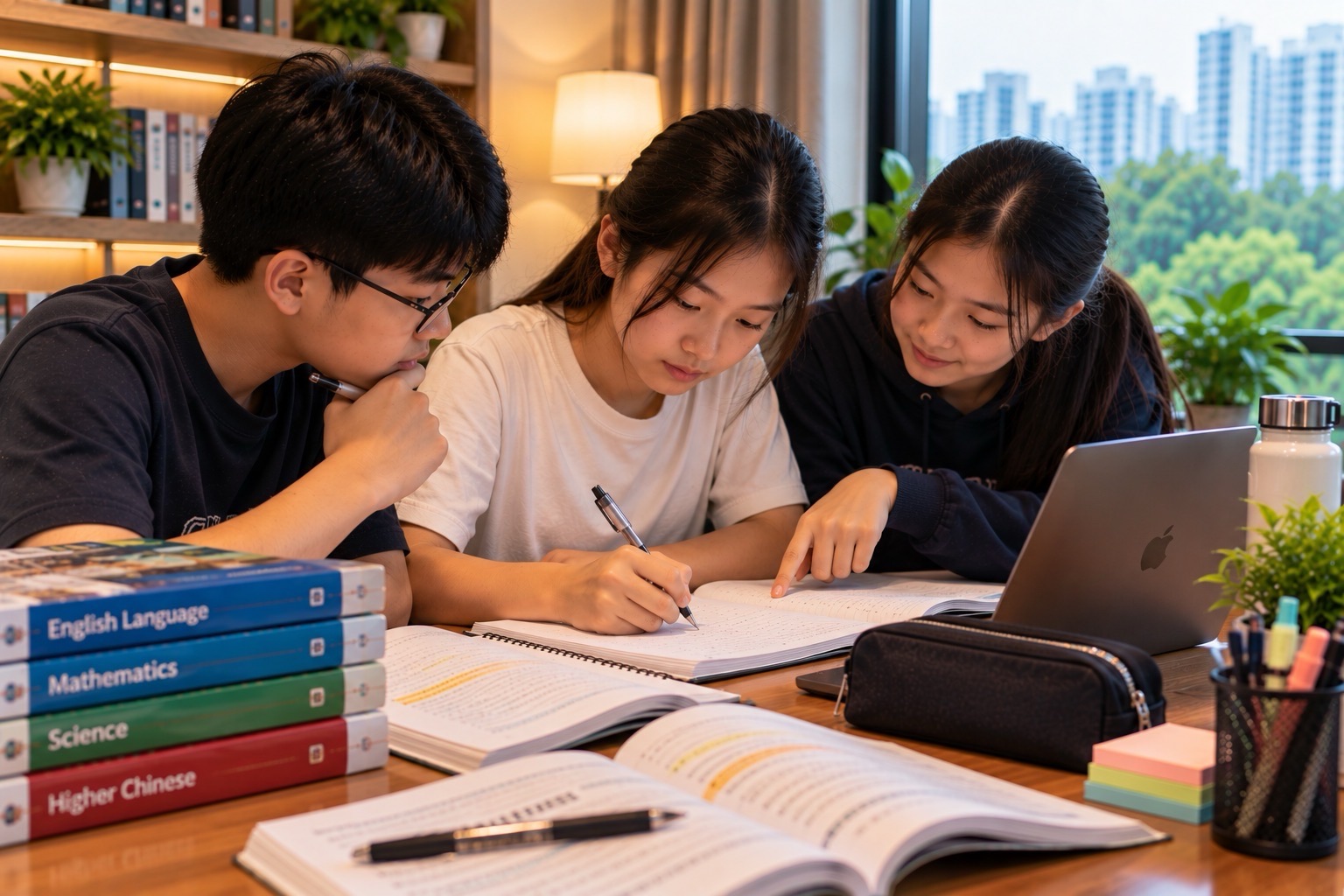
Yuying Secondary School is at 47 Hougang Avenue 1, Singapore 538884, and its 2026 Secondary 1 Posting Group 1 (PG1) admitted PSLE Score range was 25–29. The final posted score of 29 describes the 2025 PSLE cohort admitted in 2026, not a guaranteed threshold for pupils entering Secondary 1 in 2027. A family living in Punggol can consider Yuying as an eligible school option in Hougang, but must verify the child’s actual Posting Group eligibility and the school’s current details on MOE SchoolFinder. Yuying’s official website lists Kovan as its nearest MRT station and buses including 53, 62, 113 and 115; the household should still test the real journey from home.
Yuying’s distinctive programmes combine Eco-Innovators and food-related design thinking with its Yuying C.A.R.E.S. programme for community and youth leadership. Its Applied Learning Programme includes a Secondary 1 collaboration with Singapore Institute of Technology to address food wastage, and a Secondary 2 food innovation experience linked with Mr Bean’s use of soya-bean pulp. The Learning for Life Programme develops the values Collaborate, Act, Reflect, Empathise and Serve, progressing from environmental care to active ageing and wider social causes. The school has also published STEM experiences involving drones, VR Mathematics and energy projects. Under Full Subject-Based Banding, PG1 is a school-entry category, while the academic G level for each individual subject is determined separately. This guide explains what the school offers, how to distinguish cohort learning from selected opportunities, and how Punggol parents can choose responsibly.
- Yuying Secondary School: 47 Hougang Avenue 1, Singapore 538884; Kovan MRT listed as nearest station.
- Historical 2026 Secondary 1 PG1 range: 25–29, final admitted score 29; no 2027 guarantee.
- Applied Learning Programme: Design Thinking and Critical Design Futures Thinking.
- Secondary 1 example: Eco-Innovators with Singapore Institute of Technology, tackling food waste.
- Secondary 2 example: food innovation with Super Bean International (Mr Bean), using soya-bean pulp.
- LLP Yuying C.A.R.E.S.: Collaborate, Act, Reflect, Empathise and Serve.
- LLP progression: Sec 1 environment; Sec 2 active ageing; Sec 3–5 inclusivity and social causes.
- Selected Social Entrepreneurs in Action and overseas service projects are different from broad cohort LLP.
- STEM examples include Python drone coding, chemical-powered vehicles and virtual-reality Mathematics.
- Official school home page announces an Open House on 27 November 2026; confirm any changes.
- PG1 is not a permanent individual G1/G2/G3 subject-level guarantee.
- Check transport, admission eligibility, academic support and selected activities before listing the school.
As of 1 November 2026: school details reflect official 2026 programmes and a historical 2026 Secondary 1 score range. The 2027 intake’s final cut-off and all later programme allocations cannot be promised in advance.

Contents: Yuying PG1 Parent Guide
- 1. Definition Lock: PG1 at Yuying Is Not an Academic Identity
- 2. How to Read Yuying’s 2026 PG1 Range of 25–29
- 3. The PSLE Score 25 Decision Between PG1 and PG2
- 4. The Campus at 47 Hougang Avenue 1
- 5. Yuying’s Vision: Soaring Higher Together
- 6. What the Applied Learning Programme Is Designed to Do
- 7. Secondary 1 Eco-Innovators With Singapore Institute of Technology
- 8. What a Food-Waste Problem Really Requires
- 9. Secondary 2 Food Innovation With Mr Bean
- 10. Food Innovation Is a Form of Applied Literacy
- 11. Yuying’s Wider STEM Programme
- 12. Coding Drones With Python
- 13. Chemical-Powered Cars and Energy Thinking
- 14. Virtual-Reality Mathematics and the Limits of a Simulation
- 15. Scent-Making and Scientific Separation
- 16. The C.A.R.E.S. Learning for Life Programme
- 17. Secondary 1 C.A.R.E.S.: Environment and Sustainability
- 18. Secondary 2: Active Ageing and the Elderly
- 19. Secondary 3 and Upper Secondary: Inclusivity and Social Causes
- 20. Selected Social Entrepreneurs in Action
- 21. Overseas Service Learning Is a Separate Opportunity
- 22. Leadership Should Not Be Measured Only by Titles
- 23. A 2026 Open House on 27 November
- 24. English Support Within Practical and Service Projects
- 25. Mathematics for Food, Design and Budget Decisions
- 26. Science Inquiry and Responsible Environmental Claims
- 27. Mother Tongue Can Be a Separate Academic Strength
- 28. CCA Participation, School Belonging and Travel
- 29. DSA-Sec and Yuying’s Talent Areas
- 30. A Fictional Punggol Student Tackles Food Waste
- 31. A Fictional Student Discovers Service Through C.A.R.E.S.
- 32. The 2027 Family Checklist
- 33. Your Next Step: Choose on Educational Fit
Definition Lock: PG1 at Yuying Is Not an Academic Identity
Posting Group 1 is a Secondary 1 admissions category determined through Singapore’s PSLE framework. G1 is the academic standard of an individual subject under Full Subject-Based Banding; G2 and G3 describe other levels. A student may enter Yuying through PG1, join a mixed form class and take particular subjects at another eligible level where school and MOE rules permit. The Posting Group is therefore not a permanent statement about intelligence, social potential or readiness for all practical learning.
For a family, it helps to separate the PSLE eligibility notice, the school posting result and the timetable. These answer different questions. A child who takes Mathematics at G1 might be enthusiastic about food innovation or have a strong Mother Tongue profile. Parents should identify actual learning needs rather than use the admission code to predict everything a pupil can accomplish. Differentiated teaching is useful precisely because children have uneven strengths.
How to Read Yuying’s 2026 PG1 Range of 25–29
Publicly reported 2026 Secondary 1 admitted scores show Yuying’s PG1 range was 25–29. The final admitted pupil’s PSLE Score, commonly called the cut-off point, was 29. The range is based on the 2025 PSLE cohort, the school preferences submitted and the available places in that completed exercise. It does not describe the eventual 2027 allocation, which will be known only when the next exercise is completed.
A Punggol family should use the previous range to understand historical admission patterns, not to claim a place is guaranteed for a pupil with Score 29. Demand and vacancies change, and tie-break rules matter when the last places are contested by pupils with the same score. Put the intake year beside every cut-off in the school comparison sheet and check current MOE information. Avoid relying on an unofficial exact admission probability.
The PSLE Score 25 Decision Between PG1 and PG2
A pupil with PSLE Score 25 may have a choice between Posting Groups 1 and 2 under the current national framework. This affects the ordinary school-posting route and can influence starting academic subject standards. It should not be treated as a simple status contest. Families need to consider the child’s individual readiness, available schools and what the actual subject demands would mean.
If Yuying is on the list, examine the correct prior-year admission range for the intended group. Its PG1 figure cannot be substituted for PG2. The school-choice process has specified procedures for selecting the group and ranking preferences; parents should follow their child’s official result notice. A sound decision supports the teenager’s learning and gives the family a realistic set of eligible choices.
The Campus at 47 Hougang Avenue 1
Yuying’s official contact page gives 47 Hougang Avenue 1, Singapore 538884. It lists Kovan as the nearest MRT station and buses such as 53, 53M, 62, 113 and 115. These details help a family identify the right campus and transport connections. The school is not within Punggol itself, so the route should be tested with the child’s actual start and dismissal times.
Different Punggol households will have different journeys. A student near the East LRT loop may travel differently from a student near the Punggol Coast end of the North East Line. Test the final walk, crossings and the return journey after CCA, when the pupil may be tired. Do not invent a universal travel-time figure. The school that fits academically must also fit daily life.
Yuying’s Vision: Soaring Higher Together
Yuying presents the phrase Soaring Higher Together and an emphasis on achieving personal excellence. Its long history stretches back to 1910, but the present school must be evaluated through current programmes, teachers and student experience rather than through history alone. A family’s interest in heritage can be useful context without becoming a guarantee of learning quality for one particular pupil.
Ask how the school helps a new Secondary 1 pupil develop confidence, ask for help and participate. Is practical innovation available to beginners? What routines support students who find certain subjects difficult? A motto becomes meaningful when a pupil understands how to improve after feedback and work with peers respectfully. Good school fit is practical and individual, not a contest over the age of institutions.
What the Applied Learning Programme Is Designed to Do
Yuying’s 2026 Applied Learning Programme uses Design Thinking and Critical Design Futures Thinking to develop creative confidence, critical reasoning and collaboration. Students learn to examine real needs and consider possible future consequences before building and assessing a solution. This is broader than simply asking pupils to be inventive. A good proposal should address a defined problem with evidence, not rely on an attractive-looking prototype alone.
Parents can reinforce the learning by asking whom a design is meant to help and how a class discovered the real difficulty. What did the team assume initially? Which new observation made them change their mind? Such questions teach evidence and empathy. A PG1 student can contribute useful ideas while still needing explicit support in written explanation or numerical accuracy.
Secondary 1 Eco-Innovators With Singapore Institute of Technology
Yuying’s official August 2026 ALP page describes a Secondary 1 Eco-Innovators programme conducted with Singapore Institute of Technology. Pupils work on solutions to challenges such as food wastage in the school canteen. This gives them a familiar problem in which behaviour, environment, resource use and practical constraints interact. The partnership is an educational activity, not an automatic route into university.
Ask the child how food waste was measured, whose behaviour mattered and what a realistic reduction would involve. A solution that looks clever but is too difficult for users may not work. The pupils need to collect evidence and consider costs, communication and convenience. Participation details for a later intake must be checked with the school; a 2026 programme description does not guarantee an identical 2027 project.
What a Food-Waste Problem Really Requires
A canteen food-waste problem can have many causes: portion sizes, preferences, timing, pricing or habits. A group should not assume one cause without observation. Yuying’s practical approach can help students see that a problem is often more complex than a classroom exercise. They may need to talk with people respectfully and test a change before claiming success.
At home, parents can discuss how a family avoids wasting food without turning meals into a guilt exercise. Ask which pieces of evidence would help decide whether an approach works. This encourages critical thinking and responsible behaviour. A thoughtful solution balances practical constraints with environmental aims rather than rewarding the pupil who announces the grandest idea.
Secondary 2 Food Innovation With Mr Bean
The school’s official ALP page describes a Secondary 2 Food Innovation Programme with Super Bean International, associated with the Mr Bean brand. Pupils develop ideas for food products using soya-bean pulp that might otherwise be discarded. This extends environmental thinking into product design, consumer needs and the practical challenge of creating something useful from a by-product.
The learning does not mean every student becomes a food entrepreneur or that every prototype is commercially released. Parents can ask how the team understood user needs, prepared a proposal and gathered feedback. Food safety, suitability and product claims remain important. For a child entering Secondary 1 in 2027, the future Secondary 2 details should be confirmed when the school publishes the relevant year’s programme.
Food Innovation Is a Form of Applied Literacy
A food product concept can require accurate instructions, persuasive explanation and honest presentation of benefits. A pupil who struggles with English writing may enjoy the design but need support communicating why it serves a particular audience. An applied programme can reveal that gap naturally, creating a clear reason to strengthen vocabulary and sentence structure.
Encourage the child to describe the intended customer, the problem, the proposed product and the evidence that someone would want it. Avoid writing the entire pitch on the pupil’s behalf. A simple honest explanation is more valuable than polished marketing text that cannot be defended. Academic literacy supports practical invention; neither can replace the other.
Yuying’s Wider STEM Programme
Beyond the ALP, Yuying’s official STEM page describes chemical-powered vehicle prototypes, drone programming using Python, scent-making through chemical separation, and a virtual-reality Mathematics experience. These examples illustrate a broad effort to connect academic ideas with hands-on exploration. They should not be interpreted as compulsory tasks for every pupil in every year or proof that a selected student will access all the equipment.
A family should ask which experiences are part of the general programme and which require additional selection. A child who enjoys Science may find one of these opportunities motivating; another may prefer design or service. The most important learning is whether the pupil can explain a process and evaluate evidence rather than simply show that a device operated.
Coding Drones With Python
Yuying’s STEM activities include students coding drones with Python. This gives pupils a context for understanding instructions, sequences, conditions and the need to test a system safely. A program that seems logical on a screen may behave differently when an object moves in a physical environment. Students need to understand both the code and the rules of supervised operation.
Parents should not arrange unsupervised drone flying as preparation. Ask the school what introductory coding and safety learning it provides. At home, a pupil can explain a logical sequence on paper or describe what should happen if a condition changes. The purpose is computational thinking and responsible technology use, not owning the most expensive drone.
Chemical-Powered Cars and Energy Thinking
The school’s STEM page also describes building chemical-powered cars as a way to explore energy sources and scientific principles. Such activities can turn abstract ideas into visible questions about materials, transformation and the behaviour of a model. However, one successful demonstration does not prove a learner understands all the chemistry involved.
Ask what was measured and what evidence supports the explanation. Encourage the child to distinguish observation from inference and acknowledge limitations. No family should imitate hazardous chemical experiments without trained supervision. Practical learning is valuable because it teaches safe, careful inquiry, not because it permits risky home recreations.
Virtual-Reality Mathematics and the Limits of a Simulation
Yuying describes a virtual-reality adventure in which pupils explore world cities while solving Mathematics problems. The environment can make tasks more engaging and help connect numerical reasoning to familiar spatial contexts. It is still a learning tool. Putting on a headset does not automatically repair misunderstanding of ratios, fractions or graph interpretation.
Parents can ask the child to explain the mathematical idea they used, not only which location appeared in the simulation. If an answer was guessed, identify how to choose the correct method independently. Digital novelty can motivate practice but should not conceal a concept gap. A good school programme connects activity with the formal Mathematics syllabus at the student’s actual subject level.
Scent-Making and Scientific Separation
Another published Yuying STEM example is a scent-making workshop where pupils explore proportions and chemical separation. It can teach why measurements, mixtures and safe procedures matter in a practical context. The topic may seem playful, but a student should be able to explain what was combined, what varied and what could legitimately be concluded.
Safety and appropriate materials are central. Do not recreate chemical procedures at home with unknown substances. Ask how the class used evidence and why it chose particular quantities. The educational value lies in observation, measurement and explanation, not just obtaining a pleasant-smelling product.
The C.A.R.E.S. Learning for Life Programme
Yuying’s LLP is called C.A.R.E.S.: Collaborate, Act, Reflect, Empathise and Serve. It focuses on Community and Youth Leadership, with students learning how to identify social needs and work thoughtfully with others. The programme progresses across the secondary years and offers both broad cohort experiences and selected extension opportunities.
Parents can use the five words to ask concrete questions. Whom did the child listen to? What action did they take? Which observation changed their view? Who benefited? These are more meaningful than asking only how many service hours were accumulated. Leadership is developed through repeated responsibility and respectful relationships, regardless of academic Posting Group.
Secondary 1 C.A.R.E.S.: Environment and Sustainability
Yuying’s official LLP description identifies sustainability and the environment as the Secondary 1 focus. Pupils experience the problem of food wastage and are encouraged to make thoughtful choices. Related school materials describe recycling, environmental advocacy and helping the community understand the importance of reducing waste. The programme can connect classroom content with ordinary canteen behaviour.
Ask the teenager what they observed and whether the proposed action is realistic. A pupil might discover that a small habit change needs clearer communication or better organisation. Avoid turning the activity into a public contest to shame classmates about food. Responsible sustainability education should cultivate understanding and constructive participation.
Secondary 2: Active Ageing and the Elderly
Yuying’s LLP turns to active ageing and the needs of older people in Secondary 2. Students use design thinking to plan and carry out Values-in-Action projects that respond to actual circumstances. Earlier school materials mention partnerships with organisations serving seniors. These examples demonstrate the approach, but participation in a particular partnership can change from year to year.
Parents can ask the child what older people said they needed, and whether the project reflected those views. A good service activity respects the dignity and privacy of participants. Teenagers should learn to speak and listen appropriately rather than treat senior citizens as subjects for social-media content. Meaningful leadership is grounded in empathy and useful action.
Secondary 3 and Upper Secondary: Inclusivity and Social Causes
In the later years, Yuying’s LLP progresses towards advocacy for inclusivity and social causes. Students may examine issues that affect different groups and use school learning to develop a responsible response. This demands careful reading of evidence and an understanding that community problems can be more complex than a simple slogan.
Encourage the pupil to distinguish facts from assumptions and consider the perspective of people affected. A student can become more articulate through respectful discussion and constructive action. Formal advocacy projects require school guidance and should be age-appropriate. The aim is not to turn teenagers into public figures but to help them contribute thoughtfully.

Selected Social Entrepreneurs in Action
Yuying’s older detailed LLP description distinguishes a Tier 2 programme called Social Entrepreneurs in Action for selected VIA ambassadors and student leaders. Such pupils may use social-entrepreneurship skills to raise funds for a cause and refine their project management abilities. This is a selected extension rather than an automatic entitlement for all PG1 entrants.
Parents should ask what the selection criteria and responsibilities are in the current year. A child may learn useful service habits through ordinary cohort activities without joining Tier 2. Recognition and advancement should reflect genuine interest, effort and the school’s decisions, not pressure to collect one more certificate.
Overseas Service Learning Is a Separate Opportunity
Yuying’s detailed LLP materials also describe overseas service learning for selected students who show sustained interest. Historical photographs from an earlier trip illustrate that such programmes have taken place. They do not guarantee that a pupil entering Secondary 1 in 2027 will travel to the same country, or that every student receives the opportunity.
Families can encourage global awareness through reading, community relationships and language learning even without overseas travel. If a selected trip is offered, ask about its purpose, safety, cost and student suitability. The value should be meaningful learning and ethical engagement with communities, not collecting a passport stamp for an application.
Leadership Should Not Be Measured Only by Titles
Yuying’s student-development information describes leadership at class, CCA and school levels. A pupil might learn to help a new classmate, coordinate a small group task or contribute to a service project before they ever hold an official role. Posting Group 1 is not a reliable predictor of whether someone can demonstrate these qualities.
Parents can praise reliability, listening and the willingness to act responsibly. Selected roles may have specific criteria, so do not promise a student council position. A child who is shy in formal speaking can still develop confidence through appropriate participation. The long-term aim is independent character and competence.
A 2026 Open House on 27 November
Yuying’s current home page announces an Open House for 27 November 2026. Since the date falls after 1 November, parents preparing for 2027 entry can check the school’s current event page for programme details and any changes. An open house may provide a valuable opportunity to hear student and teacher perspectives, but it is not an admission offer.
Ask about Secondary 1 Eco-Innovators, English and Mathematics teaching support, the C.A.R.E.S. programme and the actual timetable. Let the child identify something they would want to learn. After the visit, compare the daily journey and the family’s priorities. A useful school tour ends with concrete knowledge rather than a collection of promotional photographs.
English Support Within Practical and Service Projects
A pupil studying at G1 English may have practical ideas but difficulty reading long instructions or organising a written answer. Yuying’s applied projects create authentic contexts for language, such as explaining how to reduce canteen waste or pitching a design. The real educational opportunity is connecting meaningful content with accurate communication.
Ask the child to describe the problem, one piece of evidence, a proposed action and the likely outcome. If the explanation is unclear, focus on the first missing link. A teacher can identify whether vocabulary, comprehension or sentence structure needs attention. Learning should be targeted; a more demanding subject level is a formal decision and not an automatic reward for a good project.
Mathematics for Food, Design and Budget Decisions
Food innovation and environmental projects can require measurement, proportional reasoning, quantities, simple costs and interpretation of data. These concepts matter at G1 Mathematics and other levels. A student may have a thoughtful design idea but miscalculate a ratio or use the wrong unit. The practical task can make the importance of accurate reasoning visible.
Parents can encourage the pupil to estimate first, perform the calculation and check whether it makes sense. If a fraction or ratio is misunderstood, repair the foundational concept before introducing harder questions. A successful product proposal does not automatically qualify a pupil for G2 Mathematics. Subject-level reviews depend on sustained readiness and official school criteria.
Science Inquiry and Responsible Environmental Claims
A hydroponics demonstration or chemical-powered car can raise useful questions about energy, materials and living systems. Pupils should learn to distinguish what was observed from explanations they have not yet tested. A prototype that moves once does not prove that it is the most efficient or safest solution. These limitations are part of genuine scientific reasoning.
Ask what changed, what remained constant and what additional evidence would support a conclusion. Do not encourage hazardous unsupervised experiments. A scientifically honest answer can include uncertainty. Developing this habit is more important than repeating technical phrases from an impressive display.
Mother Tongue Can Be a Separate Academic Strength
A PG1 entrant may have a stronger profile in Mother Tongue than in Mathematics or English. Full Subject-Based Banding can respond to individual eligibility where the school and MOE criteria permit. Parents should therefore read the actual subject allocation rather than assume that every academic course must remain at the same level for the child’s entire secondary journey.
Support the language through meaningful conversation and age-appropriate reading. If the pupil struggles with formal writing despite fluency at home, ask the teacher what needs practice. An appropriate higher level should be based on readiness, not status. A balanced timetable allows the child to participate in the school’s wider programmes without being overwhelmed.
CCA Participation, School Belonging and Travel
Yuying’s co-curricular activities can give students friendships, regular practice and a sense of belonging beyond the form class. The school’s website lists opportunities across sports, uniformed groups, performing arts, clubs and societies, with selection and schedules determined by current arrangements. Parents should not assume a pupil automatically enters a particular team merely because the school has won an award.
Compare the activity’s actual dismissal time with the journey back to Punggol. A teenager who returns late may need a meal and a realistic homework routine. Choose an activity the child genuinely enjoys and can sustain. Participation is worthwhile without treating every club as a guaranteed future LEAPS or EAGLES award.
DSA-Sec and Yuying’s Talent Areas
Publicly reported Yuying DSA areas for the 2026 exercise include Volleyball, Wushu, Concert Band and Community Youth Leadership. DSA is a separate talent-admission route with its own selection and academic eligibility conditions; it is not the same as the ordinary PG1 six-school posting exercise. A child with an interest in C.A.R.E.S. does not automatically receive a DSA place.
For the 2026 PSLE cohort entering in 2027, families should check whether the relevant DSA application period has already passed and follow their actual offer status. A final successful DSA allocation creates a commitment to the school. Do not pay an intermediary promising to convert a school workshop into a guaranteed offer.
A Fictional Punggol Student Tackles Food Waste
Imagine a pupil living in Punggol who has PG1 eligibility and enjoys suggesting practical ways to reduce waste. Their family researches Yuying’s Eco-Innovators programme, checks the school’s 2026 historical PG1 score carefully and tests the morning journey to Hougang Avenue 1. They do not assume that liking the programme guarantees admission.
If the child later joins the school, a food-waste project may invite them to collect evidence and propose a feasible change. The student might discover that a neat idea fails when users find it inconvenient. Parents encourage them to revise the proposal rather than blame others. This fictional example illustrates how practical reasoning and resilience can develop together.
A Fictional Student Discovers Service Through C.A.R.E.S.
Consider another pupil who is initially quiet but notices that a group project could better support older participants by asking what they actually want. The family celebrates the student’s thoughtful listening, even though they are still developing English writing and Mathematics confidence. Their contribution is meaningful independently of the Posting Group.
This is an invented learning scenario, not a testimonial about a named student or a promise of a formal award. It shows why a school-focused community leadership programme can reveal strengths that an examination score does not capture. A teenager can become more responsible while continuing to repair real academic gaps.
The 2027 Family Checklist
Before putting Yuying in a ranked Secondary 1 school list, check the current MOE SchoolFinder entry, the pupil’s official PG1 eligibility, the earlier score range labelled correctly, the tested route, and the school programmes that interest the child. Separate ordinary cohort learning from selected competitions and leadership opportunities.
Ask the teenager to contribute one or two real priorities, such as a particular CCA or the chance to learn design thinking. Avoid ranking by school name alone. Once allocated, follow the actual school’s registration instructions, subject booklist and communication channels. Reliable planning is better than guessing an admission outcome or buying equipment for an unconfirmed school.
Your Next Step: Choose on Educational Fit
Yuying offers a coherent mix of food-related innovation, environmental thinking and community service. That combination may appeal to a pupil who enjoys solving practical problems and working with people. It may be less compelling to another child whose strongest interests lie elsewhere. No single school programme is universally best for every PG1 entrant.
Compare eligible campuses using the same practical questions: What does the child actually learn? What support is available for their subjects? Is the journey manageable? Would the teenager want to participate? Keep the historical admission uncertainty visible. PG1 is the entry route; years of genuine learning, contribution and relationships are what will shape the experience.
Frequently Asked Questions
Where is Yuying Secondary School?
47 Hougang Avenue 1, Singapore 538884; the school’s official page lists Kovan as the nearest MRT station.
What was Yuying’s PG1 2026 cut-off?
The final admitted PSLE Score was 29, in a historical 2026 Secondary 1 PG1 range of 25–29.
Does a Score 29 guarantee Yuying for 2027?
No. The result is historical and the next cohort’s vacancies and preferences can differ.
What is the Secondary 1 ALP?
Yuying’s 2026 programme describes Eco-Innovators with Singapore Institute of Technology, addressing practical problems such as food waste.
What is the Secondary 2 food innovation programme?
Its school publication describes collaboration with Super Bean International (Mr Bean) to explore products using soya-bean pulp.
What is C.A.R.E.S.?
Collaborate, Act, Reflect, Empathise and Serve, Yuying’s Learning for Life Programme for community and youth leadership.
What is the Secondary 1 LLP theme?
Environment and sustainability, including reflection on food waste and responsible choices.
Do all pupils go overseas?
No. The school’s detailed materials describe overseas service learning as a selected opportunity.
Are selected social entrepreneurship projects compulsory?
No. The Tier 2 Social Entrepreneurs in Action extension is described for selected leaders and VIA ambassadors.
What other STEM projects does Yuying describe?
Python drones, chemical-powered cars, scent-making, and virtual-reality Mathematics are published examples.
Does PG1 determine every academic subject level?
No. PG1 is school admission; the school applies individual subject-level eligibility under Full SBB.
When is the announced open house?
Yuying’s current homepage announces 27 November 2026; check official updates.
Is the DSA route automatic for good project work?
No. DSA requires its own selection and PSLE group eligibility.
What should parents do first?
Check the child’s PG1 eligibility, SchoolFinder and the real travel route, then compare Yuying’s current educational programmes.
Official Sources and Related Punggol Guides
- Yuying Secondary — Official Address and Contact
- Yuying — Eco-Innovators Applied Learning Programme
- Yuying — C.A.R.E.S. Learning for Life Programme
- Yuying — Detailed LLP, Selected Social Enterprise and Service Learning
- Yuying — STEM Learning Activities
- Yuying — November 2026 Open House
- MOE SchoolFinder — Current PG1 and School Information
- MOE — S1 Posting Rules
- Yuying 2026 PG1 History (Independent Reference; Confirm With MOE)
- What is PG1 — Hougang Secondary School Guide
Your next step: Confirm the child’s PG1 eligibility, Yuying’s current school profile, the programme that genuinely interests the teenager and the daily route to 47 Hougang Avenue 1. Keep historical 2026 cut-offs separate from the eventual 2027 posting result.


