
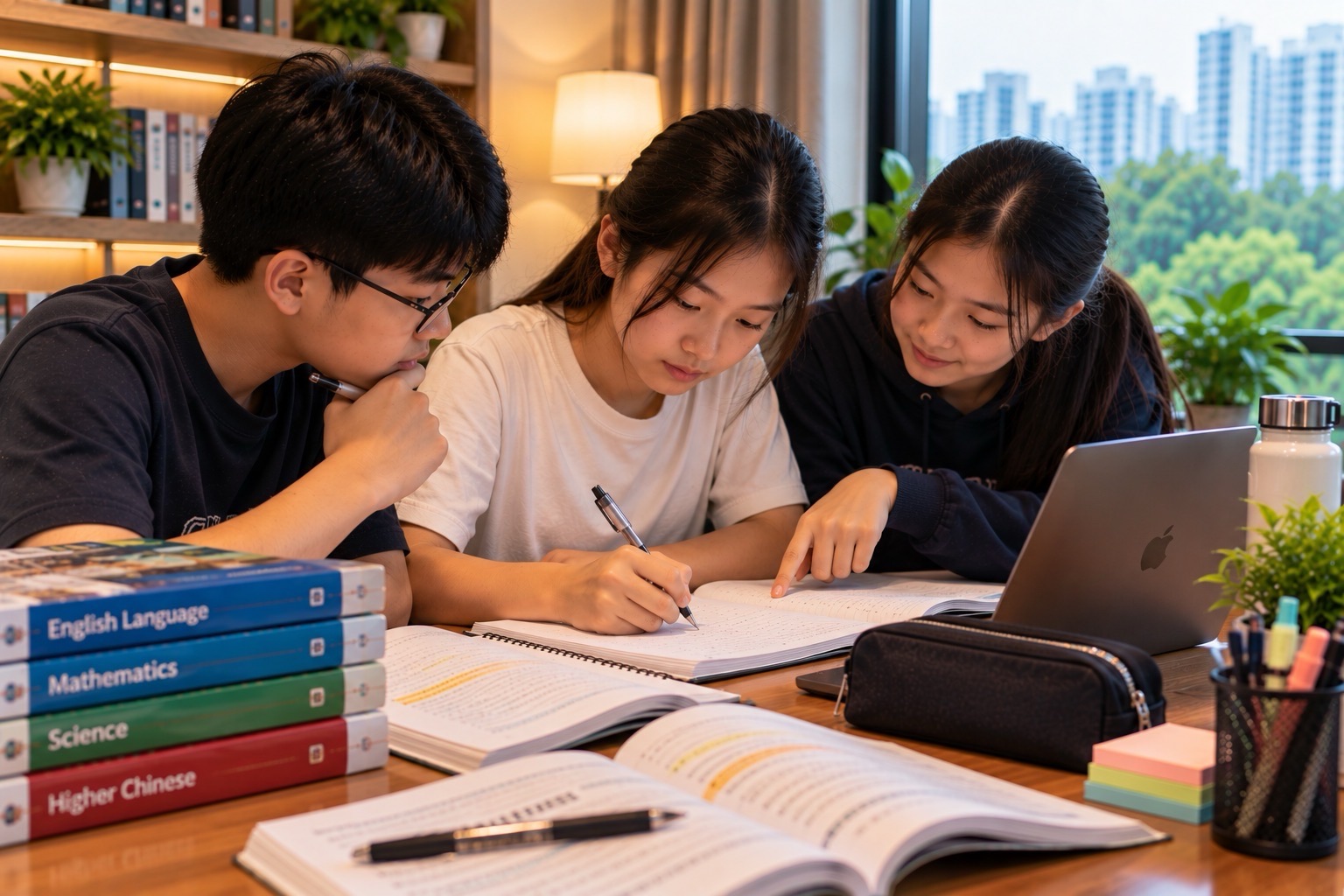
CHIJ St. Joseph’s Convent is a government-aided girls’ secondary school at 62 Sengkang East Way, Singapore 548595, that eligible Punggol and Sengkang families can consider through Posting Group 2 (PG2). Its completed 2026 Secondary 1 intake had a historical non-affiliated PG2 score range of 21–23 and an affiliated PG2 range of 21–25. These are different admissions categories and should never be combined into one supposed universal cut-off. The affiliated primary schools are CHIJ Our Lady of the Nativity and CHIJ Our Lady of Good Counsel, but being from an affiliated school does not automatically guarantee a place. Parents preparing for 2027 must check the actual MOE SchoolFinder and Secondary 1 posting instructions rather than treating either 2026 range as an advance offer.
The school’s distinctive educational approach centres on the Art of Communication through Theatre and Debates, its Applied Learning Programme, and Bringing L.I.G.H.T. to the Community, its Learning for Life Programme. L.I.G.H.T. refers to the school values of Love, Integrity, Gratitude, Humility and Tenacity. Its four-year framework connects communication, drama, debate, community service and leadership development; the 2026 LLP description progresses from sustainability in Secondary 1 to school issues in Secondary 2 and elderly-related community service in the upper secondary years. For a PG2 girl, these programmes should be considered alongside her actual G2/G3 subject-level offer, academic needs, CCAs, religious ethos, school culture and the real commute.
- School: CHIJ St. Joseph’s Convent, 62 Sengkang East Way, Sengkang 548595.
- School type: Government-aided girls’ secondary school, with the CHIJ Catholic educational tradition.
- 2026 historical PG2 range, non-affiliated: 21–23; 23 was the last admitted score in that category.
- 2026 historical PG2 range, affiliated: 21–25; 25 was the last admitted score for that completed affiliated intake.
- Affiliated primary schools: CHIJ Our Lady of the Nativity and CHIJ Our Lady of Good Counsel; confirm the current affiliation rules.
- ALP: The Art of Communication through Theatre and Debates, with oracy, literary interpretation, presentations and performance.
- LLP: Bringing L.I.G.H.T. to the Community, with Values in Action, student leadership and community partnerships.
- Year-level service themes in 2026: Secondary 1 sustainability, Secondary 2 school community, upper secondary elderly and community care.
- Academic arrangement: PG2 for admission; subjects offered at G1, G2 and G3 levels as applicable under Full SBB.
- Transport: Sengkang East Way is outside Punggol proper; assess the real morning and late-CCA journey.
- Next step: Check the admission group, affiliation status, official school programmes, actual subject offers and six-school preference list.
Definition lock: Posting Group 2 is not a new stream
Posting Group 2 is one of the Secondary 1 admission groupings used after PSLE under Full Subject-Based Banding. Its purpose is to organise posting and guide an initial academic level. G2, by contrast, is the level of an individual subject. A pupil who enters SJC through PG2 may offer different subjects at G2 or other eligible levels, depending on school and MOE criteria. The old idea that every student belongs permanently to one whole-student academic stream is not an accurate description of the current system.
The distinction has social importance. A child who is confident speaking to an audience may be less confident solving symbolic algebra. Another may be a careful mathematician but struggle to interpret the perspective of a literary narrator. Those are particular learning needs and strengths. The original PSLE total should not determine how classmates value one another or whether a pupil believes she is capable of learning a new skill.
At SJC, its ALP in communication and its LLP in service create settings where strengths outside a single examination subject can be visible. However, participation in theatre or leadership does not automatically qualify a pupil for a more demanding academic subject level. The formal subject-level offer and progress criteria remain separate.
This article owns the school-specific PG2 decision for SJC. The general PG2 posting guide explains score bands and selection; here the distinctive questions are affiliation, a girls’ school environment, communication learning and the school’s service culture.
Why the affiliated and non-affiliated scores must be kept apart
The 2026 intake reference for SJC shows two PG2 outcomes: 21–23 for non-affiliated pupils and 21–25 for affiliated pupils. The difference is not evidence that the school has two different G2 Mathematics syllabuses. It reflects separate admission priority categories under the posting exercise. A child from an appropriately affiliated primary school may have a different historical last admitted result than a child without affiliation.
Parents should never tell a non-affiliated pupil scoring 25 that SJC was certain to accept that score in the previous exercise. The 25 belonged to the affiliated category. Similarly, a family whose daughter attended an affiliated primary school must check whether the prevailing affiliation rules are met rather than assume the word “CHIJ” on an unrelated school name guarantees a preference benefit.
The most useful shortlist records the student’s actual affiliation status before comparing ranges. For a non-affiliated PG2 pupil, 23 is the published 2026 last admitted score. For an eligible affiliated pupil, the historical figure was 25. Both are previous results, not guaranteed 2027 outcomes.
Actual cut-offs depend on the applicants who choose the school, their PSLE results, posting priority and places. There is no ethical way to manufacture a future cut-off before the exercise has run.

The two affiliated primary schools
SJC’s official school history identifies CHIJ Our Lady of the Nativity and CHIJ Our Lady of Good Counsel as its affiliated primary schools. These are specific institutions, not a blanket entitlement covering every CHIJ primary school in Singapore. Families should not generalise that all girls who studied at a CHIJ primary school receive the same affiliation benefit at SJC.
A parent can consult the child’s Primary 6 school, the MOE affiliated-school list and the current Secondary 1 posting rules. The school affiliation interacts with the applicable admission priority structure and may have conditions. Confirm eligibility through official instructions rather than relying on a parent forum or a relative’s experience several years ago.
The educational question goes beyond admission. A pupil who has attended a CHIJ primary school may recognise elements of the school’s values or tradition, but she is still entering a new secondary community with different teachers, subject levels, CCAs and expectations. Affiliation does not remove the need for ordinary adjustment.
A child from a non-affiliated primary school can also become part of the school community if posted there. The same programmes and values should be approached as lived experiences rather than markers of where the pupil was educated previously.
A girls’ school: the right question is fit, not a stereotype
CHIJ St. Joseph’s Convent is a girls’ secondary school. Some families value a girls-only school environment, a particular school tradition, the opportunity to grow with peers or the focus on developing women of integrity. Those are legitimate factors to explore, but it is unhelpful to suggest that every girl will automatically learn better in a single-sex setting.
Ask the child how she feels about the environment, the school’s expectations and its activities. Does she enjoy theatre or public speaking? Would she like to develop confidence through service and leadership? Does she find the culture welcoming when speaking with current pupils? Her preferences deserve attention alongside adult hopes.
No school environment can eliminate every friendship problem. Parents should ask how teachers guide peer relationships, handle harmful behaviour and support pupils with different needs. The school’s four-year programme is one piece of the educational environment, not a guarantee of a perfect experience for every teenager.
An appropriate choice balances admission eligibility, academic support, ethos, daily life and practical transport rather than choosing from stereotypes about girls’ schools.
The Catholic CHIJ heritage and an inclusive school conversation
SJC traces its history to the Sisters of the Infant Jesus tradition. Its official school information expresses a Christian educational mission connected with truth, justice, freedom, love and particular care for those who are disadvantaged. Parents should understand this aspect of the school identity when considering whether the environment matches their family expectations.
The school’s Catholic tradition should be described accurately without assuming that every pupil or family has the same religion. A government-aided school operates within the relevant Singapore education rules, and families can seek official clarification about religious activities and school expectations where relevant. Do not invent a participation requirement or exemption that the school has not stated.
The practical educational question is how the values appear in ordinary relationships. Are pupils encouraged to serve respectfully? Can students from different backgrounds contribute meaningfully? How are humility and integrity taught when someone makes a mistake? A mission statement is useful when adults and students can explain how it is practised.
A pupil should be able to explore the school’s identity without feeling pressure to adopt a parent’s preferred explanation of what all girls’ or faith-based schools are like.
The Art of Communication through Theatre and Debates
SJC’s July 2026 ALP description identifies its focus as the Art of Communication through Theatre and Debates. The school says it aims to cultivate effective communicators who can speak clearly, confidently and convincingly, while developing empathy and critical thinking across four years. It is a school-wide approach incorporating English Language, Literature and Mother Tongue teaching.
Communication involves more than fluent speech. A convincing speaker needs to understand the audience, clarify the main claim, support it with evidence and recognise another perspective. A theatre performer needs to interpret motivation, timing, context and how words or gestures shape meaning. A debate participant needs to listen and respond rather than simply deliver an impressive memorised paragraph.
A PG2 pupil who is shy can still learn these capabilities through appropriate steps. A short prepared explanation may lead to a discussion and eventually to more spontaneous speaking. The value lies in growth and accurate thinking, not in forcing every child to perform in the same way on the first day.
Parents should ask what the ordinary Year 1 experience entails and which specialist workshops or competitions involve optional or selected participation.
Drama-based pedagogy and the English classroom
Drama-based teaching can bring a passage to life by asking pupils to consider what a character knows, wants or fears. A learner may perform a scene, read a dialogue or discuss why a writer chose a particular expression. These activities can support comprehension when they lead to evidence-based interpretation.
Imagine a short passage in which a character says something polite but appears uncomfortable. A pupil can explore tone and body language, but must still return to the words and narrative evidence. Performance is a method of interpretation, not permission to invent a conclusion unsupported by the text.
For G2 English, the child may need practice distinguishing literal meaning from inference. A teacher can ask what the passage explicitly states and which detail suggests a deeper meaning. The student then writes a concise explanation. Linking performance with accurate writing makes the activity educational rather than purely entertaining.
Parents should ask the daughter to explain one line she interpreted differently after a class discussion. That reveals how empathy and close reading can work together.
Debate: reasoning before volume
Debate can teach pupils to present a claim, provide evidence, consider alternatives and respond respectfully. It is not simply a competition to speak faster or louder. A student who can recognise the strongest opposing argument and answer it thoughtfully may show more understanding than one who repeats many prepared slogans.
Begin with a simple, age-appropriate school issue. Ask the child to state a position, give two reasons and identify evidence that would help test them. Then ask what a reasonable person on the other side might say. This makes the exercise about analysis rather than personal confrontation.
The same skills support Social Studies, History, Science and everyday decision-making. Students learn to distinguish a fact, an inference, a value judgement and an unsupported claim. They should also be able to revise their view when stronger evidence appears.
No school ALP can guarantee that every child becomes a competitive debater. The school’s normal learning experiences and selected team opportunities may be different, and both can have educational value.
Oracy and the student who needs time to speak
Oracy refers to spoken communication and listening. A teenager may have good ideas but need time to organise them. Another may be expressive but frequently answer a different question from the one asked. A good learning environment recognises that speaking confidence and reasoning accuracy are distinct capabilities.
Parents can help by asking a question and allowing a reasonable pause. Avoid finishing every sentence for the child. Invite the student to explain an example and then ask one follow-up. When the pupil makes an error, identify a small correction rather than interrupting every phrase.
A student preparing for an oral examination can practise identifying the issue, explaining a personal observation and considering another viewpoint. These habits need authentic language, not only a memorised script that collapses when the question changes.
SJC’s ALP is a useful reason to investigate how teachers provide these opportunities, especially for pupils whose written and spoken strengths differ.
Video blogs and storyboarding
The school’s official ALP page describes student opportunities to create video blogs, speeches, storyboards and discussions. These activities make communication multimodal: pupils decide what to say, how to sequence it and which visual details will help the intended audience understand. A polished video is not automatically a better piece of communication than a clear spoken explanation.
Ask the student to explain why one scene is needed. What information does it convey? Does it support the central message or merely decorate the presentation? A useful storyboard makes the argument or narrative coherent before the pupil starts filming.
Digital responsibility matters. Students should follow school rules about identifying classmates, using copyrighted material, recording in public and uploading content to external services. An authentic learning project should not create unnecessary privacy or consent problems.
A PG2 girl who enjoys visual design may find video work an entry point into stronger language structure, while another may prefer live speech. Both can develop precise communication if the tasks require thought.
Literature and empathy
Theatre invites students to consider another person’s motives and emotions. Literature requires careful attention to how a writer constructs character, setting and meaning. SJC’s ALP connects these skills with empathy, which is valuable when grounded in understanding rather than sentimental assumptions.
A student might read two passages describing the same event from different perspectives. Ask what each narrator knows and what might be missing. Which details support the pupil’s interpretation? Could another explanation fit the evidence? This practice teaches thoughtful reading and caution about one-sided accounts.
These habits transfer to relationships outside class. A teenager who is upset by a peer’s remark may benefit from distinguishing what was said from what was assumed, while still taking genuine harmful behaviour seriously. Empathy does not mean excusing mistreatment; it means understanding the relevant context fairly.
For formal English and Literature assessments, the student must still write accurately and support claims from the text. The creative activity should reinforce that academic discipline rather than replace it.
Bringing L.I.G.H.T. to the Community
The school’s LLP is Bringing L.I.G.H.T. to the Community, an acronym referring to Love, Integrity, Gratitude, Humility and Tenacity. It connects Values in Action with student leadership and community service. The July 2026 school page explicitly describes a four-year progression from sustainability to school-community projects and then work involving elderly communities.
The educational question is how pupils learn to serve responsibly. A student might begin by noticing a real need, consulting the people affected and proposing a useful action. The school can guide how projects are approved, carried out and reflected on. A photograph of a volunteer activity is not sufficient evidence of meaningful impact.
Integrity means describing the work honestly. Gratitude can involve recognising what others contribute. Humility asks the student to listen rather than assume she already knows what recipients need. Tenacity involves following through when a project becomes more complicated than expected.
Parents can ask what the child learned about the people served and whether the team’s original plan changed after feedback. Those are more useful questions than how many pictures were taken.
Secondary 1 sustainability service
SJC’s 2026 LLP page identifies sustainability as a Secondary 1 VIA theme. The purpose may include developing awareness of resource use, community responsibility and the relationship between personal behaviour and wider systems. The school’s actual project plan determines the activity, and no parent should assume every pupil visits the same site in 2027.
A useful sustainability project begins with evidence. If students want to reduce waste, what is currently discarded? What changes could be made within school procedures? What is likely to be effective, and how could the result be measured? A confident slogan about saving the planet is not a substitute for data or practical planning.
Students can contribute through different strengths. One might collect observations, another communicate with participants and a third analyse quantities. A pupil’s academic subject levels need not determine the value of these contributions.
A good reflection also recognises limits. A small school project may make a positive difference without solving a city-wide problem, and that is an appropriate conclusion.
Secondary 2 school-community action
The LLP identifies the school community as a Secondary 2 theme. This gives students a setting they understand well enough to notice needs and evaluate potential improvements. A class might consider peer support, shared spaces or school culture, subject to the school’s actual assignments.
The student should learn to ask others rather than presume their own preferred solution is universally wanted. A pupil with strong communication skills can conduct an appropriate consultation, while another can organise practical implementation. The aim is useful participation, not winning a contest for the most ambitious-sounding idea.
Projects involving classmates should respect privacy and consent. A child should not collect personal problems as content for a public display. Teachers can guide pupils in deciding what evidence is legitimate and how results may be presented.
These experiences can develop leadership from small responsibilities rather than requiring a formal position immediately.
Upper-secondary service involving the elderly
SJC’s LLP description discusses upper-secondary projects involving elderly people, including partnerships with senior activity centres in Sengkang and Punggol. The local connection can make the programme particularly relevant to a family living nearby, but it is important not to invent a specific placement or guaranteed volunteer schedule.
Meaningful intergenerational service begins with respect. Students should learn that older adults have diverse interests, capabilities and preferences, and that an activity is helpful only when it responds to what participants actually need. A teenager may discover that patient conversation and listening matter as much as elaborate event planning.
Privacy, safeguarding and the organiser’s instructions remain essential. A pupil should not publish a beneficiary’s image or personal story merely because it would make an impressive portfolio. The school and partner organisations set the appropriate boundaries.
After an activity, the child can explain one thing they learned from an older person. That is a stronger sign of respectful engagement than treating the visit as a charitable performance.
Leadership at SJC
The school’s 2026 LLP page describes Student Council, Sports Leaders, Class Leaders and CCA Leaders as four main groups of student leaders. It also emphasises developing leadership of self, not merely selecting a small group for formal titles. Pupils may learn to take responsibility for work, communicate effectively and support peers before receiving an appointment.
A teenager who leads a class activity must learn to listen, divide tasks and accept responsibility when plans change. Those habits cannot be replaced by a confident speech about leadership. A quiet student may contribute strongly through preparation and empathy, while an outspoken pupil may need practice in making room for others.
Formal appointment processes and any LEAPS 2.0 recognition follow the school’s rules. A parent should not promise that every girl in the LLP becomes a student councillor or earns two co-curricular bonus points.
The best educational outcome is a pupil who becomes more reliable and capable of contributing, regardless of title.
The difference between ALP and LLP
SJC’s ALP focuses on communication through theatre, debate and related language learning. Its LLP focuses on values, service and leadership through the L.I.G.H.T. framework. The programmes can reinforce each other—a pupil who learns to listen during debate may serve more thoughtfully during VIA—but they have different educational purposes.
Parents sometimes blend all signature programmes into one list of benefits and then promise a child that every project automatically improves examination grades. That is unrealistic. Skills may transfer, but the child needs deliberate instruction and evidence. A confident speaker can still be weak at mathematical algebra, and a caring volunteer may still need support with English writing.
An honest school profile recognises the programmes while explaining what formal subjects require. ALP and LLP experiences are not substitutes for the syllabus or a guarantee of national examination outcomes.
The pupil should be able to identify what each programme aims to develop and reflect on a real experience from each.
Full SBB timetable and the PG2 learner
SJC is part of Singapore’s Full Subject-Based Banding transition. Its students can be organised in mixed form classes with separate academic subject groupings at the relevant levels. A PG2 girl may take G2 English and Mathematics as the general starting point while potentially offering an eligible subject at G3 under the school’s actual arrangements.
Parents should request the formal subject-level offer after posting. Do not purchase every G2 textbook automatically if the pupil has been offered a more demanding level in a particular subject. The actual school booklist and instruction govern what should be bought.
A pupil who wants to move levels later must follow school criteria, which can involve sustained performance and readiness. Extra tuition cannot override these decisions. The aim is suitable challenge supported by real understanding, not collecting advanced labels.
The school can explain how learning support operates when a pupil is less secure in one subject than another. This is more useful than assuming the posting group determines every future lesson.
English comprehension: connecting speech and written inference
SJC’s communication ALP can support G2 English by encouraging pupils to explain ideas aloud before writing them. But oral confidence does not automatically create an accurate comprehension answer. A student may speak persuasively while overlooking what a passage actually says. Reading evidence must guide the conclusion.
Use a simple three-part routine: claim, textual evidence and explanation. Ask the pupil what the writer implies, which words support the inference and how those words lead to that idea. If the student supplies a plausible but unsupported opinion, return to the text.
Drama can support interpretation when students examine how tone, pauses and word choices affect meaning. The connection should be explicit. A performance does not prove the inference if the supporting words are absent.
The aim is independent reasoning that can be transferred to a new passage without a script.
Situational writing: address a real reader
Video blogs, speeches and debates all require audience awareness, which is also valuable for formal situational writing. A student should ask who the reader is, why the text is being written and what information the task requires. Formality, structure and relevant detail then follow from that purpose.
Consider a hypothetical school email explaining a community project. The pupil should say what is proposed, why it matters, what arrangements are needed and how the recipient can respond. A generic impressive introduction is weaker than a clear message that performs its job.
Parents can ask the child to revise a paragraph after one piece of feedback. Did the change improve clarity, accuracy or relevance? The pupil should be able to explain why the new version is better.
A small three-student tutorial may help with this process if a persistent writing gap exists, but ordinary school teaching and independent practice may already be sufficient.
Mathematics: a different but equally important foundation
A PG2 pupil attracted by theatre and languages still needs to develop sound mathematical reasoning. Secondary Mathematics includes algebra, ratios, graphs and multi-step problems. The family should not assume that a child’s strength in communication eliminates the need for accurate symbolic understanding.
If a learner writes 3(x + 4) = 3x + 4, the first invalid step is failure to distribute the multiplier to both terms. A teacher can show three groups of x + 4 and ask the pupil to write the equivalent expression. The corrected form is 3x + 12. A changed example tests whether the idea has been understood.
Another pupil may understand the principle but rush and copy a sign incorrectly. That needs a checking routine rather than reteaching distribution. Good educational support distinguishes the cause of the error.
Mathematical confidence grows through understanding and transfer, not solely through the number of worksheets completed.
Science and evidence in public communication
The ability to speak confidently can be useful in Science, but it creates a responsibility to make factual claims accurately. A student presenting a scientific idea should distinguish observations from interpretation and avoid overstating results. A polished speech without correct evidence can mislead an audience.
Suppose a pupil discusses a hypothetical recycling project. She should be able to say what was measured, what changed and what conclusions are supported. If the evidence is limited, the presentation should admit that limitation. Accuracy is a form of integrity consistent with the school’s L.I.G.H.T. values.
A parent can ask the daughter to explain why a claim is true rather than merely whether it sounds convincing. This teaches the difference between communication skill and persuasive appearance.
The habit applies to social media and AI-generated content too. A clear statement is not automatically a reliable statement.
CCAs, performing arts and sport
SJC publishes a wide range of CCAs, including opportunities connected to sports, performing arts, leadership and uniformed groups. The 2026 DSA talent descriptions include areas such as debate, theatre, choir, concert band, netball, volleyball, table tennis and leadership. The exact current CCA list and selection procedures must be confirmed with the school.
A daughter who enjoys acting may wish to investigate drama-related opportunities beyond the school-wide ALP, but a theatre ALP does not guarantee a place in a selected performance group. Similarly, a pupil attracted by netball should understand trial and training expectations before making an application based only on the school’s sporting history.
CCA is part of building a balanced secondary-school experience. Students can develop friendship, responsibility and specific talents while continuing academic learning. The formal LEAPS 2.0 record is separate from the broader value of participation.
Ask whether the activity is one the pupil can enjoy and sustain, not merely one that looks impressive on a portfolio.
DSA-Sec and the PG2 compatibility check
A school may offer DSA-Sec places through talent domains before PSLE results are released. SJC’s published 2026 talent list provides useful context, but actual 2027 areas, dates and selection methods must be verified. A Confirmed Offer is not a waiver of the requirement to qualify for a Posting Group offered by the school.
A girl who has strong debate or performing arts skills should still sit the PSLE and understand that the final admission group matters. A talent offer cannot manufacture academic eligibility or a place when the receiving school does not offer the pupil’s group. Likewise, the special affiliated-school category and DSA are different administrative mechanisms.
A family should also consider the commitment attached to a successful DSA allocation. The pupil is expected to honour the school’s programme and relevant talent responsibilities rather than treat DSA as a temporary route to a school name.
Authentic evidence is more valuable than a manufactured portfolio. A child should be able to explain real performances, projects or leadership experiences without an adult supplying every answer.
Travel from Punggol to Sengkang East Way
SJC is located at 62 Sengkang East Way. Its location may be practical for some Punggol households, while others face a longer bus, rail or walking journey. The parent should test the actual trip at a school-day time instead of claiming that every Punggol family lives ten minutes away.
The school is a girls’ school in Sengkang, but the address is not a guarantee of a simple route from every part of Punggol. A family’s home may be near a convenient bus service or require a transfer. The journey after CCA or a school programme should also be tested.
Time spent commuting affects sleep, homework, meals and participation in family life. A school culture and curriculum that suit the teenager may justify a longer trip, but the family should understand that trade-off.
Give the child practice identifying the correct stop, safe crossing, school entrance and a backup contact method before the first term begins.
The first term: confidence, help-seeking and relationships
If the pupil is posted to SJC, the family should move from comparison to preparation. Confirm registration, books, uniform, transport and the actual subject-level timetable through current school instructions. Do not assume the historical 2026 orientation calendar applies to 2027.
During the first weeks, ask what the daughter enjoyed learning, whom she can approach for help and whether any task has become persistently difficult. A child may be shy in a drama activity or unsettled by multiple teachers. Those are reasons for appropriate support, not evidence that the school choice was necessarily wrong.
The pupil needs ordinary opportunities to form friendships and learn class routines. Parents should not turn the first month into a continuous comparison with other schools, ranking peers by their G-level timetables.
A successful start means the teenager becomes more confident participating and asking specific questions, while developing sustainable habits.
When additional tuition may help
Tuition is not automatically necessary because a pupil entered through PG2 or because her school has an ambitious communication programme. Teachers and independent practice may provide enough support. If a genuine gap persists, a small-group tutorial can focus on the specific weakness rather than adding indiscriminate workloads.
At eduKate, three-student tutorials are intended to make each learner’s working visible. In English, a tutor may discover that a child gives strong opinions but weak textual evidence. In Mathematics, another may misunderstand algebraic distribution. The correct teaching response is different for each, followed by a new independent test of the skill.
A private tutor cannot guarantee SJC admission, affiliation priority, a G3 offer or a future SEC grade. The educational goal is better understanding and less dependence on adult prompts over time.
Parents should protect rest and CCA participation. More lessons can be counterproductive when the underlying problem is fatigue or difficulty managing a new timetable.
Three hypothetical SJC family decisions
A non-affiliated score 23 pupil. A girl receives PG2 eligibility and the family compares her score with the 2026 non-affiliated SJC last admitted score of 23. They understand it is a historical reference, not a promise. The school is ranked based on actual interest in communication and service, a workable commute and alternative choices.
An affiliated score 25 pupil. A girl from an eligible affiliated primary school has an appropriate PG2 posting choice. The family notes that the historical affiliated SJC PG2 last admitted result was 25, while the non-affiliated figure was 23. They verify the current affiliation criteria instead of treating the two columns as interchangeable.
A hesitant speaker. A third pupil is attracted by SJC’s values but feels nervous about theatre and debate. The family asks how normal Year 1 activities support beginners and whether the child would enjoy learning through gradually increasing challenges. No one promises that the pupil must become a competition debater.
These examples are invented and do not predict real school allocation outcomes.
A parent checklist before ranking SJC
Check the pupil’s official PSLE Score and permitted Posting Group. Confirm whether the child is eligible for the SJC affiliation category and use the corresponding previous-year data, clearly labelled 2026 intake. Read the school’s actual current ALP and LLP pages and understand the difference between school-wide activities and selected opportunities.
Then consider whether the child values a girls’ school environment, the CHIJ ethos, communication learning and service. Review the real transport route and after-school commitments. Ask the daughter to explain one reason she would be happy to attend SJC even if the most attractive competition or leadership position were unavailable.
Rank the six schools honestly under MOE’s rules. Do not attempt to predict a guaranteed place from a single historical number, and do not fill the list with schools the child would refuse to attend.
After posting, focus on the actual school rather than reopening every earlier comparison.
Frequently asked questions about SJC PG2
Does CHIJ St. Joseph’s Convent offer PG2 admission?
Its completed 2026 intake included PG2 pupils. The published historical ranges were 21–23 for non-affiliated pupils and 21–25 for affiliated pupils.
Why are there two PG2 ranges?
The school has an affiliation admission category. The published cut-offs are outcomes of separate affiliated and non-affiliated groups and should not be mixed.
Which primary schools are affiliated?
SJC’s official school history names CHIJ Our Lady of the Nativity and CHIJ Our Lady of Good Counsel. Verify the current MOE rules for your child’s individual eligibility.
Is a score of 25 enough for a non-affiliated pupil in 2027?
No guarantee can be made. The 2026 non-affiliated PG2 last admitted score was 23; 25 was the affiliated result. The 2027 outcome is not known before posting.
Is SJC a girls’ school?
Yes. It is a government-aided girls’ secondary school in Sengkang.
What is its Applied Learning Programme?
The Art of Communication through Theatre and Debates, involving speaking, drama, discussion, literary arts and related communication skills.
What does L.I.G.H.T. stand for?
Love, Integrity, Gratitude, Humility and Tenacity, the values named in the school’s LLP.
Does every pupil become a competitive debater?
No. School-wide communication learning and selected team or competition opportunities are different. Actual arrangements follow school rules.
Can a PG2 student study a subject at G3?
Potentially, if eligible and offered under Full SBB. The child’s individual formal subject-level offer and later school criteria govern the decision.
Does participating in VIA guarantee LEAPS points?
No. LEAPS 2.0 follows its own attainment criteria and official school records. A meaningful activity is not automatically a specific bonus score.
Does DSA override Posting Group eligibility?
No. A DSA offer remains subject to eligibility for a group offered by the school and other official conditions.
Should a parent purchase tuition before the school year?
Only when a real learning need or suitable extension has been identified. PG2 admission itself does not establish tuition necessity.
Your Next Step
Use MOE SchoolFinder and SJC’s official pages to confirm the child’s correct affiliation category and current school programmes. Discuss theatre, communication, L.I.G.H.T. service and the girls’ school environment with the teenager, then test the actual route from Punggol. The family should make an informed choice without treating historical cut-offs or selected opportunities as guaranteed outcomes.
This is the SJC-specific PG2 profile in the eduKatePunggol school-options series. Separate pages explain the generic Secondary 1 posting system, PG2 subject levels, other Sengkang schools and the later SEC pathways. Each has its own role rather than duplicating a single generic admissions essay.
Official sources and related guidance
- CHIJ St. Joseph’s Convent: Applied Learning Programme
- CHIJ St. Joseph’s Convent: L.I.G.H.T. Learning for Life Programme
- CHIJ St. Joseph’s Convent: School history and affiliated primary schools
- CHIJ St. Joseph’s Convent: The SJC Experience
- 2026 historical SJC PG2 affiliated and non-affiliated ranges
- MOE SchoolFinder
- MOE: Understanding PSLE Score ranges
- MOE: Full Subject-Based Banding
- eduKatePunggol: PG2 Punggol school choices


