
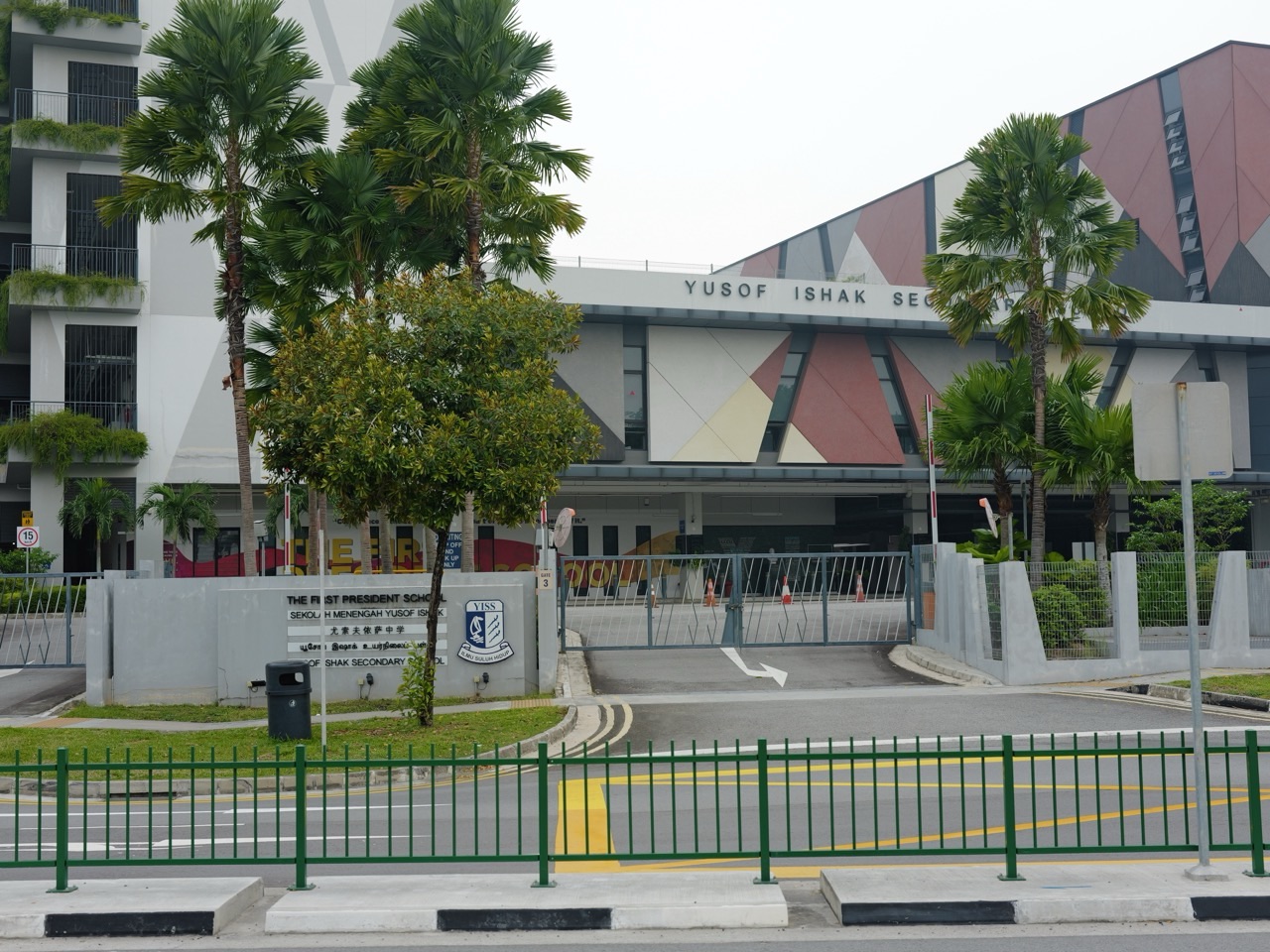
Yusof Ishak Secondary School is at 8 Sumang Walk, Singapore 828676, and the 2026 Secondary 1 intake had a published Posting Group 1 (PG1) PSLE Score range of 25–27. That historical result describes the 2025 PSLE cohort posted in 2026; the last admitted score of 27 is not a guaranteed admission threshold for students entering in 2027. The school is accessible through Punggol MRT and nearby Soo Teck and Sumang LRT stations, but individual routes should be tested. A family choosing schools in the 2026 PSLE posting exercise must check the child’s official PG1 eligibility and current MOE SchoolFinder information, rather than assuming a place because the school is within Punggol.
Yusof Ishak Secondary’s distinctive educational direction is sustainable smart-city STEM learning combined with character and youth leadership. Its S4TEM@YI Applied Learning Programme includes urban farming, coding, aeronautics and interdisciplinary sustainability projects, while YI LEAD+ encourages students to become honourable leaders who serve others. The school also publishes specific robotics and STEM opportunities, including selected CCAs and DSA talent domains. Under Full Subject-Based Banding, PG1 describes admission while G1, G2 and G3 describe academic subject levels; a pupil’s learning profile can be uneven across subjects. This guide explains what a 2027 family can verify about the school, how to distinguish ordinary STEM experiences from selective programmes, and how to assess the fit of its campus, teaching and commitments.
- School: Yusof Ishak Secondary School, 8 Sumang Walk, Singapore 828676.
- Transport references: Punggol MRT, Soo Teck LRT (PW7), Sumang LRT (PW6), and buses listed by the school.
- 2026 Secondary 1 PG1 historical admitted range: 25–27; final posted score: 27.
- 2026 past admission data does not determine the 2027 cut-off or individual admission outcome.
- ALP: S4TEM@YI, STEM for the Strategic Development of a Sustainable and Smart City.
- Published ALP experiences include urban farming, coding, aeronautics and sustainability.
- STEMx IPW links interdisciplinary learning with real sustainability questions.
- LLP: YI LEAD+, nurturing honourable leaders and active contributors.
- STEM Club, Robotics Club and DSA talent domains are separate from general school-wide ALP experiences.
- PG1 is the admission group; G1/G2/G3 subject arrangements require separate official confirmation.
Information reviewed 1 November 2026. Historical PG1 admissions describe entry in 2026 and are not final 2027 cut-offs. DSA 2026 dates and published activities must not be mistaken for new open applications.

Contents: Yusof Ishak PG1 School Guide
- 1. Definition Lock: PG1, G1 and Yusof Ishak Secondary
- 2. Reading the School’s 2026 PG1 Range Correctly
- 3. What Happens at PSLE Score 25
- 4. The Real Address and Punggol’s Western LRT Loop
- 5. The School’s Vision: Leaders for Tomorrow
- 6. S4TEM@YI: A Sustainable Smart-City ALP
- 7. What STEMx Interdisciplinary Project Work Means
- 8. Urban Farming and Learning to Care for Living Systems
- 9. YI AgriSphere and Learning Spaces
- 10. Coding and Logical Reasoning
- 11. Aeronautics and Engineering Design
- 12. STEM Club and Robotics Club Are Not the Same as the ALP
- 13. School Partnerships With Experts
- 14. Historical Competition Achievements Versus Future Opportunities
- 15. YI LEAD+: Honourable Leadership as a Daily Practice
- 16. Leadership Development and Community Service
- 17. Global Outlook Without Pretending to Know Everything
- 18. Full SBB: A Mixed Form Class, Different Subject Groups
- 19. G1 English and Communication in STEM
- 20. Mathematics and the Logic of Real Systems
- 21. Science: From Plant Growth to Evidence
- 22. Mother Tongue and Uneven Strengths
- 23. 2026 DSA Areas Are Real but Selection Is Separate
- 24. What STEMx Does Not Guarantee
- 25. How to Evaluate a School Visit
- 26. CCA Training and the Return Journey
- 27. Why Punggol Address Is Not an Admission Guarantee
- 28. A Fictional Student Interested in Smart Cities
- 29. A Fictional Student Who Wants to Serve
- 30. Prepare for a Real School Start After Allocation
- 31. A Practical Yusof Ishak Family Decision Sheet
- 32. What a Successful First Year Could Mean
Definition Lock: PG1, G1 and Yusof Ishak Secondary
PG1 is the national Secondary 1 posting category used to organise admission based on PSLE results and the current rules. G1 is an academic subject standard, alongside G2 and G3. Under Full Subject-Based Banding, new secondary students are no longer separated into the former fixed Express and Normal streams. A child may be admitted to Yusof Ishak through PG1, join a mixed form class and study different academic subjects at appropriate levels where eligibility allows.
The school uses the term Yusoffians for its students and describes a shared community of learners. A child’s actual subject combination is determined through school and MOE processes, not by the excitement of a robotics demonstration. Parents should keep the PSLE eligibility notice, final posting result and school-issued subject allocation separate. These documents answer different questions and prevent the admission code from becoming a permanent judgement on the pupil’s worth.
Reading the School’s 2026 PG1 Range Correctly
Published data for pupils entering Yusof Ishak Secondary 1 in 2026 shows a PG1 score range of 25–27. The final admitted PSLE Score was 27. These pupils had completed PSLE in 2025, and their admission results were shaped by the choices and vacancies of that specific intake. The numbers are descriptive history, not the outcome of the 2026 PSLE cohort entering Secondary 1 in 2027.
A family should use the historical range when thinking about competition, not to announce that the next year’s cut-off is fixed. Even a child who scores 27 cannot be promised an offer at Yusof Ishak merely because that was an earlier cut-off. MOE applies its current score and tie-break arrangements when limited places are contested. Use the individual eligibility notice and school profile to build a realistic list of genuine preferences.
What Happens at PSLE Score 25
A PSLE Score of 25 can give a pupil a choice of PG1 or PG2 under the current framework. That can affect which school-entry group is considered and the starting learning levels. The decision is not automatically solved by comparing two numbers. A child may be stronger in one PSLE subject than another, and the family needs to evaluate which school and curriculum route would suit their actual readiness.
When considering Yusof Ishak, read the correct historical score information for each permitted group separately. MOE’s ordinary Secondary 1 option submission applies the selected group to the listed schools according to its rules. Parents should not assume they can choose PG1 for one school and PG2 for another within a single submission. Ask the primary school or MOE when any part of the child’s eligibility is unclear.
The Real Address and Punggol’s Western LRT Loop
The school’s official contact page gives 8 Sumang Walk, Singapore 828676. It lists access via Punggol MRT and the nearby Soo Teck and Sumang LRT stations, as well as specified bus routes. The campus sits in a different part of Punggol from the established schools around Edgefield and Edgedale Plains. This geographic distinction matters to a family deciding whether the journey can be managed every day.
Test the actual morning trip using the child’s expected reporting time, then examine dismissal after CCA. A student living near Waterway Point, Punggol Coast or Nibong may need different walking and transport connections. Avoid inventing a universal journey time or claiming the school is equally close from every HDB block. A practical commuting plan supports sleep, punctuality, independence and the time available for schoolwork.
The School’s Vision: Leaders for Tomorrow
Yusof Ishak Secondary School presents a vision of developing Leaders for Tomorrow, with an emphasis on curiosity, creativity, confidence and contributing to the greater good. These goals can guide what parents look for in daily school life. A good leader is not only someone who speaks at assembly. Students need the capacity to reason responsibly, work with people and recognise the impact of their decisions.
Ask the school how pupils practise those qualities in ordinary lessons and shared activities. Does the child learn to ask questions when confused, consider a teammate’s perspective or explain a design choice? A statement on the website is useful background, but the family’s choice should be informed by what students actually do. School fit is about the environment the teenager will experience, not merely the attractiveness of the motto.
S4TEM@YI: A Sustainable Smart-City ALP
The school’s Applied Learning Programme is called S4TEM@YI: STEM for the Strategic Development of a Sustainable and Smart City. It integrates science, technology, engineering and mathematics with sustainability and community questions. Its official description connects the programme to Singapore’s environmental priorities and the MOE Eco Stewardship Programme. Students can encounter ideas through urban farming, coding, aeronautics and other age-appropriate learning experiences.
For a PG1 entrant, the ALP can make school subjects feel useful, but participation does not remove the need to understand English instructions or Mathematics concepts. A practical challenge should lead to questions about users, evidence and trade-offs. Parents can ask what problem the child is exploring and what measurements or observations matter. A colourful engineering display is only the visible end of a deeper reasoning process.
What STEMx Interdisciplinary Project Work Means
Yusof Ishak’s published STEMx IPW programme links knowledge from different areas of learning so pupils can understand issues that do not belong neatly inside one subject. The school connects this learning to sustainability, climate change and wider goals described by the Singapore Green Plan 2030 and United Nations sustainability agenda. The practical emphasis is making sense of a complex issue and developing informed responses.
A student might need to interpret a scientific observation, perform a calculation and explain the relevance to people in the community. Parents can encourage the pupil to distinguish facts from proposals. What is the actual evidence, what assumption was made and how could the idea be tested? Such reflection is useful at any academic G level and can help a pupil become more independent rather than simply memorising impressive environmental terminology.
Urban Farming and Learning to Care for Living Systems
The school’s official ALP descriptions include urban farming using soil and hydroponics. These activities can connect technology with the biological needs of plants, monitoring, resource use and responsible care. They also provide visible examples of why scientific observation matters. A pupil might learn that an attractive-looking garden does not by itself prove that one method is the most efficient or sustainable.
Ask the child what was measured and what changed over time. If an explanation goes beyond the observations, encourage them to acknowledge the uncertainty. Families do not need to build an expensive indoor farm to reinforce these habits. Ordinary conversations about water, plant growth and community use of space can be valuable, while specific school tasks should be left to its supervised programme.
YI AgriSphere and Learning Spaces
Yusof Ishak’s ALP information describes the development of its YI AgriSphere Lab and Garden learning spaces as part of its sustainability activity. Such settings can enable students to investigate environmental questions, practise technology-based monitoring and connect classroom ideas with something they can observe directly. A specialised learning space is valuable when it supports a clear learning goal, not merely because the equipment looks advanced.
Parents can ask what students are expected to understand after visiting the space. Does the activity involve interpreting data, designing an experiment or communicating a recommendation? Is it available to the full cohort or only to selected groups? A school publication may document a completed project or a past highlight; it should not be treated as a guaranteed 2027 itinerary for every new pupil.
Coding and Logical Reasoning
The school describes coding within its broad STEM experiences and has more focused technology activities through its clubs and selected programmes. Coding can help teenagers learn to express a sequence of decisions, recognise patterns and check errors. But using a digital device does not automatically mean a pupil understands the logic behind an application. Structured reasoning and clarity of instruction remain central.
A parent can ask the child to explain why a program produces a particular output and what would happen if one condition changed. Start with simple steps rather than purchasing expensive robotics kits. If the pupil makes mistakes, identify the first incorrect assumption. The goal is independent problem-solving. A PG1 child can develop these skills while continuing to work at the subject levels appropriate to their actual academic profile.
Aeronautics and Engineering Design
Yusof Ishak’s ALP and STEM Club materials describe aeronautics and unpowered glider design among learning opportunities. These can introduce ideas about stability, materials, aerodynamic principles and testing a prototype. A student may discover that making an object fly requires understanding both the design and the limitations of the trial. The educational value lies in revising the design based on evidence.
Families should not recreate unsafe flight or drone activities independently. Ask how the school supervises and what the pupil learned from testing. A simple explanation of the design aim, measurement and result can reveal more understanding than displaying a competition photograph. Opportunities in the STEM Club or selected competitions may have separate requirements and should not be presented as automatic for every PG1 entrant.
STEM Club and Robotics Club Are Not the Same as the ALP
The school advertises broader school-wide STEM experiences and also lists STEM Club and Robotics Club among its CCAs. The distinction matters. Introductory exposure to coding or urban farming does not automatically place a student into a selected team or competitive club. CCA participation can require a choice, a timetable commitment or separate selection based on school rules.
Ask which activities all students experience and which need registration, a trial or sustained training. A pupil may enjoy general STEM work without wanting to compete in robotics. Another may pursue a more demanding club when appropriate. Both are legitimate educational choices. Parents should avoid promising access to a competition merely because they saw it in a photograph on the ALP page.
School Partnerships With Experts
Yusof Ishak’s official programme page describes opportunities to learn from experts or participate in activities connected with organisations such as A*STAR, SUTD, SIT and NParks. These relationships can provide authentic examples of scientific and technological work. They do not make every secondary-school student a research employee or guarantee admission to the associated university.
When a workshop or learning journey occurs, ask what the student learned about the actual job or problem. Which skills did the professional use? What remained unfamiliar? Encourage realistic curiosity rather than career promises. A pupil might discover interest in engineering, biodiversity or design, but the first task is to strengthen their current reading, numerical and scientific foundations.
Historical Competition Achievements Versus Future Opportunities
The school publishes examples of STEM achievements and activities from 2024 and earlier years, including sustainability, robotics and engineering competitions. These records show that students have engaged with such opportunities, but they are not a contract promising the same placements or awards to every 2027 pupil. Competitions often have selected teams and eligibility conditions.
Parents should read the year beside every achievement, then ask whether similar opportunities currently exist and how students are prepared or selected. Celebrate authentic participation and skill development rather than demanding a trophy as proof of school quality. An ordinary student may learn a great deal from a class project without joining a national competition. The family should keep the child’s real interests and readiness in view.

YI LEAD+: Honourable Leadership as a Daily Practice
The school’s Learning for Life Programme is YI LEAD+, described as Nurturing Honourable Leaders for Tomorrow. The emphasis includes gratitude, respect, integrity, collaboration, growth mindset and a willingness to serve others. It aims to help students exercise positive influence among peers and the community. Leadership is therefore not limited to delivering speeches or wearing a badge.
A PG1 pupil can practise these qualities by helping a new classmate, contributing honestly to a group task and admitting when something needs correction. Parents can ask for concrete examples of responsible behaviour, not simply whether the pupil obtained a title. Meaningful leadership development can occur while a child is strengthening academic foundations. The Posting Group should never be used to imply that a pupil lacks the capacity for character or service.
Leadership Development and Community Service
YI LEAD+ describes training, authentic leadership experiences, reflection, school-based initiatives and community outreach. Pupils can learn to identify a need, coordinate with others and examine whether the contribution was helpful. These are practical capabilities. Some formal student-leadership roles and selected programmes may have particular criteria, so parents should not promise every child the same appointment.
A useful family conversation asks whose needs were considered, what the student did personally and what might be improved. Avoid treating beneficiaries of service as props for social-media photos. The purpose is empathy and responsible action. A child can learn to communicate respectfully with peers and community members, even if the activity never becomes a major award or a future admissions advantage.
Global Outlook Without Pretending to Know Everything
The LLP includes a global-outlook element, encouraging pupils to recognise that local decisions can be connected with wider issues. Sustainability, technology and community leadership all involve questions that extend beyond one school. A new Secondary 1 pupil does not need to sound like a diplomat to develop this awareness. They need to read carefully, compare perspectives and acknowledge evidence.
Parents can ask how a local Punggol issue might resemble or differ from a challenge elsewhere. What might work in one community but not another? Encourage clear reasoning and respectful listening. This helps develop critical literacy alongside the school’s broad leadership aims. A pupil can learn to think globally while continuing to manage ordinary school assignments at the appropriate academic level.
Full SBB: A Mixed Form Class, Different Subject Groups
Under Full Subject-Based Banding, new entrants may be grouped in mixed form classes for shared school life while studying some academic subjects in groups based on the level they offer. A child entering Yusof Ishak through PG1 may therefore have classmates with different English or Mathematics books. The school will explain the actual timetable and approved subject levels during transition.
Parents should present this as a normal feature of secondary education, not a hierarchy of children. The pupil needs to know how to locate lessons, track homework and ask the correct teacher for help. Friendships can develop through form-class activities and CCAs regardless of G levels. The goal is an inclusive school community in which students recognise varied strengths and learn at the standards appropriate to them.
G1 English and Communication in STEM
A child can be curious about robotics while needing help with English comprehension or writing. STEM projects rely on accurate reading of instructions, explanation of evidence and clear communication with a team. Those skills do not arise automatically from assembling a device. A pupil studying G1 English may need explicit practice with vocabulary, sentence structure or organising a short response.
Ask the child to explain a project in their own words: what problem was addressed, what action was taken and what result was observed? If the explanation is confused, identify the specific language bottleneck. A targeted learning plan is more useful than simply assigning harder worksheets. Any higher subject-level option must follow actual readiness and school criteria, not enthusiasm for a technological activity.
Mathematics and the Logic of Real Systems
Urban farming measurements, coding sequences and engineering designs can involve ratios, units, graphs and calculations. G1 Mathematics provides a foundation for interpreting quantities reliably. A pupil who misreads a scale or confuses centimetres and millimetres may reach an incorrect practical conclusion even if the idea behind the project is good.
Parents can ask the student to estimate and then verify. Which unit was used? Does the number make sense in this situation? If an error recurs, repair the concept before adding more advanced material. The school’s technology emphasis may motivate academic practice but does not automatically move a pupil from G1 to G2 or G3. Progress should be judged by independent reasoning over time.
Science: From Plant Growth to Evidence
Sustainability activities offer opportunities to practise observation, fair comparison and explanation. A pupil may see a change in plant growth and immediately attribute it to one factor. Scientific reasoning requires considering other conditions, measurement reliability and whether the conclusion is supported. This is useful both in the school’s ALP and in formal Science tasks.
Ask what was observed directly and what was inferred. Encourage the child to describe the limitations of the result. A strong scientific explanation can be short and precise. It is not necessary to create a hazardous home experiment or buy specialist equipment. The important learning is how to connect evidence with a conclusion, at the subject level the student is actually studying.
Mother Tongue and Uneven Strengths
One PG1 pupil may communicate confidently in Mother Tongue yet struggle with English writing; another may have a strong mathematics foundation and need more language practice. Full SBB’s subject-specific approach means such differences should be considered accurately. The school can advise on the actual academic levels and opportunities permitted by the child’s results and prevailing criteria.
Families can support language through meaningful conversation and reading while seeking teacher feedback on formal tasks. Avoid assuming that every subject must be pushed to a higher level because the child excels in one domain. Equally, do not ignore a real language strength because of a modest overall PSLE aggregate. The best programme matches challenge and readiness separately for each subject.
2026 DSA Areas Are Real but Selection Is Separate
Yusof Ishak’s official DSA-Sec page for admission to Secondary 1 in 2027 lists talent areas including Community Youth Leadership, Modern Dance, Robotics, STEM and several sports. Its 2026 selection and preference windows were scheduled before 1 November 2026. These details are relevant when interpreting existing offers, but parents should not treat the closed 2026 application window as still open.
DSA requires the participating school’s own assessment and the pupil’s qualifying PSLE Posting Group eligibility. A student admitted through a final DSA allocation has a commitment to the chosen school. An ordinary PG1 applicant who has no DSA place should follow the national six-school posting process. Participation in a school STEM workshop is not a guarantee of DSA or permission to ignore academic admission requirements.
What STEMx Does Not Guarantee
Yusof Ishak’s published STEMx programme describes many ways to encounter science and technology, but not every pupil will necessarily join every specialised workshop, competition or partnership event. Some experiences are broad school activities; others are selected extensions. The distinction is important for parents who see competition photographs and assume a new Secondary 1 child will immediately attend all of them.
At a school visit, ask which activities are ordinary lower-secondary experiences and how pupils can explore further interests. What are the selection conditions for a STEM CCA? How does the school support a beginner who has not learned coding? A truthful explanation of actual opportunities helps a family understand fit better than a list of famous organisations printed without context.
How to Evaluate a School Visit
A visit to Yusof Ishak is useful for understanding the physical campus, student culture and explanations of its programmes. Ask about first-year orientation, Full SBB subject groups, the actual ALP timetable and how student leaders receive training. Let the child ask whether their preferred club or activity is available and how new members join.
Do not judge everything from a single display of robotics or a well-rehearsed school performance. Try to understand what ordinary school days feel like and whether the child can access appropriate support. Note unanswered questions and follow up through the official school contact rather than guessing. A visit informs preference; it does not produce a reserved PG1 place.
CCA Training and the Return Journey
The school’s CCAs can involve regular participation beyond classroom hours. For example, the official STEM Club page describes weekly training and additional sessions for certain competitions in its published arrangements. Parents should confirm the actual schedule for the child and current year; a timetable on a website may change. The commute from Sumang Walk after a late activity needs more attention than a simple morning map.
Build a realistic week with travel, meals, homework, sleep and CCA commitments. A student who loves a technological field might still need to limit additional activities while establishing academic routines. Sustainable participation is more valuable than enrolling in every advanced workshop. The child’s wellbeing and practical capacity are part of education quality, not distractions from it.
Why Punggol Address Is Not an Admission Guarantee
The school’s location within Punggol can make it convenient for some families, but ordinary S1 posting does not grant an automatic place to every nearby resident. The pupil’s official score, eligible Posting Group, choices, vacancies and relevant national tie-break rules govern allocation. A past PG1 cut-off of 27 does not establish a fixed threshold that MOE must repeat for the next cohort.
Use the current SchoolFinder profile and build a genuinely ranked list of eligible schools. A school should be preferred because its learning environment, programmes, travel and support suit the pupil. Families should prepare other acceptable options rather than rely on a prediction that no one can verify until the actual posting exercise concludes.
A Fictional Student Interested in Smart Cities
Imagine a Punggol pupil with PG1 eligibility who is fascinated by how buildings, transport and gardens can work together. The family researches Yusof Ishak because of S4TEM@YI, reads its official programme description and checks the school’s past score range without assuming admission. The child is interested in coding but still finds long written instructions difficult.
If the pupil later attends, a sustainability project might provide motivation to read instructions carefully and explain a small program. The parents support that learning through clear questions rather than completing the task for the student. This is a fictional teaching example, not a testimonial or a guarantee of any particular 2027 workshop. Its lesson is that STEM curiosity can coexist with real academic support needs.
A Fictional Student Who Wants to Serve
Another pupil enjoys helping younger children but has not held a formal leadership title. The family likes YI LEAD+ and asks what student development looks like for newcomers. They learn to distinguish general values education from selected leadership roles. The child’s contribution is assessed through actual behaviour, not by assuming PG1 students can or cannot lead.
After joining a suitable activity, the teenager discovers the importance of listening before proposing a solution. They may still need help with Mathematics and reading, but their community contribution is meaningful in its own right. The case illustrates a balanced view of education: academic progress and character development matter together, without being the same assessment or an automatic promise of a student council role.
Prepare for a Real School Start After Allocation
Once a Yusof Ishak place is formally confirmed, read the current joining and reporting instructions. Confirm the exact campus at 8 Sumang Walk, uniform, textbooks, subject-level combinations and digital school arrangements. If the child is offered an academic subject at a different G level, buy the correct resources according to school instructions instead of guessing from the original Posting Group.
Practise the actual journey and help the student understand who the form teacher is, where assignments are communicated and how to seek help. Allow the first month to establish routines and relationships. Multiple new activities and private tuition classes can overwhelm a child before their real learning needs have been diagnosed. A steady start lets family and teachers see where targeted support is most useful.
A Practical Yusof Ishak Family Decision Sheet
Record the child’s actual Posting Group eligibility, Yusof Ishak’s correctly dated 2026 historical PG1 score, current programme descriptions, tested transport route and important unanswered questions. Under programmes, separate school-wide S4TEM@YI experiences from selected STEM Club or DSA opportunities. Under learning, note the child’s strengths and specific support needs rather than simply writing a general ability label.
Ask the teenager which part of the school appeals most and what they would actually enjoy practising repeatedly. Compare the same criteria with other eligible campuses. This worksheet is a thinking aid, not an official admissions calculator. The best list contains genuinely acceptable schools and acknowledges uncertainty about the next cohort’s vacancies.
What a Successful First Year Could Mean
A meaningful first year at Yusof Ishak might include improved confidence reading instructions, better Mathematics working, stronger friendships and thoughtful participation in a sustainability or leadership activity. The student might become able to explain how a simple system works or why a community project needed a change. These are important results even without winning a robotics prize or changing every academic subject level.
At year-end, compare a piece of independent work from the beginning of the year with a recent task. Ask what the child can now explain and organise without assistance. Discuss subject-level reviews with teachers using the actual school criteria rather than status anxiety. PG1 was the route into school; the real education is the growth that occurs through learning, responsibility and the opportunities the child uses.
Frequently Asked Questions
Where is Yusof Ishak Secondary School?
8 Sumang Walk, Singapore 828676, with Punggol MRT and Soo Teck and Sumang LRT among the transport references listed by the school.
What was the 2026 PG1 cut-off?
The final PG1 posted score was 27 for the 2026 Secondary 1 intake, within a historical admitted range of 25–27.
Does a score of 27 guarantee admission in 2027?
No. It is the previous intake’s result and cannot guarantee next year’s vacancies or selection.
What is S4TEM@YI?
The school’s Applied Learning Programme focused on STEM for the Strategic Development of a Sustainable and Smart City.
What kinds of projects are mentioned?
Its official programme describes urban farming, coding, aeronautics, interdisciplinary sustainability learning and selected STEM experiences.
What is YI LEAD+?
The school’s Learning for Life Programme, developing honourable leaders, teamwork, service and contribution to the greater good.
Is the STEM Club compulsory for PG1 pupils?
No blanket assumption should be made. The school distinguishes broader ALP experiences from club membership and selected opportunities.
Is PG1 the same as taking all subjects at G1?
No. PG1 is the entry route, while academic subject levels depend on Full SBB eligibility and school decisions.
Can a child enter by DSA?
The school lists specific DSA talents and eligibility conditions. The 2026 application window for 2027 entry had already passed by November 2026.
Does living near Sumang Walk give admissions priority?
Not automatically. Ordinary Secondary 1 posting follows the prescribed national criteria and tie-break rules.
Does a STEM achievement automatically move a child to G2 Maths?
No. Academic level changes depend on separate educational criteria and demonstrated readiness.
What should parents verify before making the school list?
The official eligibility notice, current SchoolFinder data, real daily commute, programmes, CCA expectations and student support.
Official Sources and Your Next Step
- Yusof Ishak Secondary — Official Contact and Transport
- Yusof Ishak — S4TEM@YI Applied Learning Programme
- Yusof Ishak — YI LEAD+ Learning for Life Programme
- Yusof Ishak — STEM Club Activities
- Yusof Ishak — DSA 2026 for Secondary 1 Entry in 2027
- MOE SchoolFinder — Current PG1 School Information
- MOE — Secondary 1 Posting
- MySkillsFuture Student Portal — Yusof Ishak School and 2026 Score Range
- eduKatePunggol — Compare Local PG1 School Options
Your next step: Check official PG1 eligibility and the current Yusof Ishak SchoolFinder profile, then compare S4TEM@YI, YI LEAD+, actual subject support and the journey to Sumang Walk with other schools the child would genuinely accept.


