
For a Punggol family whose child is eligible for Posting Group 1 (PG1), the practical task is to find secondary schools that can actually be considered under the child’s official eligibility, then compare the school experience rather than a single ranking. Start with MOE SchoolFinder, filter for the student’s permitted Posting Group, read each school profile, and check current admission information. Punggol’s four established mainstream secondary schools—Edgefield Secondary, Greendale Secondary, Punggol Secondary and Yusof Ishak Secondary—are natural local starting points, but they must not be described as four guaranteed PG1 offers. Some families will need or prefer to consider schools in surrounding estates.
PG1 is an entry group, not a permanent stream. A qualifying PSLE Score of 26–30 carries English and Mathematics conditions in the current framework; Score 25 can permit a PG1/PG2 choice. When choosing schools for the 2027 Secondary 1 intake, the 2026 Primary 6 family must use its actual eligibility notice and the current MOE instructions. Previous schools’ cut-off points describe earlier posting exercises, not next year’s reserved seats. The best shortlist therefore combines eligible school profiles, true family preference, subject support, travel, programmes, CCAs and the child’s readiness for daily school life.
- Confirm the student’s PG1 or dual-PG eligibility from the official PSLE posting notice.
- Explore eligible schools through current MOE SchoolFinder rather than a fixed online ranking.
- Begin with Edgefield, Greendale, Punggol and Yusof Ishak Secondary, then widen the search when appropriate.
- Read PG1 admission information for the correct intake and do not use a PG3 cut-off for a PG1 decision.
- Compare subject levels and school support under Full Subject-Based Banding.
- Measure real morning journeys and the later return journey on CCA days.
- Ask the child which programmes, CCAs and school culture they would actually engage with.
- Rank six genuine preferences; choice order matters in the specified tie-breaking situation.
- Treat prior cut-offs as history, not a guarantee; check annual MOE instructions and deadlines.
Information checked 1 November 2026. This is a PG1-specific school research guide, not a ranking, vacancy announcement or application service.
Contents: A Practical PG1 School-Choice Route
- 1. School Options Definition Lock: Eligibility Comes Before Preference
- 2. What Are the Four Punggol Secondary Schools?
- 3. Edgefield Secondary: What PG1 Families Should Investigate
- 4. Greendale Secondary: Look at Learning and Activities
- 5. Punggol Secondary: Everyday Education, Not Just a Name
- 6. Yusof Ishak Secondary: Understand the Particular Fit
- 7. When to Widen the Search Beyond Punggol
- 8. Use SchoolFinder as a Research Tool, Not a Predictor
- 9. The Difference Between a Past Cut-Off and Actual Eligibility
- 10. A Six-School List Must Represent Real Preferences
- 11. Why School-Choice Order Matters but Does Not Override Score
- 12. A Commute Audit for Punggol Families
- 13. School Culture: The Questions a Prospectus Cannot Answer Alone
- 14. Full SBB Subject Support Should Be on the Checklist
- 15. Compare CCAs as Real Weekly Commitments
- 16. What to Ask During a School Open House
- 17. A Family Decision Matrix That Stays Honest
- 18. A Sample Shortlist for an Imaginary Punggol Pupil
- 19. What to Do if the Family’s Preferred School Is Unavailable
- 20. How to Evaluate Support Without Stigmatising a Child
- 21. How to Prepare for the 2027 Secondary 1 Start
- 22. The Real Test of a Good PG1 School Choice
School Options Definition Lock: Eligibility Comes Before Preference
A school may be nearby, well liked and prominently recommended by friends without being a workable choice for a particular child. Secondary 1 posting begins with the child’s official PSLE and Posting Group eligibility. For a PG1 family, this means looking at the PG1 entry route at each school, not the general reputation of the campus and not its PG3 historical score range. SchoolFinder is designed to organise this comparison. The admission framework then considers the pupil’s score and choices against actual available places. A family shortlist is useful only after the school’s current information is read in the right context.
The choice between “I love this school” and “I can apply through this route” should be visible on paper. Make two columns before researching anything else: schools worth investigating and schools eligible for this child according to the official system. A school can appear on the first list without automatically entering the second. If a PSLE Score of 25 gives a PG1/PG2 choice, investigate each permitted option as a separate complete posting decision; MOE’s application guide says the selected group applies across the school list. The aim is to avoid promising a child a place that the available evidence does not support.
What Are the Four Punggol Secondary Schools?
The established mainstream secondary-school landscape within Punggol consists of Edgefield Secondary School, Greendale Secondary School, Punggol Secondary School and Yusof Ishak Secondary School. They serve families across different parts of the town and offer their own identities, teaching approaches, facilities and programmes. A school should be evaluated as a real community where a pupil will spend school mornings, afternoons and CCA sessions. Listing the four together does not mean they all have identical PG1 vacancies, identical subject combinations or identical cut-off points.
Parents can use local location as the beginning of a search, not its end. A child living near a Punggol LRT stop may find one Punggol campus easy to reach while another involves changes or a substantial walk. A family near Punggol Coast may make different transport calculations from a family near Oasis or Kadaloor. Then there are friendships, siblings, CCAs and subject arrangements. Build a school fact sheet based on the current SchoolFinder entry and official school site, leaving blank any information that has not been verified. Blank is more honest than guessed.
Edgefield Secondary: What PG1 Families Should Investigate
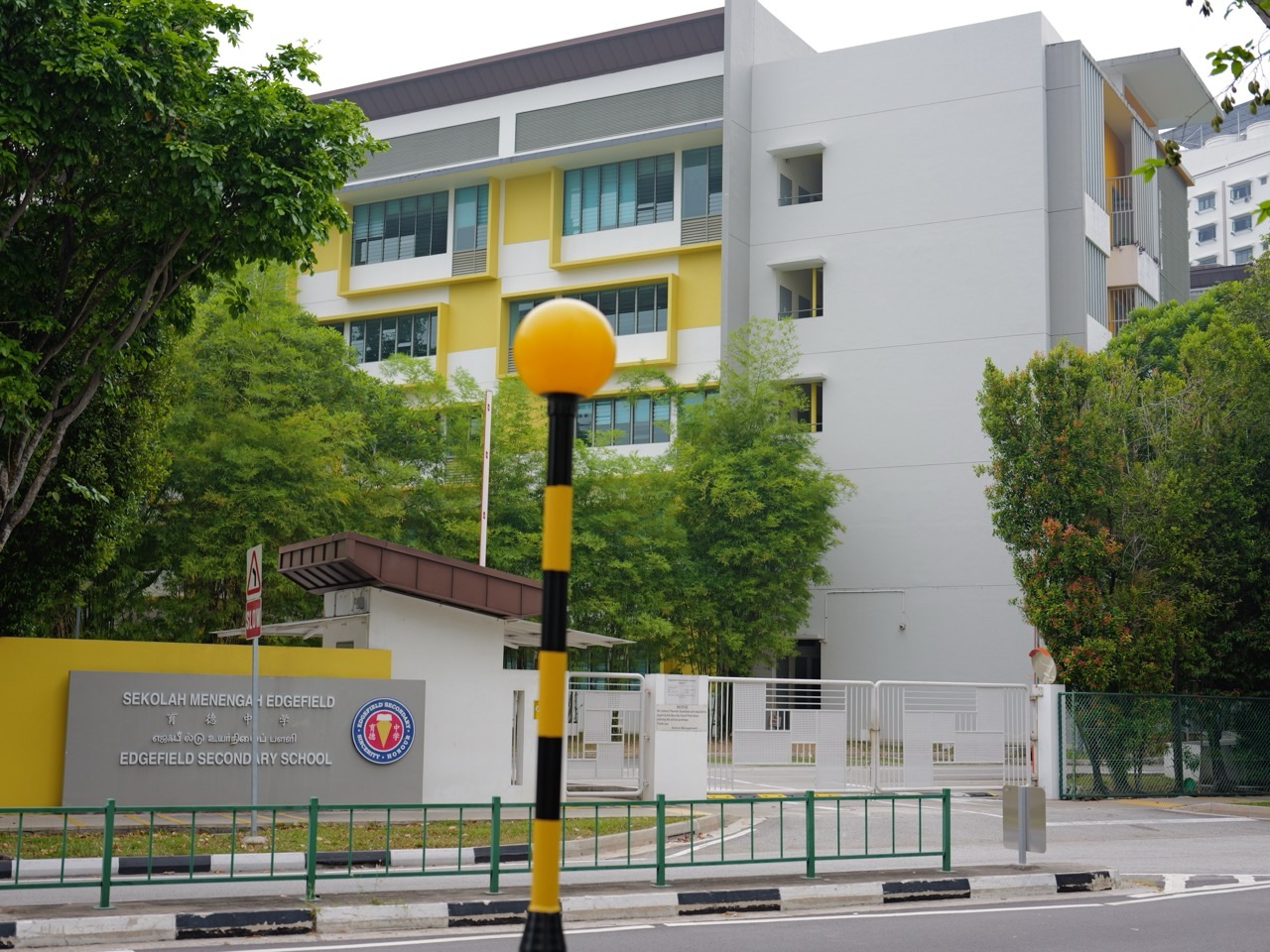
Edgefield Secondary School is one of the local Punggol schools worth examining through its current official profile. The school’s identity includes entrepreneurial thinking and student development, but parents should look beyond attractive programme names to what a Secondary 1 child actually does in the classroom. Is the student interested in collaborative projects or practical problem-solving? Can teachers explain the G-level subjects the pupil will start with? Which CCAs are offered in the relevant year? How does the school orient new students who may need extra support with language, Mathematics or executive routines?
Edgefield’s presence in Punggol is useful for location planning, not proof of a current PG1 place. If the school is on the family shortlist, inspect the applicable Posting Group row in SchoolFinder and read the school’s recent admission and programme information. Ask about daily arrival and dismissal points, parent communication and the practical transition into mixed form classes. Where possible, visit on an official open house rather than interpreting the look of a school gate as a guide to educational quality. A photograph can help recognise a campus; it cannot tell you whether the child will be posted there.

Greendale Secondary: Look at Learning and Activities
Greendale Secondary School provides another distinct starting point for Punggol families. Its publicised learning interests have included design, technology, engineering and outdoor adventure. A PG1 parent should translate those descriptions into questions about ordinary schoolwork: how are students taught to explain a design? What writing and number skills are practised in practical projects? Can a pupil who learns best through doing receive suitable guidance while strengthening literacy and numeracy? These questions turn a brochure description into an assessment of learning fit.
The family should also inspect the school’s actual timetable structures, support arrangements and CCA choices for the applicable year. A child who enjoys outdoor activity may connect strongly with a school’s culture, but the weekly journey and homework demands still matter. Ask how new students learn digital platforms, how teachers respond when a pupil has missed a concept, and what options exist when a subject strength develops. Confirm PG1 admission through current official data. Do not treat a programme that sounds appropriate as evidence that the school has an open PG1 vacancy or that the pupil has been accepted.

Punggol Secondary: Everyday Education, Not Just a Name
Punggol Secondary School deserves its own careful examination rather than automatic preference because its name matches the estate. Its school experience has publicised environmental education and youth leadership, themes that can connect Science, observation, community responsibility and practical projects. For a child entering through PG1, parents might ask how a project is scaffolded for pupils with differing reading and mathematical needs. Can students contribute with practical work and clear explanation? Is the teaching sequence explicit enough for a learner who finds long text challenging?
A school that offers meaningful leadership opportunities can be excellent for a quiet teenager who wants to build confidence as well as for a confident one. The decisive evidence lies in what the school currently offers, which opportunities the child can realistically pursue, and how the learning atmosphere feels to the family. Compare journey times carefully: the closest-looking campus on a map may not be closest by a sensible bus or walking route. Check the school’s published PG1 information through MOE, then decide whether it is a genuine preferred choice.

Yusof Ishak Secondary: Understand the Particular Fit
Yusof Ishak Secondary School has a Punggol campus and a distinct identity including sustainability-related STEM and leadership development. Those opportunities can appeal to pupils who like making, testing and improving things, but they should be understood as school-wide learning possibilities rather than a promise of a particular PG1 subject or course. Ask which parts are compulsory, which are enrichment and which require selection. Read the school’s current Secondary 1 information, check its subject-level options, and discuss how a student new to secondary school would be supported in lessons and activities.
A Yusof Ishak comparison should include the same honest checks used for every other school: applicable PG1 entry information, programmes, facilities, CCA preferences, travel, health and home commitments. The goal is not to declare one Punggol school objectively better than the other three. Different children may thrive in different cultures. If the pupil enjoys a school visit or connects strongly with a particular activity, give that experience appropriate weight, then set it beside the actual posting eligibility. Both emotional fit and admission facts are relevant; neither replaces the other.

When to Widen the Search Beyond Punggol
Punggol is a town boundary, not a legal obligation to attend a school within it. A family may find that a suitable school in Sengkang, Hougang or another accessible estate matches the child’s eligibility and interests better than the initial shortlist. Widening the search is particularly important if historical PG1 cut-off information suggests that some nearby schools had more competition than the pupil’s score would comfortably address. It is not sensible to assume that a high qualifying score within PG1 will secure one of four local places merely because those schools are geographically near.
Use SchoolFinder to discover the actual range of schools the child may consider, then narrow by a manageable journey rather than a rigid kilometre circle. A single convenient bus could make a school outside Punggol easier than a campus requiring multiple transfers inside Punggol. Think about rain, crowded vehicles, school dismissal times and the child’s ability to travel independently. The best expansion is specific: identify a school, verify eligibility, examine its published learning offer and test the commute. Do not add a school purely to fill a list with unfamiliar names.
Use SchoolFinder as a Research Tool, Not a Predictor
SchoolFinder is the primary official discovery tool for comparing Singapore schools by admission details, locations, programmes, subjects and CCAs. Begin with the child’s correct Posting Group rather than searching only by school name. Read the current information for each school and record the date you checked it. Some programme information may require confirmation with the school, especially when subject combinations and cohort arrangements change. An online profile is an important source; it is not an undertaking that every listed feature will be open to every student in every class.
Do not convert the previous year’s cut-off into a probability such as “85 per cent chance” without reliable admissions data and a valid model. The information does not support that precision. Similarly, a school’s historical score range reflects actual admitted pupils in a previous exercise; it does not tell you the next cohort’s exact preferences. A useful parent worksheet has fields labelled confirmed, historical and ask school. Separating these evidence types is a simple discipline that protects a child from overconfident promises.
The Difference Between a Past Cut-Off and Actual Eligibility
PG1 eligibility is a feature of the individual PSLE result under MOE rules. A school’s historical PG1 cut-off describes admission demand and available places in a previous exercise. They are not the same fact. A child can be eligible for PG1 in principle yet still find that particular schools were historically highly competitive for that group. Conversely, a historical cut-off that appears accommodating does not guarantee a place next year. Both statements can be true without any contradiction.
When comparing figures, record the intake year clearly: for example, a historical range describing students entering Secondary 1 in 2026 comes from the preceding PSLE cohort, not from the group entering in 2027. Read the PG1 column, note whether affiliated or non-affiliated arrangements are relevant, and verify the source. Resist a spreadsheet that hides uncertainty under green “safe” labels. If the family needs to decide quickly after results day, a clearly dated set of facts is more valuable than a decorative ranking with uncertain provenance.
A Six-School List Must Represent Real Preferences
Under the ordinary S1 Posting Exercise, families may submit up to six school choices in order of preference. The order has practical meaning in tie-breaking after PSLE Score and citizenship are considered. If two otherwise comparable students with the same score compete for a final place, choice order can affect the outcome before computerised balloting. Parents should therefore avoid ranking a school higher merely because they imagine that every application gives a separate first-choice advantage. Understand the actual matching rules, then put genuinely preferred schools higher.
The list should also have breadth. MOE advises families to consider a range of schools that fit the child’s score and interests, rather than selecting only schools with very similar previous-year results. That does not justify a rigid “two dream, two match, two safe” formula; no formula can guarantee the next intake. Ask whether the family would be willing and able to attend every listed school. A sixth choice is not a throwaway field. For a PG1 pupil, a realistic range of acceptable learning environments is more useful than a list designed to impress a relative.
Why School-Choice Order Matters but Does Not Override Score
The PSLE score and the applicant’s eligibility remain central to S1 posting. Parents sometimes hear that a school placed as first choice is automatically more likely to accept a weaker score than a school placed second. That is not a correct way to understand the system. Choice order matters at a particular tie-break point involving the same score and other conditions; it does not erase the larger merit-based framework. Other features such as affiliation or Higher Chinese considerations can be relevant in applicable cases and should be checked through MOE.
For planning, the family should make the ranked list according to where the child most wants to go among schools the family is willing to accept. Then use the correct historical data to recognise uncertainty. This combination is more defensible than a trick that claims to reverse the rules of allocation. When comparing two schools, ask whether the preference is strong enough that the child would still favour that school if both were available. If the answer is no, revisit the ordering before submitting the application.
A Commute Audit for Punggol Families
A school day begins before the first lesson. Travel affects sleep, preparation, lateness, lunch, homework and family time. Punggol’s LRT network, bus connections and walking routes make some journeys convenient and others unexpectedly complicated. A route that looks easy on a smartphone at midday may be crowded or slow during morning school hours. Test the actual trip at a realistic time. Include the walk from home, access to the stop, waiting time, transfers and the final walk to the gate.
Do a second test for a CCA afternoon, when the child may leave school later and with heavier equipment. Think about the frequency of missed connections, rain shelters, safety at crossings, and who can help if the pupil feels unwell. A parent who travels with the child for an initial test should also ask whether the child can repeat it independently. Do not invent a universal maximum journey duration; households have different constraints. Record real observations, discuss them with the child, and include them in the school comparison rather than treating travel as an afterthought.
School Culture: The Questions a Prospectus Cannot Answer Alone
A prospectus lists values and programmes, but parents also need to understand how those values are experienced. Observe how staff explain expectations to new students, how the school talks about academic progress and whether information for families is accessible. Ask what happens when a pupil struggles with an assignment, has a friendship problem or cannot find the correct lesson room. Look for clear processes rather than a claim that one school contains no difficulties. Every school has challenges; a reliable response to them matters.
A quiet student may want an environment where asking for help does not feel embarrassing. An energetic student may benefit from varied activities and firm routines. A pupil with existing support needs may require coordination between classroom teachers, parents and specialist staff. Ask respectful, specific questions about support without expecting schools to disclose other students’ private experiences. When visiting, let the child ask at least one question. The best indicator of fit is often whether the pupil can imagine participating in everyday school life rather than only admiring the facilities.
Full SBB Subject Support Should Be on the Checklist
Posting Group 1 guides initial subject levels, but Full Subject-Based Banding gives schools more flexibility to teach at the appropriate subject level. Families should ask which G1 subjects a Secondary 1 student would take, whether any subjects could be offered at G2 according to performance and eligibility, how subject-level adjustments are reviewed, and which staff can advise. The answers may differ according to individual results, school implementation and available class arrangements. Do not infer that every named subject or higher-level option is automatically open.
The goal is a coherent timetable and sustained learning, not the maximum number of difficult subjects. Ask the child which parts of Primary 6 felt understandable and which remained confusing even after practice. Bring that information to the first parent-teacher conversation. If English comprehension is the bottleneck, stronger reading habits may improve performance across several subjects. If Mathematics reasoning is difficult, targeted foundational teaching may be more useful than extra worksheets. A school’s support should be evaluated through the actual mechanisms it provides rather than a vague promise that “all students can move up”.
Compare CCAs as Real Weekly Commitments
A co-curricular activity is not a footnote to academic posting. It can be where a student builds friendships, practises leadership, discovers a genuine strength and feels motivated to attend school. But not every listed CCA is open to every pupil in every year, and some have trials, selection processes or practical equipment requirements. Check the school’s current offerings and how new pupils join. Discuss at least two activities with the child rather than selecting one based solely on the family’s idea of what looks impressive.
Calculate the week with the CCA included. A child may attend school early, finish lessons, spend several hours in an activity and reach home considerably later than on an ordinary day. That changes how much time remains for homework, family responsibilities and rest. If tuition or outside training is added, the combined schedule may become demanding. The right school should support the child as a learner and a young person with interests. A good CCA choice is not an argument for ignoring an excessive commute or unmanageable weekly load.
What to Ask During a School Open House
An open house is most useful when families arrive with prepared questions. Ask a current teacher how Secondary 1 orientation works, what a typical timetable looks like, how subject classes are organised under Full SBB and which channels parents should use for questions. Ask about teaching resources, learning support and what happens if a student is absent. Then ask a student guide what they wish they had known before starting there. The response will be personal, not a formal admissions guarantee, but it may reveal the ordinary texture of school life.
Keep the visit respectful and efficient. Admissions personnel may not be able to predict a PG1 cut-off before the posting exercise or confirm vacancies from the appearance of a crowded hall. Write down the exact question that remains unresolved and the official contact channel through which it can be answered. Distinguish helpful first-hand impressions from confirmed policies. After the visit, let the child rate the school against their own needs: where did they feel interested, welcomed and ready to try? That conversation should happen before relatives’ opinions overpower it.
A Family Decision Matrix That Stays Honest
A simple comparison table can include school name, verified PG1 information, commute, subject support, programmes, CCAs, open-house impressions and outstanding questions. Use words such as confirmed, historical, preferred and unknown. Resist the temptation to assign invented numerical probabilities. Parents can assign personal priorities—for example, manageable travel or specific support—without pretending that a weight multiplied by a score predicts the posting result. A family decision matrix is a thinking aid, not a substitute for MOE’s allocation process.
Each parent and child should first review the table separately. When they disagree, ask what evidence would change either person’s mind. If the child chooses a school because a friend applied there, explore whether the programme and commute would still appeal if that friend were posted elsewhere. If a parent prefers a school because of reputation, ask which specific characteristics match the pupil’s learning needs. This process turns a potentially emotional discussion into a respectful comparison without erasing the child’s voice or promising a certainty the family cannot possess.
A Sample Shortlist for an Imaginary Punggol Pupil
Consider a fictional twelve-year-old living near a Punggol LRT stop, with an official PG1 eligibility notice and a particular interest in hands-on projects. The family initially researches four Punggol schools because they know the estate. They then discover that some historical PG1 admission information may be less favourable than expected, so they expand the investigation to a few accessible schools outside Punggol. The new shortlist is not an admission forecast. It is a set of properly researched possibilities that can be checked against current MOE information.
The child expresses a preference for a school with practical activities and a travel route that feels straightforward. The family tests the commute, reads the CCA list and contacts an official school channel about subject-level support. They make a six-school order containing schools they would genuinely accept, not a sequence of bets on guessed cut-off points. This example does not identify a winning school because the student’s actual score, citizenship and the next year’s vacancies are not known. Its purpose is to show a reliable research method.
What to Do if the Family’s Preferred School Is Unavailable
A school preference can be strong without becoming an entitlement. If the posting result is not the family’s first choice, read the allocation notice carefully and follow the reporting instructions for the posted school. Ask MOE and the relevant school about the current rules for any permissible appeal, recognising that eligibility, vacancies and school criteria still apply. Do not encourage a pupil to skip orientation or delay preparing for the posted school while waiting for an uncertain outcome. The child needs an actual functioning start.
The emotional conversation matters as much as the administrative steps. Give the student space to be disappointed while keeping the language factual: “We ranked this school because we liked it; the posting result is different, and now we will learn about the school offered.” Find out what that school provides, plan a travel route and identify one activity the child might look forward to. Do not imply that a less familiar campus is a lesser life. An early sense of belonging often grows through classmates, teachers and daily routines rather than the original preference order.
How to Evaluate Support Without Stigmatising a Child
PG1 students are not a single learning profile. Some may need more explicit reading instruction, some have difficulties with number operations, and others show strong practical reasoning while struggling with long written tasks. When researching a school, ask about the ordinary support any new Secondary 1 student can receive: clear feedback, teacher consultation, home-school communication, learning resources and advice on next steps. Where there are specific needs, contact the school through appropriate private channels. Do not ask staff to compare your child with identifiable pupils.
A good support question describes a task instead of attaching a broad label. “My child understands a Science demonstration but struggles to write the explanation: how does the school teach this skill?” is more actionable than “Is this a school for weaker students?” Similarly, a teacher can better respond to a sample Mathematics error than to a demand that all subjects immediately be moved to G2. Keep the child’s dignity central. The family is evaluating how teaching and support will work, not seeking a permanent judgement on ability.
How to Prepare for the 2027 Secondary 1 Start
For pupils completing PSLE in 2026, the next school year begins in 2027. Exact application and reporting dates should come from the annual MOE announcements, not from a copied 2025 calendar. After the posting results, read the school’s official reporting instructions, uniform and booklist information, device arrangements, CCA orientation plans and any forms that are actually required. Check whether the school communicates through a parent portal, messaging channel or student account. Make a small household checklist without buying extra materials that were not requested.
A useful first-week practice is to walk through the journey once, pack the child’s bag together and ask how they will seek help if they become lost or confused. Let the pupil take increasing responsibility for the timetable and assignments while remaining available. Set an uncomplicated weekly check-in: what went well, which task was difficult and who could help? The goal is not to begin Secondary 1 already rehearsing four years of national examinations. It is to establish the independence and belonging that make long-term education possible.
The Real Test of a Good PG1 School Choice
A sensible decision is one the family can explain without claiming a guaranteed outcome: “This is an eligible school we would be pleased to attend, with a manageable journey, suitable subject arrangements and activities that interest our child.” The family should know why the school ranks above another and which parts of the information remain uncertain. That is an intellectually stronger position than announcing a school is certain because its previous cut-off looks favourable. It is also kinder to the pupil, who does not control the admissions algorithm.
After the child starts, evaluate the choice through the experience rather than the badge. Are school routines becoming manageable? Does the student have adults to approach? Is learning progressing in English and Mathematics? Are friendships and interests developing? If an area needs attention, ask for a specific improvement plan. Those are the questions a real school can answer through teaching and observation. The name on the gate matters less than what happens behind it over four years.
Frequently Asked Questions: PG1 Schools in and Around Punggol
Which Punggol secondary schools should PG1 parents look up?
Begin with Edgefield Secondary, Greendale Secondary, Punggol Secondary and Yusof Ishak Secondary, then search surrounding estates if needed. These are research starting points, not promises of current PG1 admission. Check each school’s applicable MOE information.
Can a PG1 student attend a secondary school outside Punggol?
Yes, the secondary-school search is not restricted to one residential town. The pupil still needs to meet the applicable posting rules, and each school’s historical entry results and actual vacancies differ. Consider journey reliability alongside education fit.
Do all four Punggol schools accept every PG1 score?
No such blanket assurance should be made. PG1 eligibility is not the same as admission to a specific campus. Inspect the correct school’s PG1 information and treat the prior year’s cut-off as history, not a guaranteed offer.
How many school choices should we prepare?
The ordinary S1 posting system provides up to six school choices. Prepare six genuine, researched preferences where possible. Choosing six unrelated schools without checking eligibility and travel does not automatically improve the quality of the plan.
Should we list the most competitive school first?
List the school the family genuinely prefers highest among schools it is prepared to accept and the pupil is permitted to consider. Choice order has a defined role in tie-breaking, but it does not override PSLE Score eligibility.
Can SchoolFinder predict the next cut-off?
No. Historical PSLE ranges and school profiles inform a decision, but demand and vacancies may change in the next intake. Avoid calculators that turn past cut-offs into certain outcomes or invent a precise admission probability.
How should we compare G1 subject support at two schools?
Ask about the actual curriculum levels the pupil would offer, teaching and feedback, how teachers identify gaps, and what the review process for subject-level adjustments looks like. Confirm any proposed option with the school.
Is a shorter commute always best?
Not always. A moderate difference in travel might be worthwhile for a better fit in subjects, support or CCA. But the journey should be tested at school times and on CCA afternoons, including transfers, weather and independent travel.
Can my child’s friend guarantee a place at the same school?
No. Friends may receive different postings. A shared preference is understandable, but the school should make sense for the individual child’s eligibility and needs even if the friend attends elsewhere.
What should I do if my child receives a school we did not prefer?
Follow the posting and reporting instructions for the allocated school. Investigate the school and, if considering an appeal, check current official eligibility, deadlines, vacancies and procedures. Do not treat an appeal as guaranteed.
What is a good question for a school open house?
Ask how a new Secondary 1 pupil learns the timetable, accesses support, joins CCAs and moves between form and subject classes. Also ask how the school helps a student improve in one difficult subject without losing confidence.
Should I rank schools by published academic results?
Results can be one part of a school’s story, but they do not reveal whether the child will receive appropriate teaching, form friendships or sustain the journey. Understand the school’s programmes and support before making a holistic preference list.
What is the difference between PG1 eligibility and a PG1 cut-off?
Eligibility is determined by the pupil’s results and MOE rules. A school’s historical PG1 cut-off records an earlier admissions outcome. The pupil may be eligible to apply through PG1 without being assured of a place at any particular school.
When will the 2027 intake rules be final?
For the cohort entering Secondary 1 in 2027, use MOE’s official instructions associated with the 2026 PSLE and S1 posting cycle. Dates, school details and operational arrangements should be checked when announced rather than extrapolated from old articles.
Official Sources and Useful Punggol School Profiles
- MOE — Secondary 1 Posting and school choice.
- MOE — SchoolFinder.
- Edgefield Secondary School — official website.
- Greendale Secondary School — official website.
- Punggol Secondary School — official website.
- Yusof Ishak Secondary School — official website.
- eduKatePunggol — Secondary 1 Posting.
- eduKatePunggol — Edgefield Secondary parent guide.
- eduKatePunggol — Greendale Secondary parent guide.
- eduKatePunggol — Punggol Secondary parent guide.
- eduKatePunggol — Yusof Ishak Secondary parent guide.
Your next step: Make a factual list of eligible schools, rank them in real preference order, and check the child’s daily route. Submit only through MOE’s current official Secondary 1 posting process.


