
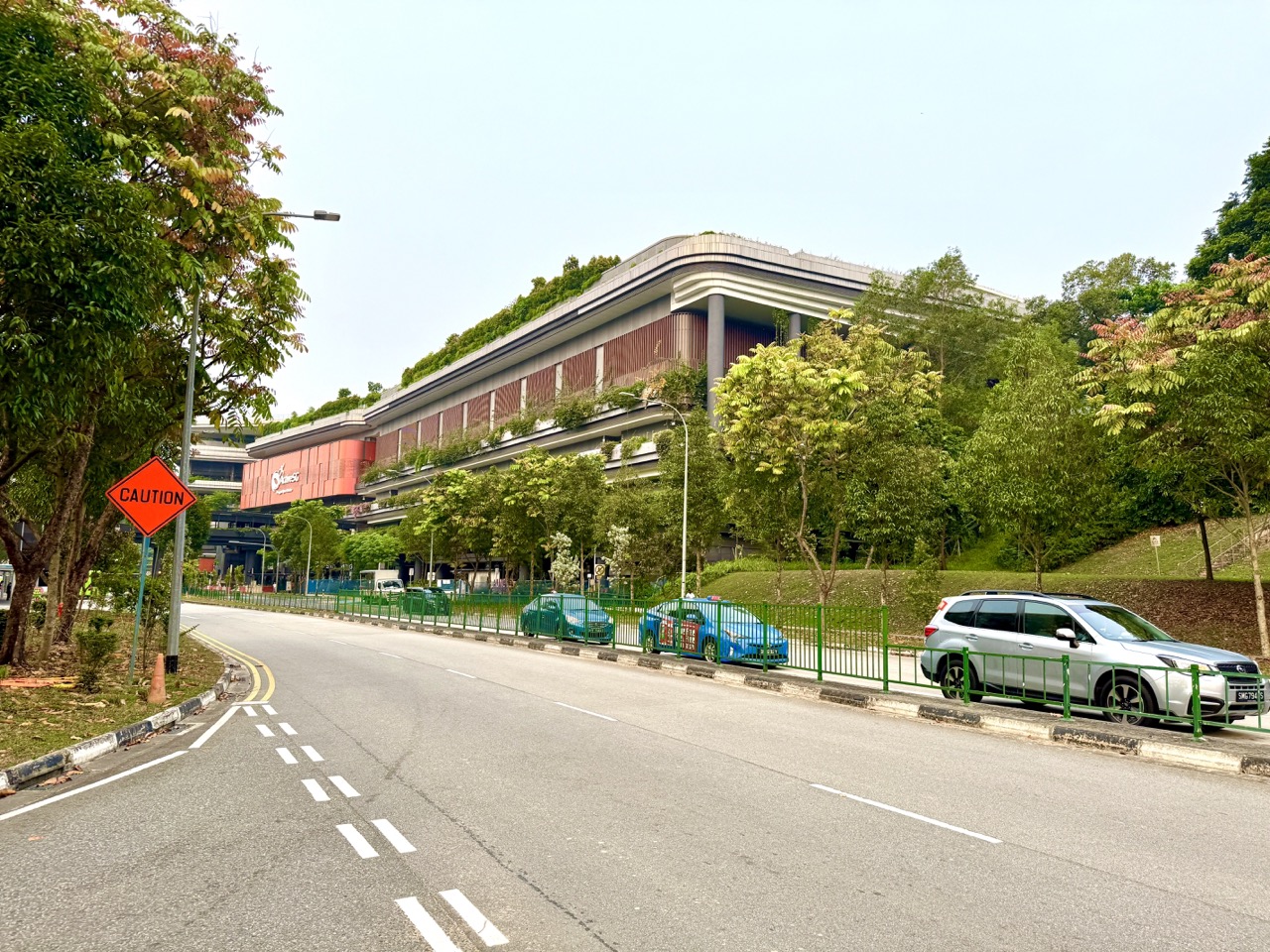
ActiveSG Punggol Sport Centre has a water-play area at its Basement 1 waterway-level plaza, with fountains, channels and small water gates that children can use to explore how water flows. A 28 October 2026 family visit reported that some play equipment was already open during the centre’s soft launch, and described water travelling from fountain jets along ground-level channels towards a basin. The site is at 11 Sentul Crescent, Singapore 828656, near Sam Kee LRT and SAFRA Punggol. Water-play hours were still being finalised when the visitors checked, so families should verify current operation rather than assume the jets run continuously.
The interesting educational activity is not just splashing. Children can notice that water moves through a path, predict what happens when a permitted play gate changes position, observe water spreading and narrowing, and explain a result in ordinary language. That is an accessible introduction to cause and effect, gravity, flow and fair testing. This article focuses on parent-guided science questions at the dedicated water-play channels, not on the larger Adventure Slides or the separately controlled swimming complex. Adults must remain responsible for supervision, posted safety rules and stopping whenever the play area is closed.
- Destination: Punggol Sport Centre, 11 Sentul Crescent, Singapore 828656.
- Play location: Basement 1 open plaza beside the waterway level.
- Observed features: fountain jets, shallow ground channels, small play gates, end basin, water curtain and spouts.
- Status: play area was observed operating during the October 2026 soft launch; its regular operating hours were not yet fixed in the 28 October report.
- Best activity: make a prediction, observe a permitted gate change, then describe where the water moves.
- Key ideas: gravity, slope, barriers, flow paths, water conservation, measurement and cause-and-effect reasoning.
- Pack: responsible adult, appropriate play clothing, non-slip suitable footwear, towel, water bottle and dry change of clothes.
- Important distinction: the splash channels are not Punggol Swimming Complex, and their operation does not mean public pools are open.
- Safety: follow staff and posted rules; do not drink play water, tamper with fittings or step into restricted areas.
- Venue information: https://www.activesgcircle.gov.sg/; reported features: https://www.littledayout.com/punggol-sport-centre-slides-water-play-facilities-activesg/

Definition lock: a water gate in a play channel
A water gate is a small barrier or movable control that can change how water passes through a channel. In the Punggol play installation, a family guide observed a series of water gates through which children can experiment with the flow from fountains towards a basin. That describes the intended play concept, not a guarantee that every gate can be operated in every configuration or that children may dismantle a fitting. The controls are part of a public amenity with its own operating conditions.
Explain the idea in a sentence a child understands: a gate changes the path or amount of water that gets through a particular place. The water does not disappear when its route changes; it may gather, move around an opening or continue downstream in another way. Children can notice those effects without altering the equipment beyond what the operator allows. This small observation is a better beginning than an abstract lesson about engineering diagrams.
First distinguish the splash area from the pool complex
The new Punggol sports precinct contains several water-related places. The Basement 1 water-play channels are a family play amenity. The swimming complex has pools intended for swimming and controlled admission. SAFRA Punggol’s Splash @ Kidz Amaze is a separate attraction under another operator. Waterway Point’s Happy Park is a separate mall feature again. Similar words in online posts can make them seem interchangeable when they are not.
Before leaving home, share the exact address and clarify which water feature the family intends to visit. Do not promise swimming laps, kayaking or access to the infinity pool because the children will see shallow water jets. As of 1 November 2026, the swimming complex’s public opening needed separate confirmation from ActiveSG. Keeping these destinations distinct prevents disappointment and teaches children that water can serve many public purposes with different safety rules.
What a visitor actually reported in October
Little Day Out published a family guide dated 28 October 2026 describing a long water-play layout on the Basement 1 open plaza. Fountains at one end released rising and falling jets, with flows running along shallow channels towards a basin. The article noted water gates, a curtain feature, extra spouts and lighting after dark. It also reported that the hours were still being fixed, although water was running during a visit at nine in the morning.
This is a useful factual snapshot, but not a live operating notice. Do not arrive at nine expecting the same status months later. A fountain can be paused for cleaning, maintenance or weather without the larger centre closing. A good family plan recognises that water play is a conditional activity. You can check onsite, choose another permitted option or return on a different day. Knowing what was observed and what remains uncertain is part of being a trustworthy local guide.
The simplest science lesson: water moves
Ask a child to look at the source of the water and point towards where it goes next. The jets may rise or fall, and water that lands in the channel travels towards another part of the installation. Depending on the slope, surface and any gate, the movement can appear fast or slow. This is not an experiment in which the child needs to touch every feature. The first lesson is simply observing a sequence.
Use plain language: ‘It starts here, goes along this line and reaches there.’ A younger child can trace the route with a finger in the air. An older child can sketch arrows on paper after leaving the wet area. Avoid drawing on the facility or blocking channels with personal objects. The ability to describe a flow path is foundational in learning about rivers, drains, pipelines and other real systems.
Gravity is involved, even when water first shoots upwards
Children may notice an apparent puzzle: water rises from the fountain before it travels downward along the channel. Explain that a pump or other mechanism supplies energy to raise or project the water, while gravity pulls the water down after it leaves the jet. It is inaccurate to say that gravity alone makes a fountain shoot into the air. The process involves equipment delivering energy and gravity acting throughout.
Ask a simple question: ‘What happens after the water reaches the top of its splash?’ Most children can see it fall or break into droplets. The water then finds the available path across the surface. This connects an exciting visual feature to an understandable physical idea. Do not encourage children to approach pump outlets, open covers or electrical fittings. The lesson is about observing a public installation, not investigating hidden machinery.
A prediction makes play into learning
Before a permitted gate change, ask the child what they think the water will do. Will more water pass through a wide opening? Will a narrow path produce a smaller stream? Might water collect briefly behind a partially closed barrier? The answer can depend on the actual shape and flow, and there is no need to insist that the child predict correctly on the first attempt.
After observing, ask what really happened. A useful response might be, ‘The water slowed here and spread beside the gate.’ That is better scientific language than ‘I was wrong’. Explain that experiments help people update predictions using evidence. This way of thinking transfers to school science, everyday problem solving and learning from mistakes. The child has turned play into a modest observation without needing a formal worksheet.
Only use controls designed for public play
A gate that looks movable is not necessarily meant to be forced. Some installations have fixed barriers, maintenance settings or parts that can become stuck. Follow signs, staff instructions and the design’s intended interaction. Do not lift, unscrew or pull components to see what lies underneath. Do not block water outlets with clothing, pebbles or personal equipment. A family cannot claim a right to alter public plumbing because the feature was described as educational.
Teach children to distinguish operating a permitted control from dismantling a system. The first is responsible exploration; the second can damage equipment and create hazards. If a gate does not move gently in its intended direction, leave it and tell staff if necessary. A useful science lesson also includes understanding boundaries. We can be curious about how a system works without breaking it open.
Water is conserved even when a path changes
Suppose a child observes water gathering behind a play gate and then continuing through an opening. The water has not ceased to exist merely because the flow slowed. In a functioning recirculating play feature, pumps may return water through a treatment system, but the exact Punggol installation’s hidden plumbing cannot be established simply by looking at the surface. Explain observable movement separately from any unverified internal design.
Use everyday examples. Water poured into a cup changes container but remains water. A drain can carry water out of sight without making it vanish. The lesson is not to calculate precise volumes at a public splash installation. It is to build an intuitive understanding that water follows physical paths and that hidden systems can exist beyond what is visible. For claims about actual water treatment, rely on operator documentation.
What changes when a channel narrows?
A narrow passage may influence the shape and speed of flowing water, but the exact result depends on volume, depth, pressure, slope and the surrounding geometry. Rather than promise that water always moves faster through every narrow channel, ask children to observe this particular installation. Does the stream look thinner? Does water pool nearby? Does another route open as water rises?
An older child can compare the appearance before and after a gate change without touching restricted parts. Teach careful descriptions such as ‘it looked faster’ rather than claiming a measured speed. A useful experiment recognises the difference between observation and inference. The child may see splashing or hear water move without possessing instruments to quantify flow precisely.
A fair test changes one thing at a time
Scientific reasoning becomes clearer when the child chooses one permitted factor to observe. If the gate can be moved safely under the operator’s rules, change that gate and watch the result while leaving the others alone. If several gates change at once, it becomes harder to know which change caused the new pattern. This is the basic idea of controlling variables.
For small children, simply say, ‘Let’s try one change and see.’ For older students, use the terms variable, observation and explanation. Do not make the family occupy the installation for a long formal experiment if others are waiting. A brief comparison is enough to demonstrate the idea. The purpose is not to generate publishable scientific data but to learn how careful questions produce more meaningful answers.
Flow direction is not always obvious
Water flowing through a shallow channel may curve around obstacles or spread over a surface. A child might predict a straight line and find that the actual path bends. This is an opportunity to discuss how the shape of a channel influences movement. The water takes available routes according to the forces and conditions acting on it; it does not deliberately choose a destination.
Ask the child to point to an upstream and downstream location in the visible play channel. If those words are too advanced, use ‘where the water comes from’ and ‘where it goes next’. Avoid walking against water into a restricted service area to find the true source. A public fountain’s pump system is not necessarily visible. The educational goal is describing the section that people are allowed to observe.
What happens when water accumulates?
If a barrier slows a stream, water may appear to gather temporarily on one side. Whether a pool forms depends on the channel’s design, the amount of incoming water and any overflow routes. Do not assume the installation is safe for deeper play simply because a small amount accumulates. Children should follow the posted use conditions and avoid attempting to create their own dam with objects.
A simple question is, ‘Does the water stay at the same level?’ After a short observation, the child may notice that it stabilises or continues moving. An adult can explain that the flow entering and leaving a small area influences what happens there. This connects play to ideas about reservoirs and drainage without claiming that a public splash gate exactly represents the engineering of a real dam.
A basin is not an invitation to swim
The Little Day Out report described water reaching a basin at the end of the channel. That is part of the surface play installation, not a public swimming pool. Do not allow children to jump into it, immerse their heads or treat the basin as a paddling pool unless signs explicitly permit a particular activity. Standing water depths and treatment arrangements should never be guessed from photographs.
Use the basin as a viewing point if access is permitted and it is safe to approach. Children can notice how incoming water changes the visible surface, or count the number of channels leading towards it. Keep small children within reach where appropriate. A successful observation does not require full-body immersion. The most educational moments often come from looking carefully at ordinary movement.
Fountains are powered systems, not natural springs
The rising and falling jets are attractive because they create movement, sound and changing shapes. They may also prompt a child to ask where the water comes from. Explain that a designed fountain uses equipment to produce the water jets; it is not the same as a natural spring. The precise pump type, filtration system and controller at Punggol are not verified by the surface appearance.
Do not make claims that the fountain uses a particular pressure, solar-powered pump or recycled-water process without a reliable operator document. It is better to say, ‘There is machinery we cannot see, and we can observe what it does here.’ That answer models honest science. Knowing what you do not know is an important intellectual skill, particularly when a modern facility looks technically impressive.
Moving water and a child’s sense of cause and effect
Young children learn through repeated actions. They may alter a permitted play gate, see the flow change, return it and repeat the observation. This repetition can be valuable because the connection between action and consequence becomes more noticeable. But the same repeated action can become disruptive if several families are waiting or the control is handled roughly.
Set a simple boundary: try the feature gently, observe the result and offer another child a turn. Explain that the purpose is discovery rather than ownership of the gate. Good scientific curiosity and good community behaviour are compatible. A person who can wait, notice a change and explain it is learning both about water and about sharing public equipment.
Why rushing water can look different from still water
Water in motion reflects light differently because its surface changes shape. Ripples, tiny waves and droplets create moving highlights, while relatively still water may appear smoother. Children can watch how sunlight or plaza lighting changes the appearance without needing to touch the water. The observation is an introduction to light and surfaces, not a laboratory demonstration of the full physics of reflection.
Ask which part looks sparkly and which part looks calm. Older children can consider why a water curtain produces a different visual pattern from a narrow channel. Do not aim bright lights into other users’ eyes or bring equipment that disrupts the play feature. A short conversation can connect science and visual art through observations already present at the public installation.
Sound is evidence of movement
A fountain jet can produce splashing sounds, while water travelling through a quieter channel may be harder to hear. A child can notice these differences and make a tentative explanation. A louder sound does not necessarily mean the water has a greater volume or speed in a simple one-to-one way; contact with surfaces and droplets matters too.
Try listening for a few seconds at a safe, permitted position. Ask the child to describe the sound with ordinary words such as splashing, trickling or pattering. Avoid recording strangers’ conversations while making audio clips. The activity can improve attention and language skills without turning the busy play area into a private sound studio.
Learn to distinguish observation from explanation
A child might say, ‘The water is faster because the gate is smaller.’ That may be a reasonable hypothesis, but the visible result could have several causes. Help separate what was actually seen from why the child thinks it happened. First ask, ‘What did you notice?’ Then ask, ‘What might explain it?’ The two questions teach a habit that remains useful through secondary science and everyday reasoning.
Adults should resist correcting every statement instantly. Encourage the child to describe the evidence, compare another condition when permitted and refine the idea. If the answer remains uncertain, say so. A short family outing need not produce a perfect scientific explanation. It can teach a more durable skill: being curious and fair about what the evidence really shows.
A five-minute science conversation for preschoolers
Begin with a simple prediction: ‘Will the water go this way or that way?’ Point to a safe visible part of the channel. Watch together, then ask the child to follow the flow with their eyes. Use words such as start, stop, turn and flow. After a few minutes, switch to normal play or take a break. Preschoolers may learn more from a short enjoyable repetition than from a long explanation.
Keep the activity child-led within firm safety boundaries. If the child becomes fascinated by the fountain, let that be the focus instead of insisting on the gates. The adult remains responsible for supervision and hygiene. A successful five-minute lesson can be as simple as hearing the child explain, ‘It went around the corner!’ That statement shows real observation.
A fifteen-minute lesson for primary-school children
Primary-school students can manage a more deliberate routine. First observe the channel, then write or say a prediction. Next, if a public control is available and permitted, make one change. Watch the result and describe it. Finally, explain one possible reason. These steps turn a playground moment into a small inquiry without requiring measurement tools or collecting water.
Ask children to use vocabulary precisely: source, path, channel, gate, flow and basin. If the child already understands fair tests, discuss why changing several gates simultaneously makes conclusions less clear. Do not insist that a busy public play area stay unchanged for your experiment. Other families have equal rights to the equipment. The lesson should fit within shared use, not monopolise it.
A twenty-minute activity for older students
An older child or secondary student can sketch a simple flow diagram after observing the water. Mark the fountain area, visible channel segments, permitted gate locations and basin. Use arrows for observed direction. Label which features were seen directly and which are assumptions. The drawing should remain a learning record, not an engineering survey or a map of restricted infrastructure.
Back at home, the student can connect the observation to gravity, water supply and drainage in a broader systems discussion. A real public fountain may recirculate water, but that cannot be established conclusively from the visible channel alone. An honest report might say, ‘We saw water returning towards a basin; we did not inspect the internal treatment system.’ That is precisely the kind of source-aware language good science requires.
How to introduce the idea of a reservoir
Punggol is strongly associated with waterways and nearby reservoirs. A child may ask whether the small play basin works like a reservoir. You can explain a similarity and a difference. Both can involve water collecting in a designated area, but Singapore’s reservoirs are large-scale water-management infrastructure with their own rules and purposes, not playgrounds with adjustable gates.
Do not encourage children to transfer habits from the splash area to open waterways. It may be permissible to interact with a designed play control but unsafe and prohibited to enter a reservoir or alter drainage infrastructure. This comparison can reinforce environmental responsibility. The child learns that similar physical ideas operate at different scales and under very different safety arrangements.
A small lesson in water conservation
Watching a fountain can prompt questions about Singapore’s water supply. Explain that water is a valuable resource and that public systems need careful operation and maintenance. Do not assert the exact water consumption or recycling rate of the Punggol feature without documentation. The educational point can be about avoiding waste and using shared facilities properly, not about claiming an unverified sustainability achievement.
Children can practise water-responsible habits at home, such as turning off a tap when it is not needed and reporting a leak to an adult. Those behaviours are separate from playing with a designed recirculating amenity. The local outing makes water visible and memorable, while household routines provide a place for practical responsibility. A good lesson links observation with an action that the child can safely perform.
Children learn mathematics from the flow too
Counting gates, comparing two channels and describing which path appears longer introduce basic mathematics. A younger child can count fountain jets when they are visible. An older child can draw a simple sequence and compare changes. Avoid pretending that a visual estimate of water volume is a precise measurement. The lesson can remain qualitative when measuring is impractical.
Parents might ask, ‘How many different turns does the channel make?’ or ‘Which gate did we observe first?’ Sequence and comparison are useful thinking tools. A child does not need to bring measuring containers or place objects in the water. A few mathematical questions about a shared visual experience are enough to connect play with school learning without making the outing feel like an examination.
Language learning through describing a process
Children sometimes understand what happened but struggle to explain it. Help them form a three-part sentence: first the water came from the fountain, then it moved through the channel, and finally it reached the basin. Words such as before, after, because and therefore can build explanatory language. The adult can model clarity without demanding a long composition.
An older student can write a short paragraph at home describing a prediction and result, using correct distinctions between observed facts and possible explanations. That exercise supports science communication and comprehension. The water-play area becomes a real-world subject rather than an abstract worksheet. The purpose is not to advertise a tuition lesson at the playground; it is to show how ordinary experiences can create useful questions.
Why older children might enjoy mentoring younger siblings
A family with children of different ages may use the play feature for shared discovery. The older child can ask the younger one to predict where the water will flow, then help describe the result. The older child should not take over the control or insist on a correct answer. A mentor’s role is to encourage attention and keep the activity respectful.
Adults still provide supervision, especially around wet ground and other visitors. Do not leave one child responsible for another simply because the older sibling understands the science. A good shared activity gives both children a meaningful task: the younger observes, and the older learns to explain clearly. Their different abilities become an opportunity for cooperation rather than competition.
Wet surfaces and sensible footwear
The play area is designed around water, so surfaces may be wet and slippery. Walk rather than run, follow any footwear rules and avoid stepping on the edges of channels not intended for climbing. Do not ask a child to sprint between gates to beat another person’s prediction. The physical environment sets limits on what a safe science activity can involve.
Bring a towel and a dry change of clothing. If a child is repeatedly slipping or struggling with balance, leave the wet section and choose an appropriate alternative. A modern play feature is not a guarantee against falls. The adult should watch the child rather than concentrating exclusively on a notebook, camera or experiment. Supervision remains the first responsibility.
Do not drink the play water
Decorative or interactive fountain water should not be assumed potable. Teach children that drinking water comes from a clean bottle or a designated drinking-water point, not from a jet or basin. Discourage putting mouths against outlets or intentionally swallowing splash water. If the operator posts hygiene instructions, follow them. A child who is unwell may need to avoid the water-play area entirely.
Keep snacks in permitted eating areas and wash or clean hands appropriately before eating. Do not introduce soap, dye, food colouring or other materials into the water to conduct a homemade experiment. Those substances can interfere with treatment, make surfaces slippery or affect other visitors. A good science lesson at a public amenity is observational and gentle rather than chemical or destructive.
No outdoor water play during unsafe weather
Heavy rain, lightning and storms can change the safety of outdoor play. Follow current weather advisories and facility staff instructions. Do not assume a shallow play channel remains appropriate during a lightning warning simply because the water depth is small. If the jets are switched off or the plaza is closed, treat that as a decision to respect, not a puzzle for a child to solve.
Explain the change calmly: ‘The water feature is not available now, so we will choose another safe activity.’ A family can return later or practise the idea using a small supervised home setup, where appropriate. The science lesson does not require ignoring public warnings. Learning when not to experiment is part of good scientific judgement.
Heat, haze and the importance of breaks
Water play may feel cooling in Singapore’s climate, but sun exposure and air quality still matter. Follow current advisories, especially for young children and people with relevant health conditions. Bring drinking water, observe signs of fatigue and plan a reasonable play duration. Do not assume that being splashed protects a child from heat stress or poor air quality.
Give children breaks before they become exhausted or irritable. A brief science conversation can take place from a safe nearby position rather than keeping them in the wet area continuously. A family outing is not a test of endurance. The activity is most useful when children remain comfortable enough to enjoy both observation and play.
Respect other families’ experiments
Several children may want to move the same gate at once. Help them take turns and explain why a change made by one person can affect the water observed by another. If a child is carefully watching a stream, avoid resetting the gate abruptly without asking. The feature is a shared interactive environment, and the learning works best when users cooperate.
Teach the difference between waiting and owning the control. No family has a permanent claim to the channel because they arrived first or started a science challenge. Keep prams, bags and footwear away from other users’ paths. If someone behaves dangerously, pause and seek help from responsible adults or staff rather than escalate. Public-science curiosity includes public-space manners.
Privacy and photographing children
A fountain can look attractive in photographs, especially when jets rise and light catches droplets. But public play areas contain children and families with different privacy expectations. Do not photograph unrelated children or post recognisable images of strangers without appropriate consent. Follow any venue photography conditions. Never step into a restricted channel or let a child stand unsafely for a dramatic picture.
If your own child wants to document the science, a drawing or written observation may be better than a video. Photograph the permitted water feature itself only where the operator allows and without obstructing anyone. A clear description of what happened can preserve the lesson even when no image is taken. Accuracy and respect matter more than producing a perfect clip.
A family plan when the gates are not running
The operating hours were being finalised when the water feature was reported on 28 October 2026. That uncertainty makes a backup important. If the jets are off, do not enter the installation to search for a switch or encourage children to operate maintenance controls. Check onsite signs and, if available, ask staff when public operation is expected. Avoid telling the child a time that has not been confirmed.
Another permitted family amenity or a short public waterfront walk may be an option, depending on current access. Keep the alternative independent of the swimming complex, which has its own admission and opening status. A parent can still discuss what gravity would do to water in a sloped channel or draw a simple flow path at home. A good learning experience should survive an ordinary operational change.
Comparing water gates with the Adventure Slides
The Basement 1 area also includes Adventure Slides and climbing features. They offer a different kind of movement experience from interacting with a water channel. Little Day Out reported that the longer tube slides are designed for children aged six and older with adult supervision at all times. Smaller open slides were described for younger children. The water gates, by contrast, encourage observing and interacting with shallow flows under their own posted rules.
Do not combine restrictions casually. Being tall enough for a slide does not establish permission to use every other feature, and a water-play visit is not a licence to climb a slide structure after closure. For general guidance on the play spaces, see the separate slides and water-play article. This page focuses on the particular educational value of controlled observations at the gates.
A short four-visit learning progression
On visit one, a young child can simply trace where water travels. On visit two, they may make a prediction about a permitted gate. On visit three, they can compare two observed flow patterns and explain a possible reason. On visit four, they might sketch a route or use vocabulary such as source, flow and basin. These are optional family themes, not an official ActiveSG class or fixed timetable.
Progress depends on the child’s interest and the feature actually operating. Do not insist on returning every week if the family has other responsibilities or a child is uninterested. The value lies in a better way of looking, not in completing an artificial curriculum. A child who asks a thoughtful new question has already made progress.
A school-style investigation without invading public space
Teachers or parents may be tempted to bring a large group to measure the water system. A public play area is not automatically available for organised school instruction or instrumented experiments. Any group visit should follow operator requirements, safety rules and supervision arrangements. Do not install rulers, barriers or collection containers in channels. If formal educational use is intended, enquire about permissions first.
A small family can nevertheless learn the structure of an investigation: question, prediction, observation, explanation and reflection. Write the conclusions afterward in a quiet permitted location. Avoid presenting a simple observation as proof of the installation’s exact flow rate or pump design. Responsible science uses the tools and evidence appropriate to the question.
Ten practical questions to ask at the water gates
Where does the water first appear? Which direction does it travel? What happens after the jet lands? Does a channel divide? What does a gate seem to change? Where does water collect? Which visible route looks longer? Are there ripples near a bend? What happens when the fountain changes height? Can you describe the journey from start to end? These are prompts for looking, not instructions to touch machinery.
Choose only one or two questions in a short outing. Too many can make play feel like homework. A preschooler might answer with gestures; an older child might use a diagram. Parents should accept reasonable uncertainty, particularly where the system’s underground components are hidden. The strongest question is usually the one the child genuinely wants to investigate.
Three real-life family situations
First, a five-year-old likes splashing but is not interested in explanations. The adult lets the child play within the permitted area and asks one short question about where the water goes. Second, a nine-year-old asks why the water gathers by a gate. The adult invites a prediction and watches with the child, without changing any restricted part. Third, two siblings argue over a gate. The adult organises turns and uses the conflict to explain why shared controls require cooperation.
All three situations are successful if safety, curiosity and respect are maintained. There is no need to deliver a full lecture or obtain a correct engineering answer. A child may remember the excitement first and understand the science later. The educational value comes from connecting a real observation with language the child can use.
Frequently asked questions
Where are the water gates at Punggol ActiveSG? The 28 October 2026 family report located them in the Basement 1 water-play area at the open waterway-level plaza. Is the feature operating all day? No confirmed permanent hours were given in that report; check onsite. Is this the swimming pool? No, the public swimming complex is a separate controlled facility. Can children touch the gates? Only in the manner intended and permitted by the operator. May we pour dye into the water? No, do not introduce substances into shared public water.
Can toddlers use the play zone? Check posted age and supervision conditions; do not assume the rules match the larger slides. What can a primary-school child learn? Flow paths, predictions, cause and effect, and responsible sharing. Can we measure water speed? Do not install measuring equipment in a public channel without permission. What if it is raining or the water is switched off? Follow closure instructions and use a safe alternative.
Sources and Your Next Step
This article is based on Little”>https://www.littledayout.com/punggol-sport-centre-slides-water-play-facilities-activesg/’>Little Day Out’s 28 October 2026 first-hand family guide, which reported the water channels, gates, basin and then-unfixed operating hours, together with TheSmartLocal’s”>https://thesmartlocal.com/read/activesg-punggol-sport-centre/’>TheSmartLocal’s 30 October walkthrough of the wider sports centre. For current access and any updated operating information, refer to ActiveSG”>https://www.activesgcircle.gov.sg/’>ActiveSG Circle and onsite signage. The scientific explanations are general principles, not statements about hidden unverified Punggol pump or treatment specifications.
Your next step is to bring a child with a responsible adult, confirm that the Basement 1 water-play feature is running, choose one question about a visible flow path and let the child observe and explain. For slides, changing clothes and a broader family visit, read our”>https://edukatepunggol.com/2026/11/01/things-to-do-at-activesg-punggol-slides-outdoor-water-play-families/’>our separate slides and outdoor water-play guide. A playful five-minute science conversation is enough.


