
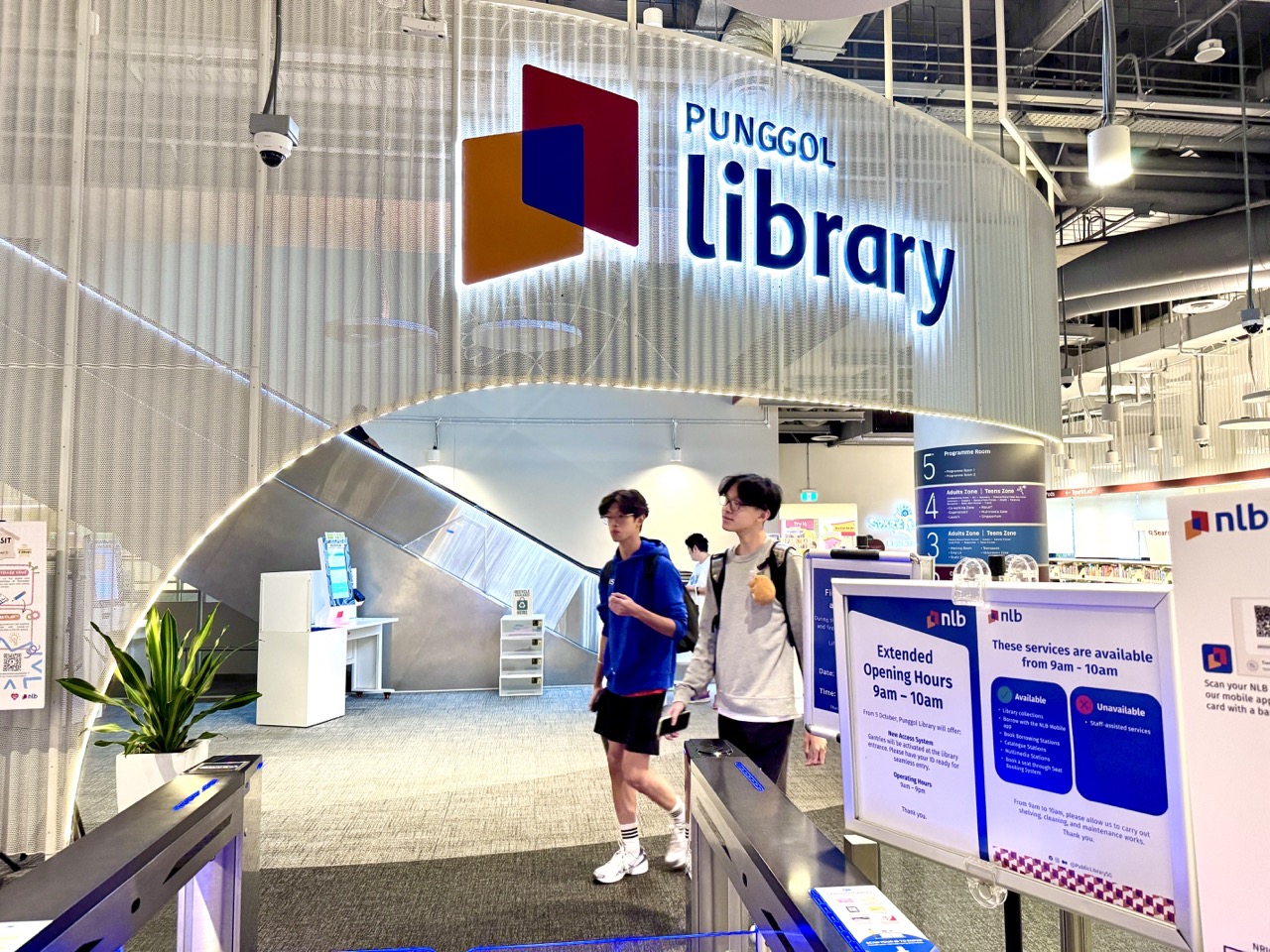
Schools and education in Punggol can build a strong reading culture when classroom literacy teaching, home conversation and public-library access work together. Parents can begin today by checking whether their child needs help with word reading, language comprehension, reading stamina or simply finding books worth opening. Punggol Regional Library at One Punggol expands the available choices; it does not replace school instruction or adult supervision.
The practical aim is not a larger pile of assessment books. It is a learner who can understand a story, interpret an information page, extract evidence from a school passage and eventually question a source independently. Start with a text at an achievable level, allow the child some choice, and talk about meaning. For current library services, consult the National Library Board; for school assignments and support, follow the individual school’s guidance.
- Audience: Punggol families with preschool, primary and secondary students.
- Start by distinguishing decoding, vocabulary, comprehension, fluency and motivation.
- Schools teach curriculum reading; parents support daily habits; NLB offers a wider public collection.
- Punggol Regional Library is at One Punggol; verify opening hours and access on the NLB website.
- Use child-selected texts alongside curriculum-specific reading in English, Mother Tongue, Mathematics and Science.
- Graphic novels, nonfiction, multilingual texts and digital reading can serve different purposes.
- For persistent difficulty, share concrete examples with teachers instead of guessing a diagnosis.
- Measure progress through independent explanation and transfer, not only pages or test marks.
What reading culture means in a real Punggol household
The reading question is bigger than an examination score
A child may obtain a reasonable English mark and still avoid books. Another may love stories yet struggle to retrieve information from a factual passage. These children require different responses. Reading is not a single lever called “English”. It involves decoding, vocabulary, comprehension, fluency, stamina, curiosity, judgement and a growing willingness to read without somebody standing over the learner. A school develops many of these capacities through teaching; a family helps by making reading accessible and ordinary. A public library makes the range of possible texts much wider than the books a household can store.
For Punggol parents, the immediate job is to notice which part of reading is working and which part has become effortful. Ask the child to tell you about a text they actually selected. Listen for what they understood, what confused them and whether they wanted to continue. This is more informative than asking only how many pages were completed. The point of a reading culture is not simply to increase volume. It is to give learners reasons to make sense of words and return to the activity voluntarily.
A real Punggol reading network has three different institutions
The school, the family and the National Library Board serve different functions. A teacher sequences instruction, exposes pupils to texts they might not select by themselves, assesses understanding and models disciplinary language. At home, adults can supply time, attention, discussion, quiet spaces and permission to read for pleasure. Punggol Regional Library expands choice through public collections and reading facilities. None is a substitute for the others. Borrowing many books does not prove that classroom comprehension is secure; a good school mark does not prove the child reads independently outside class.
The Punggol Regional Library is at One Punggol. Parents should check the current NLB library page for opening hours, facilities, memberships and accessibility information rather than relying on an old screenshot. The library is a public learning space, not a supervised student-care centre. Younger pupils still require appropriate adult supervision. Treat a library visit as a realistic part of the family calendar: travel, arrival, book choice, borrowing and return are small operational details that help the habit survive.
Begin by separating decoding from comprehension
Imagine a Primary 2 pupil reading a sentence aloud with obvious effort. The child stops at common letter combinations, guesses long words and loses the sentence before its end. More inference worksheets are not the first answer. The adult needs to find out whether print recognition and fluent word reading are limiting access to meaning. A different Primary 2 pupil may sound fluent, pronounce every word correctly and still fail to answer who did what or why the character changed their mind. That child needs work on language understanding, not merely faster oral reading.
These are useful teaching distinctions, not diagnoses made from a two-minute home exercise. Teachers have more information about classroom progress. Parents can share concrete observations without applying labels: “She can say the words but cannot retell the sequence” is much easier to act on than “She is bad at comprehension.” For older pupils, the same distinction remains important. A teenager may decode technical vocabulary accurately while lacking the background knowledge necessary to interpret a science article or a historical argument.
Vocabulary is the bridge between a book and the world
A word is not fully learned because the child can reproduce its definition once. Consider the word “evidence”. In a simple story it may mean the clues that support a claim. In Primary Science it means observations or measurements that can support an explanation. In Secondary History it can mean a source to interpret with attention to origin, purpose and limitations. The word has a stable centre and several disciplinary uses. Repeated exposure across meaningful contexts develops that flexibility.
When reading together, choose a few words worth discussing rather than stopping at every unfamiliar item. First ask whether the learner can infer the likely meaning from the sentence. Then check the meaning, create another example and revisit it later. If a child meets “habitat” in a book about birds, a supervised walk near a Punggol park may provide a real example without collecting plants or disturbing wildlife. Good vocabulary work attaches the term to a concept. Endless copying of dictionary entries may produce neat notes while leaving the concept vague.
Reading aloud is conversation, not a speed contest
For young children, a familiar adult’s voice makes language patterns audible: sentence rhythm, punctuation, emphasis, humour and the difference between a question and an answer. Reading aloud can continue after a child begins to read independently. The adult may handle a challenging passage, then invite the child to read a shorter section. Different readers can share one story without every turn becoming a fluency test.
The conversation afterward matters. Ask one question about what happened, one about the reason, and perhaps one about what could happen next. Accept plausible answers that are supported by the text. Avoid forcing a child to deliver a polished oral examination response after every page. If the book is funny, it is legitimate to laugh. If the learner wants to examine the illustrations, let the images participate in meaning-making. The reading bond should not be reduced to a daily judgement about pronunciation or marks. A calm shared experience can help children associate books with worthwhile time together.
Primary 1 and Primary 2: permission to start small
At the beginning of primary school, the educational task is to build reliable encounters with print without turning every afternoon into an assessment centre. Some children arrive recognising many words; others are still strengthening the connections between letters and sounds. Those starting points differ. Parents should follow the child’s actual classroom guidance and resist comparing reading pace with a friend’s child whose early experience was different.
A useful week might contain a short shared story, a familiar repeated book, a child-selected picture book and one conversation about a new word. For a learner who becomes tired quickly, brief success is preferable to a protracted dispute over a difficult book. Let the child see an adult using reading for a real purpose: following a recipe, understanding a notice, reading a map legend or choosing a bus route with appropriate supervision. Literacy is not an isolated school performance. It is how people obtain information and participate in daily life.
Primary 3 and Primary 4: comprehension becomes more demanding
As school texts lengthen, a pupil must move between literal details and implied meaning. The learner may need to identify a speaker’s intention, explain a cause, compare two paragraphs or decide which detail matters. This is where some children who previously read smoothly begin to struggle. They can complete a page mechanically but cannot assemble the explanation across several sentences. Parents may interpret the resulting low marks as carelessness when the real issue is a missing comprehension process.
Try a simple three-stage routine: identify what the passage is about, locate the textual evidence and explain the answer in the learner’s own words. For an information text, distinguish topic from claim. A paragraph about recycling may contain many facts but argue one central idea about waste reduction. Have the child mark that idea and defend the choice. When the routine becomes easier, remove prompts. Independence means the reader increasingly chooses a useful strategy without an adult naming every move.
Primary 5 and Primary 6: read for precise answers and broader knowledge
Upper-primary readers encounter a tension. Examination tasks reward precise responses to a passage, while long-term education depends on knowledge and curiosity that reach beyond a test paper. Both deserve attention. A child who reads only model answers may become familiar with exam phrasing yet lack the world knowledge needed to interpret unfamiliar situations. A child who reads novels enthusiastically may still need explicit practice quoting relevant evidence, organising answers and responding to task instructions.
Give the learner two sorts of reading. One is short, careful work tied to the school’s English curriculum: identify the question, retrieve the right detail and justify it accurately. The other is a sustained text the child chooses for interest, whether fiction, history, science, biography, comics or a hobby. Discuss what the child believes the author is trying to do. Do not require every leisure title to be “challenging” by adult standards. A varied reading diet creates more opportunities to practise without creating a narrow identity around test preparation.
Secondary school: information literacy becomes essential
A Secondary 1 learner may read a novel in English class, a source in History, a procedure in Science and a word problem in Mathematics on the same day. Each form expects a different reading move. The novel invites interpretation of character and language; the history source asks about context and reliability; the science text defines quantities and causal relationships; a mathematics question requires disciplined extraction of conditions. “Read carefully” is too vague to help a teenager who has not learned how these tasks differ.
Teach students to ask what kind of text they are reading and what counts as success. A science article may need a distinction between observation and explanation. An online claim may require the date, author, supporting evidence and competing interpretations. A mathematical statement may depend on one restrictive word such as “exactly”, “at least” or “remaining”. Reading becomes a cross-curricular skill that supports reasoning and independent study. Schools provide subject-specific instruction; a family can reinforce the question: “What evidence in this source supports your conclusion?”
Why school libraries and public libraries should not be confused
A school library is part of the school’s educational environment and may reflect its age group, curriculum, timetable, collection policies and reading programmes. Access depends on that particular school’s rules. A public library serves a wider community and can introduce texts beyond the school collection. A Punggol child may use both, but parents should not assume that a public-library borrowing record substitutes for a school assignment or that an attractive book on a public shelf is automatically suitable for every age.
Ask the school what reading materials and library routines it actually offers. A school may organise class visits, reading periods or projects, but those arrangements vary. Ask the child what books they can genuinely select and whether access happens during lessons, recess or scheduled library sessions. At Punggol Regional Library, families can browse and ask staff about relevant resources and accessible services. The important result is not a comparison of which building has more books. It is a dependable route from the learner’s question to a text they can use.
Choosing a book: the reader needs an achievable challenge
A child may abandon a book for several reasons. The language may be too difficult, the subject may not interest them, the text may be too long for the time available, or the first chapters may simply be dull. These are different problems. A parent who assumes every abandoned book demonstrates weak discipline may accidentally make reading feel like punishment. A thoughtful choice balances accessibility, curiosity and opportunities to stretch.
Invite the learner to look at the cover, introduction, a page near the middle and the type of language used. Can they explain what is happening without guessing every second word? Does the book offer some reward for continuing? If it is difficult but compelling, a read-aloud partnership might help. If it is straightforward and delightful, it still has value. For older children, mix familiar genres with occasional unfamiliar ones. A teenager who reads fantasy may enjoy a related mythology or history title. Book selection is not a test of sophistication; it is the beginning of sustained attention.
Nonfiction deserves its own teaching method
Reading a page about Singapore’s water system is different from reading a narrative. The child may encounter diagrams, labels, captions, dates, definitions and cause-and-effect explanations. Teach a simple sequence: preview headings, predict what information is needed, inspect diagrams, read a section, then check whether the stated question has been answered. Many learners skim explanatory text too quickly because they assume the largest print or the most striking photograph contains the main answer.
Punggol provides nearby topics that can make nonfiction feel relevant: waterways, transport, neighbourhood planning and environmental design. A family can read a reliable source about water treatment or urban ecology before or after an ordinary public outing. The child should distinguish what was observed personally from what a source claimed. Seeing a canal does not prove the mechanism behind the whole water network. Learning grows when local observations lead to questions and credible texts supply explanations rather than when parents invent certainty from a view of the landscape.
Graphic novels and comics can support serious reading
Some families worry that illustrated stories count as second-class reading. That judgement is too simple. A graphic novel asks the reader to combine dialogue, sequence, expression, visual perspective and implied action. It can develop narrative comprehension and encourage a reluctant reader to complete a longer story. The text may still be demanding, especially when humour, cultural context or time shifts matter. However, a visual format does not automatically teach every skill needed for dense academic prose.
Use comics as one part of a balanced collection rather than an adversary to prose books. Ask the learner what an image reveals that the dialogue does not and how the panels signal the passage of time. Then occasionally pair a familiar topic with a prose article. NLB has offered comics-focused collections including the Comics & Games Library at Punggol Coast Mall, but temporary locations, services and operating periods should be checked in current NLB notices. A good reading plan expands the kinds of meaning a child can work with.
Mother Tongue reading deserves a genuine place
Punggol families may read in English and one or more Mother Tongue Languages, and language exposure varies widely between homes. A child who reads comfortably in English may find another language’s written vocabulary less familiar. The response should not be embarrassment or an assumption that intelligence differs by language. The child needs accessible texts, meaningful conversation and repeated encounters with words in context.
Parents can invite a grandparent or another fluent family member to tell a story, discuss a short passage or share a familiar cultural text. Where adults are not confident readers in the language, school advice and age-appropriate resources become more important. Compare what the learner can understand, not simply how many characters or words they can copy. Reading in multiple languages can provide different routes into family memory and Singapore’s multilingual public life. It also requires realistic expectations: progress in one language does not automatically transfer every vocabulary item or writing convention into another.
The fifteen-minute habit should be a floor, not a punishment
A family routine works when the learner knows when reading can happen and can start with little friction. Fifteen minutes after a snack may be more durable than a grand promise to read for an hour every evening. The number is not a national rule or a guaranteed result. It is a convenient example of a small appointment with books. The routine should fit homework, CCA, meals, sleep and a child’s energy.
Create a visible choice: two or three books nearby, a comfortable seat, adequate light and a place to put a bookmark. Avoid making screen removal the only reason to read. Let the child know what the book itself offers. At the end, ask what was interesting rather than demanding a summary every day. As stamina grows, a keen reader may extend the session independently. A tired student may need a short read-aloud. Consistency is useful only if the experience remains humane and sustainable.
Parents can model curiosity without pretending to be literary experts
An adult does not need to know every author, term or interpretation to be a strong reading companion. Children benefit from seeing a parent ask a question, check a word and admit uncertainty. When a pupil says, “I do not understand why the person did that,” the adult can reply, “Let us see which sentence gives us a clue.” That is a reading strategy in action and an illustration of how knowledge can be built responsibly.
It can be useful for children to see adults read different formats: instructions, books, articles, subtitles, official notices and long-form explanations. Do not stage an artificial performance where every book must look prestigious. Show purposeful reading and talk about what changed in your understanding. If an adult has limited time, even a short, attentive conversation around a child-selected page may be valuable. The family is teaching a stance toward text: curiosity, willingness to revise a guess and respect for the difference between assertion and evidence.
When reading ends in argument, investigate the bottleneck
A child may resist reading because the text is too hard, the session is always followed by tests, the environment is noisy, the learner is tired or an adult repeatedly interrupts. Resistance can also reflect an uninteresting choice or a longer-standing literacy difficulty. The first step is to reduce the demand and observe. Does the learner prefer listening? Can they discuss an illustration confidently? Do they avoid reading aloud but enjoy quiet reading? These patterns provide clues for a better next step.
Do not treat a single difficult evening as a diagnosis. If decoding, comprehension, visual comfort or concentration concerns persist, share specific observations with the school and consider appropriate professional advice where warranted. Parents should not use a reading article to self-diagnose a developmental condition. The immediate objective is to keep the child able to ask for help without shame. A learner who can explain what is hard gives teachers and caregivers a better basis for support than one who has learned to hide the struggle.
A school reading assignment is not a parent-writing assignment
Book reviews, reflection journals and comprehension tasks can become family performances when adults do all the wording. A parent may have good intentions: produce a polished answer, prevent a weak mark or make homework finish faster. But the teacher then receives unreliable evidence of the child’s ability. The student loses a chance to try, revise and own the work. An attractive product can conceal the learning gap it was meant to reveal.
A better routine has three stages. First, let the student attempt the task and identify where the answer is uncertain. Second, discuss the instructions and ask questions rather than dictate entire paragraphs. Third, let the learner revise and check whether they can explain what changed. If the school restricts outside help, follow its rules. A reading journal should capture the student’s actual encounter with the book. It need not imitate an adult reviewer’s vocabulary to be educationally useful.
How to read a comprehension error without blaming the child
Suppose a Primary 4 answer says a character was “angry” because the text described them slamming a door. The question actually asks why the character behaved that way. The child has inferred an emotion but not the cause. Correcting the answer alone is insufficient. Ask the learner to distinguish observable behaviour, the emotion inferred from it and the previous event that may explain it. This three-part analysis transfers into new passages.
Another student copies a full paragraph when asked for one detail. The issue may be relevance and answer selection, not lack of knowledge. A third student answers from general knowledge despite contradictory details in the given passage. That learner needs practice respecting textual evidence. These small diagnostic categories are much more useful than “careless reading”. Parents can bring one or two representative examples to a school conversation. Teachers can then decide whether the same error pattern appears across classroom tasks and which instruction would help.
Reading for Mathematics and Science is not an optional extra
A Mathematics word problem is a compact technical text. Consider: “Three buses arrive at intervals of six, eight and twelve minutes. They arrive together now. When will they next arrive together?” A student needs to interpret “next” and “together”, represent a common time interval and test whether the answer meets the condition. A child who rushes into multiplying every number has a reading problem as well as a mathematical one. The repair begins by extracting meaning before calculation.
Science reading has similar demands. “Describe” asks what is observed or represented; “explain” asks for a causal account supported by relevant concepts. When comparing experiments, a student must identify what changed, what was measured and which variables were controlled. Parents can read a short question aloud and ask the learner to restate its task before attempting the answer. The goal is not more words. It is more accurate interpretation and independent execution.
School book lists and public borrowing should have different budgets
A compulsory school text belongs to the learner’s educational requirements and must be obtained according to the actual school instructions. Optional commercial revision materials, enrichment subscriptions and leisure books are separate decisions. Mixing these categories can create needless spending. A family may purchase several beautifully marketed vocabulary packages while a child has little time to read anything from beginning to end. Sometimes the most effective choice is to use a book already owned or borrow a suitable title.
Review what the child has actually read, whether the selection matched ability and whether returning library books is manageable. Borrowing is not always free of obligations: families should follow NLB’s current membership and loan policies, due dates and any applicable charges. Use the current app or library account rather than relying on memory. Money can also be spent on comfort and access, such as sufficient lighting or a stable reading space, rather than only on printed products. The value is in the learning that follows, not the purchase itself.
Digital reading requires a different kind of attention
Screens can enlarge print, offer accessible formats, supply dictionaries and make public information easy to reach. They can also combine reading with notifications, advertisements, endless scrolling and uncertain sources. A child who reads ten short posts has not necessarily practised the same sustained comprehension as a child following a coherent chapter. Neither format is automatically good or bad; the reading task and design matter.
For homework research, ask the student to identify the author or publisher, publication date, evidence and purpose of the material. A government syllabus page serves a different purpose from an anonymous discussion. When using AI-generated summaries or search snippets, students should trace important claims to reliable sources rather than assuming a fluent sentence is correct. Establish device routines that preserve focus and follow the school’s relevant technology rules. Digital literacy includes knowing when to close a tab, check a claim and return to the original text.
Punggol Regional Library can be a gateway to deeper subjects
A child interested in trains might begin with an illustrated transport book and later explore maps, engineering explanations and Singapore’s rail planning. A learner fascinated by wildlife might begin with a picture guide, then move into habitats, conservation and scientific methods. The public library supports this widening of subject interest. It can connect an initial curiosity to a sequence of books at gradually greater complexity.
Do not force every reading interest into a future career prediction. Enjoyment today is valuable. At the same time, adults can notice recurring questions and offer a next text that extends the idea. A public display, library programme or exhibition can stimulate conversation, but dates and access conditions change. Check official NLB information before organising a family visit. Most importantly, allow the child to make choices in a public space responsibly. Learning to browse, evaluate and return materials is itself a form of independence.
A family reading audit can be gentle and specific
Once a month, ask three questions: what kind of text did the learner willingly open, what did they understand better, and what became frustrating? Collect only a few examples rather than measuring every minute. A Primary 1 child may now sit comfortably for a familiar picture book. A Primary 4 pupil may begin distinguishing a reason from a supporting detail. A Secondary 2 learner may cite a source rather than guessing an answer from a headline. These are observable improvements.
For problems, record a small sample of actual work and the precise task that failed. If a student repeatedly loses the meaning of paragraphs, ask the teacher what strategies are being taught and how to reinforce them. If there is no meaningful difficulty, do not create one for the sake of a dashboard. A reading audit is a decision tool, not an excuse to monitor children constantly. The endpoint is a learner who increasingly chooses, comprehends, questions and uses texts independently.
Worked example: a hesitant P3 reader discovers a nonfiction topic
Imagine a Punggol Primary 3 pupil who finishes compulsory reading but refuses every long story suggested by adults. The family learns that the child enjoys watching machines move and asking why bridges do not collapse. Rather than insisting on another lengthy novel, the adult offers two age-appropriate illustrated books about engineering from the public library. The child chooses one, reads the captions, studies the diagrams and asks what the word “support” means in this context.
Over the next few weeks, they read short sections, compare two bridge diagrams and build a safe paper model at home. No claim is made that this project replaces Mathematics lessons or a professional engineering activity. The adult asks how the model distributes weight, then helps the learner find a more reliable explanation in a book. Later, the child tries a longer article about structures. The change was not a magic genre. It was a better match between curiosity, text difficulty and a sequence of questions. The school can still support narrative comprehension alongside that new reading momentum.
Worked example: a fluent S1 reader struggles with source reliability
A Secondary 1 student can read a news-like online article rapidly and retell the headline, but finds it difficult to distinguish the writer’s assertion from the evidence presented. The family selects a harmless everyday claim about an urban planning topic. The student first identifies the claim, then marks which sentences give observations, which refer to experts and which offer opinions. They check whether the article names an organisation and whether the information is current.
Next, the learner compares the claim with an official source and explains any difference in scope. The exercise is not to train blind obedience to government websites. It is to show that every source has a purpose, that primary evidence often has greater value for a narrow factual question, and that claims should be interpreted precisely. The student then attempts the same process independently with a different text. This transfer is more important than producing a single attractive worksheet.
What to ask the teacher when progress stalls
A useful conversation begins with evidence and a bounded question. Instead of saying, “He never reads properly,” ask whether the student can decode unfamiliar words at the expected level, identify key information, make inferences or sustain attention across an age-appropriate passage. Teachers may see different patterns in class from those observed at home. Respect that wider context and ask which one skill would make the greatest difference over the next few weeks.
Agree on an action the child can actually perform. It might be rereading a short passage for fluency, giving one supported inference, maintaining a modest independent-reading routine or checking vocabulary in a particular subject. Ask how improvement will be noticed. Avoid promising an examination grade as the outcome of one intervention. If the issue persists despite reasonable support, discuss whether further school-based assessment or specialist advice is appropriate. An effective parent–school partnership replaces vague worry with an observable next step.
A practical four-week reading plan for Punggol households
Week one is observation and choice. Ask the learner to select books and note when the experience feels comfortable. Week two introduces one strategy: decoding a word, retelling a paragraph, finding evidence or explaining a diagram, depending on the actual need. Week three asks for independent use of that strategy in a fresh text. Week four reviews a small example and decides whether to continue, simplify or seek teacher feedback. These weeks are a model for household planning, not an MOE-issued programme.
Keep the rest of the child’s life visible. Family meals, exercise, friendships and sleep are not obstacles that must be displaced by reading. A child who reads for pleasure on one day and needs a quiet rest on another has not abandoned learning. School subjects, home reading and public-library exploration should support one another without becoming one crowded timetable. The family has succeeded when the child knows where to find a suitable text, how to ask a meaningful question and how to continue with growing ownership.
Frequently asked questions
Is Punggol Regional Library a substitute for a school library?
No. A public library offers wider community access while school libraries and school-based reading programmes operate under each school’s curriculum and rules. They complement one another.
How many books should a Primary 1 child read?
There is no universal number that captures reading development. Choose suitable books, offer repeated positive encounters with text and follow the school’s actual learning advice.
Should I make my child finish every book?
Not necessarily. A poor-fit book may be too difficult or uninteresting. Discuss why it is not working and choose a better fit while gradually building stamina.
Do graphic novels count as reading?
Yes. They can require meaningful comprehension of words and images. They should be one component of a varied reading diet rather than the only format a child ever encounters.
When should I be concerned about reading progress?
Look for persistent difficulty across appropriate tasks, especially when a learner receives reasonable instruction and practice. Share specific evidence with the school and seek qualified assessment when appropriate.
Can reading help Mathematics?
Yes. Understanding quantities, conditions and instruction words is central to word problems, but conceptual Mathematics teaching remains necessary.
Should parents correct every mistake?
No. Prioritise the obstacle that matters for understanding, allow self-correction and preserve an enjoyable reading experience.
Is reading on a screen equivalent to reading a book?
Both can support learning, but the tasks differ. Help the child manage distractions, check reliability and practise sustained attention with coherent texts.
How can a teenager use the library?
By exploring subject interests, comparing credible sources, building research habits and choosing texts beyond examination requirements while respecting current library rules.
What is the best first step this week?
Ask the student to choose a suitable text, observe one genuine reading bottleneck and practise one helpful strategy rather than introducing a large new timetable.
Official sources and useful next reading
- MOE P1 reading parent kit
- National Library Board
- Punggol primary-school guide
- Punggol reading challenge
- Singapore education reference model
Your next step
Choose one text your child genuinely wants to read this week. Check what the learner understands, agree on one small strategy and return to the school if a persistent problem needs teaching support. Good reading habits are built through accurate instruction, suitable choice and many ordinary encounters with language, not through pressure alone.


