
The 2027 Singapore-Cambridge SEC G3 Hindi K360 examination has two compulsory papers, with 45% of the grade coming from a two-hour writing examination and 55% from a 90-minute language-usage and comprehension examination. Section A of the writing paper asks for a letter, report, dialogue or speech of about 120 Hindi words; Section B asks for an essay of about 200 words. The official syllabus says this subject is available in November only.
For a Secondary 4 pupil living in Punggol, the practical difference between memorising Hindi vocabulary and knowing the language is visible in new sentences. A student may recognise पुस्तक (book) and पढ़ना (to read), but still make a grammatical error when the subject changes. Another may memorise an idiom yet use it in a situation that does not fit. A third may write a long answer to comprehension while never explaining what the passage actually supports. Those pupils need distinct lessons, not the same additional worksheet.
- Subject: 2027 SEC G3 Hindi K360, earlier code 3194.
- Examination availability: November only in the official K360 syllabus.
- Paper 1: 2 hours, 45%, 90 raw marks: one approximately 120-word letter/report/dialogue/speech (30 raw marks) and one approximately 200-word essay (60 raw marks).
- Paper 2: 1 hour 30 minutes, 55%, 110 raw marks: language usage 50, MCQ comprehension 14, and open-ended comprehension with vocabulary 46.
- Paper 2 reading lengths: approximately 280 words for Section B and 270 for Section C.
- Language skills: Hindi word formation, idioms and proverbs, word pairs, sentence transformation, cloze, precise writing and source-based reading answers.
- Exam distinction: the published K360 scheme contains two written papers, not an added separately weighted oral or listening component.
The actual SEAB Hindi syllabus for 2027
SEAB identifies Hindi K360 among the 2027 G3 syllabuses for school candidates. The official K360 Hindi SEC 2027 syllabus sets the detailed format, raw marks and accompanying Hindi-specific language lists.
The consolidated PDF also contains Bengali, Gujarati, Panjabi and Urdu specifications. Those subjects use a common paper architecture, but each language has distinct grammar, script and conventional expressions.
G2 Hindi K241 is a different examination and should not be treated as a complete K360 mock. A child studying Hindi in an approved arrangement should confirm the exact subject level and whether teaching is organised through the school or a relevant language programme.
An educational guide does not guarantee that a private G3 Hindi specialist is on staff or has an open class. Parents should verify actual availability and teaching competence before arranging tuition.
Why the 2027 word counts are approximate
The official K360 Section A says about 120 words and Section B says about 200 words. That is not the same phrasing as a strict at least minimum used by certain Malay or Tamil SEC papers.
Pupils should aim for the expected scale while prioritising coherence and task requirements.
A letter of 130 words may be less effective than a relevant, accurate response of roughly 120 if it includes invented claims or misunderstands what the writer needs.
Likewise, an essay may contain 200 words and still fail to explain what the main character decided or how a proposed solution would work.
A teacher should diagnose content and language rather than measure writing quality by the number of words alone.
The difference between a letter, a report, a dialogue and a speech
In Paper 1 Section A, the student chooses one of two topics and writes in the genre requested.
A letter serves a recipient. It may report a situation, provide information or ask for something clearly.
A report records relevant observations and their sequence; it should distinguish what happened from the writer’s opinion.
A dialogue requires speakers who respond coherently to one another. Each turn should be relevant to what the previous speaker actually asked or said.
A speech has listeners, not just a reader. Its main point and recommendations should be understandable in that audience’s setting.
A pupil who writes the same generic paragraph for each genre is not making the language function properly.
The first drafting step is to identify audience, purpose, tone and essential information.
Worked example 1: a letter that actually requests information
Original fictional prompt: A school is arranging a Hindi reading event. A student wants to know the registration deadline and whether pupils must bring their own books.
A suitable letter should identify the reading event, express interest and ask those two precise questions.
It should not invent a fee, confirmed venue or official date if the prompt does not provide them.
A weak answer may say reading is useful and that the organisers are wonderful, but never make the request.
A stronger answer includes the two missing pieces of information and an appropriate closing.
A specialist can model the correct Hindi greeting and register, then set a changed letter task to check that the student can write independently rather than copy the first sample.
Worked example 2: Hindi grammar changes when the subject changes
These short original Hindi practice sentences illustrate the importance of grammatical relationships:
- “रवि किताब पढ़ता है।” Ravi reads a book.
- “रीना किताब पढ़ती है।” Reena reads a book.
The action is similar, but the verb form differs with the grammatical subject in these present-habitual constructions.
A pupil who merely recognises the noun किताब and the verb’s root may overlook that the sentence requires the appropriate form.
The teacher can ask which character performs the action in each sentence and what part of the Hindi expression changed.
Then change the activity, such as going to the library, and ask the child to produce a fresh correct sentence.
This kind of reasoning is foundational for both language-use questions and accurate original composition.
Worked example 3: a simple Hindi event and sequence
Original fictional sentences:
“रवि पुस्तकालय गया। उसने एक किताब पढ़ी। फिर उसने किताब वापस रख दी।”
Ravi went to the library. He read a book. Then he put the book back.
A direct question asks where Ravi went: the library.
A sequence question asks what happened after he read: he returned the book to its place.
An unsupported answer says Ravi bought the book or was fined for returning it late. Those facts do not appear.
The tutor can ask the pupil to identify who, where, action and sequence before writing a response.
The next exercise should use a different person and setting so the reading principle transfers.
Writing a report: do not manufacture facts
Original fictional scenario: A school Hindi-language event includes a welcome, a story-sharing session and a closing discussion. Volunteers then put materials away.
A report should explain the relevant activities and their order.
A pupil who writes “five hundred participants attended” when the source gives no number is inventing data. Likewise, claiming every participant was delighted may overstate what is known.
Teach the distinction among what was observed, what someone reported and what the writer personally believes.
Those distinctions strengthen factual writing, especially when the prompt includes a poster, timetable or other contextual document.
The child should be able to write a second report about a different event without repeating the first chronology mechanically.
Worked example 4: a dialogue is not two unrelated monologues
Original invented situation: One student asks whether another has returned a borrowed book. The second says not yet and explains that they intend to return it after class.
The next speaker should respond to that information, perhaps by reminding the borrower to check the due date.
A weak dialogue suddenly changes to discussing the book’s colour with no connection to the question.
A dialogue may use short turns, but they should build a coherent exchange.
A tutor should ask: What did the previous speaker actually want to know? Did this reply answer?
Then vary the scenario to an event registration or a misplaced object.
This is a practical language skill beyond school examinations.
Speech writing: use examples for listeners
Original invented speech topic: Encourage pupils to care for shared reading materials.
An appropriate speech could open with a familiar problem, explain how careful use helps other readers and suggest specific habits such as returning books to the correct place.
A weak speech repeats that reading is good but never proposes an action.
A stronger one shows what listeners can do, why it matters and how the suggestion fits their school setting.
The pupil should use natural Hindi suitable for their audience rather than an artificially grand introduction copied from an unrelated ceremonial speech.
The actual response must remain appropriate to the topic chosen in the official question.
Section B Essay: the largest writing component
The K360 Paper 1 longer essay is worth 60 of its 90 raw marks, with candidates choosing one of three topics.
For a narrative, useful structure includes setting, complication, decision, action and consequence. For a reasoned essay, it includes a clear thesis and different supporting reasons.
The student should plan enough detail to explain the central event or argument without repeating whole paragraphs.
A tutor who insists that every narrative requires a sudden accident, dramatic hospital scene or miracle ending may train the pupil to ignore the actual given topic.
A more effective method is to identify which event drives the story and what actions could plausibly change it.
Worked example 5: an original narrative plan
Original fictional topic: During preparation for a school exhibition, a student notices that several information cards have been placed in the wrong order.
A weak plot says everybody became worried and then the display was perfect.
A stronger sequence identifies a source of evidence—the original list of card numbers. The student checks that list, recruits classmates to separate the materials and organises a final verification before the visitors arrive.
The problem, method and outcome connect.
The candidate may use appropriate Hindi descriptive language and a brief reflection, but should not insert an unrelated adventure to make the story longer.
The teacher can next present a different disruption and ask the learner to plan a fresh series of decisions.
Worked example 6: develop a reason instead of listing slogans
Original fictional essay question: How can young people encourage responsible use of shared school spaces?
One point might concern clear communication of rules. A second might address a practical system for reporting damage. A third could describe shared responsibility for tidiness and accessibility.
Each point should explain how it works, not just state that responsibility is important.
A pupil who repeats “we should care for others” in every paragraph has not developed several reasons.
A stronger response offers realistic examples and recognises that different facilities may need different arrangements.
The value is in the explanation, not how sophisticated the vocabulary appears.
Paper 2 Section A: language usage is fifty raw marks
The K360 Paper 2 lasts 90 minutes and carries 110 raw marks. Section A is 50 marks, including:
- Combining or separating words.
- Idioms, proverbs and words in pairs.
- Sentence transformation.
- Cloze passage completion.
The language lists in the consolidated syllabus are not exhaustive. Memorising them can support revision, but the actual task still asks for contextual application.
A pupil should be able to explain why a particular form suits the sentence and why a similar-looking alternative does not.
This is especially important in Hindi, where changes in form and agreement can affect who performed an action and what is being said.
Worked example 7: a Hindi word’s form depends on the subject
Compare the original sentences:
“रीना स्कूल जाती है।”
“रवि स्कूल जाता है।”
These describe Reena and Ravi going to school, using different present-habitual verb forms in the standard constructions shown.
A student who writes the same form for every subject has not applied the required agreement.
The tutor can ask the child to identify which word changes and how it relates to the subject and intended meaning.
Next give a new verb and subject, then ask for independent use.
The objective is flexible grammatical control, not memorising only four familiar sentences about schools and books.
Worked example 8: the cloze answer must fit the whole passage
Original fictional Hindi reading context, explained in English: A pupil is searching for a library book. Another pupil finds it near a desk and returns it to the owner.
A cloze question might require a form describing the act of finding, while a distractor describes borrowing.
The correct answer depends on the story’s sequence and grammar. Selecting the most familiar option from a list can change the event.
A good tutor asks the student to read the sentence before and after the blank, identify who acts and consider the intended time.
The next cloze should change the setting and word choices to verify that the learner applies the method independently.
Idioms and proverbs: accuracy before decoration
Hindi idioms can enrich a letter, speech or essay when their conventional meaning is appropriate.
A common learner error is translating an idiom literally or inserting it simply because a related English word appears in the story.
Consider an authentic, familiar Hindi idiom “आँखों का तारा”. It refers to someone very dear, rather than a physical star in somebody’s eye.
It might suit a context of affection and high regard for a person. It would not automatically suit a factual description of the colour of a school noticeboard.
A specialist should teach the complete meaning, appropriate register and a contrasting situation in which the expression would be unsuitable.
The official K360 syllabus provides Hindi-specific idiom and proverb lists as guides, but explicitly states that the lists are not exhaustive.
Worked example 9: distinguish word pairs from mere neighbouring words
A word pair can be a conventional expression whose parts are related in a particular way.
In Hindi, the natural grouping of words can depend on established usage and sentence purpose. The learner should not assume every two words appearing side by side form an examinable pair.
A teacher can provide the official examples and ask pupils to identify their relationship and intended meaning.
The pupil should then use the pair in a new sentence and explain why another pairing would be inappropriate.
This approach develops meaning plus use. It is more robust than memorising a word pair’s English translation while ignoring when it can actually appear.
Sentence transformation: preserve the event
K360 includes sentence transformation within language usage.
A useful general principle is that a change in grammatical construction must respect the original subject, action, time and meaning, subject to the particular rule the question requests.
For instance, transforming an active statement into another permitted structure should not accidentally turn the recipient of an action into its actor.
A tutor can model the appropriate Hindi construction and ask the pupil to trace each role before rewriting.
A new subject and different verb should then test the same principle.
Do not mechanically apply an English passive-construction formula to Hindi without considering actual Hindi grammar, word order and relevant case marking.
Section B: seven multiple-choice reading questions
The official K360 Paper 2 Section B carries 14 raw marks, with seven MCQs based on a prose passage of approximately 280 Hindi words.
A pupil who sees the same keyword in a choice and passage may select it even when the choice gives the wrong cause or reverses an event.
The correct method is to locate the relevant sentence and ask what exactly is being established.
Some distractors may be plausible but unsupported. Others may be true in one part of the story yet irrelevant to the question.
A tutor should ask the learner to explain both the chosen option and at least one incorrect alternative.
This creates a stronger habit than merely checking whether the option letter is correct.
Worked example 10: the main idea is not one activity
Original fictional reading story: A school creates a reading programme to increase pupils’ access to books. Students share recommendations and visit a reading corner during break.
The main purpose is supporting access to reading and encouraging reading habits.
Peer recommendations and visits are means of achieving the purpose.
A weak answer might identify one minor event, such as students speaking to friends, as the entire topic.
A stronger answer considers what connects all the passage’s details.
This habit transfers to reading, report writing, speeches and explanatory essays because it distinguishes central message from supporting evidence.
Section C: open-ended answers and vocabulary
Section C is 46 raw marks, based on another prose passage of about 270 Hindi words. It includes six open-ended comprehension questions followed by a vocabulary question.
A good answer should be precise rather than long for its own sake.
When asked why a character acted, the student should identify the relevant cause. When asked what happened next, the sequence matters. When asked what a word means in context, the surrounding passage controls the appropriate sense.
A frequent mistake is to copy a whole paragraph into a response without explaining which part answers the question.
Another is to invent a character’s motivation beyond what the text actually supports.
Teach the distinction between what happened, what can reasonably be inferred and what remains unknown.
Worked example 11: an original inference from a narrative
Original fictional Hindi explanation: A student sees a younger pupil looking confused at the entrance to a library. The student approaches, asks whether assistance is needed and points the pupil towards the information desk.
A supported inference is that the student noticed another person’s difficulty and was willing to help.
An unsupported inference is that the younger pupil had stolen a book or was late for an examination.
The story provides no evidence for those claims.
A strong pupil can identify the action that supports the inference and stop before adding a dramatic imagined event.
This is evidence-led reasoning, and it strengthens the quality of both open-ended comprehension and personal narrative writing.
Worked example 12: contextual vocabulary is not one translation
Consider a word that has different senses in different sentences. The Hindi context determines which one is intended.
For example, कल can refer to yesterday or tomorrow, with the surrounding context indicating which time is meant. The word alone does not always settle the answer.
In an original sentence such as “मैं कल गया था,” the past-tense construction points towards yesterday. In “मैं कल जाऊँगा,” the future form points towards tomorrow.
A pupil who supplies the first dictionary meaning without reading the verb may choose incorrectly.
This is a concrete example of why word meaning and sentence grammar must be studied together.
The tutor should use changed examples to check whether the learner can infer the intended time independently.
The value of learning Hindi script and register accurately
Hindi uses Devanagari script, whose letter forms, vowel signs and word construction must be read accurately.
A student who can speak Hindi naturally at home may still need practice recognising formal written words. Another may read accurately but struggle to write a report or speech at a suitable register.
Teaching should identify the difference rather than assume every fluent speaker automatically has mature literacy.
A language-specific tutor can practise short authentic texts, correct orthographic errors and explain the difference between conversational and formal phrasing.
Do not treat unfamiliar Hindi vocabulary as a reason to give an English-language grammar explanation alone. The pupil needs to see the rule used correctly in the actual language.
The raw marks and percentage weighting are different
Paper 1 is marked out of 90 raw marks and weighted to 45%. Paper 2 is marked out of 110 raw marks and weighted to 55%.
These proportions are consistent because the raw marks total 200, and the percentages reflect each paper’s share.
In Paper 1, Section A carries 30 raw marks and Section B 60. In Paper 2, Section A carries 50, Section B 14 and Section C 46.
A parent should not describe Paper 2 as only a grammar paper or focus solely on cloze. A large proportion of raw marks also assesses comprehension and vocabulary.
This matters when distributing revision time: identify both the official weightings and the pupil’s actual error profile.
A targeted K360 error log
- Letter contains a generic story but omits the requested information.
- Report includes facts not supplied in its fictional task.
- Dialogue does not respond to the preceding speaker.
- Speech has no clear audience or proposed action.
- Essay contains an unrelated dramatic ending.
- Hindi grammatical form does not fit its subject or context.
- Idiom is used literally or in an unsuitable situation.
- Word pair is selected without understanding its relationship.
- Cloze answer matches a keyword but contradicts the passage.
- Sentence transformation changes who performed the action.
- MCQ inference adds a plausible but unsupported fact.
- Open-ended comprehension copies irrelevant passage material.
- Vocabulary meaning is taken from a dictionary without considering grammatical context.
A good tutor corrects the first wrong decision, not merely the last visible misspelling.
After the correction, the pupil should attempt a changed unfamiliar problem and then revisit the concept later to check retention.
A four-stage 2027 Hindi revision plan
Term 1: registration and diagnostic writing
Confirm G3 Hindi K360 and the November examination. Sample a functional response, an essay, a language-usage task and an unseen passage. Identify the most significant recurring difficulties.
Term 2: targeted language use
Practise correct Hindi word forms, Devanagari accuracy, idioms, proverbs, word pairs and sentence transformations with a qualified specialist. Include one unfamiliar example in each session.
Term 3: sustained prose and original writing
Read passages around the official lengths, explain MCQ selections and answer open questions using evidence. Practise selecting distinct narrative or explanatory points in the essay.
Final SEC period: timed paper simulation
Use the two-hour writing paper and 90-minute language-and-comprehension paper with the verified 2027 sections. Check the school and SEAB SEC candidate portal for the actual November timetable and permitted materials.
The goal is accurate independent performance, not an exaggerated volume of unreviewed worksheets.
How a genuine three-pupil Hindi tutorial can work
One learner can find a word-form error, another can identify a contextual idiom and a third can explain why an inference is not supported by a prose passage.
A specialist tutor can correct each explanation before giving three distinct new exercises, one to each pupil. This ensures the strongest student cannot do the intellectual work for the others.
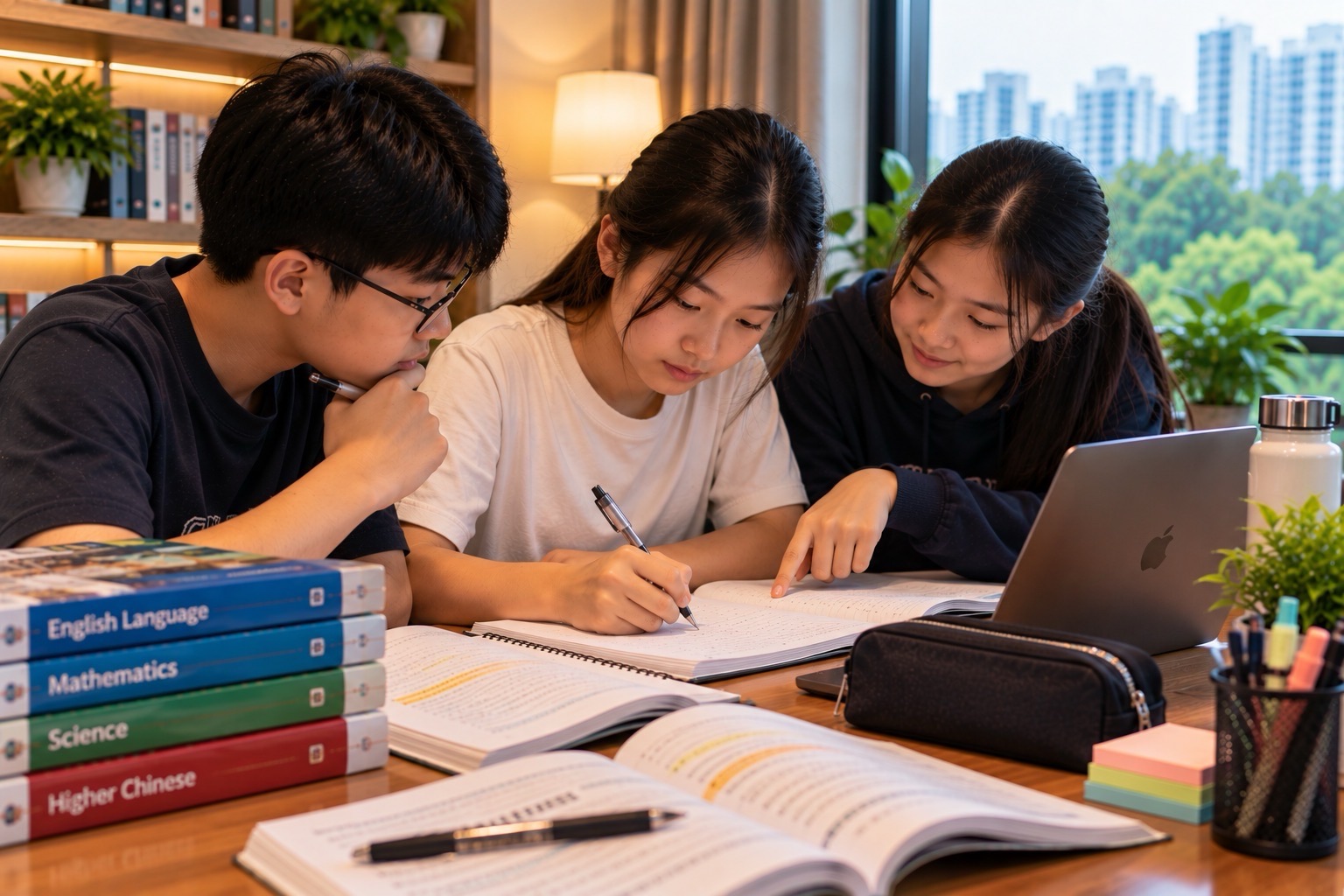
The eduKate maximum-three-student, 1.5-hour teaching philosophy can support individual attention only if a qualified G3 Hindi K360 tutor and appropriate class are genuinely available. Families must confirm that rather than infer current specialist availability from a general guide.
Related Punggol reading includes G3 Hindi idioms in their proper context, choosing a G2 Hindi essay question, the official G3 third-language syllabus guide and the eduKate three-pupil learning approach.
Questions parents should ask about Hindi tuition
- Has the school confirmed K360 G3 Hindi, not G2 K241?
- Does the tutor know the two-paper 45/55 weighting and November-only availability?
- Can the child select the correct genre for the approximately 120-word task?
- Does the 200-word essay develop a clear sequence or distinct argument?
- Can the pupil explain why Hindi verb forms change with the relevant sentence relationship?
- Are idioms and proverbs taught as contextual meanings rather than lists to copy?
- Can the learner explain an MCQ choice from actual textual evidence?
- Does each correction lead to an independent changed task?
Frequently asked questions
Is G3 Hindi K360 assessed in November?
Yes. The 2027 syllabus states the subject is available in November only.
Is there a separately weighted oral or listening examination?
The published K360 national assessment lists two written papers and no additional separately weighted oral or listening paper.
How many Hindi words are required?
The syllabus says about 120 words for the letter/report/dialogue/speech and about 200 words for the essay. These are approximate writing lengths, not fixed minimum wording.
How much is comprehension worth?
Paper 2 carries 55% overall, with 50 raw marks for language use, 14 for MCQ comprehension and 46 for open-ended comprehension and vocabulary.
Can a pupil prepare for Hindi with only a memorised idiom list?
No. The official lists are not exhaustive, and the examination also tests word formation, sentence transformation, cloze, writing and contextual comprehension.
The Punggol 2027 takeaway
G3 Hindi K360 assesses whether a pupil can use Hindi for purposeful writing and reason accurately about unfamiliar text. Correct preparation follows the 45/55 November paper scheme, teaches grammatical relationships and idioms in context, and ensures open-ended comprehension answers are supported by evidence. The child’s independent ability to explain a new question is the strongest indicator of useful tuition.
Official references: SEAB 2027 G3 Hindi K360 syllabus and SEAB 2027 G3 subject directory. Reviewed 1 November 2026; later SEAB and school instructions take precedence.


