
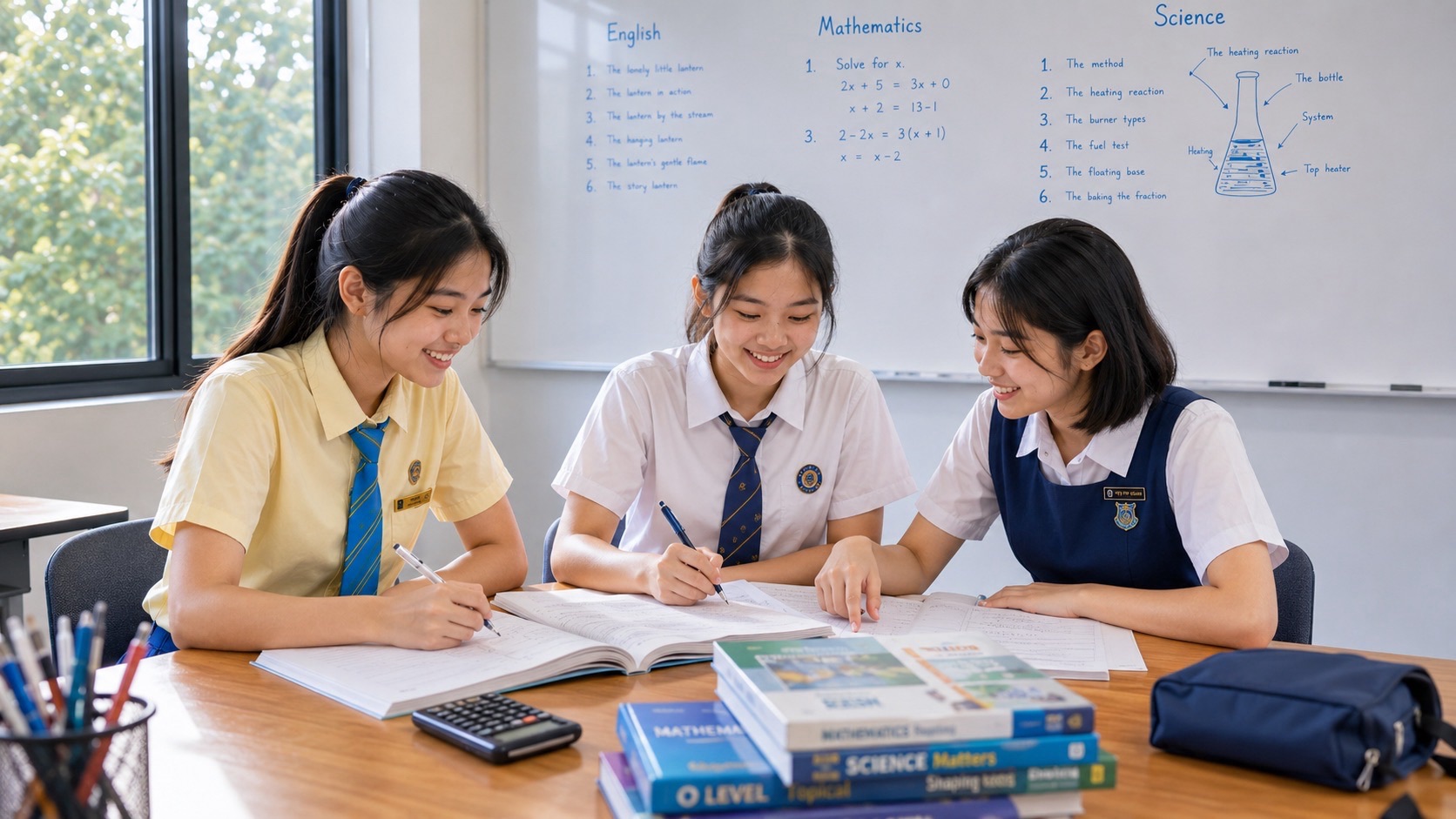
Secondary 4 pupils taking G2 Hindi K241 in the 2027 SEC should prepare for an October-only, two-paper examination. Paper 1 lasts two hours, contributes 45% of the result, and requires a letter of at least 90 Hindi words together with an essay of at least 170 words. Paper 2 lasts 90 minutes, contributes 55% and examines sentence grammar, word combination and separation, idioms, proverbs, cloze, vocabulary and prose comprehension. The correct subject code is K241, not G3 Hindi K360.
For Punggol families, the difficult part of Hindi learning is often not the number of words a student can remember. It is choosing a form that fits a sentence, identifying an author’s meaning from the surrounding context, and organising a composition that addresses the actual question. A pupil may know the meaning of a proverb but use it in an unsuitable situation. Another may read the words in a passage accurately yet invent an inference the text does not support. Good tuition finds the first mistake in reasoning rather than asking the child to repeat an entire assessment book.
- Registered subject: SEC 2027 G2 Hindi K241, previous reference code 3238.
- National availability: October only in the published 2027 specification.
- Paper 1: 2 hours, 90 raw marks, 45% overall.
- Paper 1 Section A: letter, choose one of two questions, at least 90 Hindi words, 30 marks.
- Paper 1 Section B: essay, choose one of four questions, at least 170 Hindi words, 60 marks.
- Paper 2: 1 hour 30 minutes, 110 raw marks, 55% overall.
- Paper 2 Section A: 60 marks of word formation, idioms, proverbs, paired words, transformation, cloze and vocabulary.
- Paper 2 Section B: 14 marks, seven MCQs from around 250 Hindi words of prose.
- Paper 2 Section C: 36 marks, six open-ended questions from around 240 Hindi words of prose.
- Useful preparation: precise Devanagari reading, correct sentence relationships, purposeful writing and evidence-based comprehension.
First verify the 2027 G2 Hindi examination code
The SEAB 2027 G2 school-candidate subject directory explicitly lists Hindi K241, corresponding to pre-SEC syllabus 3238.
The detailed examination rules are in the SEAB G2 2027 Bengali/Gujarati/Hindi/Panjabi/Urdu consolidated syllabus, with the Hindi section beginning on printed page nineteen.
This document should be the reference for writing lengths, section marks and national exam availability. It is not necessary to guess from another language’s examination cover.
G3 Hindi is K360 and uses the November assessment, with broader functional-writing choices and different Paper 2 language allocations. A G2 candidate should not use a full G3 mock as though every task is identical.
The child’s school and approved language teaching provider can confirm the actual entry and teaching materials.
Definition lock: what is G2 Hindi K241?
G2 Hindi K241 is the SEC 2027 subject assessing purposeful Hindi letter and essay writing, accurate language usage and understanding of written prose through selected and open-ended questions.
It is a school-language assessment, not a complete measurement of all a person’s ability to speak Hindi or appreciate literature. Its examination structure has two written papers and does not list separate national oral or listening marks.
Spoken explanations, storytelling and discussions remain valuable ways to learn Hindi. They help children organise thoughts and connect written expressions with meanings.
However, a tutor should not describe a non-examinable separate oral paper as compulsory in the K241 national scheme.
A suitable programme should concentrate on the actual registered syllabus while respecting the student’s prior language experiences.
The first comparison parents should make: K241 versus K360
G2 Hindi K241 is October only, with an at-least-90-word letter and at-least-170-word essay. Its language-and-comprehension paper has 60 marks of language usage, fourteen MCQ comprehension and thirty-six open-ended comprehension.
G3 Hindi K360 is November only, with a letter, report, dialogue or speech of about 120 words, an essay of about 200 words, and a Paper 2 50/14/46 split.
The overall paper weightings are both 45/55, but the actual tasks and demands differ.
A student can certainly benefit from language practice across levels where appropriately selected, but a tutor should never present an unmodified G3 paper as the full official G2 examination.
Start with the candidate’s examination entry, then choose materials that match that level.
How to choose between four essay topics
The K241 Paper 1 essay section offers a choice of four questions. A pupil needs to select one that can be answered with genuine understanding and sufficient relevant ideas.
A common mistake is to choose the topic with a familiar word in its title, then discover that the actual question asks for something different.
Another is to choose the most dramatic theme because the child has memorised a model story about an accident.
A better method is to read each title carefully and identify whether it asks for an event, explanation, description, argument or personal reflection.
The pupil should then briefly list the key events or two to three distinct reasons they can develop.
The best topic is usually the one the child can handle accurately and coherently, not the one with the most impressive opening sentence.
Worked example 1: comparing four fictional prompts
Four completely fictional practice options:
- Describe a time you resolved a misunderstanding.
- Explain why a school library is useful.
- Write about an unexpected change to a class activity.
- Discuss how students can work together responsibly.
A learner with a clear experience about a misunderstanding may choose the first. Another who enjoys explaining practical examples may choose the second or fourth.
A pupil who has a prepared story about missing a bus should not force it into a topic about working together unless the content genuinely fits.
A helpful tutor asks the child to outline each plausible option in one minute, then select the prompt with a clear central idea and enough relevant development.
This habit improves timing and reduces the risk of writing several paragraphs before realising the task was misunderstood.
Paper 1 Section A: the 90-word letter needs a recipient
The K241 Section A task is a letter, worth 30 marks. The student chooses one of two topics and must write at least 90 Hindi words.
The content should respond to the actual audience. A letter to a teacher may require respectful explanation and a specific request. A letter to a friend may use a different tone while still conveying the necessary facts.
The tutor should check whether the student understands why the letter is being written, not merely whether it contains a greeting and closing.
A weak letter might have many pleasant sentences about books but never ask the organiser for the information required in the prompt.
A stronger one identifies the requested detail and gives the reader a clear reason to respond.
Worked example 2: a functional Hindi request
Original fictional practice: A pupil wants to ask a school organiser when registration closes for a Hindi storytelling event.
An appropriate short request might include:
“कृपया मुझे इस कार्यक्रम के पंजीकरण की अंतिम तिथि बताइए।”
This asks for the registration deadline.
If the full prompt also asks whether students need to bring their own books, the letter must address that second matter as well.
A complete Section A answer must contain the necessary information and meet the 90-word minimum. The sample sentence alone is not a complete examination response.
A tutor should ask the pupil to write a new letter about a different event, selecting an appropriate opening and closing without simply copying the first model.
Worked example 3: an event date is different from a deadline
Original fictional notice: Registration for a Hindi reading workshop closes on Tuesday. The event takes place on Friday at a school library. No fee is specified.
The letter may accurately refer to Tuesday as the deadline and Friday as the event day.
It should not claim that registration remains open until Friday or that the activity is free without supporting evidence.
A useful tutor can ask the student to label event, date, deadline, venue and missing information before writing.
This same reading skill appears in comprehension: two facts may both be true but answer different questions.
Correct interpretation is often about relationships, not unfamiliar vocabulary.
Hindi script and the meaning behind a word
Hindi is written in Devanagari, and pupils need accurate recognition of consonants, vowel markers, conjuncts and word forms relevant to their syllabus.
A student who speaks Hindi at home may still need practice with formal written materials. Another may read every letter clearly but struggle with grammar or extended composition.
The tutor should distinguish script decoding from sentence interpretation.
For example, पुस्तक means book. Recognising it does not tell the pupil who is reading, borrowing or returning that book.
The verb and surrounding structure carry important information about the event.
A strong lesson begins with the actual misunderstanding and does not assume that copying a vocabulary list can solve a causal-reading problem.
Worked example 4: Hindi gender and verb forms
Compare these original short teaching examples:
“रवि किताब पढ़ता है।” — Ravi reads a book.
“रीना किताब पढ़ती है।” — Reena reads a book.
The object, a book, remains similar, but the present-habitual verb form changes with the relevant subject agreement.
A student may know किताब and पढ़ना yet write an unsuitable form in a new sentence.
The tutor can ask which part changes and why. Then introduce another subject and action, asking the pupil to create a correct sentence independently.
This is useful for composition and structural cloze, and it makes a grammar rule practical rather than abstract.
Worked example 5: yesterday versus tomorrow
Hindi कल can mean yesterday or tomorrow, with the verb and surrounding context resolving which is intended.
Compare:
“वह कल आया था।” — He came yesterday.
“वह कल आएगा।” — He will come tomorrow.
The word कल looks the same, but the verb construction changes the time reference.
A pupil who translates it automatically as tomorrow may misunderstand the first sentence.
A good tutor asks the learner to identify the grammatical clue, then gives a different sentence using a new action and time.
This is a powerful demonstration of why word meaning must be interpreted in context, especially in reading and cloze.
Paper 1 essay: structure before ornament
The Section B essay is worth 60 marks, twice the letter’s raw mark allocation, and must contain at least 170 words.
A narrative needs the event’s actual development. An explanatory essay needs reasons that differ from one another and connect to the question.
A common weak response includes a long description of weather or surroundings but only one sentence explaining the central problem.
Another repeats the importance of a topic without describing how the proposed actions would help.
The teacher can ask each pupil to state what their essay is really about, then identify which paragraph explains that idea.
An accurate, coherent 175-word essay can teach more about useful writing than a long memorised story unrelated to its prompt.
Worked example 6: an original Hindi narrative outline
Fictional practice topic: A student discovers that the labels for a school exhibition have been placed on the wrong displays.
A thin story says everybody was worried, then the problem was solved.
A stronger plan explains how the student checked the original list, divided the repair work with classmates and verified the labels before the visitors arrived.
The outcome follows from the specific actions.
A pupil could open an original story with an appropriate Hindi sentence such as:
“प्रदर्शनी शुरू होने से पहले हमें पता चला कि कुछ नाम-पट्टियाँ गलत स्थानों पर लगी थीं।”
That introduces a clear problem without an unrelated dramatic event.
The student should create their own continuation, with a competent teacher correcting the actual Hindi syntax and spelling.
Worked example 7: an expository essay with practical points
Original fictional writing topic: How can students care for shared school resources?
One idea might be returning borrowed materials to the correct place. A second could involve informing a teacher when an item is damaged. A third may be treating resources carefully during use.
Each point needs a reason.
A student who writes only “responsibility is important” repeatedly has not developed the topic.
A stronger paragraph describes what action is proposed and how it helps the next person using the item.
A thoughtful answer may acknowledge constraints, such as the need for a convenient return system and clear instructions.
The objective is relevant reasoning in natural Hindi, not decorative repetition.
Paper 2: language usage is sixty raw marks
The second paper lasts one hour 30 minutes and contributes 55% to the total.
Its Section A Language Usage contains 60 marks. The official specification lists:
- Combination or separation of words.
- Idioms, proverbs and words in pairs.
- Sentence transformation.
- Structural cloze.
- Vocabulary.
The learner needs to know the rules behind language forms and how an expression works within a sentence.
A pupil who memorises an idiom’s translation without knowing when it is used may choose it incorrectly. Another who sees familiar words may miss a grammatical relationship in cloze.
The tutor should require an explanation for every corrected response and then test the rule with new material.
Combining and separating words in Hindi
Word combination or separation may involve meaningful grammatical and orthographic rules. Some relevant exercises can involve संधि processes, depending on the specific items and school teaching materials.
It is unsafe to assume that joining two Hindi expressions merely requires deleting the space between them.
A qualified teacher should show the component forms, the relevant change and the correct written result.
Then the pupil should explain why that change is necessary, rather than only copying the finished word.
A second word pair not used in the explanation tests whether the rule transfers.
The relevant examples should come from authorised Hindi educational materials rather than invented spelling combinations.
Worked example 8: a sentence transformation must preserve meaning
Consider the original statement:
“रीना ने रवि को पुस्तक दी।” — Reena gave Ravi a book.
The pupil may be asked to rewrite a sentence under a specified grammatical transformation.
A wrong version that says Ravi gave Reena the book has reversed the action’s direction.
A useful tutor first identifies who gave, what was given, and who received it, and then applies the required Hindi construction.
It is not enough for the resulting sentence to contain all the same nouns.
The core relationship must remain intact where the task asks for meaning preservation.
Worked example 9: the cloze must fit the whole passage
Original fictional Hindi mini-story: A student visits the library, selects a book, reads it and returns it to its shelf.
Suppose the blank occurs in the final sentence.
A word referring to returning the book may fit, while a distractor referring to buying or losing it would contradict the earlier events.
A pupil who chooses the most familiar book-related verb may be wrong.
The tutor should ask what happened first and what the last sentence must logically add.
Then use a different fictional story with changed people and objects, so the child cannot simply remember one answer.
Idioms and proverbs should be chosen for meaning
K241 language usage includes idioms and proverbs. The consolidated official specification has Hindi-specific guide lists and explicitly states they are not exhaustive.
For example, the conventional Hindi expression “आँखों का तारा” describes someone very dear, rather than a literal star inside somebody’s eye.
It may suit a personal or family context about an especially beloved person. It would not be appropriate in a factual report about the visual appearance of a school notice.
A tutor should teach conventional meaning, appropriate register and suitable situation before asking pupils to insert an expression.
Memorising a list without understanding these conditions may produce fluent-looking but inaccurate writing.
Worked example 10: compare an appropriate and inappropriate idiom context
Original fictional situation A: A grandmother speaks affectionately about a beloved grandchild.
Situation B: A student describes the colour and size of a library poster.
An affection-related Hindi idiom might suit A. It does not automatically suit B.
The pupil should explain which feature of the situation makes the expression appropriate.
Then the tutor presents a different paragraph where the same word appears but its intended meaning is literal or unrelated.
This is a deeper test than asking the child to recite the first translation in a glossary.
It also strengthens comprehension, where the candidate may need to identify an expression’s contextual sense.
Word pairs: understand the complete expression
An examination word pair is not simply two neighbouring words.
A conventional Hindi pair can carry an established meaning or usage. Replacing one member may change the expression or make it unnatural.
The tutor should select real examples from the syllabus’s Hindi-specific guides and ask pupils to interpret them in complete sentences.
A strong learner can explain when a pair suits the passage and why a similar-looking distractor does not.
This is a language-use skill, not a memory contest in which every possible pair can be guessed from English meanings.
Because the syllabus guides are not exhaustive, wider age-appropriate Hindi reading remains valuable.
Paper 2 reading: 14 and 36 marks
Beyond its sixty language-usage marks, K241 Paper 2 has:
Section B — 14 marks: seven MCQs based on a prose passage of about 250 Hindi words.
Section C — 36 marks: six open-ended comprehension questions based on another prose passage of about 240 words.
The lengths and question types help parents choose suitable practice.
A seven-item MCQ section rewards careful selection and recognition of distractors. An open-ended section requires the pupil to express the intended answer in understandable Hindi.
A learner weak in both may need reading comprehension support rather than more grammar drills.
Worked example 11: main idea versus supporting detail
Original fictional passage: A school introduces a Hindi reading programme to encourage pupils to discover new books. Volunteers organise the shelves and students share recommendations.
The main idea is the school’s effort to encourage reading and increase access to books.
The volunteer work and recommendations are supporting actions.
A weak response may say the passage is only about arranging shelves.
A stronger pupil identifies what links the details and explains how the particular actions support the wider purpose.
This skill also improves essay planning: each paragraph should have a clear main point and supporting example, not a collection of unrelated facts.
Worked example 12: a supported inference
Original fictional story: A pupil finds a borrowed book near a school bench. The pupil gives it to a teacher so the owner can recover it.
A direct fact is that the book was found near the bench.
A supported inference is that the pupil wanted to act responsibly and help return it.
An unsupported conclusion says the pupil received a reward or was punished for a theft.
The passage says nothing of the sort.
The teacher should ask the learner to identify which action supports the inference and whether the conclusion goes beyond the evidence.
A pupil who can refuse an unsupported claim has developed useful critical reading.
Paper 2 MCQ distractors are designed to test relationships
A multiple-choice option may repeat a word from the passage but reverse the time, place or actor.
Another may contain a true detail that answers a different question.
A third may give a plausible explanation not actually supported by the text.
The tutor should ask pupils to locate the relevant source phrase before choosing and to explain one incorrect option.
A correct option letter without a reason could result from guessing.
A changed passage with a new setting is a better indicator of independent mastery.
Open-ended comprehension: concise does not mean incomplete
Section C requires written answers, not merely selecting an option.
A question asking why someone missed an event needs a cause. A question asking what happened next needs sequence. A question asking for the writer’s message needs a relevant interpretation.
The student should not copy an entire paragraph and hope the examiner identifies the answer.
A better procedure is question word → supporting line → precise Hindi answer → final relevance check.
Sometimes one clear sentence is enough; sometimes a reason or textual detail must be added.
The tutor should follow the actual marks and the school’s correction criteria rather than impose a fixed length for every response.
Worked example 13: one word, two possible times
Return to the Hindi word कल.
If the passage uses a past-tense context, the meaning may be yesterday. In a future-tense context, it may be tomorrow.
A pupil who sees the same word and gives the same translation every time has ignored the sentence.
That is a common kind of vocabulary-in-context mistake.
A tutor can create short new sentences with both time references and ask the student to identify the clue that decides the meaning.
Then introduce a different ambiguous or context-sensitive word where appropriate to the school syllabus.
The teaching principle is that the passage determines the answer, not the isolated glossary entry.
Typical K241 errors and their targeted repairs
- Writing a report or speech when G2 Section A specifically asks for a letter.
- Omitting the actual letter request in favour of unrelated background.
- Choosing an essay topic from one familiar word without reading the full prompt.
- Reaching 170 words while leaving the main narrative unresolved.
- Using the wrong Hindi verb agreement for the subject.
- Combining words without the prescribed language rule.
- Transforming a sentence and reversing who acted.
- Choosing a cloze verb that contradicts the story.
- Treating an idiom literally in an unsuitable context.
- Memorising conventional word pairs but not recognising usage.
- Selecting an MCQ from a repeated keyword rather than evidence.
- Copying irrelevant lines into an open-ended answer.
- Using the G3 K360 November paper as the official G2 October mock.
Each error calls for a specific explanation and a new independent test. Correcting a response in front of the pupil does not prove that the skill has transferred.
A four-stage 2027 Hindi revision plan
Term 1: verify G2 K241 and diagnose
Check the registered subject and October availability. Review one letter, one essay, a language-usage exercise and unfamiliar Hindi prose. Identify whether grammar, writing relevance or reading evidence is the central problem.
Term 2: develop precise writing and language control
Practise letters of at least 90 words and essays of at least 170 words in changed contexts. Teach Hindi agreement, correct word formation, sentence transformation and idioms through suitable examples.
Term 3: practise unfamiliar passages
Use MCQ passages near 250 words and open-ended passages near 240 words, with age-appropriate language. Explain every inference and revisit recurring grammar errors after a delay.
October SEC preparation: rehearse the real papers
Use two hours for Paper 1 and 90 minutes for Paper 2, confirming the actual SEAB and school timetable, exam materials and candidate instructions through the SEC portal.
Protect rest and genuine reading. Many unmarked worksheets are less informative than a smaller number corrected thoughtfully.
How a genuine three-student Hindi tutorial might help
One pupil may identify the correct verb form, another explain why an idiom suits the passage, and the third show evidence for an inference.
The tutor can ask each to explain their reasoning. Then every student receives a different new question and must demonstrate the skill independently.
That is the potential strength of eduKate’s maximum-three-pupil, 1.5-hour learning approach: close attention to the first error rather than group copying.
This requires a genuine qualified K241 Hindi specialist and suitable class, whose current availability must be verified. The publication of a guide is not proof that a class is currently operating.
Related Punggol reading includes G2 Hindi essay-topic selection, G3 Hindi K360 comparison, the five G2 language syllabuses and eduKate’s three-pupil tutorials.
Questions parents should ask before tuition
- Is the pupil entered for G2 Hindi K241, not K360?
- Does the tutor understand the October-only 45/55 two-paper format?
- Can the pupil produce an appropriate minimum-90-word letter independently?
- Does the child select and develop one of four essays at minimum 170 words?
- Can the learner explain Hindi agreement and the context determining word meaning?
- Are word formation, sentence transformation and idioms taught through actual Hindi?
- Can the pupil justify an MCQ choice with text evidence?
- Can the child answer six unfamiliar open-ended questions concisely and correctly?
- Does each correction result in a changed independent task?
Frequently asked questions
Is G2 Hindi K241 examined in October or November?
The official 2027 K241 syllabus specifies October only. G3 Hindi K360 separately specifies November availability.
What is the minimum number of words in Paper 1?
At least 90 words for Section A’s letter and 170 words for Section B’s essay.
Are the two papers equally weighted?
No. Paper 1 is 45% and Paper 2 55%.
Does K241 have an official oral paper?
The published K241 national scheme comprises two written papers and does not list an additional separately weighted oral or listening component.
What is the Paper 2 mark split?
60 raw marks for language usage, 14 for MCQ comprehension and 36 for open-ended comprehension.
The Punggol 2027 takeaway
G2 Hindi K241 requires clear letter writing, a developed essay, correct Hindi grammatical forms and evidence-based reading. The defining facts are the October-only examination, 90/170-word minimums, 45/55 assessment weighting and 60/14/36 reading-paper allocation. Good tuition should teach the underlying relationship behind a mistake and verify the pupil can use it in a completely new context.
Official references: SEAB G2 Hindi K241 consolidated SEC 2027 syllabus and SEAB G2 2027 school-candidate register. Reviewed 1 November 2026; later official and school instructions take precedence.


