
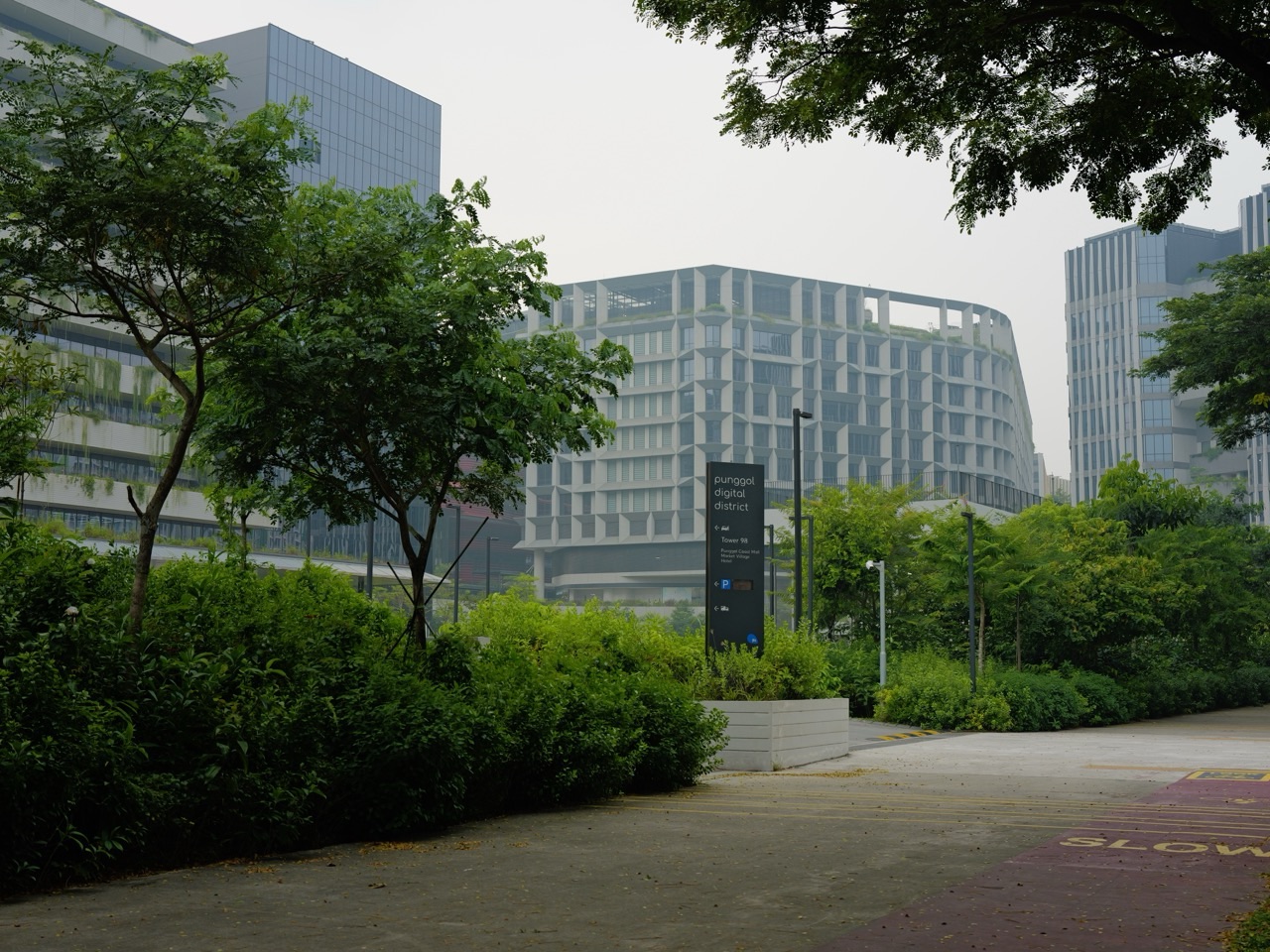
Life around Punggol Coast now involves an operating North East Line MRT station, an integrated bus interchange, a university campus, businesses and everyday food and retail services. Punggol Coast MRT opened on 10 December 2024, the bus interchange opened on 29 June 2025, and Punggol Coast Hawker Centre opened in July 2025. That means residents, students and workers can plan real weekday journeys through Punggol Digital District rather than treating the entire area as a distant future proposal. The practical question is how to combine work, study, meals and the return home without exhausting the day.
The useful distinction is between what is operating now and what is still developing. JTC identifies Punggol Coast Mall, a 40-stall hawker centre and the first 400 metres of Punggol Heritage Trail as open district amenities, while certain childcare and hospitality facilities remain forthcoming. The district’s widely cited 28,000 jobs and 12,000 students describe planned scale, not a count of jobs available to a reader today. This guide focuses on the lived weekday: choosing the correct station entrance, handling class or work schedules, finding an appropriate meal, protecting study and rest time, taking a short break safely and making the evening journey dependable.
- Rail: Punggol Coast MRT (NE18) on the North East Line, opened 10 December 2024.
- Buses: Punggol Coast Bus Interchange opened 29 June 2025 and integrates with the station and mall; check current service routes.
- District: JTC’s approximately 50-hectare Punggol Digital District, alongside Singapore Institute of Technology (SIT).
- Food: Punggol Coast Hawker Centre, officially opened in July 2025 with 40 stalls, plus mall dining options.
- Shopping: Punggol Coast Mall; JTC lists more than 120 food and retail brands, but specific tenants and hours can change.
- Outdoor break: the first 400 metres of Punggol Heritage Trail are open; the full planned 1.3 km route must not be assumed complete.
- Closure: Punggol Point Park is separately closed for upgrading, with expected works completion at the end of 2027, not confirmed reopening.
- Planning rule: distinguish operating services, future facilities and development-scale targets before making work, housing or education decisions.
Punggol Coast has become a real weekday destination
Punggol Coast used to appear in many conversations as something that would arrive later. That description is now incomplete. Since the MRT, bus interchange, SIT campus and operating retail and food venues serve the district, people can make normal daily plans around it. Some parts continue to develop, so a sensible description has to hold two facts at once: it is an active place, and it is not yet a finished version of every future concept shown in a master plan.
The difference matters to someone arriving for the first day of work or class. They need to know which exit reaches the intended building, where to eat at a realistic hour and how to get home if an activity ends late. A large artist’s impression says little about those immediate decisions. It can help explain the planned district, but should not be used to promise that every future bridge, school, hotel or service is ready.
JTC’s 50-hectare digital district brings work, learning and community functions together through proximity. The goal is to make different kinds of daily activity possible in one area. Yet physical proximity alone does not remove timetable clashes. A student can be next to a café and still miss lunch because a workshop runs long. A worker can have an MRT station nearby and still need to account for the final walk to the office.
This guide therefore treats Punggol Coast as a sequence of human decisions. Start with the right destination. Fit food into the real schedule. Protect a break that does not require an elaborate excursion. Leave through a transport route that actually operates at the time. When these small pieces work, the larger vision of a connected district begins to have meaning in ordinary life.

Where work, study and neighbourhood life actually overlap
The district is closely integrated with the Singapore Institute of Technology’s Punggol campus and JTC business spaces. That arrangement creates the possibility that students, researchers, businesses and community users will cross paths. But a shared district is not one unrestricted campus. Workplaces, laboratories, classes and public amenities have different access conditions. A person visiting a café does not gain admission to a research laboratory, and a student card should not be treated as a universal key to every business facility.
For an ordinary visitor, this distinction begins with wayfinding. A building may look open and welcoming from the outside but still have secure entrances or scheduled activities. Read the actual signs and check the organiser’s instructions. Public circulation spaces, university facilities and tenant workplaces need to be understood separately. The safest first visit is usually based on a named destination, not a general wish to explore every building.
The overlap becomes useful when a person has legitimate reasons to be in the district. A student might attend a scheduled class, buy lunch and meet a project teammate in an appropriate public or authorised study area. An employee might travel to the office, take a short food break and collect a small errand before heading home. A resident might use the mall without entering any work or educational building.
Different groups can share a place without sharing a timetable or access rights. That is one of the more interesting features of Punggol Coast. It creates opportunities to meet, learn and transact, but good etiquette requires people to respect how each space is used. Treat the boundaries as ordinary parts of an active district, not obstacles to be bypassed for a better photograph or a more impressive day.
Begin with Punggol Coast MRT, not a guessed street address
Punggol Coast MRT station, code NE18, opened for passenger service on 10 December 2024 as the northern terminal of the North East Line. It is a concrete transport anchor and one of the most useful reference points for anyone new to the district. LTA describes two entrances, including one along New Punggol Road and one within Punggol Digital District. The correct exit depends on where you are going, not which one looks more familiar in a photograph.
Before the first commute, identify the full destination address and the entrance visitors should use. Some campuses and business developments contain multiple blocks. Being ‘at Punggol Digital District’ may still leave a confusing final walk if the building or appointment location is unspecified. Follow current posted wayfinding, and use a properly accessible route if carrying luggage or using a mobility aid.
A commuter should time the entire chain. That includes leaving home, reaching a station, waiting, any interchange, alighting at Punggol Coast and walking to the room or office entrance. A person travelling from another part of Punggol may compare a bus connection with other modes. Do not assume a short main train ride proves a short door-to-door journey. Include time needed for lifts and secure building registration where applicable.
Keep the station’s opening date separate from future district announcements. The station is not ‘upcoming’, and an old preview article that describes it as future infrastructure is unsuitable for a present-day commute. At the same time, station operation does not guarantee that a nearby planned development has opened. Learn to separate what the transport network can do today from what the land-use plan may add later.
The integrated bus interchange changes the last part of many journeys
Punggol Coast Bus Interchange began operating on 29 June 2025, linked with Punggol Coast MRT station and Punggol Coast Mall. LTA announced it as an integrated transport hub with features intended to support commuters, including barrier-free access and priority queue areas. This matters for people whose useful journey involves a bus rather than a direct rail trip. The interchange gives the district another way to connect without every visitor taking the same path.
The initial services included routes 34 and 117/M, with amendments described by LTA. More broadly, operators can change services as developments evolve. Do not treat a list copied from the opening press release as a permanent current bus map. Before a journey that matters, check the latest journey planner, operator information and stop signs. This is particularly important for late shifts, airport trips and school or campus schedules.
A new visitor should also understand which direction the bus is travelling. The same numbered service can be encountered at different stops and on different sections of a route. Stand at the signed boarding point, check the intended destination and allow time to find the right berth. A real-time estimate helps only when it refers to the correct stop and service direction.
For families and older commuters, the interchange’s facilities can make transfers easier, but accessibility still involves the full origin-to-destination chain. A barrier-free terminal is useful only if the subsequent workplace, home or service has an appropriate entrance. Know the actual route, keep alternatives where possible and avoid promising that public transport can meet every care or mobility need without support.
The morning: a different plan for students, workers and residents
A student travelling to SIT, an employee based in the digital district and a parent visiting the mall may arrive at similar times for very different reasons. The student’s priority may be reaching a scheduled classroom with enough time to find the building. The employee may need a secure entry pass and time to prepare for a meeting. The parent may be combining shopping with an authorised school or care handover. A good routine starts with the specific task.
On a first morning, resist the temptation to fill every spare moment. Finding a new campus room, locating a building entrance and learning the return route are already useful achievements. Leave reasonable time before the appointment. A student who arrives slightly early can identify a suitable waiting area; a worker may need visitor registration. Neither should assume that a public food court table is guaranteed to be empty at the busiest period.
For someone living elsewhere in Punggol, test whether Punggol Coast is the best local destination for the task. Waterway Point and One Punggol may be closer to other errands, depending on the block. The word ‘newest’ does not make a place automatically more convenient. A sensible resident chooses the location that meets the need with acceptable effort, rather than selecting the district simply because it receives media attention.
In practice, a calm morning is often prepared the previous night. Confirm the address, save the correct event or class time, charge the necessary device and pack only appropriate materials. If the trip involves a child or someone needing assistance, agree on responsibilities. Predictability begins before a train reaches the station.
Breakfast and early meals: don’t confuse a full district with one schedule
Punggol Coast offers multiple food possibilities through its hawker centre and mall, but a crowded district does not guarantee that every preferred stall is serving at every hour. Specific opening times, menus and seating conditions change. A worker should not plan a crucial meal based solely on a photograph of a sign; a student should not assume the shortest break will be enough for travel, queueing, eating and returning to class.
A first-week food plan can be simple. Identify one reliable venue suitable for your usual budget, one alternative and a home-based option if the trip is interrupted. Confirm dietary requirements directly with the outlet when necessary. Somebody with a strict timetable may prefer to carry an appropriate meal rather than gamble on queues. Somebody with more flexibility may enjoy exploring the district’s range gradually.
The district’s 40-stall hawker centre opened in July 2025, providing a real food option rather than a proposed facility. This is useful information, but the number of stalls is not a promise that all 40 will operate continuously at one time. Check current vendor availability and normal service instructions. A large choice is an advantage only when the individual can eat comfortably and return on time.
Food can make a place feel familiar. A student who finds a dependable affordable lunch, or a worker who knows where to buy something small after a late meeting, experiences Punggol Coast differently from a visitor who sees only architecture. The strongest daily convenience may be the removal of uncertainty about where and when to eat.
Punggol Coast Hawker Centre: a useful anchor with real limits
The opening of Punggol Coast Hawker Centre in July 2025 gave the district an identifiable shared dining location. The operator’s release describes 40 stalls and a sizeable seated area. That is valuable for office workers, students, nearby residents and visitors, yet practical experience depends on the time of day, the availability of suitable food, queue lengths and the needs of the person dining.
An office lunch group can reduce friction by agreeing on a meeting point, a clear duration and whether people will purchase food separately. A student in a short break may choose a simpler option and plan a longer meal another day. A family with a young child may prefer an off-peak visit. These choices are not glamorous, but they determine whether a dining venue feels convenient or stressful.
Shared dining requires courtesy. Keep walkways open, follow tray-return and utensil arrangements, respect seating needs and avoid photographing strangers at close range for online content. Public popularity does not erase other patrons’ privacy. If a stall is closed or a dish has sold out, choose another appropriate option without treating a routine variation as a failure of the whole district.
A hawker centre is not a health facility, workspace or guaranteed study hall. Its primary purpose is providing food in a shared environment. People may occasionally sit and converse, but occupying tables for long periods without regard for diners can be inconsiderate. The best district routine matches the venue to the activity for which it was created.
Punggol Coast Mall: ordinary errands behind the impressive new address
JTC’s district community page identifies Punggol Coast Mall as an operating retail destination and lists over 120 food-and-beverage and retail brands. This offers variety, but it is important to distinguish the overall mall from an individual shop. A tenant may move, change hours or alter its services. A future-facing lifestyle guide should tell people how to verify their specific errand instead of storing a fragile list of supposedly permanent openings.
For workers, the mall may allow a small purchase before a return commute. For students, it may provide a meal or required stationery if the relevant shop carries it. For nearby residents, it may be one option among neighbourhood retail centres. The practical value lies in combining compatible errands without an unnecessary additional trip. It does not come from making everyone spend money to experience the area.
Consider the weight and urgency of the item. A notebook may be easy to carry home after work; a bulky household purchase may need delivery or a different shopping plan. A household should not automatically substitute expensive impulse shopping for an organised grocery list just because new storefronts are attractive. Repeated small purchases can cost more than expected.
A sensible mall visit begins with an objective and ends when the objective is met. That could be buying a household essential, meeting somebody for a meal or simply spending an appropriate amount of leisure time. The district is for real people with budgets and commitments, not merely a collection of brands to be checked off.
What a working day near SIT actually feels like
A person employed in the district may benefit from proximity to educational and innovation spaces, but ordinary work still involves deadlines, meetings and commuting. The presence of companies focused on digital technologies does not make every day a public demonstration of artificial intelligence. Most days are likely to include familiar tasks: opening the office, speaking with colleagues, doing focused work and returning home. A guide becomes useful when it respects that reality.
A strong weekday routine protects three transitions. The morning transition gets the worker into the correct building on time. The midday transition allows suitable food and a break rather than pushing every task into the same hour. The evening transition closes work, deals with any essential errand and makes the return journey predictable. Each stage benefits from a named location and a realistic clock.
Some workers may have hybrid or flexible schedules, while others must be physically present. Building access and visitor arrangements differ by employer. Do not generalise a particular company’s policies to the entire digital district. The sensible employee confirms their own workplace instructions and separates public spaces from restricted office and laboratory areas.
Proximity to a university can create genuine opportunities for collaboration, but a worker cannot assume access to a class or academic resource simply because the office is nearby. Collaborations depend on participating organisations and official programmes. The useful idea is that different institutions can meet more easily in a shared district; the individual still has to make appropriate arrangements.
What a student’s weekday needs beyond the campus timetable
For an SIT student, the district can be a place of serious study, project work and everyday life. The campus location is relevant, but the student still needs a plan for meals, revision, group meetings, rest and the route home. An hour free between classes does not automatically provide a full hour of productive study. Travel between rooms, settling, messaging teammates and eating all consume time.
Break the day into usable blocks. If a fictional student has 90 minutes between commitments, and 15 minutes are needed to move, 25 for food and 10 to prepare the next class, only 40 minutes remain for another activity. This arithmetic is illustrative, not an official SIT timetable. It demonstrates why a realistic schedule may include short review tasks rather than ambitious deep-study sessions every time there is a gap.
Use authorised study and collaborative spaces appropriately. Check campus rules for booking, access and permitted activities, and choose quieter work when suitable. A busy dining table should not be assumed to be a guaranteed place for lengthy group work. Protect fellow students’ attention and respect the privacy of people whose screens, research or conversations are visible.
An effective student day ends with a manageable next step. Write down a project task, identify tomorrow’s first commitment and travel home at a reasonable time. Independence means making sound decisions about energy and responsibility, not trying to extract academic output from every minute spent inside a modern district.
Working and studying together: realistic collaboration, not a guaranteed career
Punggol Digital District’s co-location of SIT and business spaces is often described as a place where learning and industry can interact. The potential is meaningful. Students may encounter programmes, collaborations or relevant work experiences through official channels. But the presence of prominent companies should not be converted into a promise of an internship, job offer, scholarship or admission. Eligibility, selection and availability belong to the respective organisation.
A student who wants to benefit from the environment can begin by building competence in their chosen area, attending legitimate public events or university programmes and following published application instructions. A working adult considering a career change can identify needed skills and realistic training routes. These are decisions under a person’s control; an unverified claim that a future employer will recruit everyone nearby is not.
The headline figures commonly associated with the district describe a planned scale of up to about 28,000 jobs and 12,000 students. They are not equivalent to current advertised vacancies or a census of people present on an ordinary weekday. JTC’s own description of the district is the relevant context. Job seekers need actual postings and application requirements, not a neighbourhood guide repeating development targets as recruitment promises.
This article stays focused on lived routine rather than replacing separate education or career guides. A person may decide Punggol Coast is a good place to work or study because the transport, community and amenities fit their life. That decision can be sound even if they never participate in a technology showcase or work for a named multinational company.
Lunch breaks and the surprising value of a short walk
A midday break can help somebody shift attention away from a screen, but it need not become a major outdoor expedition. People in Punggol Coast have choices between appropriate indoor settings and certain open public routes. The first task is to consider the available time and weather. A fifteen-minute break cannot contain a ten-minute walk each way plus a long activity without returning late.
Identify a nearby public place suitable for the time you have. Consider seating, shelter, accessibility and whether the route passes through a restricted or construction area. On a fine day, a brief outdoor pause may be pleasant; on a stormy or very hot day, an indoor break may be the better choice. It is sensible to adjust rather than insist that an attractive landscape must be used under all conditions.
Students and workers may also need social breaks. A quiet conversation with a colleague, a meal with a classmate or simply sitting without messages can be valuable. The point is not to monetise every pause as a productivity technique. People need opportunities to recover. The district’s mixed-use design can support those opportunities, but each person must decide what kind of break actually helps.
Respect public-space rules while taking that break. Do not block walkways, photograph private office interiors or assume an educational facility’s open door invites unregistered visitors. A safe, pleasant routine is built through repeated appropriate use of shared places, not through treating the entire district as a private recreation ground.
The Heritage Trail: only the open first 400 metres are certain
JTC’s current community information says the first 400 metres of Punggol Heritage Trail are open to the public. The planned complete trail is approximately 1.3 kilometres, but its unfinished sections must not be described as ready simply because they appear in a master plan. Check the latest NParks and JTC access notices before planning a route, particularly where paths approach active works or other temporarily restricted areas.
A short open trail can be useful without needing to reach the eventual endpoint. A student could spend part of a suitable break observing the landscape. A family could use an appropriately chosen stretch for conversation or local history. A worker could take a brief after-work walk before returning to the station. The route should be judged by its current condition and available exits, not by its future length.
Punggol Point Park is a separate destination and, as of November 2026, is closed for upgrading with works expected to finish on 31 December 2027. That target does not guarantee public reopening the following day. Do not treat the park as part of a currently fully accessible heritage-trail itinerary or enter through construction boundaries. A safe walk follows the paths officially open today.
An unfinished connection is not an embarrassment to hide. It is exactly the kind of condition a resident needs to know. Planned routes can become excellent future public spaces, but current users deserve accurate information about how much is usable now. Enjoy the operating section, check current notices and leave future sections to a future verified update.
The last class, the late meeting and the journey home
The return journey is where an otherwise appealing district can become tiring. Someone may finish a project meeting later than expected or leave a class with several bags and a hungry stomach. Rather than improvise under pressure, identify the normal trip home in advance and one reasonable alternative. That may involve the MRT, a suitable bus or another permitted transport arrangement depending on the actual destination.
Check current first and last services if travelling unusually early or late. A station that operates normally during the day should not be assumed to provide an unlimited late-night connection. For a worker leaving after dark, visibility, the correct exit and the final walk from the home station matter. For a student, a familiar return route and sensible communication can reduce uncertainty.
If several people travel together, agree on a meeting point that can be described clearly: a designated entrance, a public sign or an agreed facility. ‘Meet somewhere at the mall’ is less useful when a person is running late. Don’t share precise live routes or personal schedules with large public groups. Clear private communication protects both convenience and privacy.
A successful day does not require fitting another leisure activity between finishing work and getting home. Sometimes dinner and rest are the right priorities. The district can be lively and full of options while a resident chooses not to use them all. That freedom is part of a workable urban lifestyle.
Parents and caregivers using the district
A parent might visit Punggol Coast for a legitimate family errand, accompany a student or work nearby. The development’s transport and food options can help, but care responsibilities still require precise arrangements. A child is not safely collected just because the meeting place is near an MRT station. Use the school’s or childcare provider’s current rules, authorised contacts and an appropriate public meeting point.
JTC lists three childcare centres as upcoming on its district community page. ‘Upcoming’ should not be rewritten as ‘accepting enrolment today’ or used as a guarantee of eligibility. Parents should confirm opening announcements and registration directly with the eventual provider before making housing or employment decisions. A planned facility can be encouraging without already solving a family’s needs.
People accompanying older family members may value the interchange’s barrier-free arrangements, but should still check the complete journey. A bus terminal designed for accessibility does not remove every distance, crossing or waiting challenge beyond the terminal. Ask the person what assistance is actually wanted and keep enough time for an unhurried return.
The most useful family day may combine one appointment or errand with a simple meal, then leave. A new district does not need to be experienced like a theme park. Children, older adults and caregivers have different levels of energy. Good planning chooses a comfortable amount of activity rather than treating every accessible venue as an obligation.
Different days of the week create different district rhythms
On a Monday, the challenge may be finding the correct office or classroom and learning the local path. On a Tuesday, a worker might realise that a planned lunch stop takes longer than expected. Wednesday could bring a student group project, while Thursday involves an appointment or a late meeting. Friday may be comparatively social or may simply be the end of a tiring week. The neighbourhood does not guarantee one consistent daily mood.
A useful resident strategy is to learn a small number of reliable paths before exploring widely. Know where to reach the rail station, where a suitable ordinary meal is available and where to take a break without disrupting other users. Once those anchors work, unfamiliar places are easier to explore. The first-week goal is confidence, not comprehensive coverage.
Different rhythms can generate crowding at predictable types of times, but avoid inventing exact occupancy statistics for venues. A lunch queue may be long on one day and short on another. Students have variable timetables, and businesses have their own patterns. Use direct observation for your routine and allow flexibility. One difficult visit is not evidence that every weekday will be the same.
Weekend life may be different again. People who do not work or study in the district can visit its retail and public spaces, while weekday regulars may prefer home. The district accommodates several communities. A guide that respects those different roles is more useful than claiming that the area always has a single identity as a tech office, university campus or shopping attraction.
Where Punggol Coast fits among the rest of Punggol
Punggol Coast is not a replacement for every other Punggol centre. Waterway Point remains a significant town-centre shopping destination; One Punggol brings together community and library functions; Oasis Terraces and Northshore Plaza serve particular neighbourhoods. A resident benefits when they can choose among destinations based on actual proximity and service suitability. The newest place is not automatically the right place for every errand.
For example, somebody who lives beside Punggol Coast may find its hawker centre convenient after work. A family near Oasis may have no reason to travel farther for ordinary groceries. A parent seeking a library activity may prefer the facility that matches the real programme and route. There is no single ranking that settles these questions for every block or household.
Transport is similarly contextual. A person who works on the North East Line may find Punggol Coast station especially useful. Another resident may access the wider network more conveniently through Punggol MRT or an LRT connection. Test the full journey rather than extrapolate from the names. A comprehensive town develops multiple useful centres rather than making every resident visit one central point daily.
This is why the article has a specific operating role. It explains a work-study weekday around the digital district. More general shopping directories, school guides and property comparisons should remain distinct pages with their own questions. Readers gain clarity when each article answers a real decision instead of all competing to be ‘the complete Punggol guide’.
Development figures and what residents should not assume about 2027
Punggol Digital District is designed on a substantial scale, and JTC uses targets associated with 28,000 jobs and 12,000 students in describing it. These describe the development’s ambition and intended capacity. They must not be repeated as an independently verified count of current jobs, actual student attendance or newly available employment positions. A reader considering a career move needs a specific verified vacancy, not a master-planning headline.
Likewise, the operation of Punggol Coast Mall and the hawker centre should not be confused with every planned facility being open. JTC identifies certain childcare and hospitality developments as upcoming. Plans can be revised, built in phases or opened on dates announced later. This article does not invent a 2027 opening for a hotel, childcare centre or an unverified tenant.
The district’s LaunchPad ecosystem has been described by JTC as opening in phases from late 2026. That is not evidence that every workspace or programme is available simultaneously on 1 November 2026. Applicants, visitors and businesses should check the specific project or operator. Avoid making commitments based on an old artist’s impression or a broad ‘coming soon’ slogan.
Development has a human timeline as well as an engineering timeline. A shop opening helps a resident only when it actually trades; a new workplace matters to a jobseeker only when it offers a role they qualify for; a park link matters when it is officially accessible. The honest 2027 outlook is to watch verified milestones, not to turn aspirations into present-tense services.
A fictional SIT student: the day that fits between classes
Imagine a fictional SIT student who reaches Punggol Coast by MRT. Their first class is in a campus building they have identified from official directions. The student arrives with a short buffer, walks to the correct entrance and avoids assuming that every linked building is freely accessible. The timetable includes a midday gap and an afternoon group project, but the exact sequence is a teaching example, not a description of an actual course schedule.
At lunch, the student checks the time needed for the hawker centre, including queues and the walk back. Rather than spend the entire break hunting for a perfect new dish, they choose something suitable and save exploration for another day. The group project then takes place in an authorised space. A friend suggests working in the mall food area, but they consider whether that would be fair to diners and conducive to the task.
The day runs later than expected. The student checks the transport route and decides against an unnecessary detour along a partially completed trail. They note one action for tomorrow, charge the device they need and head home. The day has included learning, food, collaboration and a safe return without demanding a constant stream of entertainment.
This fictional story illustrates a practical lesson: good student life is built from carefully chosen transitions. A modern campus and connected district make some choices easier, but they cannot manufacture time. Learners must still protect meals, rest, attention and travel safety to benefit from the opportunities around them.
A fictional PDD worker: managing the ordinary workday
Now imagine a fictional worker whose office is located within an authorised business building in Punggol Digital District. The employee travels by public transport, uses the correct building entrance and keeps a realistic arrival buffer. They find a suitable lunch venue, then return to work rather than trying to use a short break to explore the entire development. This is intentionally an ordinary story. Most workplace wellbeing is built from repeatable choices.
Later, a meeting runs beyond its original ending time. The worker has a small item to buy before returning home. They check whether it is genuinely necessary and whether the relevant shop is still open. If not, they choose not to force the errand. The final transport route is confirmed using current service information rather than relying on a cached screenshot of the bus interchange at launch.
On one evening, the worker decides to take a brief walk along a currently open public stretch of the Heritage Trail before returning to the MRT. On another evening, rain makes the walk inappropriate, and they travel home directly. The workplace routine remains stable because leisure is optional and the essential return journey does not depend on perfect weather.
This is a hypothetical composite, not a claim about a real person or employer. The example demonstrates how a district can support practical wellbeing without turning office work into a promotional tour. Reliable transport, appropriate food, clear building access and freedom to rest may matter more than the novelty of any single innovation feature.
A fictional family: a weekend visit without confusing plans and openings
Consider a fictional family arriving in Punggol Coast on a Saturday. They want lunch, a look at the district and some time outdoors. They check the operating mall and hawker centre rather than reading an old press article that describes both as future attractions. They decide how far the youngest child can comfortably walk and confirm an appropriate route back to the station.
They see the first open section of Punggol Heritage Trail. They do not assume that the entire future route is available, and they do not attempt to reach Punggol Point Park through construction boundaries. The adults explain that public places can be important and still be temporarily closed for improvement. The family chooses to enjoy the part that is actually accessible instead of forcing a journey into a fenced site.
At lunch, they use a suitable seating area, respect other diners and pay attention to the child’s need for rest. They browse only a few shops rather than make every storefront part of a checklist. When a sudden shower changes the plan, they return by a safe sheltered route. The day remains pleasant because the schedule was flexible.
This family is illustrative, but the planning principle is widely useful. A good district visit is not a race to prove that every attraction is open. It is a comfortable sequence with reliable food, safe public access, honest information and a clear way home. The same discipline that helps tourists also helps nearby residents.
A four-week Punggol Coast routine audit
During week one, record the actual station-to-destination route, the meal options that suit your budget and the time required to return home. If using a new office or campus building, learn the legitimate entrances and access conditions. Identify one place for a short break, but do not insist on a daily recreation plan before the essential schedule is stable.
In week two, try one improvement. You might use a different appropriate station entrance, move a grocery purchase to a less tiring day or prepare a simple meal when a short lunch window makes queueing impractical. The change should reduce friction without shifting an unreasonable burden to another person. If an adjustment produces a worse day, abandon it and keep the useful evidence.
Week three is the interruption test. What if a meeting ends late, a class is rescheduled, heavy rain makes an outdoor route unsuitable or an expected stall is unavailable? Check current service notices and develop a safe alternative. Do not try to prove resilience by visiting restricted paths or deliberately testing unsafe conditions. It is enough to have a credible, lawful backup.
At week four, review the entire experience. Is the commute manageable? Is food reasonably predictable? Does the person get enough rest? Are study or work commitments realistic? Which area is better left to a specialist official service or campus office? Keep the effective routines and enjoy the district without treating every new facility as a compulsory task.
Frequently asked questions about everyday Punggol Coast life
Is Punggol Coast MRT open? Yes. The station opened for passenger service on 10 December 2024 as part of the North East Line. Confirm the current timetable, station entrances and any service advisories through LTA and the operator, especially for unusual hours or a trip involving transfers. A live station does not establish whether a nearby future building is complete.
Are there places to eat at Punggol Coast? Yes. The Punggol Coast Hawker Centre opened in July 2025 with 40 stalls, and Punggol Coast Mall offers additional options. The exact stalls, tenants and hours can change. A resident or visitor should verify a preferred outlet if it is essential to the day’s plan and allow realistic queueing time.
Can I walk the whole Punggol Heritage Trail now? Do not assume so. JTC currently identifies the first 400 metres as open; the planned full route is about 1.3 kilometres. Follow current NParks and JTC notices and on-site instructions. Punggol Point Park is separately closed for upgrading, with completion expected at the end of 2027 rather than a confirmed reopening date.
Does Punggol Digital District already have 28,000 jobs available? No such conclusion follows from the master-planning figure. It describes the district’s intended scale, not a live vacancy list. Check actual employers and published roles for recruitment information. Similarly, the 12,000-student figure should not be read as an exact count of learners attending on a particular day.
Verified sources and the useful next step
JTC’s Punggol Digital District overview explains the district’s structure and intended scale, and its community page distinguishes available mall, hawker-centre and trail facilities from upcoming developments. For the transport history and integrated interchange, refer to LTA’s Punggol Coast station announcement and LTA’s interchange announcement.
For changing retail information, read the Punggol Coast Mall Guide. For construction and open-space access, use the current NParks information and Punggol Point Park Closure Guide. These links serve different questions; a district overview should not replace a live official transport notice or park access instruction.
If you want the most useful first step after reading, choose a real Punggol Coast destination and test the full weekday chain: get there, find the correct entrance, eat suitably, take one modest break if time permits and return home. Record the part that genuinely causes friction. For someone who works or studies here daily, that information is worth more than an abstract promise about urban innovation.
Punggol Coast is an unusually interesting place where a university, businesses, transport and neighbourhood amenities share a developing landscape. The meaningful outcome is not whether every promotional phrase sounds futuristic. It is whether an ordinary person can work, learn, meet, eat and return home with enough energy to live well the next day.


