
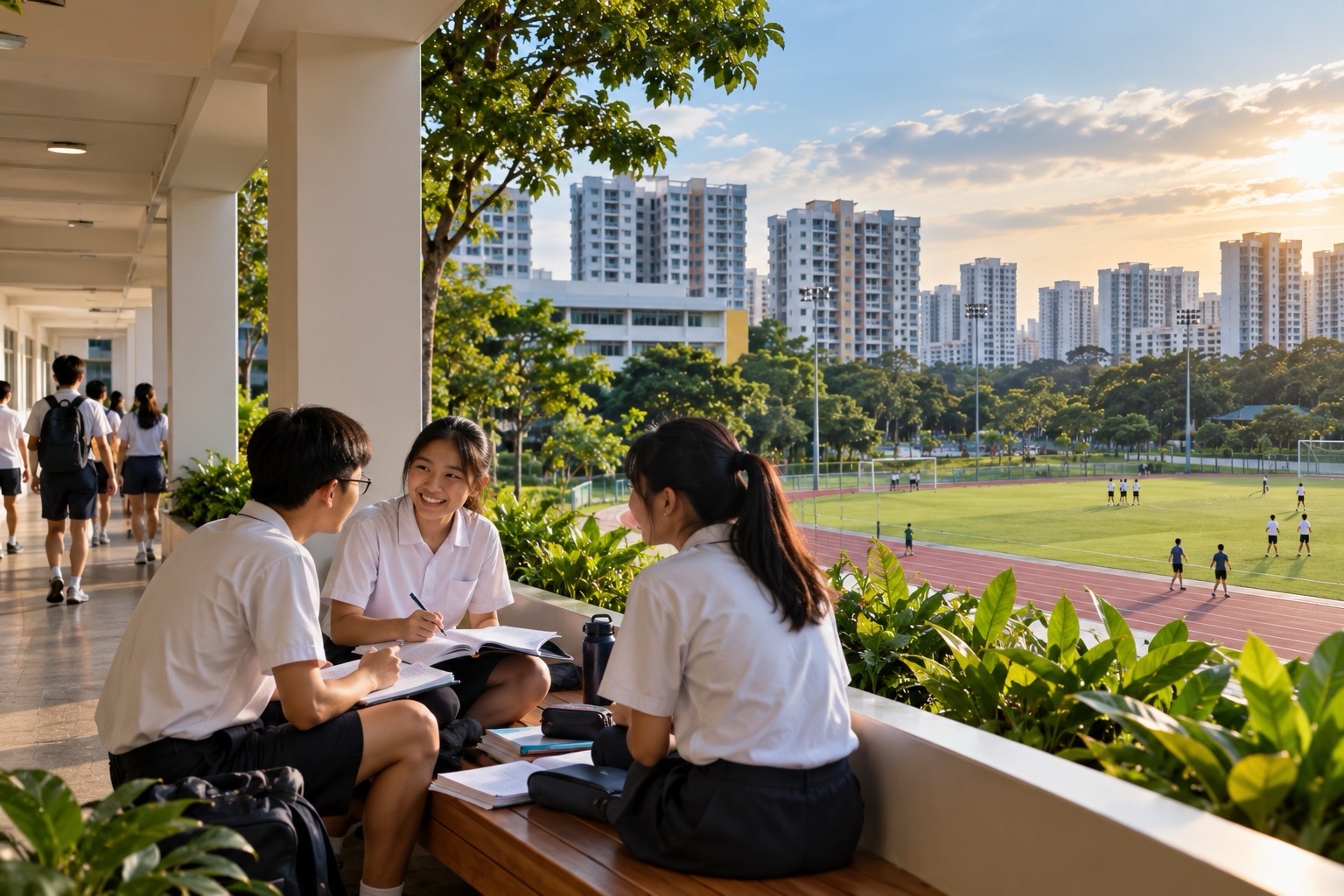
How PG1 works at Punggol in daily school life is different from the old assumption that pupils remain in one permanent stream and one fixed group of classmates. Under Singapore’s Full Subject-Based Banding (Full SBB), Posting Group 1 is used for Secondary 1 admission and generally guides a student’s initial academic subjects toward G1. Students join mixed form classes with peers from different learning profiles, while many academic lessons are organised according to the subject levels that pupils actually offer. A child can therefore belong to a form class, learn Mathematics with a particular subject group and participate in school activities with a wider circle of friends.
Punggol parents should explain the difference between a form class and a subject class before interpreting a teenager’s timetable or friendships. A form class provides a continuing school community, pastoral support and shared curriculum experiences; a subject group provides lessons matched to the actual subject level. The two do not need to contain exactly the same pupils. Families can help by encouraging respectful language, teaching students how to seek help, paying attention to genuine signs of exclusion and checking school-specific arrangements with the form teacher. The aim is belonging and effective learning, not making children compete over whether a classmate takes a subject at G1, G2 or G3.
- PG1: an admissions Posting Group, not a permanent label describing every subject or every classmate.
- G1, G2, G3: levels of individual subjects; a pupil’s subjects may be offered at different levels where the applicable criteria and school arrangements permit.
- Mixed form class: a shared community that brings students with varied subject combinations and strengths together.
- Subject group: classmates in a lesson can differ from the form-class roster because the subject is taught at the appropriate level.
- Common curriculum: MOE identifies Art, Character and Citizenship Education, Design and Technology, Food and Consumer Education, Music and Physical Education among common lower-secondary experiences.
- Daily benefits: broader friendships, teamwork, learning from different strengths and opportunities to practise respect beyond academic comparisons.
- Parent’s task: understand the actual timetable, preserve the child’s privacy, address bullying promptly and ask the school how pastoral support works.
- School-choice check: verify the precise Full SBB arrangements and current programmes at the school, not through old stream stereotypes.

The two class systems a Secondary 1 child must understand
In primary school, children often think of “my class” as a relatively stable group of pupils who take most lessons together. Secondary school under Full SBB is more nuanced. The form class can provide identity, orientation, administrative notices, friendships and common curriculum experiences. For academic subjects, students may move into separate groups because they offer the relevant subject at different levels. A student may talk about “my form class” and “my English group” without referring to exactly the same set of classmates.
This arrangement can initially sound complicated, but it is familiar in principle. A music ensemble may bring together students from different school classes, while a language lesson groups students according to what they study. The important fact is that the organisational group does not define a child’s value. Parents can ask their children to show the actual timetable and explain where they go for different lessons. If the schedule seems confusing, the school is the source of truth. A family guide should never invent an exact class-allocation rule for an individual Punggol school.
Why Singapore moved away from rigid secondary streams
Full SBB was introduced to give students more flexibility to learn subjects at levels suited to their strengths, interests and learning needs, while creating more opportunities to interact with peers of different academic profiles. From the 2024 Secondary 1 cohort, the old Express, Normal (Academic) and Normal (Technical) stream structure was phased out under the new system. This does not mean academic standards disappeared. It means the system increasingly describes the level of individual subjects rather than assigning a single schoolwide stream identity to a young person.
Parents who remember their own school years may still use old labels out of habit. Those labels can influence how children think about themselves and others. A child hearing that someone is “from the lower group” may wrongly conclude that the person has less to contribute. A better explanation is that pupils begin different subjects at levels appropriate to their current readiness and can demonstrate strengths through many kinds of school activities. Mathematical ability, artistic imagination, practical skill, leadership and kindness do not appear in exactly the same pattern in every teenager.
What PG1 does and what it does not do
PG1 is used for admission into secondary school and to guide the starting subject levels a pupil can offer. It is not the name of a separate school, a guarantee of the same classmates in every period or a prediction of the child’s future career. Most academic subjects for a PG1 entrant generally start at G1, with the precise options governed by current MOE rules and school arrangements. A school may have different teaching groups for different subjects, and those arrangements may change as students progress.
It is useful for parents to distinguish between a posting decision and a teaching decision. Posting places the student into a school through an eligible group. Teaching decisions concern the subjects, levels, timetable and available supports that apply once the child is enrolled. Parents should not assume that changing a subject level automatically changes the entire form class or the student’s social network. If there is a proposed subject-level change, ask the school which lessons and arrangements would actually be affected.
Common curriculum subjects provide a shared experience
MOE’s Full SBB materials identify six common curriculum subjects for the lower-secondary mixed form class experience: Art, Character and Citizenship Education, Design and Technology, Food and Consumer Education, Music and Physical Education. These shared subjects create time for students who learn other subjects at different levels to work together and discover varied interests. MOE has described mixed form-class learning as occupying about one-third of lower-secondary curriculum time. Actual weekly timetables and lesson organisation are school-specific.
The educational value is not simply that pupils sit in the same room. Shared tasks can encourage conversation, collaboration, creativity, responsibility and appreciation of different strengths. One child may be confident sketching a design, another may organise materials carefully, while another explains the plan clearly. These contributions do not need to correlate with the child’s Mathematics or English subject level. Parents should ask about what students actually do in common curriculum lessons and how teamwork is taught, rather than assuming those periods are incidental or less valuable than examined subjects.
Art is an opportunity to notice different forms of intelligence
In Art, a student might observe details, experiment with materials, communicate an emotion or develop a visual explanation. A classmate who is unsure of an algebraic question may have remarkable patience with drawing or an unusually strong eye for visual composition. In a mixed form class, that difference can challenge stereotypes. Students learn that ability appears in different forms and that the person who needs help in one task may offer valuable guidance in another.
Parents can support this without turning an artwork into another competition. Ask the child what choice they made, why they chose that material and what they would change after feedback. The discussion develops reflection and communication. Do not assume all pupils have identical access to optional programmes or that Art classes follow one uniform project sequence across Punggol schools. Look at the school assignment itself. A good learning experience involves the child’s decisions and growth, not a parent replacing the student’s work with a more polished product.
Design and Technology can make teamwork visible
Design and Technology helps students consider a problem, identify requirements, generate possibilities and test solutions. Within a mixed form class, pupils may approach the same practical problem from different angles. One student might draw a useful prototype, another identify a safety issue and another explain why a design does not meet its purpose. A group benefits when the teacher makes those contributions visible and students learn to discuss them respectfully.
At home, a parent can reinforce the thinking through a modest non-hazardous task: design a more organised place for school materials and ask what the solution must do. The child can sketch possibilities, assess available space and explain trade-offs. Avoid pretending that a home craft project is equivalent to a formal Design and Technology syllabus or school workshop. The point is to practise clear observation and constructive feedback. These are valuable both for technical learning and for building friendships across differences in academic confidence.
Food and Consumer Education includes life decisions
Food and Consumer Education can connect school learning with nutrition, consumer decisions and everyday responsibility, according to the school’s curriculum. Students may encounter practical activities that require careful following of instructions, measurement, preparation, safety and teamwork. A child who feels uncertain in an abstract lesson may become more confident when a task has visible purpose. Working together can also reveal how much each person depends on the reliability of others.
Family conversations can extend the learning through age-appropriate shopping comparisons, food planning or a safe kitchen routine under adult supervision. Ask why a certain choice is suitable and which safety steps matter. Do not treat FCE as a subject that is unimportant because it is shared. The abilities to understand instructions, collaborate and make informed choices are relevant beyond school. Exact activities, restrictions and facilities vary, so follow the child’s actual teacher rather than generic internet recipes.
Music gives students another language for working together
Music can build listening, timing, expression and the ability to contribute to a shared result. A student who is quiet in an English lesson may be confident maintaining a rhythm or recognising a musical pattern. Another may discover that working in a group requires paying attention to people rather than only performing an individual part. These are real educational experiences, not just breaks between academic lessons.
Parents can ask what the child enjoyed and how the class managed different levels of prior musical experience. There is no need to buy expensive equipment or assume every school offers the same instrument. Some pupils may already play music outside school; others may be beginning from scratch. The point of a common curriculum setting is to give students opportunities to engage with one another and the subject. Respect for beginners is part of a healthy school culture.
Physical Education can build belonging without academic comparisons
Physical Education asks students to use and develop movement skills, understand safety and participate appropriately in physical activities. Team games and personal challenges may create friendships that would not have formed within an academic subject class. Students discover that cooperation, persistence and encouragement matter. A child who struggles with a written explanation may still be a patient teammate or an excellent organiser of equipment.
Good participation does not mean every child must excel athletically. Students have different physical capabilities, interests and needs, and reasonable safety arrangements are important. Parents should ask the school how lessons are conducted and whether a child who needs adaptations can participate appropriately. Avoid using sporting performance as a new status hierarchy to replace academic rankings. The value is engagement, health, confidence and respectful cooperation, not producing a winner every period.
Character and Citizenship Education is not an optional extra
Character and Citizenship Education helps pupils discuss responsibilities, relationships, decision-making and care for others. In a mixed form class, these conversations can benefit from the varied experiences students bring. But simply mixing pupils does not automatically create understanding. Students need opportunities to practise respectful disagreement, notice the effects of their words and think about what fairness means in a shared environment. Teachers and school culture play important roles in shaping those experiences.
A parent can support the same principles at home. Ask the child how a group task was divided, whether everyone had an opportunity to contribute and how disagreements were resolved. If the student describes a peer using a dismissive label, ask what they actually know about that person’s skills and character. Children learn social expectations by watching adults. A family that compares pupils harshly while claiming to value respect sends contradictory messages. Everyday speech is part of citizenship education.
Why a mixed class does not erase subject-level differences
Full SBB is not a claim that every child should receive identical academic instruction regardless of readiness. If students learn Mathematics or English at different levels, their subject lessons may contain different content, pacing or assessment expectations. A mixed form class coexists with differentiated teaching. This balance is central to the system: shared community experiences with academic arrangements responsive to different learners.
A parent may worry that their child will feel confused when classmates discuss a topic from another level. Teach the child that a peer’s lesson is not a test of personal worth. Pupils can be interested in what others learn without being expected to master it immediately. Similarly, children offering a more demanding level should not use that fact to belittle others. Ask the school how teachers help pupils understand the timetable and avoid stigma. The structure can create opportunities, but respectful behaviour must still be taught and reinforced.
How a timetable reveals the logic of the school
A Secondary 1 timetable may include form-class periods, subject-group lessons, common curriculum, assemblies, recess and CCA-related commitments. Parents should ask the student to identify which parts are shared with the form class and which involve another group. This is a practical literacy task as well as an organisational one. If the child consistently goes to the wrong classroom, the response is to make the timetable clearer, not to suggest they are unsuited to secondary school.
One useful home exercise is for the student to describe a typical day: where they begin, when they move, where they can seek help and how they know what to bring. The parent can ask which lessons require specific materials. Keep the system manageable and follow any school directions about device or timetable platforms. What seems like a simple schedule to an adult may be a significant change for a twelve-year-old. Understanding the structure allows the student to focus on learning rather than worry constantly about logistics.
The form teacher’s role deserves a clear explanation
The form teacher is often a central point of contact for form-class life and student support, although schools may have different structures and roles. Parents should learn the official communication channel, understand how to raise a general concern and distinguish subject-specific questions from wider pastoral issues. A difficulty in Mathematics may call for a subject teacher; a pattern of isolation affecting several lessons may call for the form teacher or another appropriate school staff member.
Teach the student that adults at school have different responsibilities and that asking for guidance is appropriate. If a student is uncertain which teacher to approach, beginning with a trusted form teacher can be a sensible step. Do not expect one adult to know every detail immediately or assume the form teacher can independently change subject levels. Respect the school’s procedures. Constructive communication should describe concrete observations, avoid speculation about other students and identify the support the child actually needs.
A friendship should not depend on a subject level
One valuable possibility under Full SBB is friendship across different learning profiles. A child might meet a classmate through Art, school orientation, a group project or a CCA rather than through a subject lesson. Genuine friendship depends on shared interests, trust, reciprocity and respect. Students do not need to have identical English or Mathematics timetables to appreciate one another. This is worth explaining explicitly because secondary students may otherwise repeat social labels learned from older adults.
Ask the child what they enjoy doing with a friend and what makes that person reliable or kind. These questions shift attention away from marks. A student may need to learn that disagreement is normal, that friendship does not require sharing every private detail and that someone can be a good friend even when they have different ambitions. Parents should avoid judging a child’s friends solely by perceived academic status. The appropriate concerns are behaviour, safety and mutual respect.
How group work can avoid hidden exclusion
Mixed classes can create diverse teams, but group work is not automatically fair. A confident speaker may take over, a technically skilled child may complete all the work, or a quieter student may be assigned no meaningful role. Teachers can teach and model role allocation, listening and accountability. Parents can reinforce the same idea by asking whether the child contributed an identifiable part and whether every member understood the group’s objective.
A useful reflection has three questions: What was your responsibility? Which contribution from someone else improved the outcome? What would the group do differently next time? These prompts develop teamwork without turning the conversation into an interrogation of classmates. If a child reports repeated exclusion, teasing or discriminatory treatment, take it seriously and use the school’s channels. The goal is not to insist that every group task is joyful. It is to teach young people to cooperate despite different abilities, confidence levels and approaches.
Social comparisons are often created outside the classroom
Children hear comments from relatives, older siblings, social media and other parents. A well-meaning adult may say “Which stream?” even though the current system uses Posting Groups and subject levels. Students may learn to turn those labels into a ranking of people. This can undermine the purpose of mixed form classes and make children reluctant to share challenges. A family can counter the habit through accurate language and by refusing to discuss other children’s academic information as gossip.
When someone asks a child an intrusive question, teach a polite boundary: “I take the subjects my school has arranged, and I’m working on improving them.” The teenager need not disclose every subject level to classmates or adults who have no educational reason to know. Parents also should not publish marks, class lists or private school messages in neighbourhood chats without appropriate care. The right to learn with dignity applies across the academic spectrum.
Bullying is a behaviour problem, not a class-mixing inevitability
A mixed form class can create opportunities to learn from differences, but no school structure eliminates bullying by itself. Teasing about subject levels, accents, possessions, appearance or friendships can cause real harm. Parents should distinguish an isolated misunderstanding from repeated harmful conduct while taking the child’s distress seriously. Listen to what happened, ask for specific facts and use the school’s safeguarding and reporting processes. Avoid encouraging retaliation or broadcasting allegations about minors in public groups.
Teach children how to seek a trusted adult, keep relevant evidence appropriately and avoid escalating harmful online exchanges. If a student experiences threats or serious distress, address the safety concern promptly. For an ordinary disagreement, help them communicate and repair relationships where appropriate. Neither response should be replaced by “just study harder.” A child cannot learn effectively when feeling unsafe. Healthy school culture is built by early attention to respectful behaviour and suitable support.
Digital friendship needs the same care as offline friendship
Secondary students may communicate through class groups, messaging apps and online communities, subject to school and family rules. A mixed class can bring together pupils who rarely share academic lessons, and digital communication may help maintain those connections. It can also create misunderstandings, exclusion, rumours or pressure to respond constantly. Teach the child that private messages can be forwarded and that a cruel comment remains harmful even when framed as a joke.
Families should establish age-appropriate digital boundaries without pretending that friendship can be controlled through constant surveillance. Ask how the child decides whether to share a picture, what to do if a group chat becomes unkind and when to seek help. Use the school’s actual digital citizenship guidance. It is helpful for parents to model privacy and restraint themselves. A neighbourhood parent group that publishes unverified stories about classmates is not teaching the respect it expects children to practise.
When a child has no obvious friends in the first month
Some children form friendships immediately; others need more time. A quiet child who has not chosen a best friend after a few weeks is not necessarily failing socially. Ask about small connections: a classmate they greet, someone who worked with them in a project or a person they sit near during a shared activity. These are beginnings. Encourage participation in suitable school activities without insisting that the child become outgoing overnight.
If the child feels persistently isolated or school avoidance emerges, the response should be more active. Discuss concrete concerns, consider whether bullying or anxiety is involved and speak with the school appropriately. Do not assume that changing the subject level would automatically solve a relationship difficulty. Social adjustment and academic readiness are related but distinct matters. They may need separate supports. A good parent helps the child form safe relationships while respecting their temperament.
CCAs can broaden the circle beyond the form class
Co-Curricular Activities often bring together pupils from multiple classes and levels through shared interests. That can help a teenager develop friendships not defined by their academic timetable. A student who loves badminton, choir, art or a technical club has a meaningful reason to work with others. The relevant CCA options, allocations and commitments depend on the school and year, so parents should investigate current information rather than promise a particular activity.
When choosing, ask the child what they want to learn and how the activity fits the ordinary week. A strong CCA experience develops skills and belonging through participation, not necessarily competition results. It should be possible to respect different starting abilities and celebrate gradual progress. Families should also check transport after later sessions and recognise that secondary-school routines require time for sleep and homework. Friendship is valuable, but the weekly load still needs to be sustainable.
Punggol school choice should consider culture, not only location
Families may research Edgefield Secondary, Greendale Secondary, Punggol Secondary and Yusof Ishak Secondary, as well as suitable schools in neighbouring areas. They should verify current PG1 and G1 subject availability directly through MOE SchoolFinder and school information. In addition, parents can ask how mixed form classes are organised, what support students receive when transitioning, and how the school develops respectful interaction across varied learner profiles.
An open-house visit can reveal how students describe daily routines and how teachers explain different subject levels without stigma. Ask what happens when a pupil needs help in a subject lesson and where to raise a form-class concern. Also ask about the child’s interests in common curriculum and CCAs. These questions are more useful than declaring one Punggol school universally best for all PG1 entrants. The right school is one in which the particular student can participate fully, learn appropriately and build relationships.
A worked story: two timetables, one friendship
Imagine two fictional Secondary 1 students, Faris and Chloe, who meet in the same mixed form class at a Punggol school. Faris offers English at G1 and Chloe offers English at G2. They do not attend every academic lesson together, but they share form-class activities and discover a common interest in designing posters. During a group task, Chloe helps organise the written instructions while Faris contributes a strong visual layout. The completed task reflects two different strengths.
One day Faris worries that the timetable difference means he is a less valuable friend. His parent explains that the English level describes the current demand of an academic subject, not the person’s kindness, reliability or creativity. At school, the two students continue learning with different subject groups while maintaining their friendship. This is an illustration rather than a promise that every mixed class will function perfectly. It shows how adults can reinforce the intended respect without denying that some lessons genuinely require different instruction.
A second story: the silent student in group work
Imagine Priya, a fictional pupil who avoids speaking during common curriculum group work because classmates answer quickly. An adult might wrongly conclude that the mixed class is unsuitable. But a closer conversation reveals a more specific problem: she does not know how to enter a fast-moving discussion. Her teacher could assign structured roles or invite individual contributions, while her parent helps her practise a simple sentence such as “I have an idea for the next step.”
If Priya’s contribution is acknowledged and she gradually participates, her confidence can improve without changing her Posting Group or other classmates. If the problem involves deliberate exclusion or bullying, the school should address that directly rather than place all responsibility on the child to be braver. This example illustrates a key distinction: a classroom structure creates opportunities, but participation still depends on teaching practices, social skills and safety.
Practical questions to ask the form teacher
A parent can prepare a small set of questions: How are the mixed form classes organised? Which common curriculum activities are taught together? How do pupils move to subject-group lessons? Who helps a child who is confused by the timetable? How can parents raise a concern about relationships? What is the school process for discussing individual subject levels? These are practical enquiries that avoid asking teachers to guarantee a result or disclose information about other pupils.
Keep the conversation grounded in the child’s experience. “My child says they cannot find the right classroom after recess” invites a concrete solution. “Every child in this school is disorganised” does not. Similarly, “My child has been excluded from three group tasks this month” gives useful information, whereas “The entire mixed-class policy is failing” is too broad to guide support. Teachers and parents can work better together when concerns are specific, respectful and matched to the responsible school staff.
The parent conversation that protects a child’s identity
At home, avoid asking first who obtained the highest marks in the form class. Ask what the child learned from someone with a different strength, what their own contribution was and whether everyone felt included. A family can still value academic improvement and serious effort without making classmates into a permanent ranking. School is not only a set of individual examination results; it is also a community where young people practise living and working with others.
When a child criticises another student’s subject level, ask whether that information really explains the person’s behaviour or abilities. If a child feels ashamed of their own level, remind them that the school has assigned subjects according to current learning arrangements and that progress can be discussed with teachers. Respect is compatible with ambition. Students can seek more demanding learning where ready while also valuing friends whose journeys differ. That is a constructive interpretation of Full SBB.
From shared experience to stronger future collaboration
In adult life, teams routinely include people with different expertise, training and responsibilities. An engineer, a designer, a technician and a communicator may need to solve the same problem. A secondary mixed form class does not replicate the workplace, but it gives young people early experience of cooperating across differences in confidence and skill. Learning to explain an idea clearly, invite a quieter person’s contribution and accept feedback are meaningful competencies.
Parents can support this principle through family tasks: planning an outing, preparing a meal or solving a household organisation problem. Assign appropriate roles and ask what each person contributed. A child may discover that someone who is slow with mental arithmetic can be careful with details or creatively solve a practical problem. The lesson is not to deny academic standards. It is to recognise that the usefulness of a person extends beyond one subject-level label. That perspective strengthens both school belonging and future collaboration.
Frequently asked questions about PG1 mixed form classes
Will a PG1 pupil spend every lesson with other PG1 pupils?
Not necessarily. Full SBB uses mixed form classes for shared curriculum experiences and subject groups according to the subjects and levels students offer. The actual timetable depends on the school.
Do G1, G2 and G3 students take every subject together?
No. Common curriculum subjects support shared learning, while other academic subjects may be taught in groups according to subject level. The exact organisation should be checked with the school.
Which subjects are part of the lower-secondary common curriculum?
MOE’s Full SBB explanatory materials identify Art, Character and Citizenship Education, Design and Technology, Food and Consumer Education, Music and Physical Education. A school’s detailed teaching plan and timetable remain the practical authority.
Will changing from G1 to G2 automatically move a child to another form class?
Not automatically as a general rule. Subject-level changes and timetabling are school-managed. Ask the school what would change for the child’s specific circumstances.
What if my child is teased about their subject level?
Listen, record what happened and use the school’s appropriate reporting and support channels. Parents should reinforce that subject levels describe learning arrangements, not personal worth.
Can classmates from different subject levels remain friends?
Yes. Form-class activities, common curriculum, CCAs and ordinary school life create opportunities for friendships across different subject combinations. Respectful behaviour is important regardless of levels.
Sources and connected Punggol education articles
Read MOE Full Subject-Based Banding and its Full SBB mixed form-class infographic. Verify current school options with MOE SchoolFinder. For the local context, read choosing a Punggol secondary school by learning support and fit, the first 90 days of Secondary 1 and building a G1 learning portfolio.
This guide reflects information available in November 2026 and provides general family education advice rather than a description of every individual school’s class allocation, safeguarding procedures or subject timetable. The next useful step is to ask the child to explain their real form class, subject groups and shared activities, then help them build relationships based on mutual respect rather than academic labels.


